

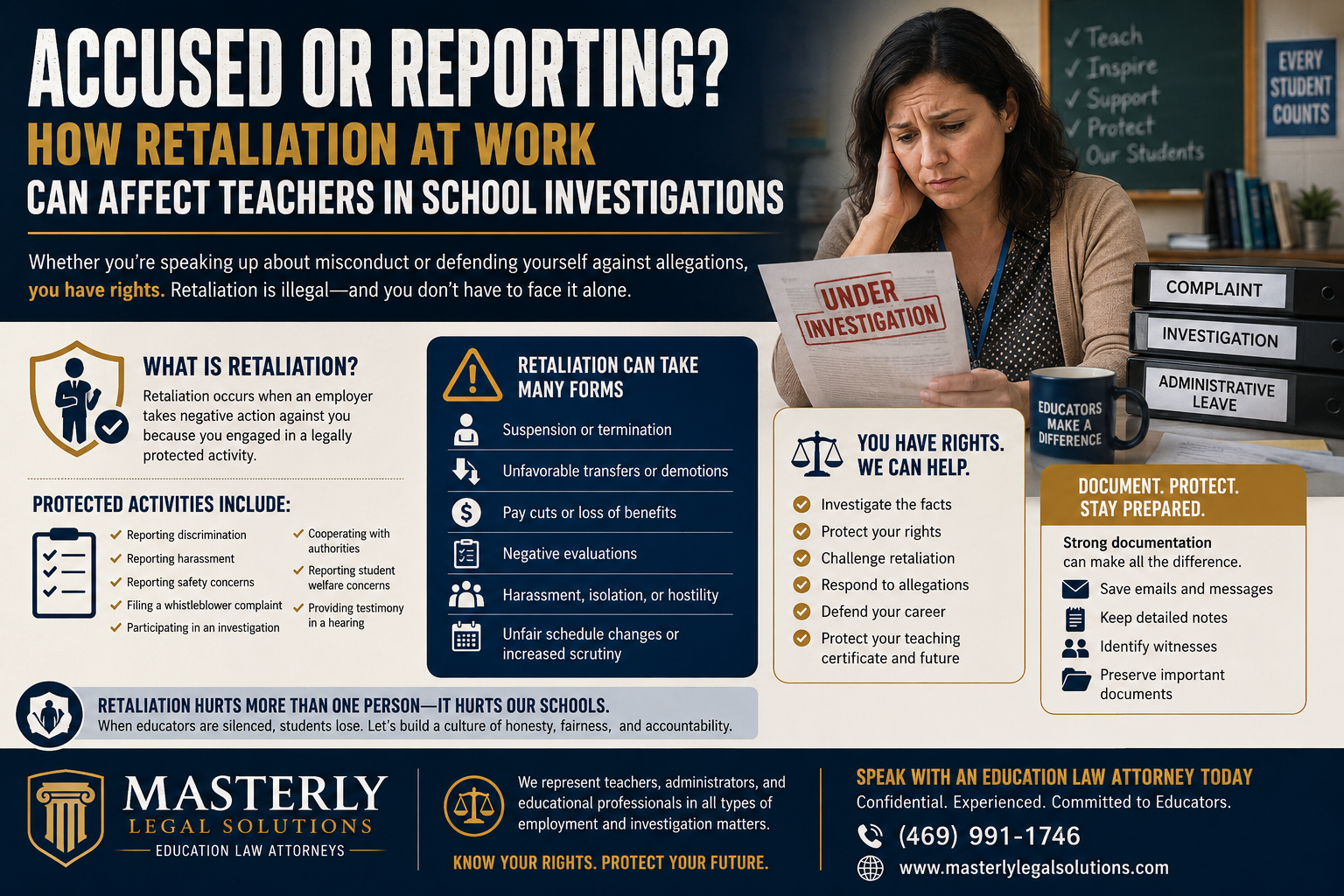
Accused or Reporting? How Retaliation at Work Can Affect Teachers in School Investigations
Teachers dedicate their careers to educating students, maintaining safe learning environments, and following the professional standards expected by school districts. Unfortunately, when concerns arise within a school, educators may suddenly find themselves involved in an investigation. Some teachers are accused of misconduct, while others step forward to report wrongdoing. In either situation, many educators worry about something beyond the investigation itself: retaliation.
The fear of retaliation is often one of the primary reasons teachers hesitate to speak up about misconduct, safety concerns, discrimination, or policy violations. At the same time, educators who become the subject of allegations may question whether disciplinary actions are being taken fairly or whether they are being targeted because of previous disagreements with administrators. Understanding how retaliation can occur during school investigations is essential for protecting professional careers, teaching certificates, and future employment opportunities.
At Masterly Legal Solutions, we regularly work with educators facing complex employment matters. Our education lawyers providing expert legal support for teachers and schools understand the unique risks involved when investigations and retaliation concerns arise. Whether you are reporting misconduct, defending yourself against allegations, or responding to disciplinary actions, understanding your rights can make a significant difference in the outcome of your case.
Understanding Retaliation in Educational Settings
When an employer treats a worker unfairly because they participated in a legally protected activity, this is known as retaliation. In school environments, retaliation can take many forms and may be difficult to identify at first.
Many teachers assume retaliation only involves being fired. However, retaliation can include a wide range of actions that negatively affect an educator's career, reputation, working conditions, or future opportunities.
A teacher who reports misconduct, cooperates in an investigation, files a complaint, or participates in a legal proceeding may be protected under various state and federal laws. If negative treatment follows those actions, it may raise concerns about retaliation.
Why School Investigations Create High-Risk Situations
School investigations often place educators in stressful and uncertain circumstances. Administrators must investigate allegations while balancing district policies, student safety concerns, and legal obligations.
During these situations, teachers frequently experience increased scrutiny from administrators, coworkers, and parents. While some level of review is expected during an investigation, problems arise when actions exceed legitimate investigative needs and begin to appear punitive.
Whether an educator is the reporting party or the accused individual, school investigations can create conditions where workplace retaliation becomes a serious concern.
What Is Considered a Protected Activity?
A protected activity generally involves conduct that laws recognize as deserving protection from retaliation.
Examples of protected activity may include:
- Reporting discrimination
- Reporting harassment
- Participating in an internal investigation
- Cooperating with government authorities
- Reporting safety concerns
- Filing a whistleblower complaint
- Reporting student welfare concerns
- Reporting violations of district policies
- Providing testimony during a hearing
Teachers who engage in protected activity should not face punishment simply because they exercised their legal rights.
A protected action does not have to result in proof that wrongdoing occurred. The protection often exists because the employee acted in good faith when raising concerns or participating in the process.
When Teachers Become Whistleblowers
Educators are often among the first individuals to observe problems within schools. They may witness improper conduct involving students, employees, finances, testing procedures, or safety issues.
When a teacher files a whistleblower complaint, they are typically reporting conduct they believe violates policies, regulations, or laws. This type of reporting can place educators in difficult positions because they may be reporting concerns involving colleagues, administrators, or district leadership.
Many teachers worry that reporting misconduct could damage relationships or career opportunities. Unfortunately, those fears are not always unfounded. In some situations, retaliation at work follows shortly after a report is made.
Reporting Student Safety Concerns
One of the most important responsibilities teachers have is protecting students. Educators frequently report concerns involving bullying, abuse, neglect, unsafe facilities, or policy violations.
When a teacher files a report involving student safety, they may expect support from school leadership. Instead, some educators find themselves facing resistance, criticism, or adverse treatment.
If an employer responds negatively because a teacher reported legitimate concerns, that response may create legal issues regarding retaliation protections.
Teachers should carefully document communications and preserve records when concerns arise regarding student welfare.
What Happens When a Teacher Is Accused?
Not every school investigation involves a reporting educator. Many investigations begin because allegations are made against a teacher.
Being accused does not automatically mean misconduct occurred. School districts have a responsibility to investigate allegations fairly and objectively before making employment decisions.
Unfortunately, some educators discover that allegations arise shortly after they previously engaged in protected activity. In these circumstances, it becomes important to determine whether allegations are legitimate or whether they may be connected to unlawful retaliation.
A retaliation claim may arise if disciplinary actions are motivated by a teacher's prior protected conduct rather than actual wrongdoing.
Administrative Leave During School Investigations
One of the most common actions districts take during investigations is placing a teacher on administrative leave.
Administrative leave is not always disciplinary in nature. In some cases, districts use administrative leave to allow investigators to gather facts without disruption.
However, the circumstances surrounding administrative leave matter greatly. Teachers should understand why they have been placed on administrative leave and whether the action is consistent with district policies.
Administrative leave may be appropriate during serious allegations involving student safety, professional misconduct, or criminal accusations. Yet administrative leave can also become part of a larger pattern of retaliation when it is imposed unnecessarily or selectively.
When administrative leave is imposed shortly after protected activity, educators should carefully evaluate the situation.
Understanding Adverse Employment Actions
To establish many retaliation claims, there must be evidence of an adverse action taken against the employee.
An adverse action generally involves conduct that would discourage a reasonable employee from engaging in protected activity.
Examples may include:
- Suspension
- Demotion
- Termination
- Unfavorable transfers
- Reduction in responsibilities
- Pay cuts
- Loss of benefits
- Negative evaluations
- Denial of promotions
- Exclusion from professional opportunities
Not every disagreement with management qualifies as an adverse action. However, significant changes affecting employment conditions often warrant closer examination.
The Role of Human Resources
Human resources departments often play a central role in school investigations and employment disputes.
Ideally, human resources personnel should help ensure policies are followed consistently and fairly. They may collect information, coordinate interviews, and monitor compliance with district procedures.
Unfortunately, some educators mistakenly assume human resources exists solely to protect employees. In reality, human resources often serves the interests of the employer as an organization.
Teachers involved in investigations should understand this distinction and consider seeking independent legal advice when their careers are at risk.
Common Examples of Retaliation Against Teachers
Retaliation can appear in many different forms.
An example might involve a teacher who reports discrimination and suddenly receives poor evaluations after years of positive performance.
Another example could involve an educator who cooperates in workplace investigations and is reassigned from a desirable position to a less desirable position without a legitimate reason.
A third example may involve a teacher who reports misconduct and then finds their schedule altered in ways that significantly interfere with professional responsibilities.
Each example demonstrates how retaliation may occur even when termination does not take place.
Harassment After Reporting Concerns
Some retaliation cases involve ongoing harassment rather than formal disciplinary measures.
A supervisor or manager may subject an educator to excessive criticism, isolation, public embarrassment, or hostile treatment after a report has been made.
This type of conduct can create a hostile workplace environment that interferes with a teacher's ability to perform effectively.
Harassment does not always involve dramatic incidents. Sometimes the cumulative effect of repeated negative behavior creates substantial harm over time.
False Allegations and Retaliatory Investigations
Teachers occasionally believe an investigation itself was initiated as retaliation.
For example, an educator may file a complaint regarding policy violations and later become the subject of questionable allegations. If evidence suggests allegations were fabricated or exaggerated in response to protected activity, legal concerns may arise.
Districts must investigate complaints appropriately. However, investigations launched solely to punish an employee for speaking up can create significant liability.
Educators should gather all the evidence available when they believe allegations were made in bad faith.
The Connection Between Discrimination and Retaliation
Discrimination and retaliation often overlap.
A teacher may initially report discrimination based on race, age, gender, religion, disability, or another protected characteristic. After the report is made, negative treatment may begin.
In many situations, the retaliation becomes easier to prove than the underlying discrimination itself.
Federal and state laws prohibit both discrimination and retaliatory conduct. Educators should understand that legal protections frequently apply to both issues simultaneously.
Sexual Harassment and Retaliation Concerns
Teachers who report sexual advances or inappropriate conduct often face heightened concerns regarding retaliation.
The law generally prohibits employers from taking adverse action against individuals who report misconduct, participate in investigations, or support another employee's complaint.
Unfortunately, some educators fear becoming targets after reporting inappropriate behavior by a coworker, supervisor, or administrator.
These concerns highlight why retaliation protections are such an important component of employment law.
How Administrative Leave Can Affect Careers
Although administrative leave may be characterized as temporary, it can still have serious professional consequences.
Teachers placed on administrative leave often experience stress, uncertainty, and damage to professional reputations. Rumors may spread even before findings are made.
Multiple periods of administrative leave can affect future job opportunities, certification reviews, and professional relationships.
When administrative leave appears unnecessary or retaliatory, educators should evaluate their legal options carefully.
Administrative leave should not be used as a tool for punishment before facts have been established.
The Impact on Employee Morale and School Culture
Retaliation affects more than the individual involved.
When workers observe retaliation against colleagues, overall employee morale often declines. Educators become reluctant to report problems or cooperate with investigations.
Employee morale suffers when teachers believe honesty and cooperation may place their careers at risk.
A healthy workplace culture depends on trust, transparency, and accountability. When retaliation becomes part of the workplace environment, those values are undermined.
Why Documentation Matters
Documentation can be one of the most powerful tools available to educators.
Teachers should maintain records of significant events, communications, and actions related to workplace disputes.
Important documentation may include:
- Emails
- Performance evaluations
- Meeting notes
- Written directives
- Witness information
- Investigation notices
- Employment records
Strong evidence can help determine whether actions taken by an employer were legitimate or retaliatory.
Without proper documentation, proving a retaliation case may become significantly more difficult.
When Administrative Leave Leads to Further Discipline
Some investigations begin with administrative leave and later result in additional employment actions.
A district may recommend suspension, contract nonrenewal, certification action, or termination depending on investigative findings.
However, decision-makers must base actions on facts rather than retaliation motives.
Teachers should carefully review investigative findings and seek legal guidance if they believe decisions are unsupported by evidence.
Administrative leave should be part of a fair process rather than a predetermined path toward discipline.
Retaliation and Teacher Certification Risks
School investigations can extend beyond local employment issues.
In some cases, allegations are reported to licensing agencies responsible for educator certifications. These agencies may investigate independently.
A retaliation claim becomes particularly important when adverse reporting appears motivated by protected conduct rather than legitimate concerns.
Because certification consequences can affect long-term employment opportunities, teachers should take these matters seriously from the beginning and understand how Texas Education Agency (TEA) investigations into educator conduct may impact their licenses.
Working With Police During Investigations
Certain allegations may involve law enforcement.
If police become involved, teachers should recognize that administrative investigations and criminal investigations are separate processes.
Statements made during one proceeding may affect another. Educators should proceed carefully when responding to questions from investigators or police officers.
A teacher's rights and obligations can vary significantly depending on the nature of the allegations.
When police involvement exists, obtaining legal representation early is often critical.
Understanding Employer Motivations
Not every unfavorable action constitutes retaliation.
Employers have legitimate authority to discipline employees, investigate complaints, and enforce policies.
The key issue is whether the employer acted because of legitimate reasons or because the employee engaged in protected activity.
Courts and agencies often examine timing, documentation, witness testimony, and surrounding circumstances to determine motive.
The ability to investigate and determine true motivations frequently becomes central to a retaliation case.
The Importance of Prompt Action
Teachers who suspect retaliation should not ignore warning signs.
Delays can result in lost evidence, missed deadlines, and reduced opportunities to protect legal rights.
Prompt action may include documenting concerns, preserving communications, reporting issues through proper channels, and consulting an attorney.
Early intervention often allows educators to address problems before they escalate into more serious employment disputes.
Special Considerations for Public School Employees
Many educators work within public school systems that are subject to additional federal sector requirements and constitutional considerations, and may benefit from legal support focused on Texas educators and school investigations when those issues arise.
Public school employees may have rights related to free speech, due process, and whistleblower protections that differ from those available in some private-sector settings.
Understanding these distinctions is important when evaluating potential retaliation issues.
Because public institutions must comply with numerous regulations, school investigations often involve unique legal considerations.
Protecting Yourself During an Investigation
Teachers can take several proactive steps to protect their interests.
First, remain professional throughout the investigation process.
Second, preserve records and communications.
Third, avoid discussing sensitive matters with unnecessary parties.
Fourth, cooperate appropriately while understanding your rights.
Finally, seek qualified legal advice, such as from an education law attorney for teachers and administrators, when allegations, administrative leave, or disciplinary actions threaten your career.
These steps can help protect educators from unnecessary harm while ensuring they are prepared to respond effectively.
What Schools Should Do to Prevent Retaliation
School districts and educational institutions should take meaningful steps to prevent retaliation.
Effective measures often include:
- Clear reporting procedures
- Consistent investigative practices
- Supervisor training
- Documentation requirements
- Anti-retaliation policies
- Prompt responses to complaints
When schools act fairly and transparently, they reduce legal risk while creating safer environments for both educators and students, and they are better positioned to work effectively with an education law attorney to ensure legal protection for teachers.
When to Speak With a Lawyer
Many teachers wait too long before seeking legal guidance.
If you have been placed on administrative leave, received disciplinary notices, experienced adverse employment actions, or believe retaliation is occurring, it may be time to consult a lawyer.
An experienced lawyer can evaluate documents, review timelines, assess evidence, and identify potential legal protections.
Early legal intervention can often prevent mistakes that become difficult to correct later.
Whether you are reporting misconduct or defending yourself against allegations, obtaining advice from an education law attorney offering expert guidance for teachers may significantly affect the outcome of your matter.
How Masterly Legal Solutions Helps Educators
School investigations can be intimidating, especially when careers, certifications, reputations, and livelihoods are at stake.
At Masterly Legal Solutions, we understand the unique challenges educators face when accusations, complaints, retaliation concerns, or disciplinary actions arise. Our legal team, led by an expert education lawyer providing legal support for schools and teachers, assists teachers, administrators, and educational professionals facing complex employment disputes and investigative proceedings.
We work to protect our clients' rights, investigate the facts, evaluate claims, respond to allegations, and advocate for fair treatment throughout the process. Whether you are dealing with workplace retaliation, a retaliation claim, a retaliation complaint, disciplinary proceedings, administrative leave, or concerns about certification consequences, our team is prepared to help.
When Reports Involve Verbal or Physical Abuse
Teachers are often required to report concerns involving verbal or physical abuse affecting students, staff members, or other individuals on campus. Reporting these incidents is not only a professional responsibility but may also be required by district policies and applicable laws. Unfortunately, some educators who make these reports later face criticism, isolation, or disciplinary scrutiny. When negative treatment follows a good-faith report of verbal or physical abuse, educators should carefully document events and seek guidance regarding their rights and legal protections.
Recognizing a Possible Violation During School Investigations
School investigations are designed to uncover facts and determine whether misconduct occurred. However, investigators may also discover a possible violation of district policies, employment agreements, or professional standards unrelated to the original allegation. Teachers should understand that even when concerns arise unexpectedly, they still have rights throughout the investigative process. A fair investigation should focus on facts rather than assumptions and should provide educators with an opportunity to respond to concerns before decisions are made, especially in serious matters like North Carolina educator misconduct defense aimed at protecting a teaching license.
The Negative Impact of Retaliation on Educators
Retaliation can have a significant negative impact on a teacher's professional and personal life. Beyond disciplinary consequences, educators may experience stress, damaged reputations, reduced career opportunities, and strained relationships with colleagues. The emotional toll can affect classroom performance and overall well-being. Schools benefit when teachers feel comfortable raising concerns without fear of retaliation, making it essential for districts to address complaints fairly and consistently.
Understanding Other Related Protected Activity
Many educators recognize protections for reporting discrimination or participating in investigations, but other related protected activity may also be covered by employment laws. For example, assisting a coworker with a complaint, providing witness statements, or cooperating with government inquiries may qualify for legal protection. Teachers should not assume that only formal complaints are protected. Various forms of participation in workplace matters may trigger anti-retaliation protections depending on the circumstances.
How Related Protected Activity Can Lead to Retaliation Claims
A teacher does not always have to be the individual who filed the original complaint to receive legal protections. Related protected activity may include supporting another employee's concerns, participating in interviews, or providing information during an investigation. If adverse treatment follows these actions, educators may have grounds to explore a retaliation claim. Understanding the connection between protected conduct and subsequent disciplinary measures is often critical when evaluating legal options.
When Retaliation Crosses the Line Into Illegal Conduct
Not every employment decision is unlawful, but retaliation becomes illegal when an employer takes adverse action because an educator engaged in protected conduct. Courts and regulatory agencies often evaluate timing, documentation, and decision-making processes when reviewing these cases. Teachers who believe they are being targeted for exercising their rights should not ignore warning signs. Prompt legal review may help determine whether actions taken by school officials violate applicable laws.
How School Districts and Companies Respond to Complaints
Although school districts are educational institutions, they often operate similarly to a company when managing employment matters. Administrators must address complaints, enforce policies, and maintain workplace standards while minimizing legal risk. When investigations are handled improperly, both the district and individual decision-makers may face significant liability, particularly in high-stakes Texas Education Agency license defense and investigation matters. Educators should understand that organizational interests do not always align with the interests of individual employees involved in disputes.
Compensation Issues Following Retaliation Allegations
In some cases, retaliation affects more than job duties or professional reputation. Teachers may experience losses involving compensation, supplemental assignments, coaching stipends, professional opportunities, or advancement prospects. These financial consequences can become important factors when evaluating damages in employment disputes. Documenting financial losses may help establish the extent of harm caused by retaliatory actions.
Asserting Your Rights During a School Investigation
Teachers should not feel intimidated when asserting their rights during an investigation. Educators have the ability to ask questions, review applicable policies, seek representation, and respond to allegations. Remaining professional and cooperative is important, but it is equally important to understand available protections. Educators who confidently assert their rights, including by consulting with experienced education law attorneys for license defense and investigations, are often better positioned to protect their careers and professional licenses.
Retaliation and Concerns About Wages
While teachers often focus on disciplinary actions, retaliation can also affect wages and earnings. An educator may lose supplemental duties, extracurricular assignments, or opportunities that provide additional income. In some situations, changes in work assignments can indirectly reduce overall earnings. Any employment action affecting wages should be reviewed carefully when retaliation concerns exist.
Why Retaliation Creates Risks for the Entire Business of Education
Retaliation does not only affect individual teachers. It can undermine trust throughout the educational business of operating a school district. When educators fear speaking up, important concerns may go unreported, creating risks for students, employees, and administrators alike. Promoting transparency and accountability helps strengthen educational institutions while reducing legal exposure for school systems.
Understanding Other Type of Retaliatory Conduct
Teachers should recognize that retaliation is not limited to suspension or termination. Other type of retaliatory conduct may include exclusion from committees, denial of training opportunities, unfavorable schedule changes, increased monitoring, or unjustified criticism. These actions may appear minor when viewed individually, but together they can create significant professional challenges. Evaluating the full pattern of conduct is often necessary when determining whether retaliation has occurred.
Speak With Masterly Legal Solutions About Retaliation at Work
No teacher should feel forced to choose between protecting students, reporting misconduct, defending themselves against false allegations, and protecting their career. If you believe retaliation has affected your employment, if you have been placed on administrative leave after reporting concerns, or if you are facing disciplinary action connected to a school investigation, it is important to understand your legal options.
The facts of every situation are different, and the right strategy often depends on timing, documentation, and the specific actions taken by the school district. Our team can review your situation, answer your questions, and help you understand the next steps available to you.
Contact Masterly Legal Solutions at (972) 236-5051 for a free consultation. We are committed to helping educators navigate difficult employment challenges and protecting the professional careers they have worked so hard to build.
Disclaimer: This article is provided for educational and informational purposes only. It does not constitute legal advice and should not be relied upon as legal guidance for any specific situation. Reading this article does not create an attorney-client relationship. If you are facing retaliation, administrative leave, a school investigation, employment concerns, or other legal issues, contact a qualified attorney to discuss the facts and circumstances of your case.


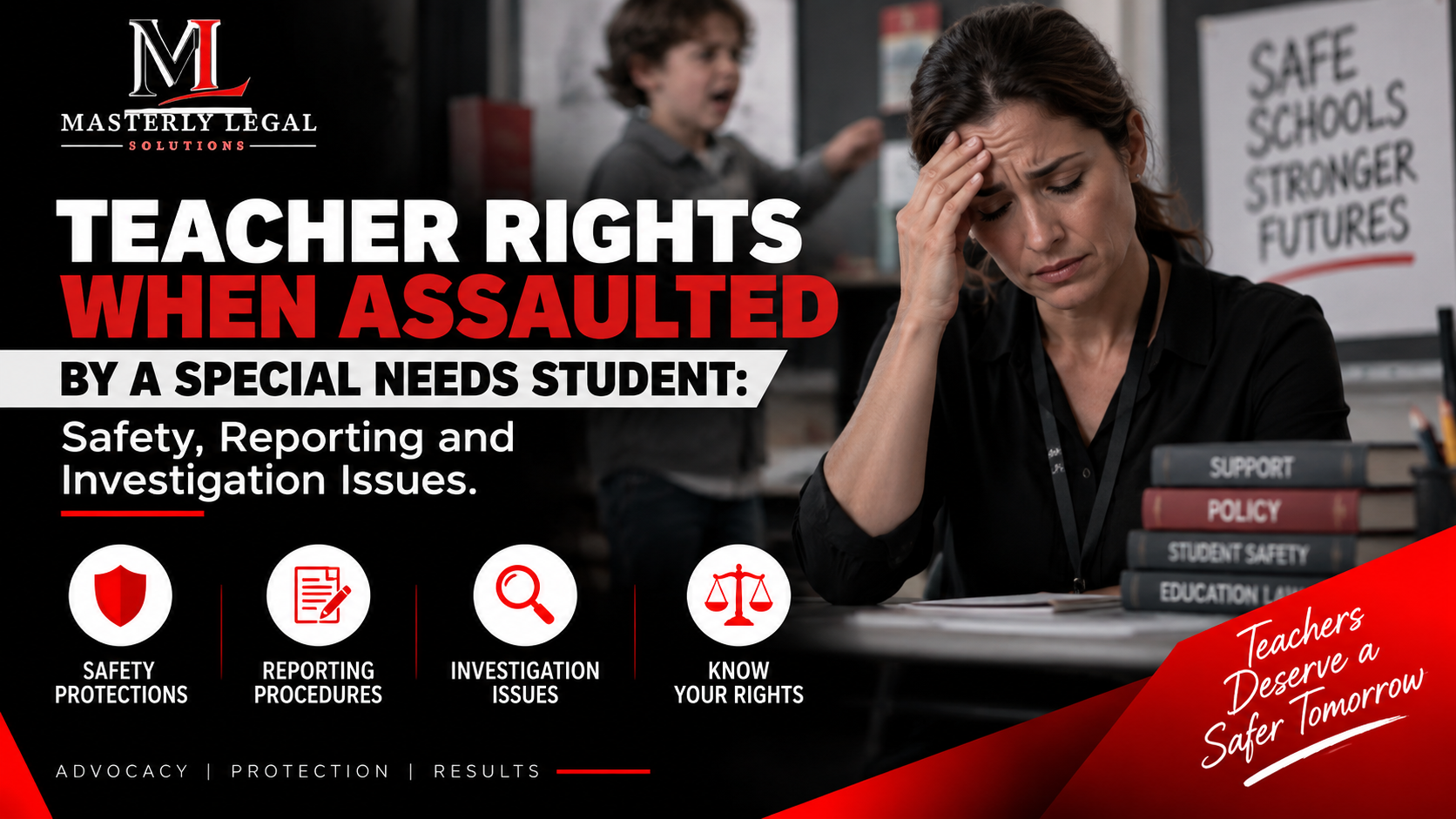
Teacher Rights When Assaulted by a Special Needs Student: Safety, Reporting and Investigation Issues


Looking for Legal & Business Solutions? Contact Us Now
Fill in the form or call us to set up a meeting





