What is the Difference Between a Revocable and Irrevocable Living Trust: A Complete Guide
Choosing the right trust can feel confusing, especially when you are trying to protect your family, manage your assets, and plan for the future. The difference between an irrevocable vs revocable trust can affect your control over assets, estate planning goals, privacy, and potential protection from creditors.
If you are comparing a revocable trust vs irrevocable trust, the most important question is not simply which one is better. It is which type of trust makes sense for your particular situation.
For Texas families, business owners, and property owners, the right choice can depend on what you own, what you want to accomplish, and how much control you want to keep.
Masterly Legal Solutions helps clients understand their options and put the appropriate estate-planning documents in place without unnecessary confusion.
Irrevocable vs Revocable Trust: What Is the Main Difference?
The biggest difference between a revocable and irrevocable trust is control.
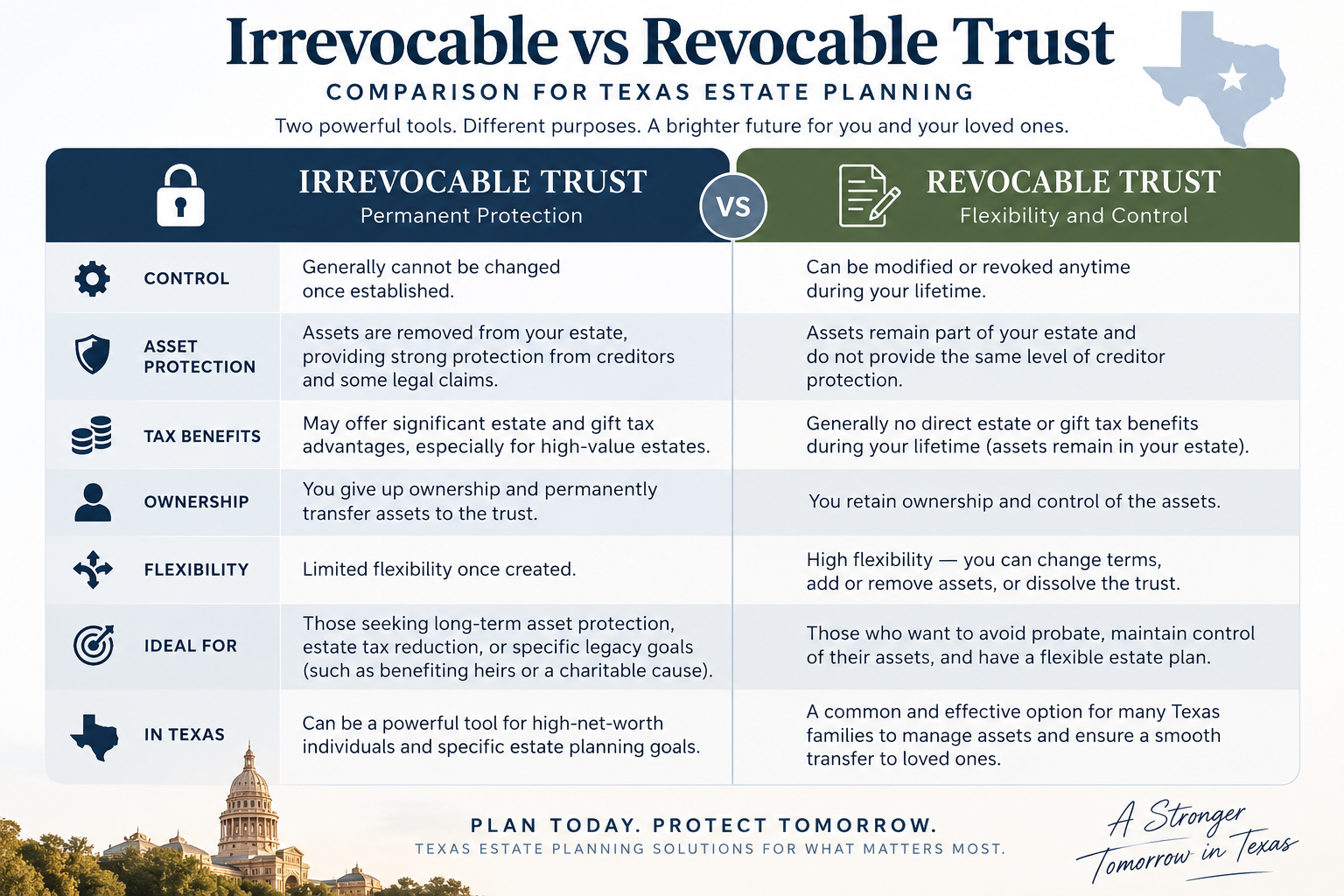
A revocable trust generally allows you to change or cancel the trust during your lifetime, revoke the trust altogether, change beneficiaries, and remove assets. You can usually maintain complete control of the assets placed in the trust while you are living, retain control over how they are managed, and in a revocable trust those assets remain effectively owned by you.
An irrevocable trust is generally designed to be much harder to change or cancel after it is created and funded, and changes may require court approval. Once transferred, the assets legally belong to the trust as a separate legal entity. Because you may give up certain rights or control, it can serve different estate-planning purposes.
The right choice depends on your goals. A trust should be designed around your circumstances rather than selected simply because one type sounds more protective or more flexible.
Simple Comparison: Revocable Trust vs Irrevocable Trust
Understanding the difference between these two trust types becomes easier when you look at the main features of each.
Revocable Trust
A revocable trust generally offers more flexibility and allows the grantor to maintain significant control over the trust and its assets.
- Can it be changed? Generally yes, during the grantor's lifetime, subject to the trust terms.
- Control over assets: The grantor generally retains significant control.
- Flexibility: High.
- Common estate-planning uses: Asset management, continuity, and planning for the distribution of assets.
- Asset protection: Generally limited.
- Who may benefit from it? People who want an estate plan that provides flexibility and continued control.
Irrevocable Trust
An irrevocable trust generally provides less flexibility because the grantor may give up certain rights or control over assets placed into the trust.
- Can it be changed? Generally much more difficult to change after it is established.
- Control over assets: Control may be reduced or transferred, depending on the trust structure.
- Flexibility: Lower than a revocable trust.
- Common estate-planning uses: Specialized estate, tax, and asset-planning goals.
- Asset protection: May provide additional protection in certain circumstances, depending on how the trust is structured and applicable law.
- Who may benefit from it? People with specific estate-planning goals that may justify giving up some control over their assets.
The right choice depends on your circumstances, assets, family needs, and long-term goals. A trust should be carefully designed rather than selected based only on whether it is revocable or irrevocable.
How a Revocable Living Trust May Fit Your Estate Plan
In addition to general estate planning, some clients specifically want to understand the flexibility and benefits of modifying a revocable living trust as their circumstances change.
A revocable living trust is often considered by people who want greater flexibility while planning for the management and distribution of their assets. It can also help assets pass outside the probate process and keep matters out of public probate court records.
Because the trust can generally be changed during the grantor's lifetime, it may be useful when your circumstances are likely to change. You may acquire property, start or sell a business, experience changes in your family, or simply want the ability to revise your estate plan, remove assets, or change beneficiaries.
A revocable trust may be worth considering when your priorities include:
- Keeping greater control over your assets
- Establishing incapacity planning through a successor trustee if you become unable to manage them yourself
- Providing instructions for distributing assets after death
- Planning for continuity of asset management
- Reviewing and changing your estate plan as circumstances change or revoke the trust altogether
However, a revocable trust is not automatically the best solution for every Texas estate.
It also does not provide the same type of potential asset-protection structure that may be associated with certain irrevocable trusts.
That is why choosing a trust based only on flexibility can leave important planning questions unanswered.
How an Irrevocable Living Trust May Fit Your Estate Plan
An irrevocable living trust is generally more restrictive than a revocable trust.
Once assets are transferred into an irrevocable trust, the person creating the trust may no longer have the same control over those assets. In many cases, trust assets legally belong to the trust as a separate legal entity, which may have its own tax ID and its own tax reporting.
An irrevocable trust may be considered when a client has more specialized estate-planning objectives, such as:
- Certain asset protection features for business owners or real estate investors
- More complex estate-planning needs
- Specific tax-planning considerations aimed at minimizing estate tax liability
- Planning involving substantial assets
- Providing for beneficiaries under specific trust terms
An irrevocable trust requires careful planning because changing the arrangement later may be difficult. It can also be more complex and costly to administer than a revocable trust.
For that reason, this is not an area where a one-size-fits-all document is appropriate.
Revocable vs Irrevocable Living Trust: Which May Be Right for You?
When comparing a revocable vs irrevocable living trust, start with the outcome you want rather than the name of the document. In practice, the choice often depends on the client's specific objectives more than the label alone.
A revocable trust may fit you if:
You want flexibility and generally want to maintain control of your assets during your lifetime. A revocable trust may fit if you want to maintain complete control, retain control as circumstances change, change beneficiaries, or revoke the trust altogether.
It may be appropriate for someone who wants a structured estate plan but expects their family, property, finances, or other circumstances to change over time. The assets revocable trust holds remain effectively owned by you during life, and those assets remain part of your client's taxable estate and taxable estate for estate taxes even if they avoid probate.
An irrevocable trust may fit you if:
You have a specific planning objective that may justify giving up some control over assets.
This may be more relevant for high net worth clients, high-liability professionals, business owners facing business debt or substantial personal guarantees, real estate investors, or anyone seeking stronger asset protection features, protection from legal judgments, or estate tax benefits; that consideration primarily affects how the trust is structured.
Irrevocable trusts may also be used to reduce countable assets for Medicaid eligibility in some circumstances.
You may need more than a trust
A trust is only one part of an estate plan.
Depending on your circumstances, your plan may also involve a will, powers of attorney, beneficiary designations, and other documents, including essential legal documents for families before age 40.
For example, a medical power of attorney can address who may make certain medical decisions for you if you cannot make them yourself. Your estate plan should work as a coordinated set of documents rather than a collection of unrelated forms.
Why Choosing the Right Trust Matters for Your Family and Assets
The wrong trust structure can create unnecessary problems.
A document that does not match your goals may provide too little flexibility, create unintended restrictions, or fail to address important assets and family circumstances.
This becomes even more important when your estate includes real estate, a family business, investment accounts, or other significant assets, especially for clients owning property in multiple states who may use a revocable trust to avoid ancillary probate proceedings. For many families in North Texas, working with a Dallas estate planning firm focused on wills and trusts can help align those assets with a personalized plan.
This can simplify the probate process for out-of-state real estate and help reduce ancillary probate proceedings.
For business owners and families with substantial property, estate planning is also about protecting the continuity of what you have built. That can be especially important for real estate investors.
Your estate documents represent more than paperwork. They communicate your wishes to the people who may eventually have to carry them out.
A carefully planned structure can help reduce uncertainty for your family and provide clearer direction about what should happen to your assets.
Why Texas Estate Planning Requires Personalized Advice
Texas has its own laws and estate-planning considerations. The way a trust interacts with your property, family circumstances, business interests, and other documents should be reviewed as part of your overall plan, and many families benefit from a coordinated approach to Texas wills, trusts, and overall estate planning services.
Online trust forms and generic documents may not account for the details that make your situation different from someone else's, and they may overlook the need for core estate planning components such as a will and other key documents.
That is why professional estate planning focuses on understanding your goals first and then determining which documents and structures may fit your client's specific objectives.
At Masterly Legal Solutions, the focus is on helping clients make informed decisions and putting a coordinated estate plan in place, including trust-based estate planning services in the Dallas–Fort Worth area.
Instead of asking you to figure out complicated trust language on your own, we help identify the planning issues that matter and guide you toward the appropriate legal solution, coordinating with qualified estate planning attorneys who draft legal documents when specialized trust planning is needed.
Federal Estate Tax Exemption
The federal estate tax exemption is an important consideration when deciding whether a revocable or irrevocable trust may fit your estate plan. Depending on the size of your estate and your overall goals, certain trust structures may offer potential estate-tax planning benefits. Because tax rules can change and the impact varies by individual, professional advice is important before making a decision.
Who Manages the Trust Assets?
A trust needs a person managing trust assets according to the terms of the trust. Depending on the structure, that person may be the grantor, trustee, or another designated individual or institution. The trustee has responsibilities that are distinct from simply managing personal property and must act according to the trust terms and applicable law.
How Trust Income Is Reported
The tax treatment of a trust depends on the type of trust and how it is structured. In some situations, trust income flows directly to the grantor and may be reported on the client's personal tax return. Other trusts may have separate tax reporting requirements. This is one reason your estate plan should be reviewed together with your tax circumstances.
Separate Investment Policies for Trust Assets
Trust assets may have investment needs that differ from your personal finances. Trustees and investment professionals may need to establish separate investment policies based on the trust's terms, beneficiaries, time horizon, risk level, and own investment objectives.
This can be especially important when trust assets are expected to remain invested for a long period or require specialized investment approaches.
Why Separate Investment Management May Matter
From a practice management perspective, trust assets should be clearly distinguished from personal assets. A trustee or investment professional may need to maintain a separate client relationship and a separate management relationship for trust assets, and some clients find it helpful to work with mobile estate planning services that can meet at home or the office.
This separation can help ensure that investment decisions reflect the trust's purpose rather than automatically following the client's personal preferences.
Trust Ownership and Permanently Transferred Assets
With some irrevocable trust arrangements, the goal may be to permanently transfer assets out of the grantor's ownership. When that happens, the assets should be properly titled and records should reflect trust ownership.
This is different from simply moving money into another account. The legal ownership and administration of the assets matter.
Trust Assets May Have Different Investment Objectives
A trust may have investment goals that differ from the grantor's personal goals. For example, personal assets may be invested according to the individual's desired risk level, while trust assets may need to support beneficiaries over a specific period.
Because of this, investment objectives should be considered separately. In some cases, trust assets may require specialized investment approaches, and the portfolio management strategy should reflect the trust's purpose.
When Personal and Trust Assets Should Be Kept Separate
Keeping both personal assets and trust assets properly identified is important for clear administration. Trust assets are not simply another category of personal property when the trust has its own legal ownership and responsibilities.
The distinction can become particularly important with an irrevocable trust, where assets are intended to be transferred and administered separately.
Revocable Trusts and Grantor Control
Initially, the grantor may retain significant control over a revocable trust, including the ability to change the trust or manage its assets according to the trust terms. Because the grantor generally retains control, the trust may be treated differently for tax and ownership purposes than an irrevocable trust.
The fact that the grantor remains involved does not eliminate the need for proper trust administration.
Fiduciary Responsibilities Are Distinct
Trust administration involves fiduciary responsibilities distinct from ordinary personal financial management. A trustee may have duties to beneficiaries and must follow the terms of the trust.
This means investment decisions cannot always be based solely on the grantor's or trustee's personal preferences. The trust's beneficiaries, purpose, risk considerations, and different investment objectives may all need to be considered.
Potential Tax Benefits and Significant Tax Savings
For some families, carefully structured estate planning may create opportunities for significant tax savings. However, tax benefits are highly dependent on the individual's circumstances, the assets involved, and the trust structure.
The federal estate tax exemption, trust ownership, income-tax treatment, and other factors should be evaluated together rather than relying on a general assumption that an irrevocable trust will automatically reduce taxes.
Why Professional Trust Planning Matters
When trust assets, personal assets, investment objectives, tax reporting, and fiduciary duties overlap, the planning can become complicated. Clients generally benefit from having their complete situation reviewed before deciding which trust structure to use.
At Masterly Legal Solutions, we help clients understand how a trust may fit within their broader estate plan. We consider your goals, client relationships, family circumstances, assets, and management relationship so your estate-planning documents are designed around your needs rather than
a generic template.
Frequently Asked Questions About Irrevocable vs Revocable Trust
What is the difference between an irrevocable vs revocable trust?
A revocable trust generally allows the person who created it to retain significant control and make changes during their lifetime. One of the key differences is ownership: in a revocable trust, the assets remain effectively owned by the creator, while in an irrevocable trust, the trust assets legally belong to the trust as a separate legal entity. That ownership difference affects control, tax reporting, taxable income, and asset protection, so an irrevocable trust generally involves giving up more control and is harder to change.
Is a revocable trust or irrevocable trust better?
Neither is automatically better. The right choice between a revocable or irrevocable trust depends on the client's specific objectives, and we focus on advising clients based on the flexibility they want, possible estate taxes, asset protection benefits, long-term planning, and any available tax benefits.
What is an irrevocable living trust?
An irrevocable living trust is a trust created during a person's lifetime that generally cannot be freely changed or revoked after it is established. Once funded, it may operate as a separate legal entity with its own tax ID and own tax return for tax reporting, and the trust assets it holds may be treated as assets legally belong to the trust rather than the individual, which can affect taxable income and tax benefits. It may be used for specific estate-planning objectives, including estate tax planning or charitable planning, and in some cases may offer estate tax benefits.
Does a revocable trust protect assets from creditors?
A revocable trust generally does not provide the same level of asset protection that may be available through certain irrevocable trust structures. Because you retain control of the assets in a revocable trust—and can often maintain complete control during your lifetime—it generally does not shield those assets from creditors or legal judgments. By contrast, some irrevocable trusts are designed with stronger asset protection features and may offer asset protection benefits depending on your goals and the trust structure.
Can a revocable trust become irrevocable?
A revocable trust can generally become irrevocable under certain circumstances, including according to its terms after the grantor's death, at which point the assets may pass under the trust without going through probate court or the probate process. The exact result depends on the trust document and applicable law.
Do I need a trust if I live in Texas?
Not everyone needs a trust. Whether one makes sense depends on your assets, family situation, goals, and the type of estate plan you want. In Texas, a trust is more often worth considering for people with privacy concerns, complex assets, or clients owning property in another state, since a properly funded revocable trust can help avoid the probate process and avoid ancillary probate proceedings tied to ancillary probate proceedings, which is a common concern for families seeking comprehensive estate planning in Austin.
Should I choose a revocable vs irrevocable living trust on my own?
Trusts can have significant legal, tax, and administration consequences, and irrevocable trusts represent a more permanent transfer that can affect estate tax liability, tax reporting, and a client's specific objectives. Because we do not draft legal documents, it is generally best to have your situation reviewed by a qualified estate-planning professional and, where appropriate, qualified estate planning attorneys before selecting or creating a trust, such as those providing personalized estate planning services in Houston.
Talk with Masterly Legal Solutions about the Right Estate-Planning Documents for Your Situation
If you are still unsure whether a revocable trust vs irrevocable trust makes sense for your Texas estate, you do not have to sort through the key differences alone.
Masterly Legal Solutions can review your goals, explain the available estate-planning options, and help determine whether a revocable or irrevocable trust fits your circumstances and your client's specific objectives.
Whether you are protecting family assets, planning for real estate, preparing for the future, or organizing a business owner's estate, the right plan starts with understanding your specific needs, including probate process planning, asset protection benefits, or estate taxes concerns, and many clients benefit from tailored estate planning services in Frisco.
Call Masterly Legal Solutions at (972) 236-5051 or visit Masterly Legal Solutions to discuss your estate-planning needs.








Looking for Legal & Business Solutions? Contact Us Now
Fill in the form or call us to set up a meeting