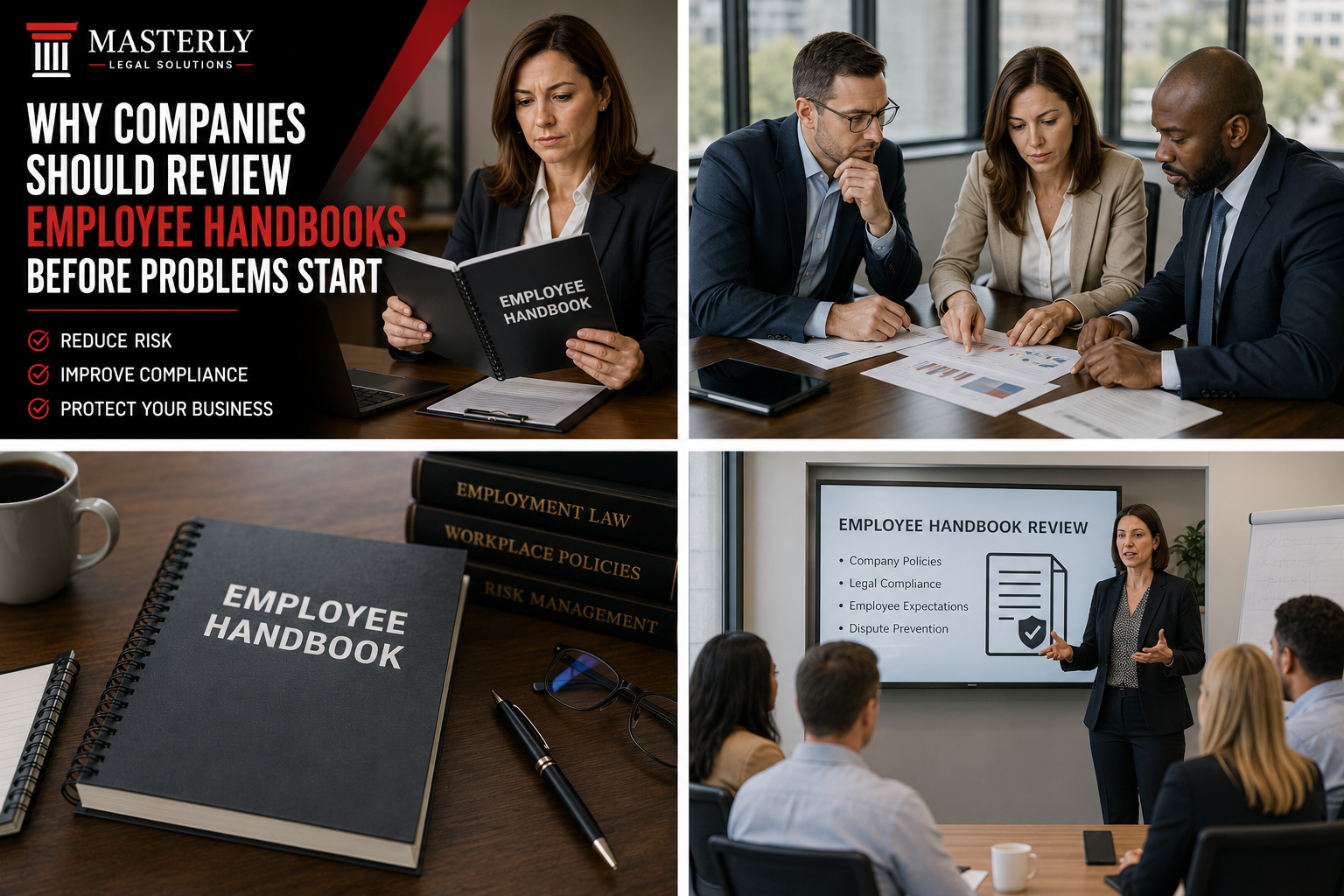
Why Companies Should Review Employee Handbooks Before Problems Star
Expert Employee Handbook Review and Compliance Services
Protect your business from legal risk and keep your workplace policies aligned with current laws. Our employee handbook review services provide comprehensive legal compliance analysis, policy updates, and implementation support so your organization can operate with confidence.
Our team of employment attorneys and HR compliance specialists has deep expertise in federal, state and local employment laws. We help companies of every size ensure compliance across all jurisdictions where their employees work - from single-location small businesses to enterprises operating in multiple states.
Why Regular Employee Handbook Reviews are Essential for Your Business
For a deeper understanding of structure, content, and best practices, many organizations reference an essential employee handbook guide with policy and manual examples when planning or updating their manuals.
A well-structured employee handbook is a practical resource for employees and a risk management tool for organizations. But employment laws change constantly, and a handbook that was compliant last year may expose you to significant liability today. Here's why regular reviews matter:
- Legal Protection from Discrimination and Harassment Claims: Employee handbooks should include anti-discrimination and harassment policies that align with EEOC guidelines. A well-publicized anti-harassment policy protects against legal liability, and clear anti-harassment policies foster an inclusive work environment. Harassment becomes illegal when it creates a hostile work environment - your handbook must give employees a clear process for reporting workplace harassment, sexual harassment, and discrimination, and employers should support those policies with comprehensive sexual harassment training that meets legal requirements.
- Compliance with Evolving Laws: Regular reviews of employee handbooks are essential for ensuring compliance with evolving legal standards. The Pregnant Workers Fairness Act regulations took effect in 2024, pay transparency laws are expanding across many states, and local employment laws around sick leave, rest breaks, and minimum wage continue to shift. Handbooks need to reflect the most recent state and federal requirements for leave and wage practices.
- Risk Mitigation from Costly Lawsuits and Penalties: Compliance failures can lead to costly legal penalties and fines. A well-constructed handbook can protect against wrongful termination lawsuits, while clear policies in handbooks help limit employer liability. When claims arise, partnering with an experienced workplace retaliation and employment law attorney can be critical to managing investigations and litigation exposure. Employee handbooks may be considered contracts in many states, meaning employers are bound by policies in distributed handbooks.
- Clear Communication of Workplace Expectations: An employee handbook does more than document rules - it helps set expectations for workplace behavior, conduct, and procedures. Clear attendance policies help set employee expectations, and a code of conduct should outline workplace behavior ethics and disciplinary procedures.
Professional review ensures comprehensive coverage across every critical area. According to a 2025 Brightmine survey, 62% of companies review their handbooks for compliance only once a year or less, and fewer than half of HR leaders feel "very confident" their handbook covers all current legal requirements.
Our Employee Handbook Review Services
Small Business and Remote Work Handbook Reviews
Our dedicated employee handbook legal services team focuses on building and reviewing policies that keep your business compliant while reflecting how your workforce actually operates.
We create tailored handbook reviews for small businesses with 5–50 employees. Whether you're a growing startup or an established local company, we focus on the essential policies and legal requirements your organization needs - anti discrimination protections, at-will employment disclaimers, wage and hour compliance, and workplace safety guidelines. Our broader HR consulting and workplace training services help ensure that these written policies are consistently implemented in day-to-day operations. The language in employee handbooks should be simple, easy to understand, and free of legal jargon, and we make sure your handbook meets that standard.
Enterprise Handbook Compliance Reviews
For large organizations and multi-state companies, we deliver comprehensive compliance reviews that address complex regulatory requirements across every jurisdiction where employees work. This includes industry-specific policies for sectors like health care, manufacturing, and hospitality, as well as multi-state compliance for remote employees and distributed teams. We help you stay ahead of regulatory fragmentation - from state-specific sick leave ordinances to emerging AI and data privacy requirements. Many organizations also rely on ongoing guidance from an experienced employment lawyer for compliance and dispute prevention to keep their handbook aligned with changing regulations.
Our Top 10 Critical Employee Handbook and Workplace Harassment Areas to Review
- Anti-Discrimination and Anti-Harassment Policies: Must define protected classes, outline reporting procedures, and comply with applicable federal, state, and local laws. Anti-harassment policies limit organizational liability. Effective policies require employee acknowledgment of anti-harassment guidelines. The employee handbook should include information on how to report harassment or discrimination.
- At-Will Employment Disclaimers and Contract Language: Ambiguous or contradictory language should be eliminated from employee handbooks to avoid legal risks. At-will disclaimers must be prominent and clearly state the handbook is not an employment contract.
- Wage and Hour Compliance: Review policies for compliance with the Fair Labor Standards Act regarding wage and hour rules. Employee handbooks should clearly define employee classifications like full-time, part-time, and exempt. This includes overtime pay, minimum wage, premium pay, and how you pay employees.
- Leave Policies: Employers must comply with the Family and Medical Leave Act for up to 12 weeks. The Family and Medical Leave Act allows 12 weeks of leave. State-specific sick leave, paid time off, and sick days requirements must also be addressed. Employee handbooks should reflect state-specific employment laws.
- Social Media and Acceptable Use Policies: Policies regarding technology usage and social media should be included to protect data privacy. An acceptable use policy should cover personal devices, company systems, and online conduct while respecting NLRA protections.
- Workplace Safety and OSHA Compliance: Workplace safety policies ensure compliance with OSHA regulations. Emergency procedures and workplace safety guidance should be stated in the employee handbook, covering everything from injury reporting to hazard communication at every job site.
- Code of Conduct and Disciplinary Procedures: A code of conduct should outline workplace behavior ethics and disciplinary procedures. Avoid rigid progressive discipline commitments that could create unintended contractual obligations. Managers need clear guidelines for consistent enforcement.
- Information Security and Data Protection Policies: In 2025, global cybercrime costs are estimated to hit $10.5 trillion. Your handbook must address data breaches, confidentiality expectations, breach reporting, and employee responsibilities around information security.
- Remote Work and BYOD Policies: With remote workers now common, handbooks must clarify working hours, availability, cybersecurity expectations for personal devices, and expense reimbursement. State tax and labor law implications differ based on where remote employees are located.
- State and Local Law Compliance Updates: Identify every jurisdiction where employees work and include specific addenda covering applicable laws - from rest breaks to predictive scheduling to pay transparency. Handbooks should reflect current legal standards and practices.
Our Employee Handbook Review Process
Step 1: Initial Assessment
We review your current handbook for completeness and legal compliance gaps. This includes identifying all state and local law requirements based on your business locations, comparing company policies against actual workplace practices, and determining scope. Key elements of an employee handbook include employee classifications and conduct policies - we verify all are present and accurate. Documenting the handbook review process is vital for compliance and potential audits.
Step 2: Employment Laws and Legal Compliance Analysis
Our team conducts a comprehensive review against federal, state, and local employment laws. For companies with a distributed workforce, we perform a multi-state compliance assessment - mapping each policy to relevant laws and regulations, confirming eligibility thresholds, and reviewing recent court decisions. Legal compliance requires that employee handbooks reflect current federal, state, and local employment laws. We also assess whether your policies align with any applicable collective bargaining agreement.
Step 3: Policy Updates and Recommendations
Our expanding Texas footprint—including our Austin employment and business law office—allows us to support employers across the state with localized policy guidance.
We provide detailed recommendations for policy revisions and additions, then draft updated language for legal compliance and risk mitigation. Reviewing an employee handbook requires balancing legal compliance and operational clarity. We rewrite confusing legalese into plain language, address emerging topics like AI in hiring and pay transparency, and ensure no internal contradictions exist. A thorough employee handbook review confirms it meets current legal requirements and actual workplace practices, and our Texas office locations and contact options make it simple to connect with our team for follow-up questions.
Step 4: Implementation Support
Even the best revisions fail if policies are not communicated. We provide employee communication strategies for handbook updates, including distribution methods and training recommendations for management and HR teams. Employers should train managers on policy interpretation and consistent enforcement of employee handbooks. Acknowledgement of receipt ensures employees are aware of the current handbook and any changes made. We also help you require employees to sign updated acknowledgments.
Frequently Asked Questions
How often should we review our employee handbook?
Employers should review handbooks at least annually for compliance. Establishing a regular review schedule is critical for employee handbooks - at least annually or after significant changes. Beyond the annual cycle, trigger events requiring immediate review include: expanding into new states, changes in relevant laws (for example, the Pregnant Workers Fairness Act), mergers or acquisitions, shifts to remote work, and reports of internal issues like harassment complaints. Employers should regularly audit employee handbooks for compliance with federal, state, and local laws. Regular audits of compliance programs can prevent costly legal penalties.
What happens if our handbook is outdated?
Non compliance with current laws creates serious risk. If your handbook says one thing but your actual practice is another, you may lose critical legal defenses in discrimination, harassment, or wage and hour claims. For example, a company that fails to include state-required sick leave protections can face employee lawsuits and regulatory penalties. Inconsistent enforcement across departments can also create claims of discrimination. Handbooks should be reviewed annually to ensure legal compliance, and they must comply with the Family and Medical Leave Act and other applicable federal and state regulations.
Do you handle multi-state compliance?
Yes. We have deep expertise in complex multi-state employment law requirements. Many multistate employers adopt a "national core" handbook plus state-specific addenda to cover jurisdiction-specific requirements - from leave policies to wage rules to data privacy. We provide state-specific policy recommendations and implementation support so your organization can fully understand and comply with every jurisdiction's requirements. Whether your employees work from a single office or across dozens of states, we help you build a compliant workplace.
Can independent contractors be covered by our handbook?
Independent contractors generally should not be subject to the same employee handbook as your W-2 employees, as doing so can blur the lines of employee classification and create legal exposure. Many organizations also need parallel planning around ownership, succession, and beneficiaries, and our team can coordinate your workforce strategy with comprehensive Texas estate planning services and trust-based asset protection solutions. We can help you develop separate guidelines for independent contractors that protect your business without creating an implied employment relationship.
Request a handbook and compliance review
Don't wait for a lawsuit or a regulatory audit to discover gaps in your company policies. Our experts will help you build a handbook that protects your business, communicates clear policies and procedures, and keeps you in step with every relevant law.
Masterly Legal Solutions
https://www.masterlylegal.com/
Phone:
(972) 236-5051




Teacher Rights When Assaulted by a Special Needs Student: Safety, Reporting and Investigation Issues



Looking for Legal & Business Solutions? Contact Us Now
Fill in the form or call us to set up a meeting