

Child Protective Services New Jersey vs. Texas CPS: What Parents Often Confuse
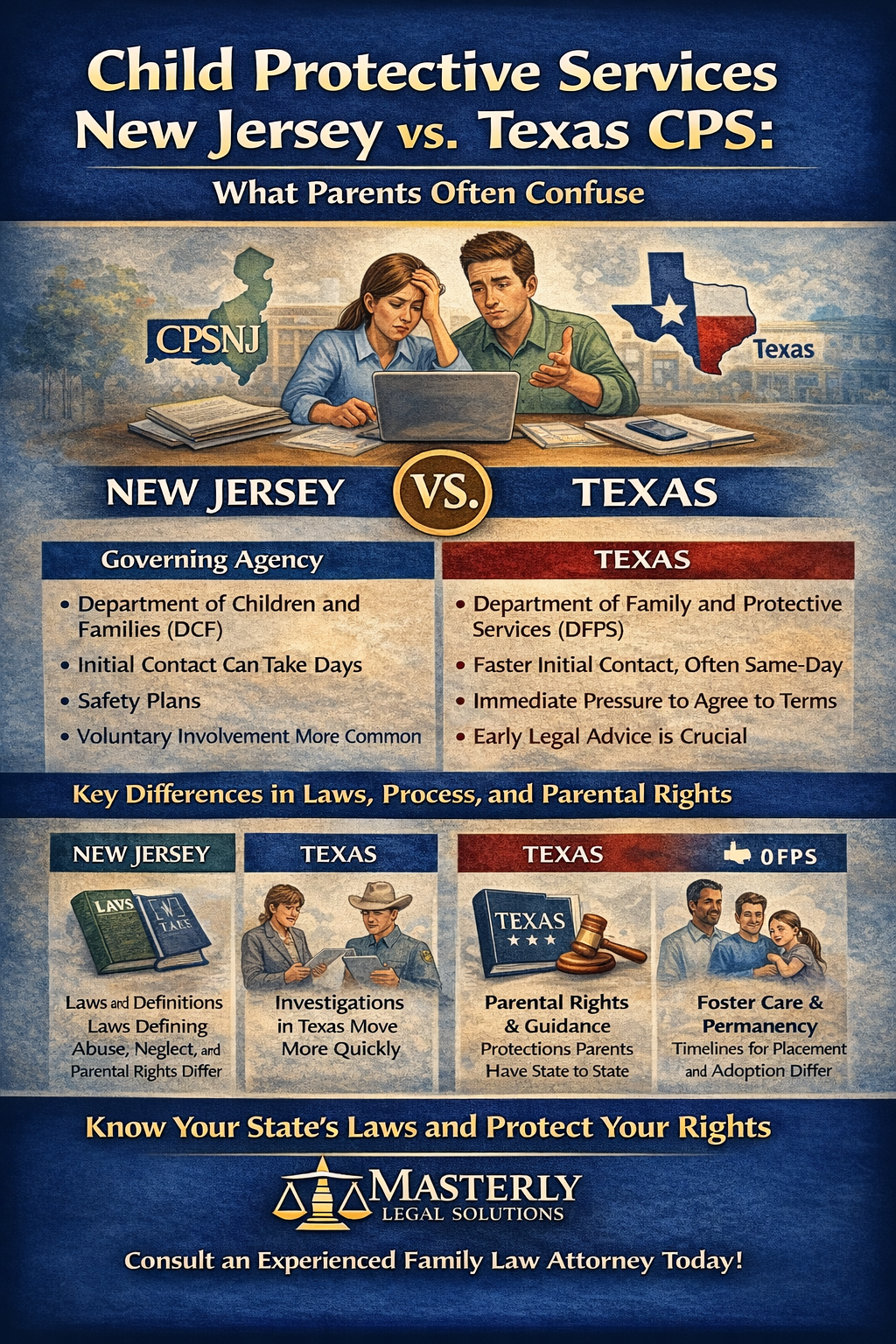
When parents hear the words “Child Protective Services,” the reaction is almost universal—fear, confusion, and a sense that everything is suddenly at risk. Many families search online for answers and come across information about child protective services New Jersey, even though their situation is unfolding in Texas. This confusion is understandable, but it can also be dangerous if it leads parents to misunderstand how the process truly works where they live.
At Masterly Legal Solutions, we focus exclusively on Texas CPS cases. We regularly help parents, caregivers, and professionals who are overwhelmed by CPS involvement and unsure how to respond. While child protective services across states share a common mission of child safety, the laws, procedures, and consequences can differ in critical ways. Understanding these differences early can help protect parental rights, family stability, and long-term outcomes for your child.
Why Parents Often Mix Up CPS Systems Across States
Parents often assume that child protective services operates under a single national system. In reality, each state runs its own child protective services agency under a unique legal framework. While federal legislation sets broad standards, the day-to-day process is governed by state-specific laws and departments.
When parents rely on information meant for another state, such as child protective services New Jersey, they may unknowingly make decisions that harm their position in a Texas CPS investigation. What seems harmless in one state can have serious consequences in another.
The Shared Mission of Child Protective Services
Across the country, child protective services exists to respond to reports of child abuse, neglect, or safety concerns. The goal is promoting safe environments, keeping children protected, and helping families access services when risks are identified. Protective services agencies are designed to intervene when a child’s health or safety may be in danger.
Despite this shared mission, the way child protective services CPS carries out investigations, develops plans, and documents findings varies significantly by state.
Federal Laws That Influence CPS Nationwide
Several federal laws shape how child protective services operates nationwide. These acts provide funding, guidelines, and priorities, but they do not eliminate state control. Understanding these laws helps explain why CPS systems look similar on the surface but function differently in practice.
Key federal legislation includes:
- The Child Welfare Act
- The Adoption Promotion Act
- The Safe Families Act
- The Prevention Services Act
- The Foster Care Independence Act
Each act emphasizes child safety, permanency, and family stability, but states decide how these principles are applied.
Texas CPS and Its Governing Department
In Texas, child protective services is a division of the Department of Family and Protective Services. This department oversees investigations, safety plans, foster care placements, and reunification efforts. Texas CPS has broad authority during an investigation, even before any court involvement.
Parents are often surprised by how quickly Texas CPS can act once a report is received. Understanding this structure is essential for responding appropriately from the very beginning.
How New Jersey’s CPS Structure Differs
New Jersey child protective services operates under a different department and statutory framework. While it also focuses on child abuse prevention and family support, the procedures, timelines, and documentation standards differ from Texas.
Parents who confuse these systems may expect safeguards or processes that do not exist in Texas. This misunderstanding can lead to misplaced confidence or delayed action during a critical period.
Reporting and Intake: Where Confusion Often Begins
Reports to CPS usually begin with a call or online submission alleging suspected child abuse or neglect. These reports may come from mandated reporters, school staff, medical professionals, or community members. In both Texas and New Jersey, CPS must assess the risk and determine whether an investigation is warranted.
However, how reports are screened, prioritized, and assigned can differ. In Texas, a report may quickly trigger an in-person visit, sometimes with little notice.
What CPS Means by Abuse and Neglect
Abuse and neglect are defined by state law. While there is overlap, Texas definitions may be broader or interpreted differently than those in New Jersey. This includes physical abuse, emotional harm, sexual abuse, and failure to provide adequate care or supervision.
Parents may believe certain parenting choices are acceptable based on information from another state, only to find that Texas CPS views them as risk factors.
The Investigation Process in Texas CPS
Once an investigation begins, Texas CPS has authority to interview the child, parents, and other involved individuals. Investigators may visit the home, review records, and assess safety risks. This process can feel intrusive and overwhelming, especially when parents are unsure of their rights.
Unlike what parents may read on a general page about CPS, Texas investigations move quickly and focus heavily on immediate safety determinations.
Consent and Cooperation Misunderstandings
One common point of confusion involves consent. Parents often believe they must consent to everything CPS requests. In reality, consent rules vary, and agreeing too quickly can create unintended consequences.
Information from child protective services New Jersey may suggest different expectations around cooperation. In Texas, understanding when consent is required—and when it is not—can significantly impact the outcome of a case.
Safety Plans and Their Long-Term Impact
Texas CPS frequently uses safety plans as an early intervention tool. These plans may restrict contact between a parent and child, require supervision by a family member, or mandate services. While often presented as temporary and voluntary, safety plans can have lasting effects.
Parents who rely on out-of-state guidance may underestimate how safety plans influence future decisions, documentation, and findings.
Foster Care and Placement Differences
When CPS determines that a child cannot safely remain at home, foster care may be considered. Texas foster care policies, placement preferences, and timelines differ from New Jersey’s approach. Federal laws like fostering connections and interethnic placement provisions guide placement decisions, but states retain discretion.
Keeping children with relatives or kinship placements is often prioritized, but parents must act quickly to propose appropriate family members.
Adoption and Permanency Considerations
Adoption laws and practices also differ between states. Federal acts such as the Increasing Adoptions Act and adoption assistance programs encourage permanency for foster children. Texas CPS may move toward permanency planning earlier than parents expect.
Misunderstanding these timelines can cause parents to miss opportunities to demonstrate compliance or progress.
Parental Rights and State-Specific Protections
Parental rights are protected by law, but the scope and enforcement of those rights vary by state. Texas law outlines specific rights during CPS investigations, including notice, participation, and representation.
Parents who rely on New Jersey-based information may not assert their rights properly in Texas, weakening their position during the process.
The Role of Data and Documentation
CPS cases rely heavily on data, records, and written documentation. Everything from investigator notes to service referrals becomes part of the case file. These records can follow a family long after the investigation ends.
Understanding how Texas CPS documents allegations and findings is critical. Incorrect assumptions based on another state’s practices can be costly.
Preventing Sex Trafficking and CPS Authority
Federal and state laws emphasize preventing sex trafficking and protecting vulnerable youth. CPS investigations may expand quickly if trafficking risks are suspected, even indirectly. Texas CPS takes these concerns seriously and may involve multiple agencies.
Parents often do not expect how quickly a case can escalate once trafficking risk factors are identified.
Social Services Versus Protective Services
Parents often confuse social services with protective services. While both aim to assist families, CPS operates with investigative authority and enforcement power. Services offered by CPS are often tied to compliance expectations.
Failing to understand this distinction can lead parents to treat CPS interactions too casually.
Helping Children Versus Investigating Families
CPS often frames its work as helping children and supporting families. While this may be true in intent, the process is still investigative. Statements made with the hope of cooperation can later be used to justify findings.
Understanding this balance helps parents communicate carefully and strategically.
The Role of Attorneys in CPS Matters
An attorney experienced in CPS matters can explain state-specific procedures, advocate on your behalf, and help manage communication with the department. Legal guidance is especially important when parents feel pressured or confused.
At Masterly Legal Solutions, our approach is administrative and proactive, focusing on preparation rather than litigation.
Why Texas-Specific Representation Matters
Because CPS operates differently in each state, representation must be state-specific. Advice based on child protective services New Jersey standards may not protect a Texas family.
Our focus on Texas CPS allows us to guide clients through the exact process they are facing, with clarity and precision.
What Parents Should Expect at the Beginning
The beginning of a CPS case sets the tone for everything that follows. Investigators assess risk, determine safety measures, and document their impressions early.
Parents who understand what to expect are better positioned to protect their family and respond appropriately.
Common Missteps Caused by Online Misinformation
Online searches often mix information from different states, agencies, and time periods. Parents may follow advice that is outdated or irrelevant to Texas law.
These missteps can affect consent decisions, interviews, and compliance with services.
The Importance of a Clear Plan
Having a plan early in a CPS investigation helps parents stay focused and organized. This includes understanding allegations, documenting compliance, and identifying supportive relatives or resources.
A clear plan reduces confusion and improves the chances of a favorable outcome.
Long-Term Consequences Beyond the Investigation
Even after a CPS case closes, records may remain accessible to agencies, employers, or licensing bodies. Findings related to abuse or neglect can affect future opportunities.
Parents often underestimate how long these consequences can last.
Education, School, and CPS Intersections
Schools are common sources of CPS reports. Teachers, counselors, and administrators are mandated reporters. CPS involvement can affect a child’s education and school environment.
Parents should understand how school records and communications may intersect with CPS investigations.
Youth, Services, and Ongoing Monitoring
For some families, CPS involvement does not end quickly. Ongoing services, monitoring, or follow-up visits may continue for months.
Understanding this possibility helps families prepare emotionally and practically.
Justice, Fairness, and the CPS Process
CPS systems aim to balance child safety with family rights. Achieving justice requires parents to understand the process and advocate effectively.
Legal guidance can help ensure fairness and accountability.
Knowledge Is a Form of Protection
Knowledge empowers parents during uncertain times. Understanding how Texas CPS differs from other states reduces fear and prevents costly mistakes.
Preparation allows families to respond calmly and strategically.
Moving Forward With Confidence
Facing CPS involvement is never easy, but clarity makes a difference. Parents who understand the process are better equipped to protect their child and family.
Support, preparation, and informed decision-making are key.
Contact Masterly Legal Solutions
If you are dealing with CPS involvement and have questions influenced by information about child protective services New Jersey, we encourage you to contact Masterly Legal Solutions. We offer a free consultation to help parents understand how Texas CPS operates and what steps make sense for their situation.
Our team is committed to guiding families through CPS investigations with clarity and professionalism. Contact us at (972) 236-5051 to discuss your concerns and learn how we can assist you.
Disclaimer: This article is for informational and educational purposes only and does not constitute legal advice. Reading this article does not create an attorney-client relationship. For legal advice regarding your specific situation, consult a qualified attorney.



Teacher Rights When Assaulted by a Special Needs Student: Safety, Reporting and Investigation Issues



Looking for Legal & Business Solutions? Contact Us Now
Fill in the form or call us to set up a meeting





