

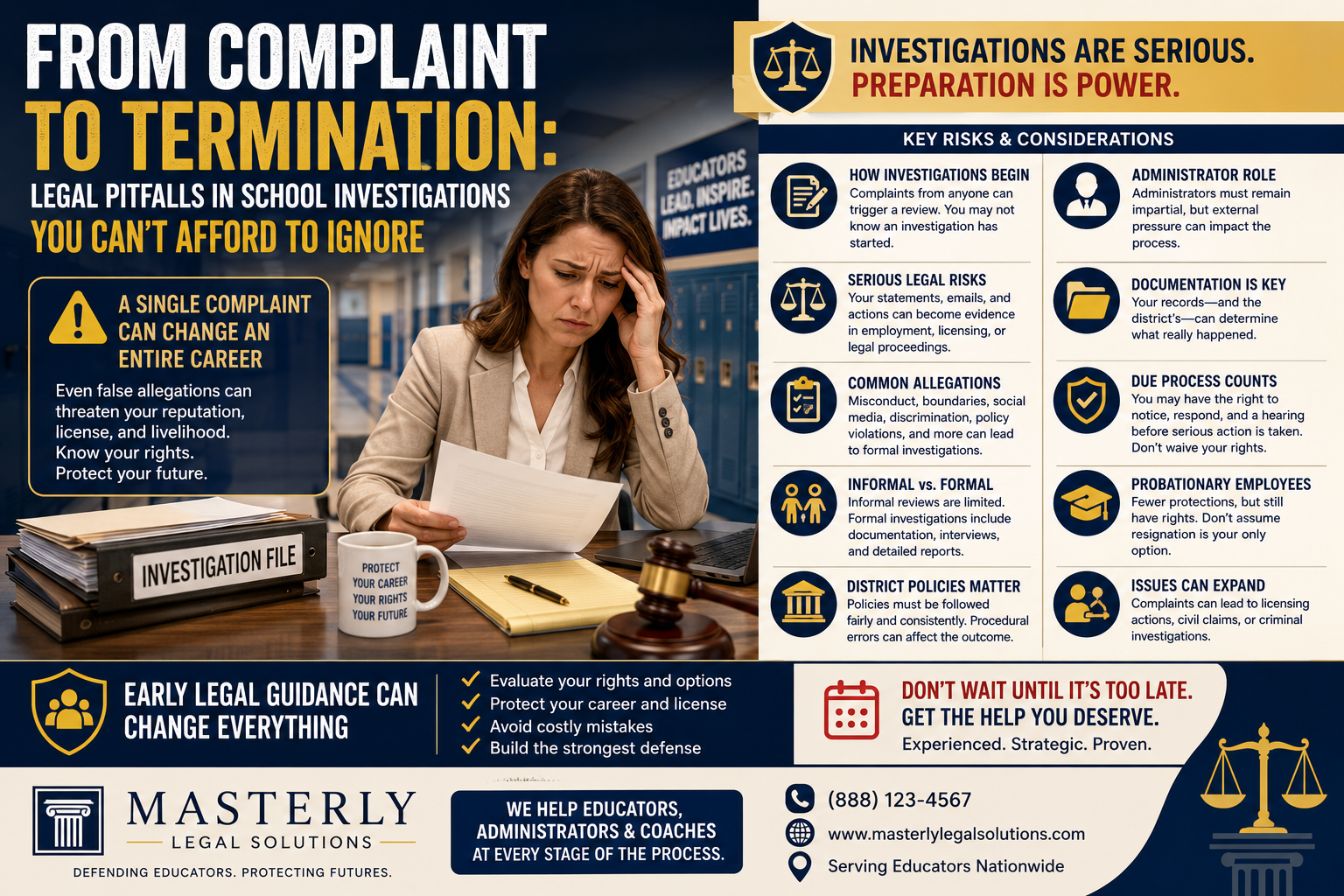
From Complaint to Termination: Legal Pitfalls in School Investigations You Can’t Afford to Ignore
A Single Complaint Can Change an Entire Career
Most people enter the field of education because they want to make a positive difference in the lives of students. Whether working in elementary schools, high schools, colleges, or universities, dedicated teachers and other professionals often spend years building a reputation based on trust, professionalism, and commitment. Unfortunately, it only takes one complaint to place that reputation under intense scrutiny.
Many complaints are resolved quickly, but others develop into formal investigations that can threaten a person's career, professional license, and future employment opportunities. Even allegations that are ultimately proven false can create lasting consequences if they are not handled properly. Understanding your rights and responsibilities before, during, and after an investigation is essential for anyone working in education.
For teachers, administrators, coaches, counselors, and other professionals, an investigation is more than an internal workplace issue. It may involve district policies, federal law, state law, licensing agencies, or even criminal investigators depending on the nature of the allegation. The earlier an experienced education lawyer becomes involved, the greater the opportunity to protect both your career and your future.
At Masterly Legal Solutions, we understand that every investigation deserves careful attention. Our goal is to help educators understand the legal landscape while providing practical guidance through difficult situations involving education law, employment disputes, and professional licensing concerns.
Understanding How School Investigations Begin
Not every investigation starts with a dramatic event. In many cases, the process begins with a simple complaint from a parent, coworker, student, or member of the community. While some complaints involve legitimate concerns, others arise from misunderstandings, personality conflicts, or inaccurate assumptions.
Regardless of the source, schools have an obligation to review allegations that could affect student safety, employee conduct, or compliance with district policies. This means that even minor concerns may receive formal attention before administrators determine whether any policy violations actually occurred.
Complaints may involve classroom management, communication with parents, grading disputes, professional boundaries, social media activity, discrimination claims, or alleged policy violations. Depending on the circumstances, investigations can quickly expand beyond the original complaint.
For many teachers, the most difficult part is realizing that the investigation process often begins long before they are informed that one exists. By the time an employee is interviewed, documents may already have been collected, witnesses identified, and preliminary conclusions formed.
Why Employment Investigations Carry Serious Legal Risks
Employment investigations are designed to gather facts, but they also create records that may influence future employment decisions. Statements made during interviews, written responses, emails, text messages, and personnel files can all become important evidence.
Once an investigation begins, every action matters. Employees who respond emotionally, destroy documents, or communicate carelessly may unintentionally create additional problems beyond the original allegation.
An experienced attorney understands that employment investigations are not simply workplace conversations. They often become the foundation for future disciplinary decisions, contract disputes, licensing actions, and civil litigation.
Because investigations can affect professional licenses and long-term career opportunities, seeking legal guidance early often provides significant advantages. Resources that explain how education law attorneys protect teachers during investigations can help employees recognize when to involve counsel. Waiting until termination has already occurred frequently limits the available options.
Common Complaints That Lead to Investigations
School investigations arise from many different circumstances. Some involve legitimate concerns requiring immediate attention, while others stem from misunderstandings that escalate unnecessarily.
Common allegations include:
- Professional misconduct
- Boundary concerns involving students
- Workplace discrimination
- Retaliation claims
- Failure to follow district policies
- Social media conduct
- Testing irregularities
- Financial concerns
- Classroom management issues
- Alleged violations involving special education
Although every case is unique, the seriousness of an allegation often determines how quickly investigators become involved and whether outside agencies participate.
Many school districts have established investigative procedures that require administrators to document interviews, preserve evidence, and provide reports before making employment recommendations.
The Difference Between Informal Reviews and Formal Investigations
Not every complaint becomes a formal investigation. Sometimes administrators resolve concerns through coaching, clarification, or additional training. Other situations require a much more structured process.
An informal review generally focuses on gathering enough information to determine whether additional action is necessary. These reviews may involve only a few interviews and limited documentation.
A formal investigation is significantly different. It typically includes written complaints, witness interviews, evidence collection, timelines, and detailed reports. Formal investigations may also involve human resources, district counsel, outside investigators, or regulatory agencies.
Understanding which type of review is taking place helps employees appreciate the potential consequences and determine when contacting an attorney becomes appropriate.
How School District Policies Affect Investigations
Every district adopts policies governing employee conduct, reporting obligations, investigations, and disciplinary procedures. These policies often work alongside federal and state laws, creating multiple layers of responsibilities for employees and administrators alike.
Many school districts also maintain employee handbooks outlining expectations regarding professional behavior, confidentiality, technology use, student interactions, mandatory reporting, and workplace ethics.
Employees sometimes assume that district policy automatically determines the outcome of an investigation. In reality, policies must still be applied fairly and consistently. Failure to follow established procedures may become an important issue during later employment disputes.
A knowledgeable education lawyer providing expert legal support for teachers and schools can evaluate whether district officials followed required procedures and whether any procedural mistakes affected the fairness of the investigation.
The Role of School Administrators During an Investigation
Effective school administrators face difficult responsibilities whenever allegations arise. They must balance student safety, employee rights, district obligations, and public confidence while gathering reliable information.
Administrators are expected to remain impartial throughout the investigative process. Their responsibility is to collect evidence rather than assume guilt before all relevant facts have been reviewed.
Unfortunately, investigations sometimes become influenced by public pressure, media attention, community concerns, or internal politics. These outside factors may unintentionally affect how evidence is evaluated.
Experienced legal counsel understands these realities and works to ensure that employees receive fair treatment throughout every stage of the investigation.
Documentation Can Determine the Outcome
Good documentation protects everyone involved in an investigation. Unfortunately, many employees underestimate how important their own records can become.
Keeping copies of evaluations, lesson plans, communications, disciplinary reports, meeting notes, and relevant emails may help establish important timelines if allegations arise later.
Likewise, administrators typically maintain extensive documentation throughout an investigation. Interview summaries, witness statements, electronic communications, surveillance footage, attendance records, and personnel documents frequently become part of the investigative file.
Accurate documentation often becomes one of the strongest forms of evidence available during employment disputes involving teachers, administrators, and other educators.
Due Process Matters More Than Many Employees Realize
One of the most important concepts in education law is due process. Although the specific protections available depend upon the employee's position, contract status, and applicable law, many school employees possess important procedural rights before serious employment action occurs.
These rights may include notice of allegations, opportunities to respond, access to certain evidence, and hearings before significant disciplinary decisions become final.
Unfortunately, many employees unknowingly waive important rights by signing documents without review, participating in interviews without preparation, or failing to respond within required deadlines.
An experienced lawyer helps employees understand their options before decisions are made that cannot easily be reversed.
Probationary Employees Face Different Challenges
Employees serving a probationary period often have fewer employment protections than those with continuing contracts. However, that does not mean employers may ignore applicable legal standards or district policies.
Many new teachers mistakenly believe they have no rights simply because they are still completing a probationary period. While employment protections may differ, investigations must still comply with applicable employment laws, contractual obligations, and district procedures.
Probationary employees should never assume resignation is their only option when concerns arise. Every situation deserves careful evaluation before important career decisions are made.
Seeking guidance early allows employees to understand potential consequences before accepting disciplinary action or separation agreements.
Investigations Involving Special Education Require Additional Care
Cases involving special education frequently involve additional legal requirements beyond ordinary employment policies. Allegations concerning services for students with disabilities may trigger obligations under multiple federal statutes and administrative regulations.
Issues involving individualized education programs, accommodations, student services, and compliance requirements often require careful documentation throughout the investigative process.
Because many students receiving special education services have protections established under the disabilities act, investigations involving these matters demand careful attention from administrators and legal professionals alike, and education law attorneys who help protect teacher rights can play a critical role in navigating these complex obligations.
When allegations involve free appropriate public education, documentation, communication, and procedural compliance become especially important. Mistakes made during these investigations may expose districts to significant liability while also affecting employee careers.
When Allegations Expand Beyond Employment Issues
Some investigations begin as workplace complaints but later expand into licensing, civil, or even criminal matters. What initially appears to be a personnel concern can quickly become much more complicated.
For example, allegations involving inappropriate communications, mandatory reporting obligations, student safety concerns, or financial misconduct may require reporting to outside agencies.
Similarly, complaints involving Title IX, harassment, or civil rights violations often extend beyond ordinary employment investigations and require compliance with specialized federal regulations.
Recognizing these risks early allows employees to make informed decisions before participating in interviews or providing written statements that could later be used in multiple proceedings.
Early Legal Guidance Can Change the Direction of an Investigation
One of the biggest mistakes employees make is waiting until termination appears inevitable before seeking help. By then, many important decisions have already been made, and valuable opportunities to address misunderstandings may have been lost.
An experienced education lawyer provides more than courtroom representation. Early involvement allows counsel to evaluate documents, explain employee rights, prepare responses, identify procedural concerns, and help clients avoid unnecessary mistakes.
Because investigations often move quickly, timely legal advice from Texas attorneys focused on education law and teacher representation can significantly influence both the investigative process and the options available afterward.
Whether you work in public institutions, private schools, charter schools, colleges, or universities, understanding your rights before making critical decisions is one of the most effective ways to protect your professional future.
How Witness Interviews Can Shape the Outcome
Witness interviews are often viewed as routine, but they frequently become one of the most influential parts of an investigation. Investigators compare statements from multiple individuals, looking for consistency, credibility, and supporting evidence. Even small differences between accounts may receive significant attention.
Employees should never assume that an interview is simply an informal conversation. Everything discussed may become part of the official investigative record. Taking time to prepare, understand the allegations, and provide accurate responses can make a substantial difference in the overall process.
An experienced attorney can help clients prepare for interviews by explaining expectations, identifying potential concerns, and ensuring responses remain factual rather than emotional. Careful preparation often reduces misunderstandings that might otherwise complicate the investigation.
The Importance of Preserving Evidence
Evidence comes in many forms, and not all of it exists on paper. Emails, text messages, lesson plans, attendance records, surveillance video, social media posts, and electronic communications may all become relevant during an investigation.
Employees should never delete files, alter records, or attempt to "clean up" communications after learning about a complaint. Doing so can create additional legal issues, even when the original allegation lacks merit.
Likewise, school administrators have responsibilities to preserve records that may become important later. Proper documentation supports a fair investigation and helps ensure decisions are based on reliable information rather than speculation.
Maintaining organized records throughout a career in education is one of the simplest ways to protect yourself if questions ever arise about your professional conduct, and working with an education law firm offering comprehensive legal services for teachers can help ensure that documentation is used effectively during an investigation.
Social Media Can Become Evidence
Many teachers underestimate how often social media appears during employment investigations. Personal accounts, private messages, photographs, and public comments may all become part of an investigative review if they relate to the allegations.
Even posts intended as jokes can be interpreted differently when viewed outside their original context. Comments about coworkers, students, parents, or district leadership may raise questions regarding professionalism.
Privacy settings do not always prevent investigators from obtaining relevant information. Screenshots, forwarded messages, and publicly available content frequently become evidence.
An experienced lawyer can explain how electronic communications may affect both employment decisions and future proceedings.
Title IX Investigations Require Specialized Knowledge
Allegations involving Title IX demand careful attention because they involve unique procedural requirements and significant potential consequences. Complaints involving sexual harassment, discrimination, or misconduct often trigger separate investigative procedures in addition to ordinary employment reviews.
Many colleges and universities maintain dedicated Title IX offices responsible for investigating complaints involving employees, faculty, and students. These investigations frequently involve interviews, documentary evidence, and formal findings.
Employees should understand that a Title IX investigation may proceed even if criminal charges are never filed. Different standards apply, and institutional decisions may affect future employment regardless of criminal outcomes.
Having knowledgeable education lawyer representation in Texas for investigations and hearings during these investigations helps ensure that employees understand their rights and obligations throughout the process.
Investigations Involving Disability-Related Concerns
Complaints involving disabilities require careful consideration under both federal and state law. Allegations concerning accommodations, accessibility, or disability discrimination often involve multiple overlapping legal standards.
Employees working in special education or student support services may face particularly complex situations when disagreements arise regarding services or accommodations. These cases frequently require detailed documentation and careful review of applicable regulations.
Questions involving students with disabilities should never be handled casually. Decisions affecting educational services can have lasting consequences for families as well as school employees.
Experienced counsel with knowledge of education law matters, such as attorneys who explain why teachers need an experienced education law attorney, can help evaluate whether investigative procedures complied with applicable legal requirements.
Teacher Contracts Do Not Guarantee Employment
Many educators mistakenly believe that signing teacher contracts completely protects their positions. While contracts establish important employment rights and responsibilities, they do not eliminate the possibility of investigations or disciplinary action.
Contract language often outlines standards of conduct, evaluation procedures, reporting obligations, and circumstances that may justify termination. Understanding those provisions before problems develop is essential.
Employment decisions must still comply with applicable law, district policy, and contractual obligations. An investigation that ignores contractual procedures may create additional grounds for challenging an adverse decision.
Reviewing contractual obligations with an education lawyer before responding to allegations can help employees make informed decisions throughout the investigative process.
Federal and State Regulations Affect Every Investigation
Employment investigations rarely rely on district policy alone. Various federal statutes, texas law, agency rules, and local policies frequently overlap during disciplinary proceedings.
For example, workplace investigations may involve civil rights laws, employment statutes, privacy requirements, mandatory reporting obligations, licensing standards, and constitutional protections depending upon the facts.
Understanding these overlapping regulations requires substantial knowledge of employment and education law. What appears straightforward on the surface may actually involve multiple legal questions requiring careful analysis.
Employees benefit from working with Texas education lawyers who understand TEA investigations and educator discipline, familiar with both workplace investigations and the complex regulatory environment affecting schools throughout Texas.
Special Education Cases Often Present Unique Challenges
Working in special education creates responsibilities that extend beyond ordinary classroom instruction. Employees must comply with documentation requirements, accommodation standards, and procedural safeguards established by federal and state authorities.
Disagreements involving services for students with disabilities sometimes lead to complaints against individual employees as well as school systems. These situations may involve allegations of procedural violations rather than intentional misconduct.
Investigators often review whether required meetings occurred, records were maintained, timelines were followed, and services matched applicable plans.
Understanding these specific requirements helps employees recognize potential concerns before they develop into larger employment disputes.
Charter Schools and Private Institutions Face Similar Risks
Although charter schools and private schools often operate under different governance structures than traditional public institutions, employment investigations remain a common reality.
Employees working in private schools, religious institutions, and charter schools may assume employment rules differ significantly. While contractual relationships may vary, investigations involving employee conduct, discrimination, harassment, or student safety remain serious matters.
Many private educational institutions establish internal investigative procedures that closely resemble those used by public employers. Documentation, interviews, evidence preservation, and disciplinary recommendations remain central components of the investigative process.
Legal guidance remains valuable regardless of the institution where an employee works.
Higher Education Investigations Continue to Increase
Employment disputes are not limited to elementary and secondary schools. Colleges and universities increasingly investigate complaints involving professors, administrators, coaches, researchers, and staff members.
Issues involving academic integrity, research misconduct, workplace conflict, discrimination, student complaints, and professional conduct frequently require extensive investigations.
These matters often affect faculty, tenure considerations, grant opportunities, and long-term professional reputations.
Whether representing college professors, administrators, or instructional staff, experienced counsel understands the unique procedures often found within higher education institutions.
The Role of Texas Education Laws
Employees working in Texas benefit from understanding how state statutes affect workplace investigations. The Texas Education Code establishes numerous provisions governing employment, certification, discipline, and administrative procedures within the state's educational system.
Because Texas education laws continue evolving through legislative updates and court decisions, remaining informed is essential for both employees and administrators.
Questions involving educator certification, employment rights, reporting obligations, and professional standards frequently require careful legal interpretation.
Working with Texas education lawyers familiar with both state and federal law helps ensure that important rights are recognized throughout the investigation.
Administrative Hearings May Follow an Investigation
Some investigations conclude with internal disciplinary decisions. Others continue into formal administrative hearings, licensing reviews, or appeals before state agencies.
These proceedings differ from ordinary workplace meetings. Evidence may be presented, witnesses examined, and procedural rules followed more closely than during internal investigations.
Preparation becomes increasingly important as cases advance. Documents gathered early in the investigation often become critical exhibits during later proceedings.
Experienced attorney representation helps employees understand what to expect and how to present their position effectively.
The Appeal Process Is Often Time Sensitive
Receiving an unfavorable employment decision does not always mark the end of the matter. Depending upon the circumstances, employees may have opportunities to challenge findings through an appeal process established by contract, district policy, or applicable law.
Strict deadlines frequently apply. Missing a filing deadline may permanently eliminate available remedies.
Before deciding whether to appeal, employees should carefully review investigative findings, supporting evidence, procedural issues, and applicable employment standards.
Early evaluation allows counsel to determine whether meaningful legal options remain available.
Free Speech Does Not Eliminate Professional Responsibilities
Questions involving free speech occasionally arise during employment investigations. Employees certainly possess constitutional protections in many situations, particularly within public institutions.
However, those protections are not unlimited. Courts frequently balance employee speech against legitimate governmental and institutional interests, especially when workplace efficiency, student welfare, or professional responsibilities are affected.
Understanding how constitutional principles apply requires careful legal analysis rather than assumptions based upon general public discussions.
Employees should seek experienced advice before relying upon constitutional arguments during disciplinary proceedings.
Investigations Can Affect Professional Licensure
For many teachers, employment is only one part of the equation. Certain allegations may also trigger licensing reviews that affect future career opportunities throughout Texas.
State agencies responsible for educator certification may review investigative findings independently of district employment decisions. A resignation does not necessarily prevent licensing authorities from conducting their own review.
Protecting professional credentials often requires addressing both employment matters and licensing concerns simultaneously.
This is one reason why early involvement from Texas education lawyers can significantly improve overall case strategy.
Protecting Your Reputation During an Investigation
An investigation may eventually close, but reputational damage can continue long afterward if concerns are not addressed appropriately. Colleagues, future employers, licensing agencies, and professional organizations may all review aspects of prior employment history.
Remaining professional throughout the investigative process, preserving documentation, following legal advice, and avoiding unnecessary public discussion often helps minimize long-term consequences.
Every communication should reflect professionalism, accuracy, and respect for confidentiality.
Protecting your reputation begins long before the final investigative report is issued.
How Parents Influence School Investigations
The relationship between parents and schools is built on communication and trust, but disagreements sometimes escalate into formal complaints. Concerns about classroom instruction, student discipline, accommodations, grading, or interactions with school personnel can all trigger an investigation.
Most complaints are made with sincere intentions, but investigators must distinguish between emotional concerns and verifiable facts. Decisions should be based on evidence rather than assumptions or public pressure.
When allegations involve protecting student rights, district officials have an obligation to review the matter thoroughly while also respecting the rights of the employee involved. A fair investigation protects everyone—not only the reporting party but also the professional responding to the allegations.
Employees should remain respectful when communicating with families throughout an investigation. Professional communication often helps prevent misunderstandings from becoming larger disputes.
Balancing Student Rights and Employee Rights
One of the greatest challenges facing educational institutions is balancing the rights of employees with the rights of students. Every investigation should seek to ensure that student rights are respected while also providing employees with fundamental procedural protections.
This balance becomes particularly important in cases involving classroom accommodations, student discipline, safety concerns, or allegations of misconduct. Decisions made too quickly can negatively affect both employees and students.
When investigations involve a student's educational services, officials should also consider the child's rights, the unique circumstances of the child's case, and the best interests of everyone involved.
An experienced advocate understands that fairness requires careful attention to facts rather than assumptions or outside pressure.
Discrimination Claims Require Immediate Attention
Allegations of discrimination are among the most sensitive complaints handled by educational institutions. Claims involving race, age, religion, national origin, gender, disability, or other protected characteristics often require immediate investigation under applicable employment policies and federal requirements.
Even if an allegation ultimately proves unfounded, the investigation itself may affect workplace relationships and professional reputations. For that reason, employees should avoid making assumptions about the complaint or attempting to influence witnesses.
Schools, colleges, and universities are expected to investigate these matters objectively while following applicable regulations and internal procedures.
Early legal guidance helps employees understand both their rights and their responsibilities throughout the investigation.
When Discipline Becomes a Possibility
Not every investigation ends with termination, but many conclude with some form of discipline. Depending on the findings, employees may receive verbal counseling, written reprimands, mandatory training, suspension, contract nonrenewal, or dismissal.
The severity of the outcome often depends on the evidence gathered, the employee's history, district policies, and whether similar conduct has occurred previously.
Before accepting any disciplinary decision, employees should carefully review the investigative findings and understand the long-term consequences. Some actions may affect future employment, certification, and professional opportunities.
Because disciplinary decisions often involve significant legal matters, obtaining guidance from an experienced lawyer before responding can be extremely valuable.
Why Experienced Legal Counsel Makes a Difference
Every employment investigation presents different facts, different policies, and different risks. An attorney with extensive experience handling school employment disputes understands how investigations are conducted and where procedural mistakes commonly occur.
Experienced counsel can review investigative documents, evaluate evidence, prepare clients for interviews, identify violations of employee rights, and develop strategies that support the strongest possible outcome.
At Masterly Legal Solutions, we recognize that every case deserves individualized attention. Our extensive experience representing education professionals as an education law attorney for teachers and administrators allows us to provide practical guidance tailored to each client's circumstances.
The earlier legal counsel becomes involved, the more opportunities may exist to resolve concerns before they permanently affect a career.
How Masterly Legal Solutions Assists Education Professionals
At Masterly Legal Solutions, we understand that careers in education are built over many years but can be placed at risk by a single complaint. Whether you teach in elementary schools, work in colleges, serve in universities, or support educational institutions in another capacity, your professional future deserves careful protection.
Our firm assists clients facing investigations involving employment disputes, certification concerns, workplace discrimination, contract matters, student complaints, and other complex legal matters affecting educational professionals, and our role as a Texas law firm focused on protecting educators in school investigations is to safeguard both careers and professional licenses.
We provide personalized assistance, explain available options, review investigative procedures, and work to protect the careers and professional reputations of the individuals we represent.
From the initial complaint through hearings, negotiations, and possible appeals, our goal is to serve as a trusted advocate for every client.
Choosing the Right Attorney for School Employment Matters
Not every employment dispute involves the same legal questions. Cases arising in educational settings often require an understanding of employment law, licensing rules, district policies, constitutional principles, and administrative procedures.
Working with an attorney who understands education law, school investigations, and educator licensing issues can make a meaningful difference throughout the case.
At Masterly Legal Solutions, our team understands the unique challenges facing today's educational professionals. We strive to provide practical advice that helps teachers, administrators, and other employees make informed decisions during difficult situations.
Whether you need immediate advice or long-term representation, selecting the right lawyer is one of the most important decisions you can make.
Protect Your Career Before It's Too Late
Most professionals never expect to become the subject of a school investigation. Unfortunately, investigations can arise with little warning and often progress much faster than employees anticipate.
Waiting until termination is recommended or certification issues arise may reduce the available options. Taking proactive steps early in the investigative process allows employees to understand their rights, preserve evidence, and make informed decisions.
If you work in Texas education, do not assume that everything will resolve itself. A carefully planned response developed with experienced legal counsel can significantly improve your ability to protect your career, professional reputation, and future employment opportunities.
Understanding the investigation today may determine where your career stands tomorrow.
Employees Are Entitled to Fair Treatment Throughout the Investigation Process
Every employee working in schools plays a vital role in creating a safe and productive learning environment, and that responsibility extends to district leadership and administration during workplace investigations. Regardless of the allegations involved, employees are entitled to fair treatment and should have an opportunity to understand the claims against them while exercising any available process rights provided under district policy, employment agreements, or applicable law. Investigations involving student injuries, allegations of physical misconduct, or concerns that could affect federal funding often receive heightened attention because of the potential impact on the school system. Even in these high-pressure situations, investigators must remain objective, follow established procedures, and avoid reaching conclusions before reviewing all available evidence. When fairness is compromised, obtaining legal guidance can help ensure that both the employee's rights and professional future are properly protected.
Why Early Legal Representation Can Make a Meaningful Difference
One of the biggest mistakes educators make is waiting until an investigation has reached its final stages before seeking legal representation. By that point, interviews may have already been completed, evidence gathered, and recommendations submitted to decision-makers. Obtaining experienced legal counsel early allows employees to better understand their rights, prepare for meetings, respond appropriately to allegations, and avoid mistakes that could negatively affect their careers. Whether the matter involves disciplinary action, employment disputes, or certification concerns, timely legal representation can help protect your professional reputation and place you in the strongest possible position as the investigation moves forward.
Contact Masterly Legal Solutions for a Free Consultation
When your professional reputation, livelihood, and future are on the line, you should not have to face an investigation alone. Whether you are dealing with an employment complaint, disciplinary proceeding, certification concern, workplace discrimination, or another complex issue affecting your career in education, the team at Masterly Legal Solutions is ready to help.
Our attorneys for teachers understand the pressures facing professionals in public and private schools, charter schools, colleges and universities, and every level of public education. We regularly assist teachers, administrators, coaches, counselors, support staff, the school nurse, and other educational professionals with a wide range of legal issues. If you are searching for education law attorneys, an experienced education lawyer, or trusted Texas education lawyers, our team is prepared to provide the guidance and assistance you need.
Every situation is different, and early action often creates more opportunities to preserve your career. We invite you to schedule a free consultation so we can listen to your concerns, answer your questions, explain your options, and discuss how we may be able to help. Call Masterly Legal Solutions at (972) 236-5051 to speak with our team and take the first step toward protecting your professional future.
Disclaimer: This article is provided for educational and informational purposes only. It is not intended to serve as legal advice and should not be relied upon as a substitute for advice from a qualified attorney regarding your particular circumstances. Reading this article does not create an attorney-client relationship with Masterly Legal Solutions. If you have questions about an investigation, employment matter, or other legal concern involving schools, teachers, or education, contact Masterly Legal Solutions to discuss your specific situation during a free consultation.
Teacher Rights When Assaulted by a Special Needs Student: Safety, Reporting and Investigation Issues



Looking for Legal & Business Solutions? Contact Us Now
Fill in the form or call us to set up a meeting





