

How CPS Defines Compliance During Investigations
Why Understanding Compliance Matters More Than Most Parents Realize
Receiving a call from Child Protective Services can be one of the most stressful experiences a parent will ever face. Many families immediately focus on defending themselves against allegations, but they often overlook another important issue: compliance. During a CPS case, investigators are constantly evaluating whether parents are cooperating with requests, following instructions, and taking steps they believe are necessary to address concerns.
Unfortunately, many parents misunderstand what compliance actually means during a CPS investigation. They assume that simply answering questions or attending meetings is enough. In reality, CPS workers often evaluate a family's actions, responsiveness, and willingness to participate throughout the entire investigation process.
At Masterly Legal Solutions, we frequently speak with parents who believed they were cooperating fully, only to learn later that CPS viewed their actions differently. Understanding how Child Protective Services defines compliance can help families avoid misunderstandings that may negatively affect their case.
What Compliance Means in a CPS Case
When Child Protective Services opens a case, investigators begin gathering information to determine whether abuse or neglect may have occurred. During this process, they also assess how parents respond to requests and recommendations.
Compliance generally refers to a parent's willingness to participate in the CPS process and cooperate with reasonable requests. This may include attending meetings, providing requested information, participating in assessments, and complying with court directives when applicable.
However, compliance does not necessarily mean agreeing with every allegation or admitting wrongdoing. Parents can cooperate with an investigation while still protecting their legal rights.
Understanding that distinction is extremely important.
Why Compliance Is Often Misunderstood
Many parents assume compliance means complete agreement with everything CPS says or does.
That is not always the case.
A parent may disagree with allegations of child abuse or neglect while still complying with requests to participate in interviews, provide records, or attend scheduled meetings.
Likewise, a family may cooperate extensively but still face challenges if investigators believe concerns remain unresolved.
The key is understanding that compliance and guilt are not the same thing.
Unfortunately, confusion about this issue causes many families to make avoidable mistakes.
The Goals of Child Protective Services During Investigations
The primary mission of Child Protective Services is to evaluate child safety concerns and determine whether intervention is necessary.
Investigators are tasked with assessing allegations involving abuse or neglect while considering the overall well being of the child. Their decisions are often influenced by perceived risk factors and the family's ability to address concerns.
During the investigation process, CPS workers evaluate whether conditions exist that could place a child at risk now or in the future.
Because compliance is often viewed as a sign of cooperation, it can influence how investigators perceive a family's willingness to address concerns.
How the CPS Investigation Process Begins
The CPS investigation process usually starts after a report alleging child abuse or neglect is received.
Once the report is accepted, Child Protective Services begins gathering information. Investigators may contact family members, review records, conduct interviews, and schedule visits to the child's home.
The early stages of a CPS case often move quickly.
Parents who understand the investigation process from the beginning are generally better positioned to respond appropriately and avoid unnecessary complications.
The Role of Risk Assessment in Compliance Evaluations
A major component of child protective investigations involves risk assessment.
Investigators use risk assessment tools to evaluate whether a child may face danger or future abuse. These evaluations consider various factors including family history, living conditions, prior reports, criminal history, and current allegations.
The purpose of a risk assessment is not only to determine whether abuse or neglect occurred but also to identify potential future concerns.
Compliance often influences how investigators evaluate overall risk.
Families viewed as cooperative may be perceived differently than those viewed as resistant.
Why Child's Safety Remains the Primary Concern
Throughout every CPS investigation, the agency's focus remains on the child's safety.
Investigators are responsible for determining whether a child faces an immediate risk of harm. This responsibility affects nearly every decision made during the investigation stage.
Even when allegations remain unproven, CPS workers may take actions they believe are necessary to protect the child while information is being gathered.
Understanding this perspective can help parents better understand why certain requests are made during the case.
What CPS Workers Look for During Home Visits
One of the most common parts of a CPS case involves a visit to the child's home.
During these visits, CPS workers often observe living conditions, household interactions, sleeping arrangements, and general safety concerns.
Parents sometimes become defensive during home visits because they feel judged. While those feelings are understandable, it is important to recognize that investigators are gathering information as part of their evaluation.
The condition of the child's home can significantly influence perceptions regarding compliance and child safety.
Compliance and Access to Information
During child protective investigations, families are often asked to provide information.
This may include:
- Medical records
- School records
- Counseling records
- Contact information for family members
- Documentation relating to services
Providing requested information in a timely manner is often viewed as a sign of cooperation.
However, parents should understand that providing records can have legal implications, which is why obtaining legal counsel may be beneficial in certain situations.
How CPS Defines Noncompliance
Many parents assume noncompliance only occurs when someone outright refuses to cooperate.
In reality, CPS may view a variety of actions as noncompliance.
Examples may include missed appointments, failure to provide requested documentation, refusal to participate in assessments, or ignoring recommendations intended to address child safety concerns.
Whether these actions are justified depends on the specific circumstances.
The important point is that investigators often document these issues throughout the CPS case.
The Importance of Communication During a CPS Case
Communication can play a major role in how compliance is perceived.
Parents who respond promptly to calls, attend scheduled meetings, and communicate respectfully may be viewed differently than those who avoid contact.
This does not mean parents should answer every question without considering the legal implications.
Instead, families should strive to communicate thoughtfully while understanding their rights.
Balancing cooperation with legal protections is often one of the most important aspects of navigating a CPS case.
When Abuse or Neglect Is Alleged
A CPS investigation may begin after allegations involving abuse or neglect are reported.
These allegations can involve physical abuse, sexual abuse, neglect, domestic violence exposure, substance abuse concerns, or other child safety issues.
At the beginning of the investigation stage, allegations remain just that—allegations.
Investigators must collect evidence before determining whether abuse or neglect occurred.
Understanding this distinction helps parents avoid assuming the outcome has already been decided.
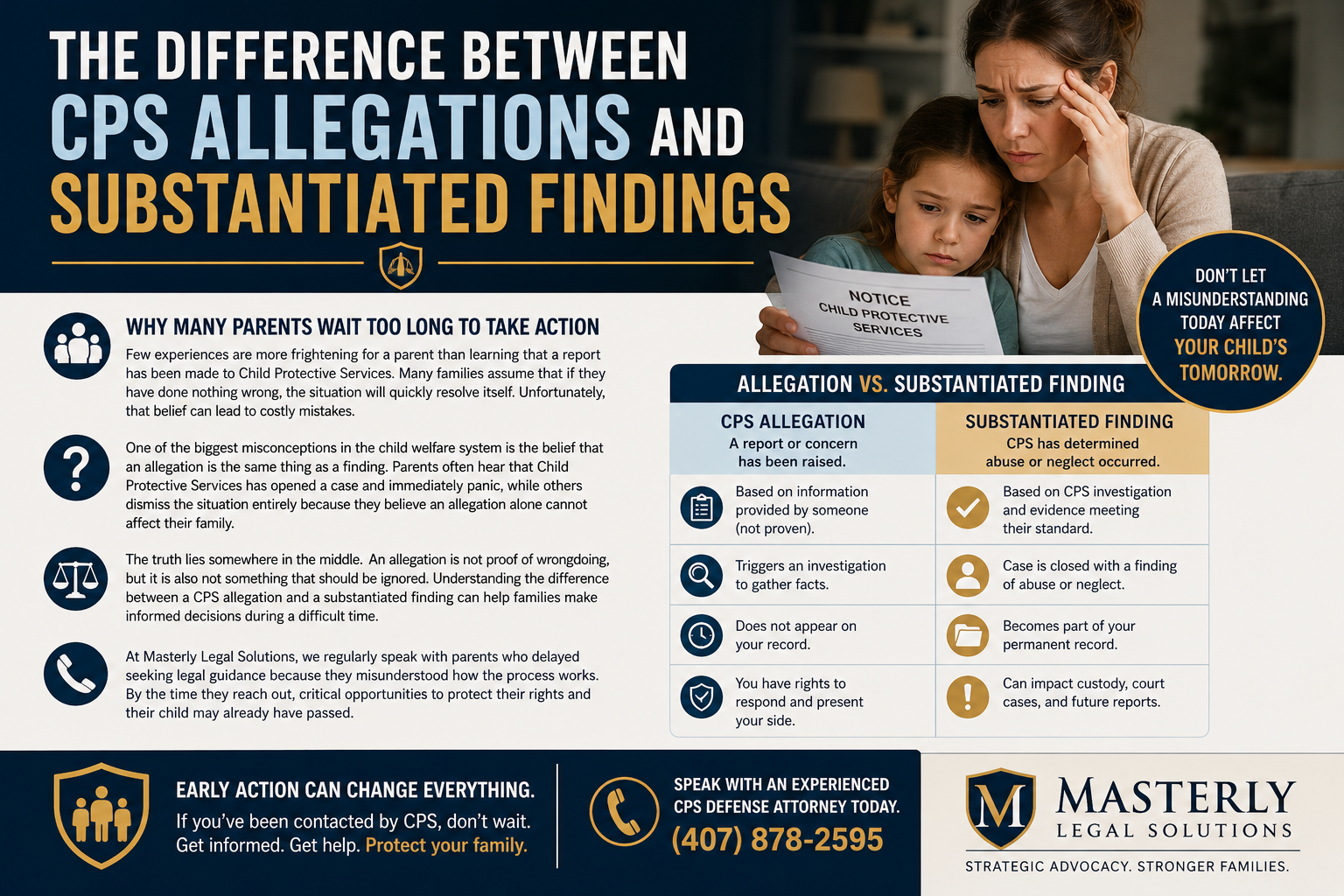
The Difference Between Allegations and Findings
One of the most common misconceptions involves confusing allegations with findings.
An allegation means someone reported concerns regarding possible abuse or neglect. A finding occurs after investigators review evidence and reach conclusions regarding those allegations.
Unfortunately, some parents assume they can wait until investigation results are issued before taking the matter seriously.
By that point, important opportunities may have already been missed.
The investigation stage is often when critical decisions are made.
Why Family Based Safety Services May Be Recommended
In many cases, Child Protective Services recommends Family Based Safety Services.
Family Based Safety Services are designed to help families address concerns while allowing children to remain in the home whenever possible.
These services may involve parenting education, counseling, safety planning, and referrals to community resources.
Participation in Family Based Safety Services is often viewed as a sign of cooperation.
However, parents should understand the purpose and potential implications of any services being offered.
Understanding the Purpose of a Safety Plan
A safety plan is one of the most commonly used tools during CPS investigations.
A safety plan typically outlines steps intended to address identified concerns and protect the child's safety.
Depending on the circumstances, a safety plan may involve supervision arrangements, visitation restrictions, counseling participation, or other measures.
Many parents sign a safety plan without fully understanding its significance.
Because safety plans can affect important rights, families should carefully review their obligations before agreeing to terms, and some parents may also benefit from exploring powers of attorney that help protect their children during emergencies.
How Safety Plans Affect Compliance Determinations
Once a safety plan is implemented, investigators often evaluate whether the family follows its requirements.
Compliance with a safety plan may influence future decisions regarding the CPS case.
Failure to follow the plan can raise concerns about cooperation and child safety.
At the same time, parents should understand that agreeing to a safety plan does not necessarily mean admitting abuse or neglect occurred.
The legal significance of safety plans can vary depending on the circumstances.
Temporary Custody and Emergency Actions
In some situations, Child Protective Services may seek temporary custody of a child.
This typically occurs when investigators believe an immediate risk exists and intervention is necessary to protect the child from serious harm.
Temporary custody decisions are often made quickly.
Parents facing these situations should understand that emergency actions can have long-term consequences if not addressed promptly.
Obtaining legal representation early may help families better navigate these challenges, just as proactive planning for essential legal documents such as wills, trusts, and powers of attorney can help protect a family's long-term interests.
Why Legal Representation Can Make a Difference
Many families attempt to handle CPS investigations alone because they believe cooperation will automatically resolve the situation.
Unfortunately, the process is often more complicated.
Legal representation can help parents understand their rights, evaluate requests made by investigators, and avoid actions that may unintentionally damage their position.
An attorney can also explain how compliance is being evaluated and help families respond strategically.
Understanding the process early often leads to better outcomes.
How CPS Investigations Gather Relevant Data
Throughout the investigation process, CPS workers engage in extensive data collection.
Investigators may review medical records, school records, prior reports, criminal history information, and interviews conducted with family members.
The purpose of gathering relevant data is to develop a complete picture of the family's circumstances.
Information collected during this phase may significantly influence investigation results and future recommendations.
Because of this, every interaction during a CPS case can matter.
How CPS Determines Whether Compliance Exists
One of the most important questions during a CPS case is whether CPS determines that the family is cooperating with efforts to address concerns.
Compliance is not evaluated based on a single event. Instead, investigators often review a pattern of behavior throughout the investigation process.
They may consider attendance at meetings, participation in recommended services, responsiveness to requests, and adherence to any existing safety plan.
Because compliance is often viewed as an ongoing process, families should understand that every interaction can influence how their case is evaluated.
The Role of Family Members During Investigations
Family members frequently become involved during Child Protective Services investigations.
Grandparents, relatives, and other individuals may provide information regarding the child's living environment and overall well being.
In some cases, investigators may ask family members to assist with supervision arrangements or temporary placement options.
The willingness of family members to participate can affect how CPS views available support systems.
Strong family involvement is often viewed favorably when evaluating child safety concerns.
When an Alleged Perpetrator Is Identified
Many investigations focus on an alleged perpetrator believed to be responsible for abuse or neglect.
The alleged perpetrator may be a parent, caregiver, household member, or another person with access to the child.
It is important to remember that being identified as an alleged perpetrator does not automatically establish wrongdoing.
The agency must still complete its investigation and evaluate evidence before reaching conclusions.
Understanding this distinction helps families avoid assuming outcomes before the investigation results are finalized.
How Domestic Violence Can Influence a CPS Case
Domestic violence allegations frequently arise during CPS investigations.
Even when a child is not directly involved in an incident, investigators may evaluate whether exposure to violence creates safety concerns.
Protective services agencies often view domestic violence as a potential risk factor because of its possible impact on children.
As a result, CPS workers may recommend counseling, safety planning, or additional services when domestic violence concerns exist.
These recommendations can influence compliance evaluations throughout the case.
Compliance and Child Abuse or Neglect Investigations
Every child abuse or neglect investigation involves multiple assessments designed to evaluate risk and safety.
Investigators examine allegations, conduct interviews, and review available records to determine whether intervention is necessary.
Compliance becomes important because it often influences how CPS views a family's willingness to address concerns.
However, compliance alone does not determine whether abuse or neglect occurred.
The agency must still evaluate evidence and reach conclusions based on the facts presented.
Why Legal Counsel Is Important During CPS Investigations
Many parents do not realize how quickly a CPS case can become complicated.
Requests for interviews, documentation, assessments, and services may begin almost immediately after contact from investigators.
Legal counsel can help families understand their rights and obligations throughout the process.
An attorney may also help parents evaluate requests, understand potential consequences, and respond appropriately to agency concerns.
Seeking guidance early often provides families with greater confidence during stressful situations.
The Relationship Between Compliance and Risk Factors
Investigators often evaluate multiple risk factors when assessing child safety concerns.
Examples may include prior CPS involvement, criminal history, substance abuse allegations, domestic violence concerns, or unstable living conditions.
While the presence of risk factors does not automatically mean a child is unsafe, investigators may consider them when making decisions.
Compliance may influence how those concerns are viewed and addressed.
This is why understanding the agency's expectations can be beneficial.
How a Service Plan May Be Used
In some cases, CPS develops a service plan outlining recommended actions for the family.
A service plan may include counseling, parenting classes, treatment programs, or other supportive services.
The purpose is often to reduce identified concerns and improve long-term child safety.
Participation in a service plan is frequently evaluated as part of the overall compliance assessment.
Parents should carefully review any proposed service plan before agreeing to its terms.
Administrative Closure of a CPS Case
Not every CPS case results in court involvement or ongoing agency supervision.
Some investigations conclude through administrative closure.
Administrative closure generally means the agency has determined that no additional intervention is necessary at that time.
This outcome may occur when allegations are not substantiated or when investigators conclude that identified concerns have been adequately addressed.
Families often view administrative closure as a significant milestone in resolving the case.
Investigation Results and Their Impact
The investigation results can have a lasting effect on a family.
Depending on the findings, the agency may close the case, recommend services, pursue court intervention, or take other actions.
Parents should understand that investigation results are based on information gathered throughout the case.
Actions taken during the investigation process may influence how those results are viewed.
This is another reason why early preparation can be important.
Understanding the CPS Investigation Timeline
Many parents want to know the CPS investigation timeline immediately after learning a report has been made.
Unfortunately, timelines vary depending on the complexity of the allegations and the amount of information that must be reviewed.
Some investigations are completed relatively quickly, while others remain active for extended periods.
Factors such as medical records, witness interviews, and coordination with other agencies may affect timing.
Patience and preparation are often necessary during this phase.
When a Criminal Investigation Is Also Occurring
Some CPS investigations occur alongside a criminal investigation.
This often happens when allegations involve severe physical abuse, sexual abuse, or other conduct that may violate criminal laws.
When an ongoing criminal investigation exists, parents face additional challenges.
Statements made during a CPS case may have implications beyond child welfare proceedings.
Understanding these risks highlights the importance of obtaining legal representation early, much like organizations facing serious allegations often rely on outside counsel to conduct impartial internal investigations.
The Difference Between a Criminal Case and a CPS Case
A criminal case and a CPS case serve different purposes.
A criminal case focuses on whether criminal laws were violated and whether criminal charges should be pursued.
A CPS case focuses primarily on child safety and protective services concerns.
Although the two processes may overlap, they operate under different standards and objectives.
Families should understand that outcomes in one process do not automatically determine outcomes in the other.
Court Hearings and Court Proceedings
When Child Protective Services seeks judicial involvement, court proceedings may become necessary.
A court hearing allows parties to present information and arguments regarding the case.
The court may review evidence, hear testimony, and consider recommendations from protective services agencies.
Court proceedings can affect custody arrangements, service requirements, and long-term case outcomes.
Preparation is essential when a case reaches this stage, much like timely assistance from Texas education lawyers experienced in TEA investigations and hearings is critical when an educator's license is at stake.
How a Juvenile Dependency Court Operates
A juvenile dependency court is responsible for handling legal matters involving child welfare concerns.
The juvenile dependency court reviews evidence and determines what actions are necessary to protect the child.
In many cases, the juvenile dependency court evaluates placement decisions, service recommendations, and reunification efforts.
Parents often find these proceedings intimidating because the stakes are extremely high.
Understanding the purpose of the juvenile dependency court can reduce uncertainty.
Decisions Made by a Juvenile Dependency Court
The juvenile dependency court may issue rulings regarding placement, visitation, and services.
In some cases, the court determines whether a child should remain in the home, enter foster care, or be placed with relatives.
The juvenile dependency court also reviews progress made by parents and evaluates compliance with court directives.
Because these decisions can significantly affect a family, proper preparation is critical.
Legal representation often becomes particularly valuable during this stage.
Temporary Custody and Foster Care Decisions
When concerns involve an immediate risk to the child, CPS may seek temporary custody.
Temporary custody is generally intended to provide short-term protection while concerns are addressed.
If removal occurs, a child may enter foster care or be placed with approved relatives.
The goal is often to maintain child safety while the case progresses through the system.
These decisions are frequently reviewed by the juvenile dependency court.
Foster Care and Long-Term Planning
Foster care is typically considered a temporary solution rather than a permanent outcome.
Protective services agencies often work toward reunification whenever it is safe and appropriate.
Families may be asked to complete services, participate in counseling, and demonstrate progress before reunification occurs.
The ultimate goal is often to ensure the child can return to a safe and stable environment.
Compliance with recommendations may influence these decisions.
Family Services and Community Resources
Many families benefit from family services and community resources offered during a CPS case.
These resources may include counseling, parenting education, treatment programs, and other supportive services.
The purpose is often to address identified concerns while helping families build safer environments
Access to community resources can sometimes reduce risk factors and improve outcomes, similar to how education lawyers in Texas who support teachers and schools can help address systemic issues that affect students and families.
Participation may also demonstrate a commitment to addressing agency concerns.
Understanding Legal Protections Available to Parents
Parents often feel powerless when facing Child Protective Services.
However, important legal protections exist throughout the process.
The Texas Family Code establishes various rights and procedures governing CPS investigations and court involvement.
Understanding these protections can help families make informed decisions.
Knowledge of available rights is often one of the strongest tools a parent can have.
Legal Aid and Court-Appointed Representation
Some parents may qualify for legal aid services or a court appointed attorney depending on the circumstances of the case.
These resources can provide valuable assistance when families face complex legal issues.
Parents should not assume they must navigate the process alone, just as educators facing agency investigations benefit from legal guidance on Texas teacher certification rules and license defense.
Access to qualified legal representation can significantly affect how a case is handled.
Understanding available options is an important step toward protecting family interests.
Compliance Reports and How CPS Documents Cases
Throughout a CPS case, investigators frequently create documentation regarding family interactions and case progress.
A compliance report may include information about participation in services, attendance at meetings, implementation of a safety plan, and other relevant factors.
The compliance report becomes part of the agency's record regarding the case.
Because these reports can influence decisions, families should understand the importance of their actions throughout the process.
Careful attention to compliance-related issues may affect how the case is evaluated.
The Importance of Effective Compliance Reporting
Effective compliance reporting helps investigators track progress and evaluate whether concerns are being addressed.
In many ways, a compliance report functions as a record of how the family responded during the case.
Accurate documentation allows relevant stakeholders to assess compliance status and determine whether additional intervention is necessary.
This concept is similar to effective compliance reporting used in organizational settings where performance and accountability are monitored, an area where firms that provide business, estate planning, and compliance-focused legal services can offer valuable guidance.
Understanding how reports are created can help families better navigate the process.
Understanding Additional Factors CPS May Consider During a Compliance Review
During a CPS investigation, several outside factors may influence how the agency evaluates a family's situation. Investigators may review allegations involving an alleged victim and determine whether the reported conduct constitutes alleged abuse or suspected abuse under applicable standards. Depending on the circumstances, the Texas Department of Family and Protective Services may coordinate with child and family services providers and refer families to available family and community resources intended to address safety concerns. In some cases, a court order may require specific actions by the family, and compliance with those requirements can become an important part of the case. The agency's goal is often to help keep the child safe while evaluating whether intervention remains necessary. During this process, the actions of the child's parents are frequently reviewed alongside recommendations from professionals and service providers. Certain matters may also undergo an administrative review to evaluate findings or procedural concerns. While CPS cases are very different from corporate compliance matters, concepts such as organization's adherence to established standards and oversight by risk managers are sometimes used as examples to explain how agencies assess cooperation, accountability, and risk reduction. Families seeking additional information may also find educational resources through organizations such as the Texas Legal Services Center, which provides information regarding legal rights and available assistance programs, and educators in particular may benefit from Texas education law attorneys who assist with investigations and disciplinary actions.
Compliance Reporting and Broader Evaluation Standards
Although CPS cases focus on child welfare, certain principles resemble concepts used in risk management and organizational oversight, where experienced counsel provide broad legal services for corporations, nonprofits, and individuals.
For example, agencies often review relevant data, evaluate compliance posture, and assess whether actions taken adequately address concerns.
In corporate settings, an organization's compliance posture may reflect its ability to follow rules and reduce risk. Similarly, CPS evaluates whether a family is following recommendations designed to address child safety concerns.
These assessments influence how the agency views ongoing risk and future abuse prevention efforts, just as early intervention by Texas education lawyers who handle TEA investigations and license defense can shape outcomes for educators facing professional risk.
The process is often more detailed than many families initially realize.
How Masterly Legal Solutions Helps Families During CPS Investigations
A CPS investigation can feel overwhelming, especially when parents are unsure how Child Protective Services defines compliance. Families often believe they are cooperating fully, only to discover that investigators view certain actions differently. These misunderstandings can have serious consequences during a CPS case.
At Masterly Legal Solutions, we help families understand the CPS process, evaluate compliance concerns, respond to agency requests, and protect their rights throughout the investigation. Whether your case involves allegations of child abuse or neglect, foster care concerns, court proceedings, or questions regarding a compliance report, our team can help you better understand your options.
If you are facing a CPS case, do not wait until important decisions have already been made. Early action can make a significant difference in protecting your child, your family, and your future.
Contact Masterly Legal Solutions today at (972) 236-5051 for a free consultation. We can answer your questions, explain the investigation process, and help you understand how compliance issues may affect your case. Every family's circumstances are unique, and obtaining guidance early may help you avoid costly mistakes.
Taking Control of the Process Before It Controls You
Many parents focus entirely on disproving allegations while overlooking how compliance is being evaluated. Yet compliance often plays a major role in how Child Protective Services views a family's willingness to address concerns and protect a child's safety.
The more families understand about compliance expectations, protective services procedures, investigation outcomes, and court requirements, the better prepared they are to navigate difficult situations. Knowledge, preparation, and timely legal guidance can make a meaningful difference when a CPS case affects your family.
Disclaimer: This article is provided for educational and informational purposes only. It is not legal advice and should not be relied upon as legal guidance regarding any specific situation. Reading this article does not create an attorney-client relationship with Masterly Legal Solutions. If you are involved in a CPS investigation, juvenile dependency court proceedings, or any matter involving child protective services, foster care, or child welfare concerns, you should consult with a qualified attorney regarding your specific circumstances.

Teacher Rights When Assaulted by a Special Needs Student: Safety, Reporting and Investigation Issues


Looking for Legal & Business Solutions? Contact Us Now
Fill in the form or call us to set up a meeting