

Texas Medical Board Medical Records Complaints: What Physicians Should Preserve
A Texas Medical Board Medical Records Complaint Can Put Your Professional Future at Risk
A Texas Medical Board medical records complaint can quickly become a serious licensing matter before the Texas Medical Board, a state agency that licenses and regulates physicians. Allegations involving incomplete, altered, unavailable, or inaccurate medical records often raise questions about documentation practices, patient care, and compliance with professional standards, and they can lead to disciplinary actions against a license, including suspension or revocation. Even when a physician believes the records accurately reflect the care provided, responding to a regulatory investigation requires careful legal planning.
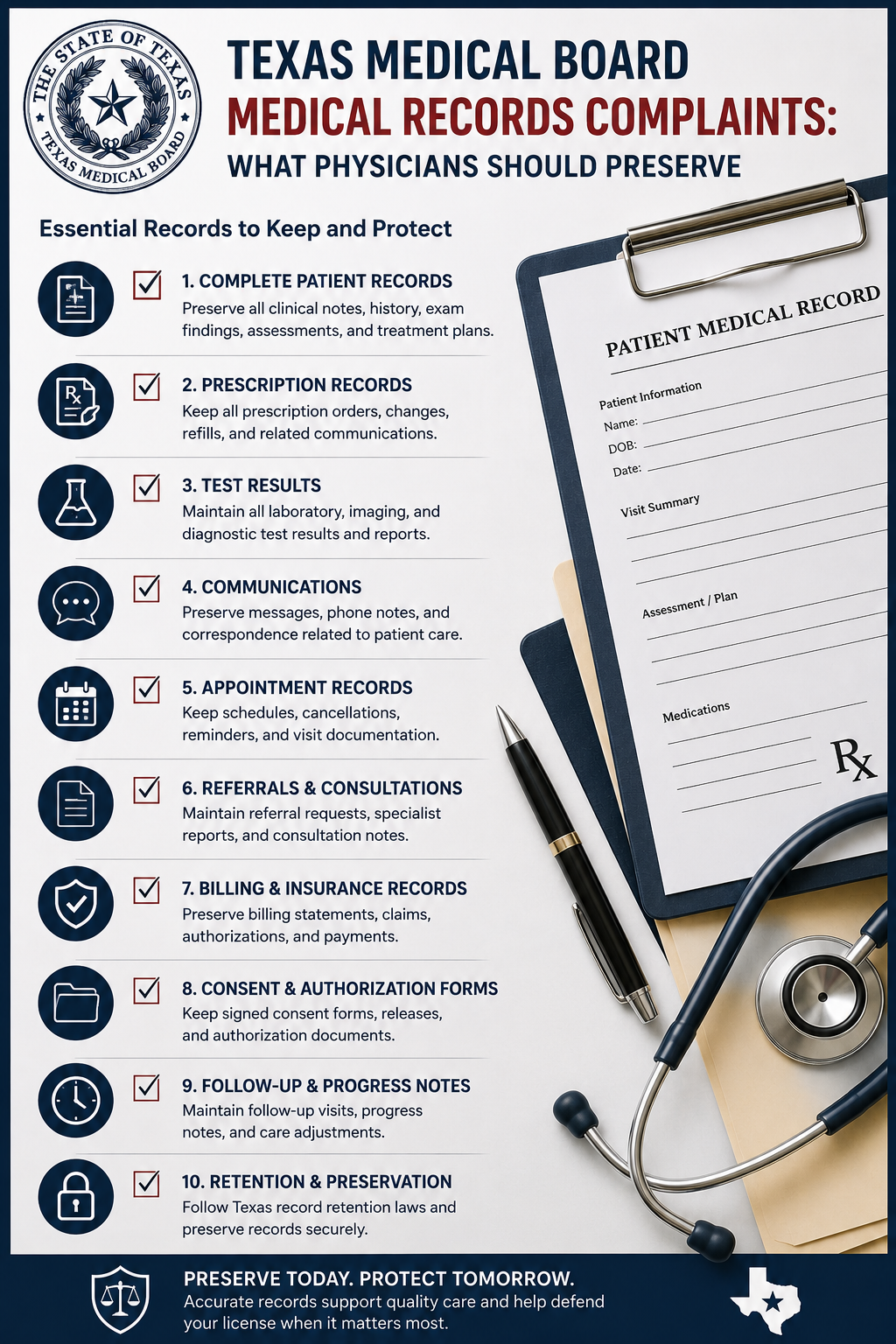
Medical records are one of the most important forms of evidence in a licensing investigation. How those records are maintained, preserved, and presented may influence how the Texas Medical Board evaluates the allegations.
Masterly Legal Solutions represents physicians throughout Texas facing a Texas Medical Board medical records complaint. As a Texas-based law firm offering a broad range of legal and business services, we help physicians understand the investigation, protect important documentation, and develop a thoughtful legal strategy before responding to the Board.
Why Medical Records Matter in a Licensing Investigation
Medical documentation serves as the written history of patient care. When questions arise regarding treatment decisions, prescribing, follow-up care, informed consent, or professional judgment, investigators often begin by reviewing the patient's chart.
If documentation is incomplete, unavailable, inconsistent, or difficult to interpret, the investigation may become more complicated regardless of the quality of the medical care that was provided. Under texas law, physicians must provide copies of medical records within 15 business days after receiving a proper request, so delays or gaps in production can also become part of the issue.
Early legal guidance helps physicians organize records, evaluate allegations, and respond strategically while protecting their professional interests.

Understanding a Texas Medical Board Medical Records Complaint
A Texas Medical Board medical records complaint generally involves allegations concerning the creation, maintenance, availability, or accuracy of patient records, though some complaints can also involve unprofessional conduct or substance abuse.
The complaint itself does not determine that misconduct occurred. Instead, it begins an administrative review in which the Texas Medical Board evaluates available evidence before deciding whether further action is appropriate. During the initial review, the Board must evaluate complaints within 45 days of receipt. If the complaint involves a matter within its jurisdiction, the physician receives written notice and a written request for a response within 28 days. Investigations may take several months to over a year, and status updates are typically provided every 90 days until the matter is resolved.
Each investigation depends on its own facts, documentation, and surrounding circumstances.
What May Lead to a TMB Records Complaint
A TMB records complaint may involve questions concerning:
- Missing medical records
- Incomplete documentation
- Altered records
- Delayed documentation
- Record accessibility
- Patient file management
- Documentation consistency
- Compliance with applicable recordkeeping requirements
The Board’s jurisdiction is limited and does not directly handle billing disputes or complaints centered on hospitals or nurses, which may fall under other agencies. It regulates physicians and physician assistants and oversees certain health professions within its statutory scope.
Every case presents different facts, making individualized legal evaluation essential before responding.
Medical Documentation Investigations Require Careful Preparation
A medical documentation investigation often extends beyond reviewing a single patient chart.
Investigators may examine the provider’s broader documentation systems, including:
- Clinical documentation
- Office procedures
- Documentation timelines
- Electronic medical record practices
- Record preservation
- Communication records
- Administrative processes
- Compliance procedures
Careful preparation allows physicians to assess the scope of the investigation before providing responses.
Record Retention Protects Physicians During Investigations
Proper record retention plays an important role in protecting physicians when questions arise about patient care.
Maintaining complete and organized records helps preserve information regarding:
- Patient history
- Clinical findings
- Treatment decisions
- Follow-up care
- Physician observations
- Communications
- Test results
- Ongoing medical management
When records are preserved appropriately, physicians are often better positioned to explain the medical decisions made throughout patient care.
Chart Documentation Supports Clinical Decision-Making
Clear chart documentation helps demonstrate the physician's clinical reasoning and professional judgment.
Well-maintained charts often document:
- Patient complaints
- Examination findings, including each relevant sign noted during the exam
- Medical assessments, including the physician’s statements and clinical reasoning reflected in the chart
- Treatment plans
- Medication decisions
- Follow-up recommendations
- Informed discussions
- Clinical observations
When documentation accurately reflects patient care, it becomes an important part of responding to regulatory questions.
Responding to a Subpoena Requires Careful Legal Review
Some investigations involve requests for medical records through a subpoena response or other formal legal process.
Before producing records, physicians should understand:
- What information has been requested
- Applicable obligations under governing law and any formal written request tied to the records demand
- Patient privacy considerations
- Documentation preservation requirements
- Regulatory procedures
Careful legal guidance helps physicians respond appropriately while protecting both patient information and professional interests.
Your Professional Reputation Depends on More Than Documentation
A records investigation may affect much more than regulatory proceedings, even when some related concerns involve a facility or other parties outside the Board’s direct disciplinary scope.
Physicians often worry about:
- Hospital credentialing
- Employment opportunities
- Insurance participation
- Referral relationships
- Professional reputation
- Practice operations
- Future licensing matters
A thoughtful response helps physicians address regulatory concerns while recognizing that the Texas Medical Board does not handle billing disputes or issues involving hospitals and nurses directly, while protecting the professional reputation they have spent years building.

Why Physicians Choose Masterly Legal Solutions
Medical licensing investigations require legal representation that understands the importance of documentation, professional standards, and regulatory procedure within the broader healthcare regulatory system.
Masterly Legal Solutions represents doctors, physicians, physician assistants, and other practitioners throughout Texas facing licensing investigations involving medical records and professional documentation. Our firm also provides legal services for corporations, nonprofits, and individuals. The Texas Medical Board regulates physicians and physician assistants and oversees various health professions.
Our firm assists physicians by leveraging a diverse range of legal services, including estate planning, HR consulting, and sports law, and by:
- Reviewing Board correspondence and coordinating with TMB staff when needed
- Evaluating investigative materials
- Organizing medical documentation
- Assessing legal issues, including those that may require general counsel services for businesses facing compliance and regulatory scrutiny
- Preparing responses, including clear formal complaint submissions with supporting statements
- Developing defense strategies by identifying possible violations under the Medical Practice Act and related professional standards, while also advising on business consulting strategies that support long-term practice management
- Protecting professional interests throughout the investigation, informed by our experience providing HR consulting services and workplace training to minimize employment disputes
We understand that every licensing matter is unique and work closely with physicians to develop practical legal solutions tailored to their circumstances. Our broader practice highlights the importance of legal business consulting to support long-term professional success. Early legal counsel can also help address risks to a physician’s license and reputation.
Protecting Your Professional Responsibilities During a Medical Records Investigation
Every health care professional has a responsibility to maintain accurate medical records and respond appropriately when regulatory concerns arise. For health care professionals, a records investigation may involve reviewing documentation, responding to requests for information, or evaluating whether an agreed order is an appropriate resolution, similar to how educators may require legal support for education law, TEA license defense, and school investigations. The details contained in every report and supporting record can influence how the Texas Medical Board evaluates the matter. Physicians should not automatically deny allegations or agree to proposed terms without first understanding the legal and professional consequences. Masterly Legal Solutions helps physicians review each page of the Board's correspondence, assess the available evidence, and develop a strategic response while protecting their licenses, reputations, and ongoing professional education and practice, drawing on our broad legal services in education law, estate planning, and business consulting.
Frequently Asked Questions
What is a Texas Medical Board medical records complaint?
A Texas Medical Board medical records complaint is an allegation involving the accuracy, completeness, preservation, or availability of patient medical records that prompts the Board to review a physician's documentation practices. The complainant may be the affected patient, a family member, or another representative with knowledge of the records issue. Complaints cannot be submitted anonymously to the Board, but the complainant’s identity may remain confidential unless waived.
What is a TMB records complaint?
A TMB records complaint refers to a Texas Medical Board investigation involving questions about medical records, documentation, or recordkeeping compliance. In a tmb complaint, the matter may be dismissed after initial review or referred elsewhere if it falls outside the Board’s jurisdiction.
What is a medical documentation investigation?
A medical documentation investigation examines patient records, documentation practices, and related materials to determine whether regulatory concerns exist regarding medical recordkeeping. It may take several months and, in some cases, more than a year to be resolved.
Why is record retention important?
Proper record retention helps preserve important clinical information that may be needed during licensing investigations, regulatory reviews, or other legal proceedings. It also helps preserve requests, responses, and related documentation so the physician can document any contact about records if questions arise later.
What should physicians know about subpoena responses?
A subpoena response should be reviewed carefully to ensure compliance with applicable legal requirements while protecting patient information and preserving important documentation, especially because subpoena issues can arise during an investigation by the Texas Medical Board, a state government agency, through a state office or later in administrative hearings. If a case is not resolved early, it may move to an informal settlement conference with board representatives and TMB staff before any formal hearing, and more serious matters can result in disciplinary actions affecting the license, including suspension or revocation.
Schedule a Confidential TMB Records Review
If you have received a Texas Medical Board medical records complaint, do not assume that documentation concerns are minor. The Texas Medical Board is a state government agency, and medical records often become the foundation of a licensing investigation, making early legal guidance an important step in protecting your license and professional reputation. After receiving Board notice, do not contact the complainant directly; prompt legal assistance can help you avoid missteps from the outset.
Masterly Legal Solutions represents physicians throughout Texas facing TMB records complaint matters, medical documentation investigation proceedings, and regulatory issues involving record retention, chart documentation, subpoena response obligations, assistance with responding to Board requests, and related administrative proceedings, with certain disciplinary actions also reportable to the National Practitioner Data Bank. You can find our Texas office locations and contact information to schedule a confidential consultation.
Masterly Legal SolutionsWebsite: https://www.masterlylegal.com/Phone: (972) 236-5051





Teacher Rights When Assaulted by a Special Needs Student: Safety, Reporting and Investigation Issues



Looking for Legal & Business Solutions? Contact Us Now
Fill in the form or call us to set up a meeting





