

The Difference Between CPS Allegations and Substantiated Findings
Why Many Parents Wait Too Long to Take Action
Few experiences are more frightening for a parent than learning that a report has been made to Child Protective Services. Many families assume that if they have done nothing wrong, the situation will quickly resolve itself. Unfortunately, that belief can lead to costly mistakes.
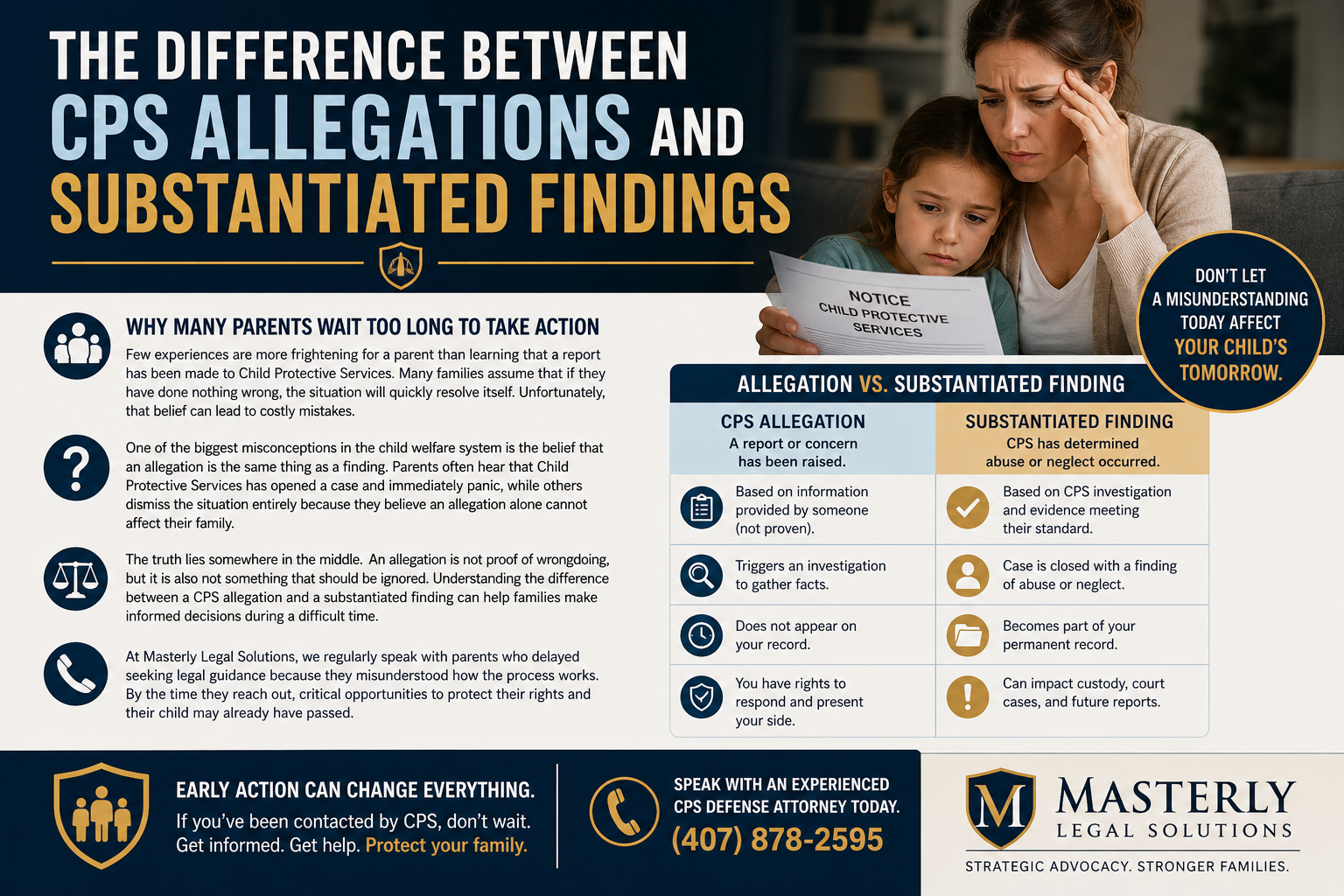
One of the biggest misconceptions in the child welfare system is the belief that an allegation is the same thing as a finding. Parents often hear that Child Protective Services has opened a case and immediately panic, while others dismiss the situation entirely because they believe an allegation alone cannot affect their family.
The truth lies somewhere in the middle. An allegation is not proof of wrongdoing, but it is also not something that should be ignored. Understanding the difference between a CPS allegation and a substantiated finding can help families make informed decisions during a difficult time.
At Masterly Legal Solutions, we regularly speak with parents who delayed seeking legal guidance because they misunderstood how the process works. By the time they reach out, critical opportunities to protect their rights and their child may already have passed.
Understanding the Role of Child Protective Services
Child Protective Services is a government agency responsible for investigating allegations involving child abuse or neglect. The agency operates as part of a larger child welfare framework designed to promote the safety and well being of children.
When Child Protective Services receives a report, it must determine whether the allegations meet legal requirements for further review. Not every report results in an investigation, but many do.
The goal of Child Protective Services is to evaluate whether a child may be at risk of harm. Investigators often review family circumstances, interview witnesses, and collect information before making decisions.
Because the process can move quickly, parents should understand what is happening from the very beginning.
What Is Child Protective Services CPS?
Many people use the term CPS without fully understanding how the agency operates. Child Protective Services CPS is responsible for responding to reports involving possible abuse or neglect of a child.
The agency works with law enforcement, schools, medical providers, social workers, and other professionals when evaluating allegations. Depending on the circumstances, multiple agencies may become involved.
Parents are often surprised to learn that a single report can trigger interviews, home visits, document requests, and ongoing monitoring. The actions taken depend on the nature of the allegations and the perceived level of risk.
Understanding the agency's authority is essential when responding to an investigation.
What Is a CPS Allegation?
A CPS allegation is simply a claim that abuse or neglect may have occurred. It is not a finding of guilt, and it does not automatically mean that a parent has done something wrong.
Anyone can make a report to Child Protective Services. Teachers, doctors, neighbors, family members, and even anonymous individuals may submit a complaint if they believe a child may be in danger.
Sometimes reports are based on genuine concerns. Other times, allegations arise from misunderstandings, family disputes, custody disagreements, or incomplete information.
Regardless of the source, every report deserves serious attention because it can lead to an investigation that affects the entire family.
Why Allegations Are Not the Same as Findings
One of the most common misconceptions involves confusing an allegation with a substantiated finding.
An allegation simply means someone has made a report. A substantiated finding means investigators believe sufficient evidence exists to support the claim.
This distinction is critical.
A parent may hear that a report has been filed and assume they have already been found responsible for abuse or neglect. In reality, the investigation process exists to determine whether the allegations are supported by evidence.
Failing to understand this difference often causes families to react in ways that hurt their case.
How a CPS Investigation Begins
The beginning of a CPS investigation typically starts with a report alleging abuse or neglect.
After receiving the report, the department evaluates whether the allegations require further review. If the report meets certain criteria, an investigation may be opened.
Investigators may contact the family quickly, particularly when allegations involve an immediate threat to a child’s safety.
In some situations, parents receive little warning before investigators arrive at their home or request interviews.
Knowing what to expect can reduce uncertainty during this stressful period.
What Happens After a Report Is Filed?
Once a report is accepted, the investigation process begins.
Investigators gather information from multiple sources. They may interview the child, parents, teachers, medical professionals, and other individuals involved in the child's life.
The department may also review records relating to education, health, or prior agency involvement.
Throughout this process, investigators attempt to determine whether abuse or neglect occurred and whether ongoing intervention is necessary.
The findings can have long-lasting consequences for a family.
Who Can Report Suspected Child Abuse?
Many people are legally required to report suspected child abuse.
Professionals working with children often have mandatory reporting obligations. Teachers, counselors, doctors, nurses, and certain social services providers may be required by law to report suspected child abuse when concerns arise.
In other situations, any person who believes a child may be at risk can make a report.
The person making the report does not need definitive proof. Instead, they generally need a reasonable basis for their concerns.
Because reporting requirements are broad, investigations often begin based on limited information.
Understanding Suspected Child Abuse Reports
A report involving suspected child abuse does not mean abuse occurred.
Investigators understand that some allegations are later determined to be unfounded. Nevertheless, every report must be evaluated carefully.
Parents sometimes make the mistake of assuming that false allegations will automatically disappear. Unfortunately, that is not always the case.
The investigation process still moves forward until sufficient information has been collected.
This is one reason families should take every allegation seriously from the outset.
Common Reasons Families Become Involved With CPS
There are many reasons a family may become involved with Child Protective Services.
Common allegations include:
- Physical abuse
- Sexual abuse
- Neglect
- Substance abuse concerns
- Inadequate supervision
- Unsafe living conditions
- Educational neglect
- Domestic violence exposure
Some investigations involve allegations that are later disproven. Others result in findings that require intervention.
Regardless of the outcome, the process can be stressful for everyone involved.
The Difference Between Abuse and Neglect
Many people assume abuse and neglect are identical concepts.
While both can trigger CPS involvement, they generally refer to different types of conduct.
Abuse often involves actions that cause physical or emotional harm to a child. Neglect usually involves failures to provide necessary care, supervision, health care, education, or protection.
Both abuse and neglect can result in agency intervention if investigators believe a child faces significant risk.
Understanding these distinctions can help parents better understand the allegations being investigated.
When Child Abuse or Neglect Is Alleged
Allegations involving child abuse or neglect often create immediate anxiety for families.
Parents may worry about losing custody, damaging their reputation, or facing court proceedings.
While those concerns are understandable, panic can lead to poor decisions.
The better approach is to gather information, understand the allegations, and develop a plan for responding appropriately.
Taking proactive steps early often places families in a stronger position.
Home Visits and Family Interviews
One of the first things investigators may request is a visit to the family home.
During a visit, investigators often evaluate living conditions, observe interactions, and assess the child's safety.
They may also interview family members separately.
Parents are frequently surprised by the number of questions asked during these meetings. The investigation may cover education, health, employment, discipline practices, and household relationships.
What occurs during these interviews can significantly influence the outcome of the case.
Why Child Safety Is the Primary Focus
Throughout every investigation, child safety remains the central concern.
Investigators are tasked with determining whether a child faces immediate danger or ongoing risk.
This responsibility influences nearly every decision made during the process.
When concerns involve possible abuse or neglect, investigators may take steps they believe are necessary to protect a child while the investigation continues.
Understanding this perspective can help families better navigate agency interactions.
What Makes a Finding Substantiated?
A substantiated finding occurs when investigators determine there is sufficient evidence supporting allegations of abuse or neglect.
This is very different from merely receiving a report.
The agency reviews statements, records, observations, and other information collected throughout the investigation.
If investigators conclude that the evidence supports the allegations, they may issue a substantiated finding.
Such findings can carry significant consequences for parents and caregivers.
The Consequences of a Substantiated Finding
Many parents underestimate the impact of substantiated findings.
A substantiated finding may affect employment opportunities, licensing issues, custody matters, and future interactions with social services agencies.
In some situations, substantiated findings can influence court proceedings or placement decisions involving a child.
The consequences may continue long after the investigation concludes.
This is why families should not assume they can simply wait and see what happens.
How Foster Care Can Become Part of the Process
Not every CPS investigation results in foster care placement.
However, when investigators believe a child faces an immediate threat, removal may become a consideration.
Foster care placements are generally intended to provide temporary safety while concerns are addressed.
Parents often assume removal only occurs in extreme situations. In reality, decisions depend on specific facts and agency assessments.
The possibility of foster care is one reason every investigation deserves prompt attention.
Misunderstandings That Cause Parents to Delay Action
Many families delay seeking help because they believe the allegations are obviously false.
Others assume the agency will quickly recognize that no abuse occurred.
Unfortunately, waiting can make matters worse.
Important evidence may disappear, witnesses may become unavailable, and opportunities to respond effectively may be lost.
The sooner parents understand the seriousness of the process, the better prepared they can be.
Why Early Legal Guidance Matters
One of the biggest mistakes families make is waiting until after major decisions have already been made.
By then, investigators may have completed interviews, gathered records, and formed preliminary conclusions.
Early legal guidance can help parents understand the process, evaluate risks, and avoid common mistakes.
It can also help families better protect their rights while responding appropriately to agency requests.
The actions taken during the first days of an investigation often have lasting consequences.
The Role of Social Workers During an Investigation
Many parents assume that social workers only become involved when severe allegations exist. In reality, social workers are often assigned early in the process to gather information and assess family circumstances.
These professionals may interview the child, speak with parents, review records, and evaluate living conditions. Their observations can become an important part of the investigation file.
Although many social workers genuinely want to help families, parents should remember that information provided during interviews may influence decisions regarding the case.
Understanding the role of social workers can help families prepare for interactions that may affect the outcome of the investigation.
How the Child Welfare System Evaluates Risk
The child welfare system is designed to identify situations where children may face danger or ongoing harm.
When evaluating allegations, investigators examine several factors, including the child's age, the severity of the allegations, family history, and whether there appears to be an immediate threat.
The child welfare process is not focused solely on determining whether an incident occurred. Investigators also evaluate future safety concerns and the overall stability of the home.
Because risk assessments play a major role in agency decisions, families should understand how those evaluations are conducted.
When a Court Becomes Involved
Not every investigation leads to court proceedings.
However, if Child Protective Services believes intervention is necessary to protect a child, the agency may seek court involvement.
A court may review evidence, hear testimony, and determine what actions should be taken moving forward.
In some cases, a court order may authorize temporary removal, require participation in services, or establish conditions for reunification.
Understanding the legal process is essential when a CPS case moves beyond the investigation stage.
What a Court Order Can Mean for Parents
A court order can significantly affect a family's rights and responsibilities.
Depending on the circumstances, a court order may address custody arrangements, visitation, service requirements, or placement decisions.
Parents sometimes assume they can resolve concerns informally after court involvement begins. Unfortunately, court proceedings often require strict compliance with specific requirements.
Failing to follow a court order can create additional complications and may affect future decisions regarding the child.
This is one reason families should take court proceedings seriously from the beginning.
Temporary Removal Does Not Always Mean Permanent Separation
When a child is removed from the home, many parents fear they will never see their child again.
Fortunately, that is not always the case.
The goal of many child welfare cases is to address concerns and create conditions that allow a child to return home safely.
Families may be asked to complete certain programs, participate in counseling, or comply with other requirements designed to improve child safety.
Successful completion of these requirements can often play an important role in reunification efforts.
Understanding Foster Care Placement
Foster care serves as a temporary placement option for children when investigators believe remaining in the home presents a significant risk.
The purpose of foster care is not to punish parents. Instead, it is intended to provide stability while concerns are addressed.
Children may be placed with licensed foster parents, relatives, or other approved caregivers depending on the circumstances.
Many families are surprised by how quickly foster care decisions can occur when investigators believe an immediate threat exists.
Understanding the process can help reduce uncertainty during a difficult time.
How Foster Families and Foster Parents Support Children
Foster parents often provide temporary care for children who cannot safely remain at home.
Their role is to offer stability, supervision, and support while longer-term decisions are made.
Many foster families work closely with agencies, service providers, and biological families when appropriate.
The goal is often to help children maintain stability while addressing issues that led to removal.
Although foster placements can be challenging for everyone involved, they are designed to prioritize the child's safety and well being.
Family Services Designed to Promote Reunification
In many cases, agencies offer family services aimed at helping families address identified concerns.
These services may include counseling, parenting education, substance abuse treatment, or other support programs.
The purpose of family services is often to strengthen families and reduce future risks.
Participation in recommended services can demonstrate a willingness to address concerns and improve family circumstances.
Every case is different, but cooperation with appropriate services can be an important factor in achieving positive outcomes.
Programs Intended to Support Families
Many agencies offer programs designed to help families overcome challenges.
Programs may focus on parenting skills, childhood development, mental health support, education, or family stability.
Participation in these programs is often viewed favorably during a CPS case.
These services are intended to promote safer environments and improve outcomes for children and parents alike.
Understanding available resources can help families make informed decisions during difficult situations.
The Importance of Documentation During an Investigation
Documentation can play a critical role during a CPS investigation.
Parents should keep records relating to communications, appointments, service participation, and interactions with agency representatives.
Accurate documentation can help clarify misunderstandings and provide important context when disputes arise.
Maintaining organized records may also assist if the case later involves court proceedings.
A strong paper trail can become valuable evidence when important facts are questioned.
What Happens When a Complaint Is Found Unsubstantiated?
Not every complaint results in a substantiated finding.
Sometimes investigators conclude that available evidence does not support allegations of abuse or neglect.
When this occurs, the agency may close the investigation without additional action.
While this outcome can bring relief, parents should understand that the process itself may still have created stress, disruption, and uncertainty.
Taking allegations seriously from the start remains important regardless of the eventual outcome.
Child Abuse Allegations and False Assumptions
Parents frequently assume that innocent people have nothing to worry about.
Unfortunately, child abuse allegations are not always resolved quickly or easily.
Investigators must evaluate evidence carefully, and misunderstandings can occur.
Even when allegations are ultimately determined to be unfounded, families may spend weeks or months navigating the process.
This reality highlights why prompt action and informed decision-making are so important.
Cases Involving Sexual Abuse or Exploitation
Some investigations involve allegations of sexual abuse, sex trafficking, indecent exposure, or sexually explicit visual material.
These cases are often treated with heightened urgency due to the potential danger to a child.
Investigators may work closely with law enforcement, prosecutors, medical professionals, and specialized service providers.
The seriousness of these allegations often leads to extensive investigations and additional scrutiny.
Families facing such allegations should understand the significant stakes involved.
The Role of Human Services and Social Services Agencies
Human services agencies and social services organizations often work alongside Child Protective Services during investigations.
These agencies may provide counseling, financial assistance, educational resources, and other forms of support.
Their involvement is frequently intended to address underlying concerns affecting child welfare.
Many families benefit from available resources that help improve stability and reduce future risks.
Understanding how these agencies operate can help parents navigate the broader support system.
Adoption and the Child Welfare Process
In some situations, adoption becomes part of a long-term permanency plan.
When reunification efforts are unsuccessful, agencies may explore adoption opportunities that serve the best interest of the child.
Many children eventually find permanent homes through adoption.
The adoption process can involve foster families, relatives, or other approved caregivers.
While adoption is not the outcome in most CPS cases, it remains an important part of the child welfare system.
Adoptive Families and Long-Term Stability
Adoptive families play an important role in providing stability for children who cannot safely return to their biological families.
Many children who are adopted have experienced difficult circumstances and benefit from consistent support and care.
Adoption decisions are generally made after careful review of the child's needs and long-term interests.
The goal is to provide permanent, nurturing environments where children can thrive.
For many children, adoption represents an opportunity for a more stable future.
The Increasing Adoptions Act and Child Welfare Policy
Various laws and policy initiatives have been developed to improve outcomes for children.
One example is the Increasing Adoptions Act, which reflects efforts to encourage permanency and improve support for children involved in the child welfare process.
Legislative initiatives often seek to balance child safety with family preservation whenever possible.
Understanding these broader policy goals can help families better understand agency decisions.
Child welfare laws continue to evolve as policymakers address changing needs.
Why Child Development Matters During CPS Cases
Investigators frequently consider child development when evaluating allegations.
A child's age, maturity level, communication abilities, and developmental needs may affect how information is interpreted.
Experts often recognize that children of different ages may describe events differently.
Understanding childhood development can help investigators evaluate statements more accurately.
Developmental considerations frequently influence case decisions.
Health, Education, and Child Well Being
Child welfare investigations often extend beyond allegations themselves.
Investigators may review a child's health records, educational progress, and overall well being.
Concerns involving missed medical care, chronic absences, or developmental delays sometimes become relevant during investigations.
The agency's focus is generally broader than a single incident.
Instead, investigators often evaluate the child's overall circumstances and future safety.
When Families Feel the System Is Unfair
Many parents become frustrated when they believe investigators have already formed conclusions.
Some feel that important information has been overlooked or misunderstood.
While these concerns are understandable, reacting emotionally can sometimes make matters more difficult.
A more effective approach often involves gathering information, remaining cooperative when appropriate, and understanding available legal options.
Staying focused on facts can help families navigate challenging situations.
The Best Interest Standard
Many decisions within child welfare cases are guided by what officials believe is in the best interest of the child.
This standard influences placement decisions, service recommendations, and permanency planning.
While parents may disagree with certain decisions, understanding this framework can provide valuable context.
The best interest standard is intended to prioritize the child's long-term welfare and safety.
It remains a central principle throughout many child welfare proceedings.
Child Protection Concerns Across Different Communities
Child protection issues arise in communities throughout the country.
Whether a family lives in a large metropolitan area such as Virginia Beach, a smaller community in Virginia, or elsewhere, the investigation process often follows similar principles.
Each local department may have unique procedures, but the core mission remains consistent.
Agencies seek to investigate allegations, evaluate risk, and promote child safety.
Understanding these shared goals can help families better understand the process.
Taking Action Before a Finding Is Made
One of the biggest mistakes parents make is waiting until after a substantiated finding occurs.
The investigation stage often provides the best opportunity to respond effectively, present information, and address concerns.
Delaying action may limit available options.
Parents who take allegations seriously early in the process are often better positioned to protect their interests.
Prompt attention can make a meaningful difference in the outcome of a case.
Protecting Children From Serious Exploitation and Abuse
Some of the most serious cases handled by a child protection law firm involve allegations of severe exploitation, including sex trafficking, abuse, and other crimes that place a child in immediate danger. These cases often require extensive investigations involving law enforcement, child welfare agencies, and legal professionals working together to protect vulnerable children. Communities across the country, including areas such as Virginia Beach, have increased efforts to identify warning signs and intervene before additional harm occurs. While not every CPS investigation involves criminal conduct, parents should understand that allegations involving exploitation are treated with the highest level of urgency. When families face complex child protection matters, obtaining experienced legal guidance can help them better understand the process, protect their rights, and focus on the safety and well-being of their child.
Understanding Accountability, Child Development, and Long-Term Success
When Child Protective Services investigates allegations involving a child, one of its primary goals is identifying the person responsible for any conduct that may have placed the child at risk. During the process, investigators may gather records, interview witnesses, and, in some cases, rely on court testimony to better understand the facts. The agency also considers how a child's growth and development commits them to certain needs that require protection and support. Often, people notice warning signs before a formal report is made, particularly when concerns involve vulnerable youth or potentially neglected children. Families can often find valuable information on an agency's website, where guidance, policies, and applicable rules are explained. Many communities also offer education programs designed to help parents strengthen their caregiving skills and promote healthy family relationships. Working with an experienced child protection law firm can help families better understand the process and pursue the best path toward a successful resolution. Ultimately, every page of a CPS case file can affect the outcome, making early action an important factor in achieving long-term success for both parents and children.
How Masterly Legal Solutions Helps Families Facing CPS Investigations
A CPS investigation can create fear, confusion, and uncertainty for even the most loving families. When parents misunderstand the difference between an allegation and a substantiated finding, they may unintentionally delay important decisions that could affect their future.
At Masterly Legal Solutions, we understand how overwhelming Child Protective Services cases can be. Our team works with families facing investigations involving child abuse or neglect allegations, foster care concerns, adoption matters, court proceedings, and other child welfare issues.
If your family has received notice of an investigation, do not assume the situation will resolve itself. Early action can help protect your rights, your relationship with your child, and your ability to respond effectively to agency concerns.
Contact Masterly Legal Solutions today at (972) 236-5051 for a free consultation. We can answer your questions, explain the process, and help you better understand your options before critical decisions are made. Every family's situation is unique, and obtaining information early may help you avoid mistakes that could have lasting consequences.
Protecting Your Family's Future Starts With Understanding the Process
The difference between an allegation and a substantiated finding is more important than many parents realize. An allegation is simply the beginning of an investigation, while a substantiated finding may carry significant consequences that affect a child, a parent, and an entire family.
Understanding the process allows families to make informed decisions rather than reacting based on fear or assumptions. When concerns arise, knowledge, preparation, and timely action often provide the strongest foundation for protecting a child's future and preserving family stability.
Disclaimer: This article is provided for informational and educational purposes only. It is not legal advice and should not be considered legal guidance regarding any specific situation. Reading this article does not create an attorney-client relationship with Masterly Legal Solutions. If you are involved in a Child Protective Services investigation or have questions regarding child welfare, foster care, adoption, abuse or neglect allegations, or related legal matters, you should consult with a qualified attorney regarding your specific circumstances.



Teacher Rights When Assaulted by a Special Needs Student: Safety, Reporting and Investigation Issues



Looking for Legal & Business Solutions? Contact Us Now
Fill in the form or call us to set up a meeting