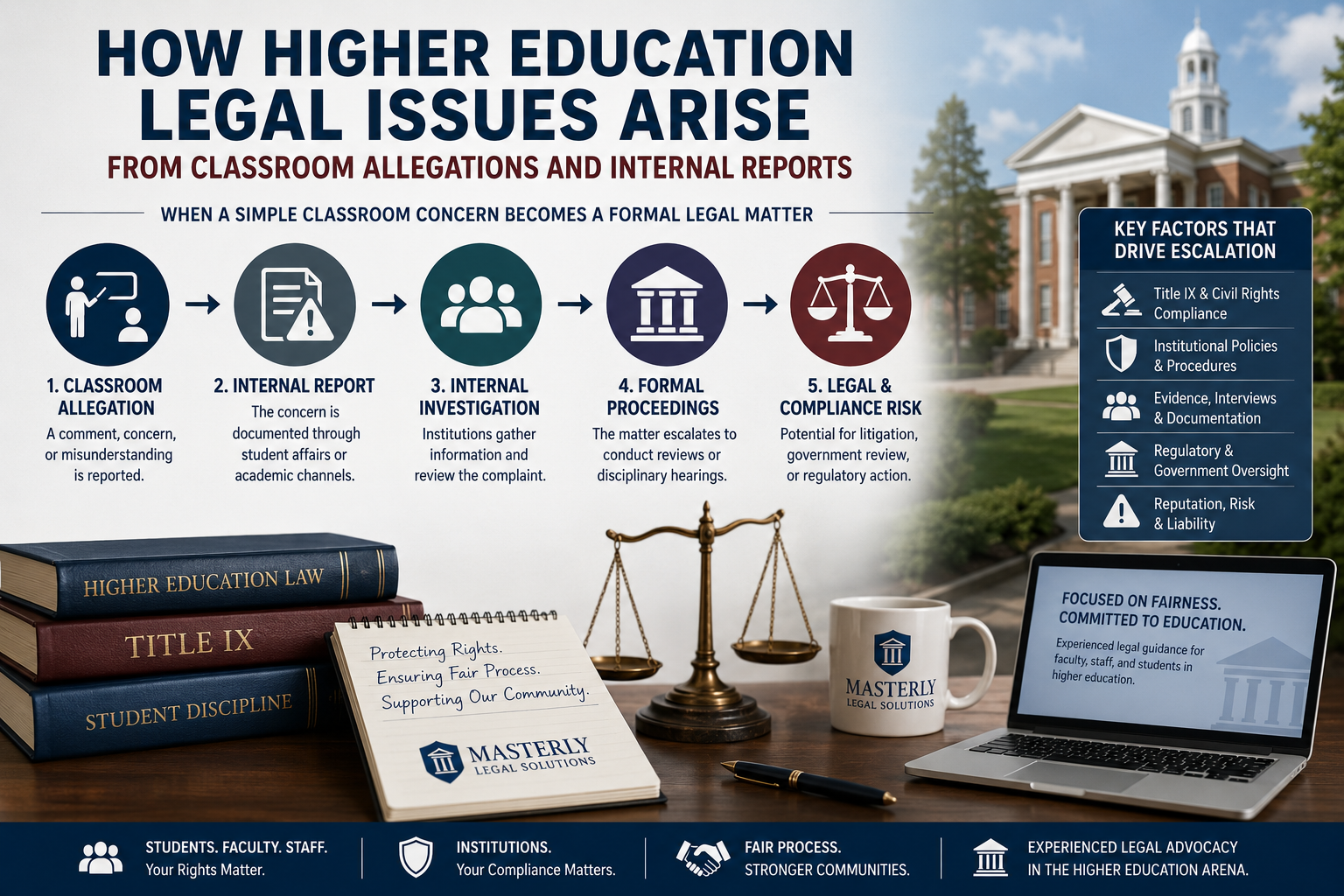
How Higher Education Legal Issues Arise from Classroom Allegations and Internal Reports
When a Simple Classroom Concern Becomes a Formal Legal Matter
In higher education, many serious cases begin in ways that seem small at first. A comment made in class, a misunderstanding between a faculty member and a student, or a concern raised in student life can quickly evolve into something much more formal. Within colleges and universities, these early concerns are often documented through student affairs offices or academic affairs channels before anyone realizes they may turn into structured proceedings. What starts as a conversation can rapidly grow into one of the most sensitive legal issues an individual or institution may face.
At Masterly Legal Solutions, we have seen how higher education institutions across the higher education sector respond quickly to protect compliance and reputation. Whether it involves public and private institutions, private colleges, or a private university, internal reporting systems are designed to escalate concerns for review. While these systems are necessary for safety and accountability, they can also create pressure points where individuals—students, staff, or adjunct faculty—find themselves pulled into formal internal investigations without fully understanding the process. This is where experienced legal services and early guidance from a dedicated higher education attorney become critical.
The First Step: Classroom Allegations and Informal Reports
Most higher education legal issues begin with a classroom-level allegation. These may come from a student complaint, a peer observation, or a report submitted through institutional channels tied to student organizations or student records. In some cases, concerns are raised informally but still make their way into official systems due to strict regulatory requirements and institutional compliance programs. Once documented, even informal concerns can become part of an official record that influences later decisions.
Within education institutions, these early reports are often reviewed by student affairs professionals or department leadership before escalating further. Many university clients and college and university clients are surprised at how quickly an informal issue becomes a formal file. This is especially true in environments involving international students, student athletes, or programs tied to athletic conferences, where oversight is often heightened. A higher education attorney understands how these early reports are interpreted and how they may later shape disciplinary outcomes or institutional liability.
Internal Investigations and How They Escalate Quickly
Once a complaint is filed, many educational institutions initiate internal investigations. These investigations are designed to determine whether the complaint has merit and whether further action is necessary under student discipline policies or Title IX compliance rules. In community colleges, major universities, and academic medical centers, the process may involve interviews, evidence collection, and coordination with academic affairs or compliance offices. Even minor allegations can trigger structured investigative procedures.
A key concern for many higher education clients is how quickly these investigations expand beyond the original complaint, including the risk of delayed or suspended Title IX investigations. Statements taken during interviews can lead to additional concerns, especially in cases involving sexual misconduct, academic misconduct, or allegations tied to civil rights investigations. Institutions must also comply with federal guidance from government agencies, including the Equal Employment Opportunity Commission, when faculty or staff are involved. A higher education attorney helps ensure that the investigation remains fair and that procedural protections are followed throughout the process.
The Role of Title IX and Civil Rights in Escalation
Many cases involving higher education legal issues escalate under Title IX compliance, particularly when allegations involve discrimination or sexual misconduct. Once a Title IX report is triggered, institutions must follow strict procedures to ensure fairness and compliance with federal law. This process can apply to both private institutions and public institutions, including community colleges and large universities.
In some cases, overlapping laws such as Title VII, the Disabilities Act, and Equal Pay Act provisions may also come into play, especially when faculty or staff are involved. These matters can quickly expand into complex legal territory involving labor relations, policy development, and institutional governance. A higher education attorney provides legal guidance on the Title IX investigation process and respondent rights to ensure that both individuals and institutions understand their rights and obligations during these sensitive proceedings. Without proper oversight, these cases may escalate into litigation defense matters or external regulatory review.
How Internal Reports Impact Faculty and Staff
Faculty members, including adjunct faculty, are often affected by internal reporting systems as much as students. A classroom comment or grading dispute can be interpreted differently once it becomes part of a formal complaint. Within institutions of higher education, these concerns may be routed through senior leadership teams, general counsel, or academic affairs offices for review. Even when issues are minor, the documentation process can significantly affect employment status and reputation.
For private colleges and private universities, protecting institutional integrity often means responding quickly to any allegation. However, this speed can sometimes create challenges for fairness, especially when individuals are not given sufficient time or support to respond. A higher education attorney works to ensure that academic freedom is respected while also addressing institutional concerns under regulatory compliance frameworks. These cases often require a deep understanding of both employment law and academic policy, underscoring why colleges need dedicated higher education attorneys.
Student Discipline and the Expansion of Formal Proceedings
As investigations progress, many cases move into formal student discipline hearings. These hearings may involve student affairs officers, disciplinary boards, or designated hearing panels within colleges and universities. The outcome of these proceedings can lead to outcomes such as warnings, suspension, or even student dismissed decisions. For international students, these outcomes may also impact immigration status or academic standing.
A higher education attorney plays a critical role in helping individuals prepare for these hearings. Evidence review, witness statements, and institutional procedures must all be carefully analyzed to ensure fairness. In some cases, errors in procedure or violations of family educational rights related policies may provide grounds for appeal or further legal action. These proceedings often involve careful coordination between education team members and institutional representatives responsible for risk management and compliance.
Institutional Pressure, Compliance, and Risk Management
Behind every investigation is an institution managing significant pressure to remain compliant with federal and state requirements. Higher education institutions must balance student safety, employee rights, and regulatory obligations while maintaining trust with community members and stakeholders. This often involves coordination between compliance programs, communications professionals, and senior leadership teams to manage both legal and reputational risk.
In some cases, institutions must also consider external relationships such as tax exempt financing, clinical affiliation agreements, and partnerships with national associations or athletic conferences. These relationships add complexity to how investigations are handled and reported. A higher education attorney helps ensure that institutional responses align with legal standards while reducing exposure to litigation, including matters involving litigation defense, personal injury, or regulatory enforcement actions, often drawing on the firm’s broader internal investigations and higher education legal services.
When Complaints Turn Into Litigation or Government Review
Some higher education legal issues do not end at the institutional level. In certain situations, cases may escalate to external review by government agencies or lead to formal litigation. Courts may evaluate whether institutions followed proper procedures, and in some cases, institutions may seek or achieve summary judgment or have previously obtained summary judgment in similar disputes. These legal outcomes often depend heavily on how the initial investigation was handled.
A higher education attorney provides representation for both individuals and institutions navigating these advanced stages, and may also coordinate with business consulting services for institutional clients when broader organizational strategy is implicated. This may include defending college and university clients, advising university clients, or assisting representing colleges in regulatory or civil proceedings. Matters involving higher education arena disputes often require coordination between legal counsel, law firms, and institutional stakeholders to resolve conflicts efficiently while protecting rights and obligations under the law.
The Human Impact Behind Every Investigation
Beyond policies and procedures, every case involves real people. A faculty member, a student leader in student organizations, or a staff member in student life may suddenly find their academic or professional future uncertain. These situations can affect mental health, career opportunities, and long-term stability within the higher education sector. Even when allegations are ultimately resolved, the process itself can leave lasting effects.
For many individuals, early access to comprehensive legal resources from Masterly Legal Solutions and counseling services becomes essential. A higher education attorney helps bridge the gap between institutional process and individual rights, ensuring that no one is left navigating complex systems alone. This is especially important in environments involving campus culture, where perception and process often move quickly and unpredictably.
Comprehensive Legal Resources for Higher Education Institutions
Higher education institutions face a wide range of legal and regulatory challenges that require experienced guidance and practical solutions. From colleges and universities to academic medical centers and other education institutions, having access to reliable legal resources is essential for managing risk and supporting long-term success. An experienced Frisco attorney can work closely with an education team, general counsel, and institutional leadership to address matters involving employee benefits, labor relations, governance, compliance, and student affairs. Legal support is also important for navigating issues affecting international students and the evolving higher education sector. Whether assisting a single campus or providing ongoing counsel as part of a dedicated higher education team, legal professionals help institutions make informed decisions while protecting their academic mission and operational goals.
Strategic Legal Support for Education Systems, Employment Matters, and Institutional Compliance
A skilled Frisco attorney with a strong understanding of the higher education sector plays an essential role in helping higher education institutions, colleges and universities, and academic medical centers navigate today’s increasingly complex legal environment. Across various education institutions, issues often arise involving governance, policy interpretation, employment disputes, and regulatory oversight. These challenges require not only legal knowledge but also a practical understanding of how academic systems function on a day-to-day basis.
Our higher education team works closely with an internal education team and institutional general counsel to address matters involving labor relations, employee benefits, and compliance concerns that affect both staff and students. We assist institutions in managing risks involving international students, faculty employment issues, and operational policies that must align with federal and state regulations, often through tailored outside general counsel services for institutions. By providing clear legal guidance, we help ensure that higher education institutions can maintain stability, support their communities, and continue operating effectively in a highly regulated academic environment.
Legal Guidance for Institutions, Employment Matters, and Regulatory Compliance Challenges
Navigating today’s complex education and employment landscape requires the support of an experienced Frisco attorney with extensive knowledge of both institutional policies and evolving regulatory frameworks. Many experienced attorneys work closely with school districts and other organizations to interpret student handbooks, strengthen training programs, and ensure compliance with internal and external requirements. In matters involving workplace disputes, governance issues, or labor-related concerns under agencies such as the National Labor Relations Board, legal guidance becomes essential to reduce risk and maintain operational stability.
Our role is to assist institutions by providing strategic legal services that help support institutions through employee-related and policy-driven challenges, including matters involving employee benefits and workplace compliance. We counsel clients across a broad range of industries, helping organizations make informed decisions that protect both their people and their operations, supported by our full-spectrum legal and business services. By combining practical insight with a deep understanding of institutional needs, we help ensure that policies are properly applied and risks are effectively managed across school systems and educational environments.
Contact Masterly Legal Solutions for Guidance
If you are currently facing a classroom allegation, internal report, or formal investigation within a higher education institution, it is important to understand how quickly these situations can escalate. What begins as a simple concern can quickly become a structured legal process involving student discipline, compliance review, and long-term consequences for your academic or professional future. At Masterly Legal Solutions, our higher education team provides focused support for individuals and institutions dealing with sensitive higher education legal issues.
We assist clients across a broad range of matters involving colleges and universities, public and private institutions, and complex internal processes governed by regulatory requirements and institutional policy. Whether your situation involves Title IX compliance, academic misconduct, or employment-related concerns, we are prepared to provide clear legal guidance tailored to your circumstances. Our goal is to help you understand your rights, your options, and the most effective path forward.
Contact us at (972) 236-5051 or visit our Masterly Legal Solutions contact page for a free consultation so we can answer your questions and help you take the next step with confidence.
Disclaimer: This article is for informational purposes only and does not constitute legal advice. No attorney-client relationship is created by reading this content.




Looking for Legal & Business Solutions? Contact Us Now
Fill in the form or call us to set up a meeting