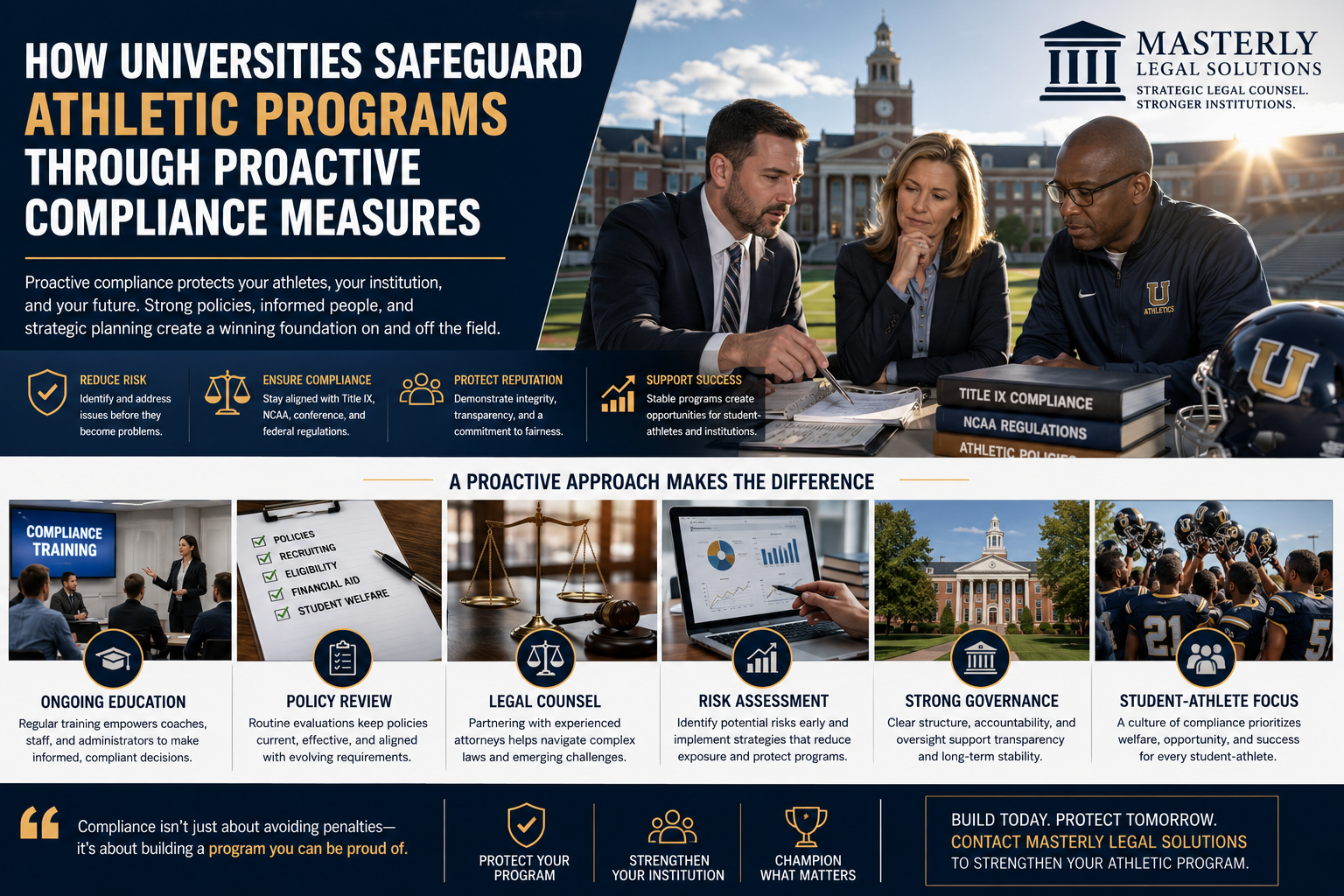
How Universities Safeguard Athletic Programs Through Proactive Compliance Measures
College athletics creates opportunities that extend far beyond competition. Athletic programs shape institutional reputation, attract prospective students, encourage alumni support, and strengthen community engagement. At the same time, universities face an increasingly complex legal and regulatory environment that requires careful oversight. Maintaining compliance is no longer limited to enforcing eligibility rules; it now involves managing evolving obligations related to Title IX, athlete welfare, recruiting, contracts, governance, and institutional accountability.
Universities that approach compliance proactively are often better positioned to protect their athletic programs from costly disputes and unnecessary disruptions. Rather than reacting after problems arise, they establish policies, conduct routine reviews, educate coaches and administrators, and evaluate risks before they become significant legal concerns. This preventive approach helps institutions maintain integrity while supporting student success both on and off the field.
At Masterly Legal Solutions, we understand that collegiate athletics operates within a rapidly changing legal environment. Our team helps colleges and universities evaluate compliance programs, strengthen institutional policies, conduct internal investigations, and address evolving regulatory challenges affecting athletic departments, drawing on our broader experience providing legal services for corporations, nonprofits, and institutions. Protecting athletic programs requires more than understanding the law—it requires strategic planning that supports institutional goals for years to come.
Whether an institution sponsors a handful of varsity teams or manages a nationally recognized athletics department, proactive compliance creates a stronger foundation for long-term success. Every decision made today can influence future opportunities, making legal preparation one of the most valuable investments an institution can make.
Why Proactive Compliance Matters
Successful athletic departments rarely rely on chance. They invest time and resources into developing systems that identify risks before they become legal disputes or public controversies. This mindset helps universities remain focused on education and competition rather than crisis management.
The modern sports environment changes rapidly. Federal guidance evolves, conference expectations shift, and institutional responsibilities continue expanding. Universities that regularly evaluate policies place themselves in a stronger position to respond effectively while reducing uncertainty.
Proactive planning also strengthens institutional credibility. Students, coaches, faculty members, alumni, and governing organizations often have greater confidence in universities that demonstrate a commitment to accountability and transparency.
Compliance should therefore be viewed as an ongoing institutional responsibility rather than a one-time administrative task.
Compliance Supports Institutional Stability
Athletic success depends on much more than talented athletes and experienced coaches. Behind every successful program are administrators responsible for ensuring institutional decisions comply with applicable laws, conference requirements, and university policies.
When compliance programs function effectively, universities reduce the likelihood of investigations, eligibility disputes, and operational interruptions. This stability allows athletic departments to remain focused on serving student-athletes while advancing institutional objectives.
Strong compliance programs also support sound decision-making across multiple departments. Collaboration between athletics, legal counsel, student affairs, and university leadership helps identify concerns before they escalate.
Understanding Today's Compliance Environment
University athletic departments now operate within one of the most heavily regulated areas of higher education. Institutions must navigate federal law, conference regulations, institutional policies, and evolving expectations affecting college athletics.
Among the most significant responsibilities is maintaining compliance with Title IX, which continues to influence athletic participation, resource allocation, scholarship opportunities, and institutional responses to misconduct. Universities must consistently evaluate policies to ensure equal opportunities while addressing emerging legal developments.
Athletic departments must also monitor recruiting practices, financial aid administration, eligibility standards, student conduct procedures, and reporting obligations. These responsibilities require coordinated efforts across multiple university offices rather than isolated decision-making.
As collegiate athletics continues evolving, institutions benefit from maintaining adaptable compliance systems capable of responding to new legal challenges, often by partnering with dedicated higher education attorneys who understand the regulatory landscape.
Building a Culture of Compliance
Policies alone rarely create effective compliance. Successful universities establish organizational cultures where accountability becomes part of everyday operations.
Athletic directors, coaches, compliance officers, faculty representatives, and university administrators all contribute to creating environments where ethical decision-making remains a shared responsibility. Open communication encourages employees to report concerns early before problems become more difficult to resolve.
Leadership also plays an essential role in reinforcing expectations. Regular education, policy updates, and practical discussions help employees understand not only institutional rules but also the reasons those rules exist, and many institutions turn to sports law and consulting services for training and guidance to support these efforts.
Creating a culture of compliance helps reduce preventable mistakes while strengthening institutional trust.
Education Reduces Institutional Risk
Many compliance issues develop because individuals misunderstand evolving requirements rather than intentionally violating them. Ongoing education therefore remains one of the most effective preventive strategies available.
Universities should regularly provide training addressing Title IX, recruiting regulations, reporting obligations, conflict-of-interest concerns, and institutional policies. These educational opportunities allow employees to ask questions while improving overall awareness.
Training should also include practical examples reflecting situations employees actually encounter. Realistic scenarios encourage better understanding than relying solely on written policies.
An informed workforce strengthens institutional compliance while supporting consistent decision-making.
The Expanding Role of Sports Law
Modern college athletics increasingly intersects with numerous areas of sports law. Universities must evaluate contractual relationships, employment concerns, governance obligations, risk management, and emerging athlete rights while balancing institutional missions.
Experienced sports attorneys recognize that higher education presents unique legal considerations distinct from professional sports organizations. Colleges and universities must simultaneously satisfy educational responsibilities, athletic objectives, and regulatory obligations.
Working with a knowledgeable sports law attorney allows institutions to evaluate potential concerns before they become costly disputes, similar to engaging a top sports lawyer for NCAA compliance and disputes. Preventive legal guidance frequently reduces long-term exposure while supporting institutional decision-making.
The growing complexity of collegiate athletics makes proactive legal planning increasingly valuable.
Governance Creates Stronger Athletic Programs
Effective governance provides structure for every successful athletics department. Clear reporting relationships, documented policies, and defined responsibilities help institutions operate more consistently.
Strong corporate governance principles encourage transparency while improving institutional oversight. Decision-makers benefit from clearly established approval processes, accountability measures, and documentation requirements, supported by sports and education law counsel focused on governance and compliance.
Universities also strengthen governance by regularly reviewing committee responsibilities, conflict-of-interest procedures, and policy implementation. These evaluations help identify opportunities for improvement before concerns develop
.
Well-designed governance systems create stronger foundations for sustainable athletic success.
Collaboration Strengthens Compliance
Athletic departments should never operate independently from the rest of the university. Compliance improves when departments work closely together toward common institutional objectives.
Legal counsel, finance professionals, student affairs personnel, human resources, risk management, and athletics administrators each contribute valuable perspectives during policy development and compliance reviews.
This collaborative approach helps universities evaluate issues from multiple viewpoints while improving consistency across institutional operations.
Shared responsibility also reduces the likelihood that important compliance concerns remain overlooked.
Title IX Continues Shaping Collegiate Athletics
Few legal developments have influenced college athletics as significantly as Title IX. Universities must continually evaluate participation opportunities, scholarship distribution, facilities, program resources, and institutional responses to ensure compliance.
Although many institutions have invested substantial effort into compliance, expectations continue evolving. Regular policy reviews help universities adapt while reducing unnecessary legal exposure.
Beyond participation equity, Title IX responsibilities frequently intersect with campus investigations, reporting obligations, education initiatives, and institutional response procedures. Athletic departments therefore play an important role within broader university compliance efforts.
Proactive planning allows universities to address these responsibilities confidently while supporting equitable opportunities for all students.
Investigations Require Careful Planning
Even well-managed athletic departments occasionally encounter allegations requiring formal review. Responding appropriately often determines whether concerns remain manageable or escalate into larger institutional challenges.
Conducting fair internal investigations requires independence, careful documentation, and consistent procedures. Universities should establish investigation protocols before allegations arise rather than attempting to develop processes during a crisis.
Institutions also benefit from preserving confidentiality whenever possible while ensuring investigations remain thorough and impartial.
Preparation allows universities to respond efficiently while protecting both institutional integrity and individual rights.
Documentation Supports Accountability
Accurate documentation strengthens nearly every aspect of compliance. Written policies, training records, meeting notes, eligibility determinations, and investigation files provide important evidence demonstrating institutional diligence.
Consistent documentation also supports continuity during leadership transitions. New administrators can better understand previous decisions when comprehensive records remain available.
Universities should periodically review documentation practices to ensure information remains organized, secure, and accessible when needed.
Strong documentation reinforces accountability while reducing uncertainty during audits or investigations.
Compliance Extends Beyond Competition
Many people associate athletic compliance exclusively with competition rules, but institutional responsibilities reach much further. Universities increasingly evaluate issues involving contracts, employment, governance, student welfare, and financial oversight.
Athletic departments often coordinate with multiple campus offices to address emerging legal responsibilities. These collaborative relationships help institutions identify concerns early while improving operational consistency.
Understanding this broader compliance landscape allows universities to better protect their athletic programs while supporting their educational mission.
Name, Image, and Likeness Continues to Transform College Athletics
The rapid expansion of name image and likeness opportunities has fundamentally changed the collegiate athletics landscape. Student-athletes now have opportunities to pursue endorsements, partnerships, and other commercial activities while continuing their education. Although these opportunities create exciting possibilities, they also introduce significant compliance responsibilities for universities.
Institutions should develop clear guidance explaining how name image and likeness activities intersect with institutional policies, conference expectations, and applicable laws. Coaches, compliance officers, and administrators all benefit from understanding where university responsibilities begin and end.
Educational programming remains one of the strongest preventive tools available. Helping collegiate athletes understand contracts, disclosure obligations, financial considerations, and reputational risks encourages informed decision-making while reducing unnecessary compliance concerns.
Universities that proactively educate student-athletes are often better prepared to adapt as NIL regulations continue evolving.
Educating Student-Athletes Beyond Competition
Athletic departments play an important role in preparing students for life beyond graduation. Compliance education should include financial literacy, professional conduct, digital communication, and understanding contractual obligations.
Helping athletes navigate these responsibilities benefits both the institution and the individual. Well-informed collegiate athletes are more likely to recognize potential risks before entering agreements that may create future complications.
Comprehensive education demonstrates institutional commitment to supporting students as individuals rather than simply competitors.
Contract Management Strengthens Athletic Operations
Contracts influence nearly every aspect of university athletics. Coaching agreements, sponsorship arrangements, facility projects, vendor relationships, licensing opportunities, and service agreements all require careful review.
Strong contract negotiations reduce uncertainty while helping universities clearly define expectations before projects begin, particularly when supported by sports law counsel focused on NCAA compliance and contracts. Well-written agreements frequently prevent misunderstandings that might otherwise develop into disputes.
Athletic departments should also coordinate closely with university general counsel during significant contractual matters, as well as with higher education law specialists for NCAA, Title IX, and NIL issues. Early legal review often identifies concerns before agreements become legally binding.
Careful planning creates stronger partnerships while protecting institutional interests.
Sponsorship and Commercial Relationships
Athletic departments regularly develop partnerships with local businesses, national brands, and community organizations. These sponsorship agreements provide valuable financial support while strengthening institutional visibility.
Every sponsorship should reflect the university's mission, values, and compliance obligations. Universities should carefully evaluate promotional expectations, financial commitments, branding requirements, and performance obligations before finalizing agreements.
Institutions also benefit from periodically reviewing existing sponsorship agreements to ensure they remain consistent with current policies and evolving legal standards.
Thoughtful planning helps preserve positive relationships while minimizing contractual uncertainty.
Protecting University Intellectual Property
University logos, mascots, trademarks, uniforms, and branding represent valuable institutional assets. Protecting intellectual property should remain an important component of every athletic compliance strategy.
Athletic departments should establish policies addressing authorized logo usage, merchandise approvals, media licensing, and promotional activities. Strong intellectual property protection reduces unauthorized use while preserving institutional reputation.
Universities may also negotiate licensing agreements and licensing arrangements with outside organizations seeking to use institutional branding. Careful legal review, often supported by a firm offering sports law and comprehensive legal services, helps ensure these agreements align with university objectives.
Protecting intellectual property strengthens long-term brand value while supporting responsible commercial partnerships.
Governance Supports Long-Term Athletic Success
Strong governance allows athletic departments to operate consistently despite changing leadership, evolving regulations, and expanding institutional responsibilities.
Effective corporate governance encourages transparency, accountability, and documented decision-making throughout the athletics department. Clearly defined responsibilities also improve communication between administrators, coaches, compliance officers, and university leadership.
Institutions that periodically evaluate governance structures often identify opportunities to strengthen oversight before problems emerge. Continuous improvement remains an important component of effective compliance.
Leadership should view governance as an ongoing process rather than a static administrative requirement.
Employment Matters Affect Athletic Departments
Athletic departments function as large organizations with coaches, trainers, administrators, compliance personnel, and support staff working together toward shared goals.
Universities must address employment matters involving hiring practices, performance evaluations, compensation, workplace expectations, and policy compliance. Addressing potential employment issues proactively helps maintain stable working environments while reducing unnecessary disputes.
Athletic administrators should collaborate with human resources professionals and general counsel when navigating complex personnel decisions. Consistent procedures promote fairness while reducing institutional risk.
Thoughtful employment practices contribute to stronger athletic programs and healthier organizational cultures.
Responding to Emerging Legal Issues
Higher education continues evolving alongside changes in legislation, technology, athlete rights, and public expectations. Universities must remain prepared to respond to new legal issues affecting collegiate athletics.
Regular policy reviews help institutions evaluate whether existing procedures remain effective. Updating policies before problems arise often reduces long-term legal exposure.
Athletic departments that remain adaptable are generally better positioned to respond confidently to future developments while maintaining compliance.
Learning From the Broader Sports Industry
Although college athletics differs significantly from professional competition, universities can still learn valuable lessons from the broader sports industry.
Professional organizations frequently invest heavily in governance, compliance education, contract management, and organizational accountability. While universities operate under different legal frameworks, many preventive strategies remain applicable.
Observing trends across sports leagues, professional sports leagues, and the larger sports sector provides valuable insight into emerging challenges affecting athletics.
Institutions that remain informed are often better prepared to adapt proactively rather than reactively.
Facilities Require Legal Planning
Athletic infrastructure projects often involve significant financial investments and long-term institutional commitments. Building or renovating sports facilities requires careful legal oversight from initial planning through project completion.
Universities frequently negotiate construction agreements and design and construction agreements while coordinating architects, contractors, engineers, and project managers. Large projects involving arena development, stadium financing, or a new stadium require detailed planning to minimize legal and operational risks.
Athletic facilities also influence student experience, recruiting efforts, and institutional reputation. Careful planning helps ensure projects support both immediate needs and future growth.
Thoughtful facility development reflects responsible institutional stewardship.
Financial Oversight Supports Sustainability
Major athletic initiatives frequently require careful financial planning. Whether evaluating stadium financing, donor participation, or future expansion opportunities, universities benefit from transparent financial oversight.
Some institutions collaborate with outside organizations, including private equity firms or an investor group, on certain development initiatives. Others evaluate opportunities involving mixed use developments that combine athletic facilities with commercial or community spaces.
Every financial decision should support institutional objectives while maintaining appropriate governance and accountability standards.
Strong financial planning contributes to sustainable athletic operations for years to come.
Understanding the Broader Sports and Entertainment Landscape
College athletics increasingly intersects with sports and entertainment, media rights, technology, sponsorships, and digital marketing. Universities should recognize how these evolving relationships influence compliance responsibilities.
Many legal concepts affecting sports and entertainment also appear in entertainment law, particularly regarding branding, licensing, media distribution, and publicity rights.
Athletic departments benefit from understanding these broader trends while remaining focused on educational missions. As commercialization continues expanding, thoughtful legal planning becomes even more valuable.
Institutions prepared for change are generally better positioned to manage future opportunities responsibly.
Risk Assessment Should Be Continuous
Compliance should never become a once-a-year exercise. Universities benefit from conducting periodic assessments evaluating policies, reporting procedures, documentation practices, and institutional preparedness.
Routine reviews help identify gaps before they become significant concerns. Evaluating recruiting practices, financial procedures, educational programming, and governance systems supports continuous improvement.
This proactive approach strengthens institutional resilience while encouraging accountability across the athletics department.
Effective compliance evolves alongside the institution itself.
Universities Benefit From Experienced Legal Guidance
Athletic departments face increasingly complex legal responsibilities that extend well beyond competition. Institutions often seek guidance from experienced attorneys who possess deep knowledge of higher education, collegiate athletics, and regulatory compliance. Preventive legal planning frequently helps universities resolve concerns before they develop into larger institutional challenges.
Working with knowledgeable legal professionals allows universities to evaluate policies, strengthen governance, and improve compliance strategies across multiple departments. Rather than responding after problems occur, institutions can proactively identify risks and implement practical solutions.
A legal team that is well versed in higher education understands the unique balance between institutional mission, student success, and athletic excellence. This perspective supports thoughtful decision-making while protecting the university's long-term interests.
Effective legal planning strengthens confidence among administrators, coaches, governing boards, and student-athletes alike.
Compliance Requires Collaboration Across the University
Athletic departments cannot manage compliance alone. Universities achieve stronger outcomes when legal professionals, compliance officers, administrators, coaches, and institutional leadership work closely together.
Collaborative planning improves communication while ensuring policies remain consistent across departments. This coordinated approach also allows institutions to respond more efficiently when new regulatory expectations emerge.
By encouraging collaboration, universities reduce operational silos while strengthening accountability throughout the athletics program.
The Relationship Between Sports and Entertainment Law
Modern collegiate athletics increasingly overlaps with the broader sports and entertainment marketplace. Media partnerships, digital content, sponsorships, broadcasting rights, and branding opportunities all require thoughtful legal oversight.
Many principles associated with entertainment law also influence university athletics, particularly as institutions expand marketing initiatives and student-athletes pursue commercial opportunities. Universities should understand how these evolving relationships affect institutional responsibilities.
Organizations that monitor developments across both sports and entertainment and the entertainment industries often identify emerging legal trends earlier. Remaining informed helps institutions make strategic decisions while minimizing unnecessary risk.
A proactive approach allows universities to adapt confidently as collegiate athletics continues evolving.
Learning From the Professional Sports Industry
Although colleges differ significantly from professional sports, valuable lessons can still be drawn from established organizations. Many professional sports teams invest heavily in governance, compliance education, risk management, and organizational oversight because prevention is almost always more effective than crisis response.
Examples from organizations such as the New York Yankees, San Diego Padres, Minnesota Timberwolves, Sacramento Kings, or even an individual NHL club demonstrate how structured compliance systems support long-term organizational stability. While universities operate under different legal frameworks, the underlying principles of accountability remain remarkably similar.
Professional organizations also recognize the importance of protecting organizational reputation. Colleges and universities benefit from adopting the same commitment to preparation while remaining focused on education and student development.
Studying best practices from across the sports industry provides valuable insight without compromising the educational mission.
Governance Beyond Athletics
Strong governance reaches beyond competition schedules and recruiting calendars. Universities should periodically evaluate board oversight, committee responsibilities, reporting structures, and institutional accountability.
Many organizations across the sports sector emphasize governance because effective leadership reduces uncertainty during periods of change. Colleges can adopt similar practices while tailoring them to higher education.
Clear governance structures also improve communication between athletic departments and university leadership, supporting better institutional decision-making.
Supporting Coaches and Student-Athletes
Athletic departments serve a diverse community that includes coaches, administrators, support staff, and student-athletes. Effective compliance programs should provide resources that help everyone understand institutional expectations.
Educational initiatives can assist athletes by explaining reporting obligations, eligibility requirements, financial considerations, and professional conduct. Coaches likewise benefit from regular updates addressing recruiting rules, policy revisions, and compliance expectations.
Providing consistent education encourages informed decision-making while reducing avoidable misunderstandings.
Universities that invest in education often create stronger, more resilient athletic cultures.
Preparing for Future Growth
College athletics continues changing alongside advancements in technology, media, finance, and commercial partnerships. Institutions should regularly evaluate whether existing compliance programs remain capable of addressing future challenges.
Emerging areas such as sports technology, expanded media rights, digital engagement, and athlete branding will continue influencing university athletics, increasing the value of top sports law firms experienced with NCAA investigations and violations. Institutions prepared for these developments are generally better positioned to respond effectively.
Forward-looking compliance planning supports sustainable growth while protecting institutional resources.
Preparation today creates flexibility for tomorrow.
Strategic Planning Protects Institutional Reputation
Every compliance decision contributes to the university's public reputation. Students, alumni, donors, governing organizations, and community members all expect institutions to demonstrate integrity and accountability.
Universities that provide strategic counsel internally through compliance leadership and external legal advisors, and that leverage business consulting for governance, risk, and operational planning, often resolve concerns before they become public controversies. Strong planning protects institutional credibility while supporting athletic success.
Legal preparation should therefore be viewed as a strategic investment rather than merely a regulatory obligation.
Working With Legal Professionals Who Understand Athletics
Higher education presents unique legal challenges requiring thoughtful analysis and practical solutions. Institutions often benefit from legal advisors who understand the intersection of education, governance, athletics, and institutional administration.
At Masterly Legal Solutions, our sports law group combines experience across sports law, higher education, compliance, investigations, and institutional governance. We recognize that universities need practical solutions that support both legal compliance and educational excellence.
Whether advising administrators, evaluating policies, or representing clients during sensitive matters, our goal is to help institutions make informed decisions with confidence.
Strong partnerships between universities and experienced legal advisors help create safer, more accountable athletic environments.
Why Preventive Compliance Is a Long-Term Investment
Proactive compliance does far more than reduce legal exposure. It strengthens institutional culture, supports student success, improves operational consistency, and protects the reputation universities spend decades building.
Athletic departments that invest in regular policy reviews, educational programming, governance improvements, and risk assessments often experience greater organizational stability. Preventive strategies also reduce disruptions that could affect coaches, athletes, and institutional leadership.
Every university operates within a unique environment, but the value of preparation remains consistent across institutions of every size.
Strong compliance creates confidence, and confidence supports sustainable success.
Collaboration With Industry Stakeholders Strengthens Athletic Compliance
Universities benefit from staying informed about developments across the broader sports and entertainment landscape by working with experienced legal professionals, an entertainment practice group, and other law firms that understand the evolving needs of higher education. Publications such as the Sports Business Journal frequently highlight emerging trends involving NCAA rules, governance, commercial partnerships, and the growing influence of industry stakeholders, giving institutions valuable insight into changing expectations. As universities evaluate opportunities involving a sports arena, auto racing partnerships, appearances by famous athletes, or projects where outside investors hold a minority interest, proactive legal planning helps reduce risk while supporting responsible decision-making. Understanding these developments allows athletic departments to adapt confidently while maintaining compliance and protecting the long-term integrity of their programs.
Partner With Masterly Legal Solutions
Protecting a successful athletic program requires more than reacting to legal concerns after they arise. It requires strategic planning, experienced legal insight, and a commitment to building compliance systems that support long-term institutional success. At Masterly Legal Solutions, our experienced sports law attorney and sports law group help colleges, universities, conferences, and other sports clients navigate today's evolving legal landscape with practical solutions tailored to higher education.
Our attorneys advise institutions on sports law, Title IX, regulatory compliance, corporate governance, dispute resolution, employment matters, contract negotiations, executive compensation, investigations, policy development, and broader sports and entertainment matters. We also understand the needs of universities interacting with governing bodies, franchise owners, team owners, professional athletes, sports teams, sports businesses, professional teams, and organizations operating throughout the sports industry. Whether your institution requires strategic counsel, ongoing legal counsel, assistance with civil litigation, guidance involving a district court matter, questions related to a minor league affiliate, arena development, team formation, or advice concerning complex relationships involving the playing field, our team is prepared to help. We are committed to representing clients with professionalism while delivering practical legal solutions that support institutional goals.
If your university is evaluating compliance procedures, strengthening athletic governance, responding to a regulatory concern, or preparing for future challenges, Masterly Legal Solutions is ready to assist. Contact our team today at (972) 236-5051 to schedule a free consultation. We proudly serve institutions throughout Texas and work with colleges and universities across the country, helping protect athletic programs through proactive legal planning and experienced counsel.
Disclaimer: This article is provided for general informational and educational purposes only. It is not legal advice, does not create an attorney-client relationship, and should not be relied upon as legal guidance. Every institution and legal matter is unique. Consult a qualified attorney regarding your specific circumstances before making legal or compliance decisions.
Teacher Rights When Assaulted by a Special Needs Student: Safety, Reporting and Investigation Issues




Looking for Legal & Business Solutions? Contact Us Now
Fill in the form or call us to set up a meeting