

Title IX Hearings Explained: What Happens When You Don’t Have an Attorney
Facing a Title IX complaint can be one of the most overwhelming experiences a student or employee encounters at an educational institution. For many people, the first notice of a complaint brings uncertainty, confusion, and concerns about what will happen next. Questions about the investigation, potential disciplinary action, and the long-term impact on education and future career opportunities often arise immediately. While every Title IX case is unique, one reality remains consistent: the decisions made early in the Title IX process can significantly influence the outcome.
Many individuals mistakenly believe that because Title IX proceedings take place within a school rather than a courtroom, professional legal assistance is unnecessary. Unfortunately, this misunderstanding can leave respondents unprepared for interviews, evidence review, and formal Title IX hearings. Schools that receive federal funding are required to follow Title IX regulations, but that does not mean navigating the process is simple or without risk. Understanding your rights and preparing an effective response can make all the difference when serious allegations threaten your education and reputation.
At Masterly Legal Solutions, we understand how stressful these situations can become. Whether you are a college student, graduate student, faculty member, or employee, our goal is to help individuals understand the Title IX process, protect their rights, and make informed decisions. Working with a knowledgeable Title IX defense attorney provides valuable guidance during every stage of the investigation and hearing, helping clients respond strategically rather than emotionally.
Understanding the Purpose of Title IX
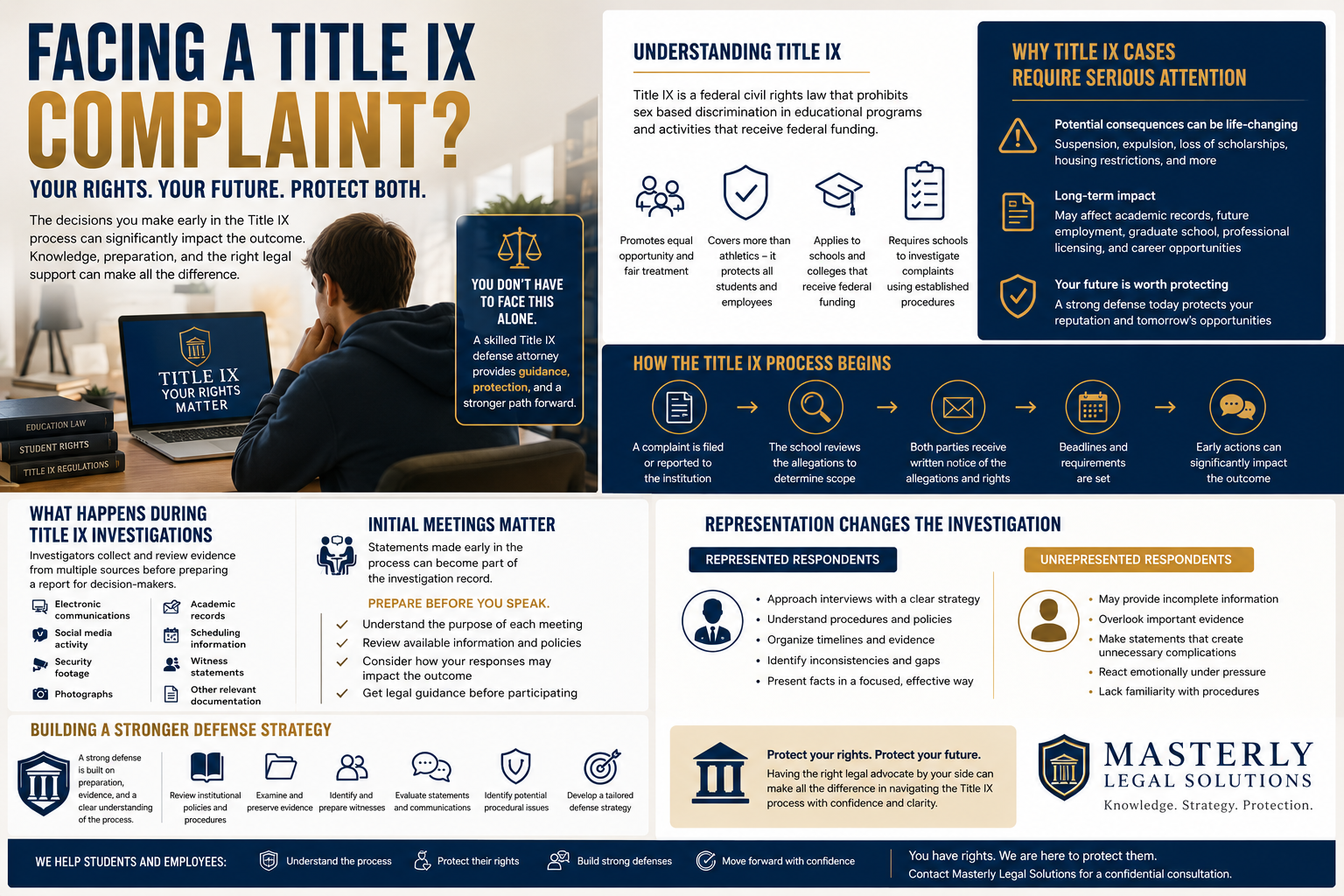
Originally enacted as part of the Education Amendments of 1972, Title IX is a federal civil rights law that prohibits sex based discrimination in educational programs and activities conducted by institutions that receive federal financial assistance. While many people associate the law with athletics, its protections extend much further, addressing equal opportunities and fair treatment throughout educational environments.
Today, Title IX law also governs how schools respond to allegations involving sexual harassment, sexual assault, domestic violence, dating violence, stalking, and other forms of prohibited conduct. Every educational institution that receives federal funding must establish procedures for investigating complaints, including comprehensive Title IX training within educational institutions, while attempting to provide every person equal access to educational opportunities.
Why Title IX Cases Require Serious Attention
A Title IX violation may involve disciplinary actions that extend well beyond the classroom. Depending on the allegations and institutional policies, consequences may include suspension, expulsion, loss of scholarships, removal from campus housing, restrictions on student activities, or permanent notations affecting a student's academic record.
For many students accused of misconduct, these outcomes can influence future employment, graduate school admissions, professional licensing, and career opportunities. Because the potential impact is so significant, working with a qualified Title IX defense lawyer should be viewed as an important step rather than an unnecessary expense.
How the Title IX Process Begins
The Title IX process begins when a school receives a formal Title IX complaint or otherwise becomes aware of conduct that may require investigation under institutional policy. At that point, school administrators determine whether the allegations fall within the scope of Title IX regulations and whether a formal investigation is appropriate.
Once an investigation is opened, both the complainant and the respondent generally receive written notice describing the allegations, applicable policies, and procedural rights. This early stage often shapes everything that follows, making it essential to understand deadlines, institutional requirements, and expectations before responding.
Initial Meetings With School Officials
Many respondents underestimate the importance of their first conversation with school officials. Statements made during preliminary meetings may later become part of the investigation record and influence how Title IX investigators evaluate the case.
Before participating in interviews, respondents should understand the purpose of each meeting, review available information, and carefully consider how their responses may affect later stages of the investigation process. Preparation is especially valuable because initial statements often remain part of the record throughout the entire matter.
What Happens During Title IX Investigations
Most Title IX investigations involve collecting documents, interviewing witnesses, reviewing communications, and examining other available evidence. Investigators typically gather information from multiple sources before preparing a report summarizing relevant facts for decision-makers.
Depending on the allegations, investigators may review:
- Electronic communications
- Social media activity
- Security footage
- Photographs
- Academic records
- Scheduling information
- Witness statements
- Other relevant documentation
Throughout this stage, respondents should understand that investigators are evaluating information from numerous perspectives. A carefully prepared response supported by evidence often carries significantly greater weight than reacting emotionally during interviews.
Why Representation Changes the Investigation
Individuals represented by a Title IX attorney or experienced Title IX defense attorney frequently approach interviews with greater preparation and a clearer understanding of institutional procedures. Their legal counsel can help organize timelines, identify supporting evidence, review policies, and ensure responses remain focused on relevant facts.
By comparison, unrepresented respondents sometimes provide incomplete explanations, overlook important evidence, or unintentionally make statements that create unnecessary complications later in the case. While every situation is different, thoughtful preparation can influence how investigators evaluate available information.
Represented Versus Unrepresented Respondents
One of the most important differences between represented and unrepresented individuals involves preparation. A knowledgeable Title IX defense attorney understands institutional procedures, applicable policies, evidentiary standards, and hearing expectations. Rather than responding impulsively, represented clients typically develop organized strategies before participating in interviews or submitting written statements.
Unrepresented respondents often enter the process believing they can simply "tell their side of the story." Although honesty is essential, effective advocacy usually requires much more than providing a personal account. Organizing evidence, identifying inconsistencies, reviewing policies, and anticipating procedural issues frequently influence the direction of a Title IX case.
Building a Stronger Defense Strategy
An effective IX defense begins long before a hearing is scheduled. Preparation often includes reviewing institutional policies, examining available evidence, identifying favorable witnesses, preserving communications, and evaluating potential procedural concerns, as outlined in our detailed guide to the Title IX investigation process and respondent rights.
Working with an experienced Title IX attorney allows respondents to better understand available options while developing a thoughtful Title IX defense strategy tailored to their individual circumstances. Every case presents unique challenges, but careful preparation provides a stronger foundation for protecting educational opportunities and future goals.
Understanding the Title IX Hearing Process
After Title IX investigations are completed, many schools move into the hearing process outlined by their institutional policies and applicable Title IX rules. Although every school has its own procedures, the purpose of the hearing is generally to evaluate the available evidence before determining whether a policy violation occurred. This stage is often one of the most important moments in the entire Title IX process, as the decision reached can have lasting academic and personal consequences.
Unlike an informal meeting with administrators, a hearing is a structured proceeding that follows established procedures. Hearing officers or decision-makers review evidence, consider testimony, and determine whether the information supports the allegations. For respondents, understanding how the process works before entering the hearing room can significantly improve their ability to participate effectively.
Why Preparation Matters Before the Hearing
Walking into a hearing without preparation places respondents at an immediate disadvantage. Every answer, document, and statement should support a consistent narrative that is backed by evidence whenever possible. Careful preparation also helps reduce anxiety, allowing respondents to communicate more clearly during questioning.
An experienced Title IX defense attorney helps clients understand what to expect, how questions may be presented, and which pieces of evidence deserve additional attention. This preparation often allows respondents to remain focused even during difficult or emotionally charged discussions.
The Importance of Due Process
Every student deserves due process when facing serious allegations. Although Title IX proceedings are administrative rather than criminal, schools are still expected to follow their published policies and provide fair opportunities for both parties to participate.
These protections help ensure that important decisions are not made arbitrarily. Respondents should receive notice of the allegations, opportunities to review evidence, and meaningful chances to respond before disciplinary decisions are finalized. When institutions fail to follow their own procedures, significant fairness concerns may arise.
Following the Same Rules for Everyone
Fairness depends upon applying the same rules consistently to everyone involved. Regardless of the nature of the allegations, both the complainant and respondent should receive equal opportunities to participate in the process under institutional policies.
An experienced Title IX lawyer carefully reviews whether the school followed required procedures throughout the investigation and hearing. Identifying procedural errors may become an important part of an effective IX defense, particularly when fairness has been compromised.
Presenting Evidence Effectively
One of the most common misconceptions is that simply denying allegations will resolve the matter. In reality, respondents often need to present evidence that supports their position and addresses the claims raised during the investigation.
Evidence may include communications, photographs, videos, location records, schedules, witness testimony, or other relevant documentation that helps clarify disputed facts. Presenting information in an organized and persuasive manner is frequently more effective than submitting large amounts of unrelated material.
Organizing Information Before the Hearing
Preparation involves much more than gathering documents. Respondents should carefully review timelines, identify inconsistencies, and ensure supporting materials are presented logically. A qualified Title IX defense lawyer can help determine which evidence is likely to be most persuasive under institutional procedures.
Well-organized evidence also helps decision-makers understand the broader context of the allegations. Instead of reacting to isolated statements, they can evaluate the complete factual picture before reaching a decision.
Why Having an Advisor Matters
Many schools allow each party to have an advisor present during significant stages of the Title IX process. While institutional policies vary, an advisor can provide valuable support by helping respondents understand procedures and remain focused throughout the proceedings, especially in situations involving delayed or suspended Title IX investigations.
Choosing an advisor with experience in Title IX matters is often far more beneficial than relying solely on a friend or family member who is unfamiliar with institutional investigations. Knowledge of procedural requirements can make interactions with investigators and hearing officers much more effective.
Legal Representation Offers Strategic Advantages
Professional legal representation provides more than emotional reassurance. A knowledgeable Title IX attorney understands how institutional policies are interpreted, how hearings are conducted, and what issues commonly influence outcomes.
Working with a dedicated defense attorney allows respondents to prepare strategically rather than reactively. From reviewing investigative reports to developing an effective Title IX defense, experienced counsel helps clients avoid mistakes that could weaken their position.
Common Mistakes Made Without an Attorney
Many respondents believe they can successfully manage the process alone because they have never faced disciplinary proceedings before. Unfortunately, this confidence sometimes leads to avoidable mistakes that become difficult to correct later.
Some of the most common errors include:
- Speaking with investigators before understanding institutional procedures.
- Failing to preserve important communications or evidence.
- Providing inconsistent statements during interviews.
- Overlooking witnesses who could support their account.
- Missing important deadlines established by the school.
- Assuming the investigation is informal simply because it takes place on campus, similar to how some families underestimate the seriousness of UIL disciplinary defense proceedings.
Each of these issues may affect the credibility of a respondent or limit opportunities to present important information during the hearing.
Comparing Represented and Unrepresented Cases
Although every Title IX case depends on its own facts, there are meaningful differences between respondents who obtain experienced legal assistance and those who proceed alone. Individuals represented by a Title IX defense attorney often have a clearer understanding of institutional expectations, stronger evidence organization, and a more structured defense strategy.
By contrast, respondents without legal representation may struggle to recognize procedural issues, evaluate investigative reports, or prepare persuasive responses. When educational opportunities, future employment, and personal reputation are at stake, experienced guidance can make a significant difference.
Understanding the Types of Allegations That May Trigger Title IX Proceedings
Not every Title IX complaint involves the same type of allegation. Depending on the facts presented, a school may investigate claims involving sexual harassment, sexual assault, domestic violence, dating violence, stalking, or other forms of prohibited conduct. While each allegation requires careful review, the procedures followed by an institution can have a significant impact on everyone involved.
For respondents, it is important to remember that an allegation is not the same as a finding of responsibility. Nevertheless, even before a final decision is reached, a Title IX case can affect a student's academic experience, campus participation, housing arrangements, and reputation. Taking the matter seriously from the very beginning is one of the most important steps in protecting your future.
Allegations Can Extend Beyond the Classroom
Many people assume Title IX applies only to conduct that occurs inside classrooms or on school property. In reality, schools may investigate incidents connected to school-sponsored activities, athletic programs, student organizations, residence halls, and other education programs when institutional policies or Title IX mandates require action.
Because every situation is fact-specific, respondents should avoid making assumptions about whether a school has jurisdiction. Consulting a Title IX defense attorney early can help clarify how institutional policies may apply to the allegations.
When a Title IX Investigation and Criminal Investigation Occur at the Same Time
Some allegations may result in both a Title IX investigation and a separate criminal investigation. Although these proceedings may involve similar facts, they serve different purposes and follow different rules. A school focuses on compliance with institutional policies and federal law, often requiring support from an experienced education lawyer for schools and teachers, while law enforcement evaluates whether criminal statutes may have been violated.
Responding without understanding this distinction can create unnecessary risks. Statements made during a campus investigation could potentially affect related legal matters, making early advice from a defense attorney especially valuable.
Criminal Cases and School Proceedings Are Not the Same
A common misunderstanding is that campus proceedings operate like criminal court. They do not. Criminal cases are handled within the judicial system, while Title IX proceedings are administrative processes conducted by educational institutions.
Likewise, a campus determination does not automatically establish criminal responsibility, nor does the absence of criminal charges prevent a school from continuing its own investigation. Each process follows different legal standards and objectives.
Understanding the Standard of Proof
Many people are familiar with the concept of reasonable doubt, which is the standard used in many criminal law proceedings. Most Title IX hearings, however, apply a different evidentiary standard established by institutional policy and applicable Title IX regulations, an area where a comprehensive education law and Title IX defense firm can provide crucial guidance.
This distinction often surprises respondents who expect the same burden of proof used in criminal proceedings. Because the standards differ, careful preparation remains essential regardless of whether law enforcement is involved.
Why Your Defense Strategy Should Reflect the Process
An effective Title IX defense recognizes that campus investigations are governed by school policies rather than traditional courtroom procedures. Building a persuasive response requires understanding institutional rules, organizing evidence, and preparing for interviews or hearings with those differences in mind.
A skilled IX defense attorney helps clients tailor their strategy to the specific procedures being used rather than relying on assumptions drawn from television or criminal trials.
Protecting Student Rights Throughout the Process
Every respondent deserves to have their student rights respected throughout the investigation and hearing. Institutions that receive federal funding are expected to administer their procedures fairly while complying with applicable Title IX law and protecting the civil rights of everyone involved, including educators and coaches who rely on Title IX guidance for educators in sports.
Respondents should understand available procedural protections, opportunities to review evidence, and deadlines for responding to investigative findings. Missing important opportunities can make defending the allegations much more difficult later in the process.
Early Action Can Prevent Bigger Problems
Many respondents wait until a hearing is scheduled before seeking help. Unfortunately, valuable opportunities to strengthen an IX defense may already have been lost by that stage. Early involvement from a Title IX defense lawyer often allows more time to review evidence, identify witnesses, and respond effectively to investigators.
Proactive preparation also helps respondents avoid common procedural mistakes while preserving information that may become important later in the case.
The Long-Term Consequences of a Title IX Finding
A Title IX finding may affect much more than a student's current enrollment. Depending on institutional policies and the seriousness of the allegations, disciplinary decisions can influence academic standing, campus housing, scholarships, leadership positions, and future educational opportunities.
Students found responsible for a Title IX offense may also encounter challenges when applying for internships, employment, professional licensing, or graduate school. These potential legal consequences highlight why every stage of the process deserves careful attention, particularly for student‑athletes and coaches whose futures may also depend on US sports law and athletics compliance.
Why Experience Matters in High-Stakes Cases
Respondents facing allegations involving sexual misconduct, sexual harassment, or domestic violence often experience significant stress and uncertainty. Having an experienced Title IX defense attorney provides guidance throughout the process while helping clients understand procedural requirements, evaluate evidence, and prepare for hearings.
At Masterly Legal Solutions, we understand that every Title IX case is unique. Our team works closely with clients to protect their rights, develop thoughtful defense strategies, and pursue the fairest outcome possible while minimizing unnecessary risks to their education and future.
Choosing the Right Title IX Defense Attorney
Selecting the right Title IX defense attorney is one of the most important decisions a respondent can make. These cases involve unique procedures that differ from traditional litigation, so experience with Title IX matters and higher education law counsel for colleges and universities can be just as important as general legal knowledge. An attorney who regularly handles campus investigations understands institutional policies, hearing procedures, and the challenges respondents commonly face throughout the process.
When evaluating legal representation, look beyond years of practice alone. Consider whether the attorney has experience with Title IX investigations, understands evolving Title IX regulations, and can explain complex issues in a way that helps you make informed decisions. Strong communication and careful preparation often become valuable assets when your education and reputation are at stake.
What a Legal Team Does Behind the Scenes
An experienced legal team does much more than appear at a hearing. Preparation often begins immediately after a Title IX complaint is received and continues throughout every phase of the matter. Building an effective Title IX defense requires careful planning, strategic decision-making, and attention to detail.
Depending on the circumstances, your legal team may:
- Review investigative reports and institutional policies.
- Analyze available evidence and timelines.
- Prepare responses to investigator questions.
- Evaluate witness statements for consistency.
- Organize relevant documentation before hearings.
- Help clients prepare to present evidence effectively.
This preparation allows respondents to approach the process with greater confidence and a clearer understanding of what lies ahead.
The Value of Independent Investigation
School investigations are designed to gather information, but respondents may also benefit from conducting a private investigation when appropriate. Independent fact gathering can uncover additional evidence, identify overlooked witnesses, or clarify details that deserve further review.
Every Title IX case is different, and additional investigation is not necessary in every matter. However, when important facts remain unresolved, an independent review may strengthen the overall Title IX defense strategy and provide valuable context for decision-makers, much like the support colleges receive from dedicated higher education attorneys.
Building a Strong Record Before the Hearing
Preparing a persuasive case requires more than simply responding to allegations. Respondents should carefully preserve communications, organize timelines, and identify documents that support their position before the hearing begins.
An experienced IX defense attorney understands how to present information clearly while avoiding unnecessary distractions. Well-organized evidence often helps hearing officers evaluate the facts more accurately than scattered or incomplete submissions.
Why Early Legal Guidance Can Make All the Difference
Many respondents contact an attorney only after interviews have been completed or a hearing date has already been scheduled. By that point, important opportunities may have been missed. Early legal guidance allows respondents to understand their rights before making statements, submitting documents, or participating in meetings with investigators.
Working with a knowledgeable Title IX attorney from the beginning often helps avoid procedural mistakes that become difficult to correct later. Early preparation also provides more time to review evidence, evaluate institutional policies, and develop a thoughtful response tailored to the specific allegations.
Protecting More Than Your Current Education
The outcome of a Title IX matter may affect much more than a single semester. A disciplinary finding can influence future educational opportunities, scholarships, campus leadership positions, employment prospects, professional licensing, and other important milestones.
Students who are accused of sexual misconduct often focus only on the immediate investigation, but long-term consequences deserve equal attention. A carefully prepared IX defense seeks not only to address the current allegations but also to protect future academic and professional opportunities.
Responding to Title IX Allegations During the Disciplinary Process
Facing Title IX allegations can be overwhelming, especially for accused students who have never been involved in a campus investigation before. While schools receiving federal funding must comply with requirements established by the federal government, they are also responsible for conducting a fair disciplinary process that follows their published policies. Allegations involving alleged student misconduct or other forms of alleged misconduct should never be treated as proof that a policy violation occurred. Every respondent deserves an opportunity to review the evidence, respond to the claims, and protect their rights before any decision is made.
Why Legal Representation Matters When Serious Allegations Arise
Although a campus investigation is different from a criminal proceeding, accusations involving violating Title IX may overlap with allegations that carry significant legal and personal consequences. In some situations, claims may involve sex discrimination or conduct that is also investigated as potential sex crimes, making it important to understand how school proceedings and outside investigations can intersect. An attorney with experience in criminal defense and Title IX matters can help respondents understand the differences between these processes while developing an informed strategy. At Masterly Legal Solutions, our law firm is committed to helping clients navigate complex Title IX matters with careful preparation, experienced advocacy, and a focus on protecting their educational and professional future.
Every Decision During the Process Matters
A Title IX investigation rarely moves in a straight line. New information may emerge, additional witnesses may be interviewed, and procedural questions may arise before a final decision is reached. Each stage presents opportunities to strengthen or weaken a respondent's position.
At Masterly Legal Solutions, we believe preparation, strategy, and attention to detail are essential throughout the Title IX process. Whether you are responding to allegations of sexual misconduct, sexual harassment, domestic violence, or another Title IX matter, our goal is to help you navigate the process with confidence while protecting your rights and future.
If you are facing a Title IX complaint, do not wait until the hearing is only days away. Early preparation often provides more opportunities to build an effective defense and respond strategically to the allegations. Contact Masterly Legal Solutions today at (972) 236-5051 for a free consultation. We work with students, faculty members, and professionals across the country, helping clients understand their options and prepare for every stage of the Title IX process with experienced legal support.
Disclaimer: This article is provided for informational purposes only and should not be considered legal guidance or legal advice. Every Title IX matter involves unique facts and circumstances. Reading this article does not create an attorney-client relationship. If you are involved in a Title IX investigation or hearing, consult a qualified Title IX defense attorney to obtain advice specific to your situation.

Teacher Rights When Assaulted by a Special Needs Student: Safety, Reporting and Investigation Issues







Looking for Legal & Business Solutions? Contact Us Now
Fill in the form or call us to set up a meeting





