

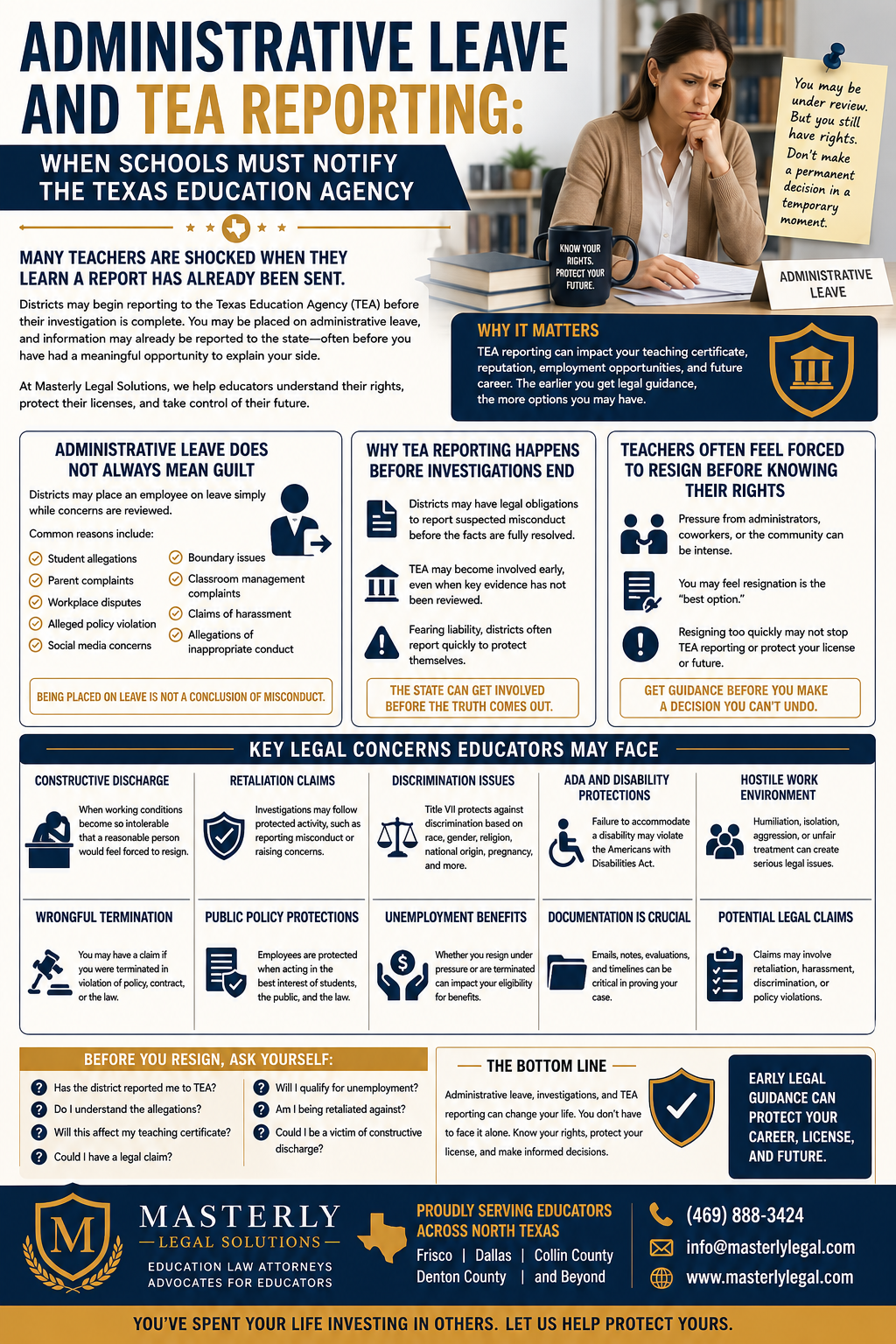
Administrative Leave and TEA Reporting: When Schools Must Notify the Texas Education Agency
Many Teachers Are Shocked When They Learn a Report Has Already Been Sent
For many educators across Texas, being placed on administrative leave feels confusing, humiliating, and deeply personal. Most teachers enter education because they care about students, their communities, and the future of young people. They rarely expect to become the subject of a school investigation or state inquiry. Unfortunately, many educators do not realize that school districts may begin TEA reporting long before the investigation is complete, exposing them to the risks of a TEA license defense and disciplinary process.
A teacher may believe the district is still “looking into the situation,” only to later discover that information has already been submitted to the Texas Education Agency. In some cases, the educator has not even had a meaningful opportunity to explain their side before the district begins the reporting process. This often creates fear, uncertainty, and confusion about what comes next.
At Masterly Legal Solutions, we help educators, administrators, and school employees understand their rights when facing investigations, administrative leave, and possible TEA reporting. Our firm understands how quickly allegations can escalate and how devastating these situations can become for an employee, their family, and their future career opportunities.
Administrative Leave Does Not Always Mean Guilt
One of the biggest misconceptions educators face is the belief that administrative leave automatically means wrongdoing occurred. In reality, districts sometimes place an employee on leave simply to separate the individual from the campus while concerns are reviewed.
Schools may place teachers on leave because of:
- Student allegations
- Parent complaints
- Workplace disputes
- Alleged policy violation
- Social media concerns
- Boundary issues
- Classroom management complaints
- Claims involving alleged harassment
- Allegations involving inappropriate conduct
An educator may feel embarrassed or assume their career is over immediately. However, being placed on leave does not necessarily mean the district has concluded misconduct occurred.
Why TEA Reporting Happens Before Investigations End
Many teachers assume districts must complete their internal investigation before notifying the Texas Education Agency. That assumption is often incorrect. Under certain law and district obligations, schools may begin TEA reporting before the facts are fully resolved, and teachers should understand how TEA investigations of educators typically unfold.
This creates serious problems for educators because the state may become involved before important evidence is gathered or reviewed. Even if the allegations later prove inaccurate, the reporting process may already be underway.
Some districts act quickly because they fear being held liable for failing to report potential educator misconduct. Others interpret their obligations broadly to avoid scrutiny from state regulators.
The result is that an employee may face serious professional consequences while the facts remain unclear.
Teachers Often Feel Forced to Resign Before Knowing Their Rights
Many educators placed on administrative leave feel intense pressure from administrators, coworkers, and the surrounding community. In some situations, school officials may imply that resignation is the “best option.”
This pressure can create what is commonly described as a forced resignation situation. Teachers may fear losing future employment opportunities, damaging their reputation, or facing additional public scrutiny if they refuse to resign.
Unfortunately, some educators submit a resignation too quickly without understanding the long-term consequences. A resignation may not stop TEA reporting, and it may not prevent future licensing concerns.
Before deciding whether to resign, educators should understand the full situation and seek guidance from an experienced attorney.
What Is Constructive Discharge in School Employment Matters?
In certain employment situations, an educator may feel they had no reasonable choice except to leave their position. This concept is sometimes referred to as constructive discharge or constructive dismissal.
A constructive discharge argument may arise when the work environment becomes so difficult, hostile, or professionally damaging that a reasonable person would feel compelled to resign. In some cases, teachers report feeling isolated, humiliated, threatened with termination, or pressured into immediate decisions.
For example, a district may:
- Publicly isolate an educator
- Remove classroom duties abruptly
- Pressure the teacher to submit a resignation immediately
- Create an intolerable work environment
- Threaten future career consequences
- Discourage the educator from seeking representation
While every situation is different, educators should understand that being pressured to resign may have serious legal implications.
Administrative Leave Can Affect Your Entire Career
When a teacher is placed on leave, the impact often extends far beyond the current school district. Future employers may ask questions about prior investigations, resignations, or disciplinary concerns.
An educator who resigns under pressure may later struggle with:
- Future employment opportunities
- Licensing concerns
- Reputation damage
- Emotional stress
- Financial uncertainty
- Difficulty securing references
- Delays in obtaining future teaching positions
These concerns become even more serious when TEA reporting has already occurred.
Some Teachers Feel Forced Into Silence
Many educators are afraid to ask questions during investigations because they worry they will appear defensive or uncooperative. Unfortunately, silence and confusion often benefit the district more than the teacher.
An employee placed on leave may not fully understand:
- Why they were removed
- What allegations exist
- Whether TEA reporting has started
- What evidence is being reviewed
- Whether future employment is at risk
Teachers should never assume the district is protecting their personal or professional interests during the process.
The Emotional Impact of Forced Resignation
A forced resignation can feel devastating for educators who spent years building their careers. Teachers often describe feeling embarrassed, isolated, and emotionally exhausted after being pressured to leave their position.
Some educators later realize they resigned before understanding:
- Their legal rights
- The district’s obligations
- Whether allegations were substantiated
- Whether reporting to TEA was mandatory
- Whether they had potential claims involving retaliation or discrimination
These situations often leave educators wondering whether they were treated fairly or manipulated into leaving too quickly.
Retaliation Concerns in School Investigations
Not every school investigation begins because of student safety concerns. In some situations, educators believe investigations began after engaging in protected activity such as reporting misconduct, raising concerns, or challenging administrative decisions.
Retaliation claims may involve allegations connected to:
- Reporting policy concerns
- Opposing unlawful practices
- Filing internal complaints
- Reporting unethical behavior
- Participating in investigations
- Raising concerns involving public policy
An educator should never assume that retaliation concerns are impossible simply because the employer is a school district.
Title VII and Employment Discrimination Issues
Some educator investigations may overlap with concerns involving Title VII, the Civil Rights Act, or other areas of employment law. Teachers who experience unequal treatment based on protected categories may have additional legal concerns beyond TEA reporting, and may benefit from guidance from an experienced education law attorney for teachers and administrators.
Examples of potential concerns may involve:
- Race discrimination
- Gender discrimination
- Religious discrimination
- National origin discrimination
- Pregnancy-related issues
- Retaliation concerns
The Equal Employment Opportunity Commission may become relevant in some workplace disputes involving school employees.
Teachers With Disabilities Face Additional Risks
Educators with medical conditions or impairments sometimes face unique challenges during investigations and administrative leave proceedings. Concerns involving the Americans with Disabilities Act or related workplace protections may arise if a district fails to accommodate a teacher properly.
Issues involving a disability may overlap with:
- Medical leave
- Workplace accommodations
- Administrative decisions
- Fitness-for-duty concerns
- Communication misunderstandings
An educator should not feel pressured to resign simply because they are dealing with medical or personal challenges.
Hostile Work Environments Can Escalate Quickly
Some teachers report feeling targeted by administrators or coworkers long before formal investigations begin. A hostile or toxic work environment may contribute to significant emotional stress and confusion.
A hostile environment may include:
- Repeated humiliation
- Isolation from coworkers
- Aggressive treatment from a supervisor
- Constant criticism
- Unfair scrutiny
- Unreasonable expectations
When these conditions become severe, an educator may feel professionally trapped.
Constructive Dismissal Is Not Always Obvious
A constructive dismissal situation does not always involve dramatic threats or public accusations. Sometimes the pressure develops gradually over time.
For example, an educator may:
- Lose classroom responsibilities suddenly
- Experience repeated disciplinary scrutiny
- Face increased monitoring
- Receive inconsistent directives
- Feel pressured by management
- Be excluded from important meetings
Over time, the educator may feel there is no realistic option except to leave.
Wrongful Termination Concerns in School Employment
Some educators wonder whether they were wrongfully terminated or pressured out improperly after being placed on administrative leave. While every case depends on specific facts, concerns involving wrongful termination may arise when districts violate policies, contractual obligations, or anti-discrimination protections.
A wrongful discharge claim may involve allegations connected to:
- Retaliation
- Policy violations
- Discrimination
- Improper investigations
- Violations of public policy
Teachers should not assume districts are always acting appropriately simply because an investigation exists.
The Role of Public Policy in School Employment Cases
Texas schools operate within a complex framework of state regulations, district rules, and broader public policy concerns. Districts often justify decisions by arguing they are protecting students or complying with reporting obligations.
However, not every administrative decision automatically aligns with fair treatment of employees. Courts sometimes examine whether actions violated important public policy protections designed to prevent retaliation or unlawful treatment.
Understanding how public policy affects educator investigations can be extremely important during disputes involving forced resignation or alleged retaliation.
Reporting Violations Can Create Additional Tension
Teachers and staff members sometimes report concerns involving testing integrity, student safety, financial irregularities, or district misconduct. Unfortunately, educators who report violations occasionally fear retaliation afterward.
This creates a difficult situation where an employee may worry that speaking up could jeopardize their career or trigger increased scrutiny.
Educators should understand their rights before participating in sensitive workplace disputes.
Teachers Should Be Careful Before Resigning
A resignation may seem like the fastest way to escape stress and embarrassment. However, resigning too quickly can create unintended consequences.
Before deciding to resign, educators should carefully evaluate:
- Whether TEA reporting has occurred
- Whether allegations are substantiated
- Whether future employment could be affected
- Whether they may qualify for unemployment benefits
- Whether they may have potential legal claims
In many cases, educators later regret making rushed decisions during emotional situations.
Unemployment Benefits May Become Complicated
Educators who resign during investigations sometimes assume they will automatically lose access to unemployment benefits. However, the situation may depend on the surrounding circumstances and the reasons behind the resignation.
In some cases, teachers who were effectively forced to leave due to unbearable conditions may still have arguments regarding benefits eligibility.
Because these situations can become legally complicated, teachers should seek guidance before making employment decisions.
Administrative Leave Often Feels Public Even When It Is Not
Teachers placed on leave frequently describe feeling ashamed or publicly judged, even when details remain confidential. Rumors can spread quickly among staff members, students, and parents.
This emotional pressure may cause educators to panic and make decisions against their own best interests. Some individuals feel forced to accept blame simply to end the stress and uncertainty.
A calm and informed strategy is often more effective than emotional reactions.
The Importance of Documentation During Investigations
Documentation can become critical when disputes involve alleged retaliation, discrimination, or procedural concerns.
Important records may include:
- Emails
- Text messages
- Witness names
- Administrative directives
- Performance evaluations
- Timeline notes
- Leave notices
Strong documentation may provide strong evidence supporting an educator’s position later.
Filing Complaints and Legal Claims Requires Strategy
In some situations, educators may eventually consider filing internal grievances or pursuing a legal claim related to their treatment.
Potential concerns may involve:
- Wrongful termination
- Retaliation
- Harassment
- Discrimination
- Violations of district procedures
- Violations of statutory protections
Every situation is different, and strategic planning is extremely important before pursuing formal action.
School Districts Fear Liability Concerns
Many districts move aggressively during investigations because they fear being found liable for failing to address allegations properly. Schools are often concerned about media attention, parental pressure, student safety concerns, and potential civil exposure, which is why educators should understand why every teacher needs a lawyer for legal protection.
As a result, districts may prioritize protecting institutional interests over protecting the educator involved.
Teachers should understand that the district’s priorities may not always align with the employee’s best interests.
Employment Law and School Investigations Frequently Overlap
School investigations often involve more than simple policy reviews. Some disputes overlap with broader areas of employment law, including discrimination protections, retaliation concerns, and procedural fairness, where support from an experienced education lawyer for teachers and schools can be critical.
An experienced employment attorney can help educators understand how employment-related rights may interact with TEA investigations and district actions.
Teachers should never assume their situation involves only school policy concerns.
The Pressure to Continue Working Under Difficult Conditions
Some educators are not immediately placed on leave but instead experience worsening working conditions while investigations continue. They may feel isolated, targeted, or emotionally overwhelmed.
In some cases, an employee may attempt to continue working despite severe stress, public embarrassment, or increasing hostility from administrators and coworkers.
These situations can affect emotional health, career stability, and long-term professional confidence.
Severe Harassment Allegations Can Destroy Reputations
Even unproven allegations involving harassment or inappropriate conduct can seriously damage an educator’s reputation. Teachers often discover that public perception changes rapidly once rumors spread.
In some cases, the allegations may involve misunderstandings, false claims, or exaggerated accounts. Unfortunately, the emotional and professional harm may occur long before the investigation finishes.
This is one reason early legal guidance matters so much.
Wrongful Discharge Claims May Arise After Investigations
A wrongful discharge claim may become relevant if a teacher believes they were improperly pushed out or terminated because of retaliation, discrimination, or procedural misconduct.
Potential issues may involve:
- Violation of district policies
- Unequal treatment
- Improper investigation procedures
- Retaliatory motives
- Protected workplace activity
Each case depends heavily on the surrounding facts and documentation available.
Plaintiffs Often Face Emotional and Financial Stress
Individuals pursuing legal action after employment disputes frequently experience major financial and emotional strain. Plaintiffs may worry about future employment opportunities, family stability, and public reputation.
For many educators, the stress of litigation or administrative proceedings feels overwhelming because their professional identity is closely tied to teaching and student relationships.
This is why early intervention can be so valuable.
District Reporting Decisions Can Affect Future Jobs
Even when allegations are not ultimately substantiated, TEA reporting may still create long-term concerns for educators seeking future employment or meeting Texas teacher certification and TEA requirements.
A future former employer may disclose investigation details during reference checks or hiring reviews. School districts may also ask about prior resignations, leave situations, or licensing investigations.
Protecting your record early is often much easier than repairing damage later.
Public Policy Protections Do Not Guarantee Easy Outcomes
Although certain statutory and public policy protections exist for employees, legal disputes involving schools can still become difficult and emotionally draining.
Some educators assume the law automatically protects them once retaliation or discrimination occurs. Unfortunately, proving claims often requires substantial evidence, careful documentation, and strategic legal planning.
This is why consulting an experienced attorney early can be so important.
Punitive Damages and Civil Liability Concerns
In some employment disputes involving intentional misconduct or severe retaliation, discussions about punitive damages may arise. These damages are intended to punish especially harmful behavior.
While not available in every situation, they may become relevant when employers engage in egregious misconduct or intentional violations of employee protections.
Districts and administrators often consider these liability risks carefully when disputes escalate.
Working Conditions Matter More Than Many Educators Realize
Teachers sometimes normalize unhealthy working conditions because they feel dedicated to their students and profession. However, no educator should feel trapped in an abusive or retaliatory environment.
Persistent humiliation, intimidation, retaliation, or severe mistreatment may create serious professional and emotional consequences.
Educators deserve fair treatment and professional respect.
Public Policy and Employee Protections Continue to Evolve
Employment protections involving schools continue evolving through court decisions, statutory developments, and administrative guidance. Concerns involving retaliation, discrimination, leave rights, and workplace treatment remain active areas of legal discussion.
Teachers should remain informed about changes affecting employee rights and district obligations under Texas and federal law, including how an education lawyer for teachers in Texas can help navigate evolving TEA disciplinary rules.
Plaintiffs Must Often Prove Severe Conditions
Courts evaluating constructive discharge or retaliation concerns frequently examine whether conditions became sufficiently severe that a reasonable person would feel compelled to resign.
For example, repeated retaliation, humiliation, threats, or retaliatory actions may strengthen certain arguments. However, every situation depends heavily on documentation and specific facts.
This is why preserving evidence matters.
Labor Concerns and Employment Disputes Can Intersect
Some school disputes may involve broader labor concerns connected to workplace treatment, compensation, or employee rights.
Questions involving:
- Wages
- Leave policies
- Contractual obligations
- Workplace protections
- Employment status
may all become relevant depending on the dispute involved.
Undocumented Workers and School Employment Risks
Although less common in educator investigations, some workplace disputes involve allegations concerning undocumented workers or concerns involving employing undocumented workers. These situations can create additional legal exposure for institutions and employers.
Employment-related investigations often become more complicated when immigration concerns or regulatory compliance questions arise.
Educators Should Protect Their Careers Before Problems Escalate
The most important thing educators can do is take concerns seriously from the beginning. Waiting until a formal TEA action or termination occurs may reduce available options significantly, so understanding the steps to take when on administrative leave can be critical.
Teachers should seek guidance if they experience:
- Administrative leave
- Pressure to resign
- Threats involving certification
- Retaliation concerns
- Harassment
- Discrimination
- Reporting threats
- Severe workplace hostility
Protecting your future starts with understanding your rights early.
Helping Educators Across San Antonio Texas School Districts
At Masterly Legal Solutions, we proudly help educators and school employees throughout Texas, including professionals working in San Antonio Texas school districts and surrounding communities. We understand how frightening TEA reporting and administrative leave situations can become for teachers who have spent years building their careers.
Our firm works with clients facing investigations, retaliation concerns, employment disputes, and potential certification consequences. We know these situations affect far more than just employment status. They impact families, finances, emotional health, and long-term career opportunities.
Speak With Masterly Legal Solutions About Your Situation
If you are an educator facing administrative leave, possible TEA reporting, retaliation concerns, or pressure to resign, you do not have to face the process alone. The earlier you seek guidance from an experienced education law attorney and teacher license defender, the more opportunities you may have to protect your career, reputation, and professional future.
At Masterly Legal Solutions, we understand how quickly investigations can escalate and how overwhelming these situations may feel for teachers and school employees. Whether you are dealing with reporting concerns, discrimination allegations, hostile working conditions, or possible wrongful termination, our team is prepared to help you evaluate your options carefully.
Call Masterly Legal Solutions at (972) 236-5051 to schedule a free consultation today. We are committed to helping educators understand their rights, protect their professional standing, and move forward with confidence during difficult situations. Contact our team to discuss your concerns confidentially and learn more about your legal options.
Disclaimer: This article is provided for informational and educational purposes only and should not be interpreted as legal advice. Reading this article does not create an attorney-client relationship with Masterly Legal Solutions or any attorney associated with the firm. Every case involves unique facts and circumstances, and individuals should seek legal guidance regarding their specific situation before making employment or legal decisions.



Teacher Rights When Assaulted by a Special Needs Student: Safety, Reporting and Investigation Issues



Looking for Legal & Business Solutions? Contact Us Now
Fill in the form or call us to set up a meeting