

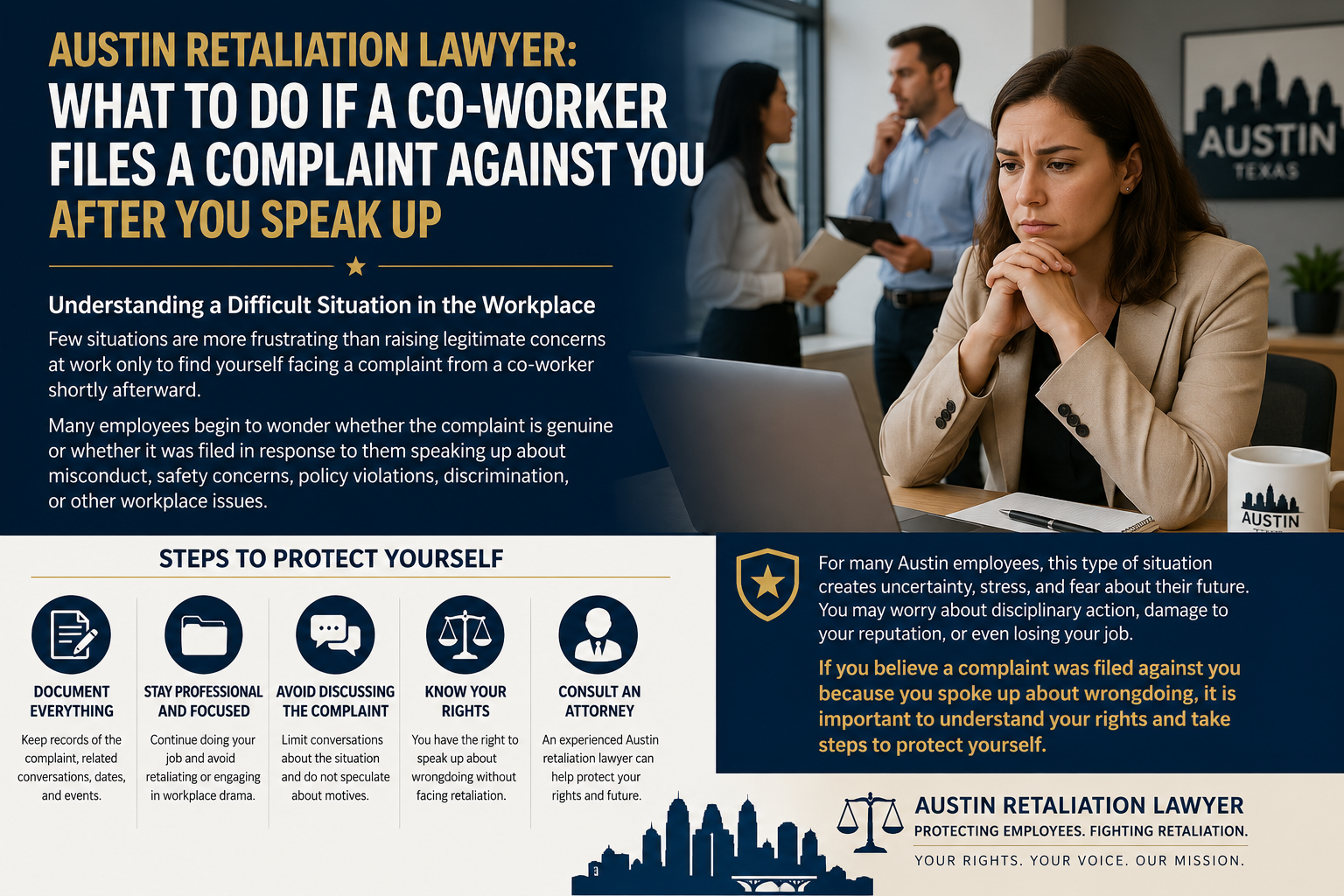
Austin Retaliation Lawyer: What to Do If a Co-Worker Files a Complaint Against You After You Speak Up
Understanding a Difficult Situation in the Workplace
Few situations are more frustrating than raising legitimate concerns at work only to find yourself facing a complaint from a co-worker shortly afterward. Many employees begin to wonder whether the complaint is genuine or whether it was filed in response to them speaking up about misconduct, safety concerns, policy violations, discrimination, or other workplace issues.
For many Austin employees, this type of situation creates uncertainty, stress, and fear about their future. You may worry about disciplinary action, damage to your reputation, or even losing your job. In some cases, a co-worker's complaint may be completely unrelated to your actions. In others, the timing may raise serious questions about retaliation in the workplace.
If you believe a complaint was filed against you because you spoke up about wrongdoing, it is important to understand your rights and take steps to protect yourself. An experienced Austin retaliation lawyer can help evaluate the circumstances and determine whether your situation involves unlawful retaliation.
Why Employees Speak Up in the First Place
Employees often report workplace problems because they want to improve conditions, follow company policies, or comply with state and federal laws. In many cases, workers believe they are doing the right thing by reporting concerns.
Examples may include reporting:
- Safety violations
- Harassment
- Unlawful discrimination
- Wage and hour violations
- Ethics violations
- Fraudulent activity
- Misuse of public funds
- Violations involving school districts in Austin
Many employees assume their employer will appreciate their honesty. Unfortunately, that is not always what happens.
What Is Retaliation?
When an employer treats a worker unfairly because they participated in a legally protected activity, this is known as retaliation. Under employment law, certain activities are protected because public policy encourages workers to report wrongdoing without fear of punishment.
Retaliation can take many forms. While some people immediately think of termination, retaliation may occur long before an employee is fired.
Common examples include:
- Demotions
- Pay reductions
- Negative evaluations
- Unfair disciplinary actions
- Exclusion from meetings
- Reduction of responsibilities
- Harassment
- Increased scrutiny
- Schedule changes
- Even termination
A skilled Austin employment retaliation lawyer can review the facts and determine whether retaliation may be occurring.
Can a Co-Worker Complaint Be Part of Retaliation?
Yes. In some situations, a co-worker may file a complaint after an employee reports misconduct or raises concerns. While every complaint should be taken seriously, timing often matters.
For example, imagine an employee reports discrimination to management. Two weeks later, a co-worker suddenly files a complaint accusing that employee of misconduct. The employer immediately launches an investigation and begins treating the reporting employee differently.
That does not automatically prove retaliation. However, it may be a warning sign that deserves closer examination.
An Austin retaliation lawyer can help determine whether there are facts suggesting a connection between the protected report and the complaint.
Recognizing Protected Activity
One of the most important questions in any retaliation case is whether the employee engaged in a protected activity.
Protected activity may include:
- Reporting discrimination
- Reporting harassment
- Filing a workplace complaint
- Participating in an investigation
- Testifying in a proceeding
- Reporting violations of law
- Cooperating with government agencies
- Opposing unlawful workplace practices
A protected activity does not require an employee to prove wrongdoing occurred. In many situations, the employee only needs a reasonable belief that a violation took place.
Understanding whether your actions qualify as protected activity is often the first step in evaluating potential retaliation claims.
Why Timing Matters
Timing can be one of the most important pieces of circumstantial evidence in retaliation cases.
When a complaint appears shortly after an employee raises concerns, investigators and employment lawyers often look closely at the sequence of events.
Questions may include:
- When did the employee report concerns?
- Who knew about the report?
- When was the complaint filed?
- Who filed the complaint?
- What actions followed the complaint?
- Did treatment of the employee change afterward?
While timing alone may not prove retaliation, it can help establish a pattern that supports a claim.
Distinguishing Legitimate Complaints From Retaliating Behavior
Not every complaint filed against an employee is retaliatory. Employees can still be disciplined for legitimate misconduct even if they previously reported workplace concerns.
The challenge is determining whether the complaint is based on actual conduct or whether someone is retaliating because an employee spoke up.
An experienced attorney may examine:
- Witness statements
- Internal communications
- Performance records
- Prior disciplinary history
- Company policies
- Investigation procedures
The goal is to determine whether the complaint appears legitimate or whether it may have been intended to punish an employee for speaking up.
Signs That Retaliation May Be Occurring
Several warning signs may suggest retaliation in the workplace.
Sudden Changes in Treatment
Employees often notice dramatic changes in how supervisors or co-workers interact with them after they report concerns.
Friendly relationships may become strained. Opportunities may disappear. Management may begin treating the employee differently.
Increased Scrutiny
Some employers begin closely monitoring employees who raise concerns.
Minor mistakes that were previously overlooked may suddenly become major issues.
Unusual Complaints
A complaint that appears exaggerated, unsupported, or inconsistent with an employee's history may warrant further review.
Escalating Discipline
Sometimes a complaint becomes the foundation for increasingly severe disciplinary actions.
These adverse actions may eventually lead to termination if left unchallenged.
What To Do Immediately After Learning About the Complaint
Employees often make mistakes during the early stages of a dispute because emotions are running high.
Taking the right steps can help protect your interests.
Stay Calm
Receiving notice of a complaint can be upsetting. However, emotional reactions may complicate matters.
Remain professional and avoid confrontations with co-workers.
Request Information
Ask for information regarding the allegations if appropriate.
Understanding the nature of the complaint can help you respond effectively.
Preserve Documentation
Keep copies of:
- Emails
- Text messages
- Performance evaluations
- Meeting notes
- Investigation notices
- Prior complaints you submitted
This information may become important later.
Avoid Retaliating Yourself
Even if you believe the complaint is unfair, do not engage in behavior that could be viewed as retaliating against another employee.
The Importance of Documentation
Documentation is often critical in employment law cases.
Employees should maintain a detailed record of events, including:
- Dates of reports
- Individuals involved
- Conversations
- Complaints received
- Disciplinary actions
- Changes in job duties
A well-organized timeline can help an attorney determine whether retaliation may have occurred.
How Internal Investigations Can Affect Your Rights
Many employers conduct internal investigations when a complaint is filed.
These investigations may influence future employment decisions, making it important to participate carefully.
Employees should answer questions truthfully while also protecting their legal rights.
An attorney can often provide guidance regarding participation in independent workplace investigations.
Understanding Employer Responsibilities
An employer has a responsibility to investigate complaints fairly and objectively.
Investigations should not be used as tools for punishment or intimidation.
Employers should evaluate evidence from all sides rather than assuming guilt based solely on allegations.
When employers fail to conduct fair investigations, they may create additional legal issues.
When a Complaint Creates a Hostile Work Environment
In some situations, the filing of a complaint is only part of a larger pattern of mistreatment.
Employees may begin experiencing hostility from supervisors or co-workers after speaking up.
A hostile work environment can develop when ongoing conduct becomes severe or pervasive enough to interfere with an employee's ability to perform their job.
The presence of hostility does not automatically establish retaliation, but it may strengthen concerns about workplace misconduct.
The Connection Between Discrimination and Retaliation
Many retaliation cases begin with reports involving discrimination.
Employees who report race discrimination, gender discrimination, disability discrimination, age discrimination, or other forms of unlawful discrimination are often protected under federal law.
Unfortunately, some employees experience retaliation after making such reports.
This is one reason employment lawyers frequently handle cases involving both discrimination and retaliation.
How School Employees May Face Unique Challenges
Employees working in school districts in Austin often face unique workplace concerns.
Teachers, administrators, support staff, and other education professionals may report violations involving student safety, testing procedures, employment practices, education law compliance, or regulatory requirements.
When a complaint follows shortly after speaking up, employees may wonder whether retaliation is involved, and Texas educators in particular may need guidance on what to do after receiving a TEA complaint notice.
Because education-related matters may also involve the Texas Board and other oversight entities, it is important to seek experienced legal guidance for retaliation in schools.
The Role of Government Agencies
Various government agencies investigate workplace complaints and enforce employment protections, and employees sometimes need guidance on filing retaliation and labor complaints.
Depending on the circumstances, employees may have options involving state or federal enforcement agencies.
Deadlines may apply, making it important to act promptly.
An attorney can help determine which agency may have jurisdiction over a particular matter.
How Retaliation Can Affect Your Career
The effects of retaliation often extend beyond a single complaint.
Employees may experience:
- Lost promotion opportunities
- Damaged professional reputations
- Lost wages
- Emotional distress
- Career setbacks
- Increased workplace stress
These consequences can affect families and long-term career goals.
That is why employees should take retaliation concerns seriously.
The Importance of Gathering Facts
When evaluating a case, an attorney will often gather evidence to determine what actually happened.
Important factors may include:
- The timeline of events
- Witness accounts
- Written communications
- Employer policies
- Investigation records
The objective is to determine whether retaliating behavior may have occurred and whether legal protections apply.
How Austin Employment Lawyers Analyze Retaliation Cases
Austin employment lawyers carefully review the facts before recommending a course of action.
They may examine:
- Whether the employee engaged in protected conduct
- Whether adverse actions followed
- Whether the employer had legitimate reasons for its decisions
- Whether there is evidence suggesting retaliation
This detailed review helps identify potential legal options.
What Happens If You Are Wrongfully Terminated?
Some retaliation disputes eventually result in an employee being wrongfully terminated.
If this occurs, the employee may have legal options depending on the facts and applicable law.
Potential remedies can vary significantly from case to case.
Because strict deadlines may apply, it is important to speak with an attorney, such as a firm offering labor and employment counsel for individuals and organizations, as soon as possible after a termination.
Why Early Legal Advice Matters
Many employees wait until the situation becomes severe before contacting a lawyer.
Unfortunately, waiting can make it harder to preserve important evidence and protect legal rights.
Seeking advice early allows an attorney to evaluate risks, identify potential claims, and recommend practical strategies.
Early intervention, including proactive HR consulting and training, can sometimes prevent problems from escalating.
Common Mistakes Employees Make
Employees facing workplace retaliation often make avoidable mistakes.
Ignoring Warning Signs
Some workers dismiss troubling behavior until the situation becomes much worse.
Deleting Important Documents
Important records may become difficult to recover later.
Posting About the Situation Online
Social media posts can create complications in employment disputes.
Resigning Too Quickly
Leaving a position without understanding your options may affect future claims.
How a Board Certified Attorney Can Help
A board certified attorney with experience handling employment matters understands the complexities of retaliation disputes.
Board certified professionals have demonstrated substantial experience and knowledge in their practice areas.
When evaluating retaliation claims, a board certified attorney can help identify strengths, weaknesses, and potential legal strategies.
Employees often find comfort in working with legal professionals who understand the challenges they face.
Why Experience Matters in Employment Law Cases
Employment disputes can involve complicated factual and legal issues.
An experienced lawyer understands how employers defend cases, how investigations work, and how evidence is evaluated.
This experience can be valuable when assessing whether an employer's actions were lawful or unlawful.
It can also help employees make informed decisions about their future, while employers may benefit from ongoing general counsel services to manage legal risk.
Protecting Yourself During an Ongoing Investigation
If an investigation is still underway, employees should focus on professionalism.
Continue performing your job duties, follow company policies, and avoid unnecessary workplace conflict.
Keep records of significant events and communications.
Most importantly, avoid conduct that could distract from the central issues involved in the case.
How Retaliation Claims Are Evaluated
Successful retaliation claims often require proof that protected conduct contributed to negative treatment.
Courts and investigators may consider:
- Timing
- Witness testimony
- Documentation
- Internal communications
- Consistency of employer explanations
Each case is unique, and outcomes depend heavily on specific facts.
When Retaliation May Take Many Forms
Retaliation is not always obvious.
It can occur through subtle conduct that develops over time.
For example, an employee may suddenly lose opportunities, receive unfair criticism, or become isolated from colleagues.
These forms of retaliation can sometimes be just as damaging as more obvious disciplinary actions.
Serving Austin Workers and Surrounding Communities
Austin workers deserve workplaces where they can report concerns without fear of punishment.
The law is intended to protect employees who raise legitimate issues and help ensure accountability in the workplace.
Whether concerns involve private businesses, public employers, educational institutions, or matters connected to San Antonio and surrounding regions, employees should understand their rights.
Protecting those rights often begins with obtaining accurate information from a qualified lawyer.
Standing Up Against Workplace Retaliation in Austin School Districts
Employees who work hard to serve students and their communities should not face punishment for reporting misconduct or exercising their legal rights. Unfortunately, workplace retaliation can occur in both public and private employment settings, including school districts in Austin and throughout Texas. Retaliation in the workplace may involve demotions, reduced responsibilities, unfair discipline, termination, or other adverse actions taken against an employee who reports wrongdoing or participates in a protected activity. When these actions occur, employees may have legal options available to protect their rights and seek accountability. An experienced law firm can evaluate the facts of the case, help determine whether unlawful retaliation has occurred, and guide employees through the process of pursuing appropriate legal remedies.
Taking Legal Action to Assert Your Rights and Pursue Justice
When individuals believe they have been harmed by illegal conduct, they may choose to complain to the appropriate authorities or seek legal counsel about their options. In some situations, taking legal action may be necessary to asserting their rights and holding responsible parties accountable. Depending on the circumstances, victims may be entitled to seek compensation for their losses through a lawsuit or other legal remedies. While not all disputes require such actions, it is important to understand when to pursue available legal options. An experienced attorney can help clients fight for a fair outcome and work toward achieving justice through the legal process.
How Masterly Legal Solutions Helps Employees
At Masterly Legal Solutions, our law firm understands how overwhelming workplace disputes can become.
Our firm works with clients facing allegations, complaints, investigations, discrimination concerns, and potential retaliation. We know that employees often feel isolated when a complaint appears after they have spoken up about workplace issues.
Our attorneys work hard to evaluate the facts, identify potential violations, and help clients understand their options. We are committed to protecting the interests of employees throughout Austin and across Texas.
Whether you need guidance regarding a workplace complaint, concerns about employer retaliation, or questions involving Austin employment matters, our legal team is prepared to help.
Speak With an Austin Retaliation Lawyer About Your Situation
If a co-worker filed a complaint against you after you reported misconduct, safety concerns, discrimination, or another workplace issue, do not assume you must handle the situation alone. Retaliation can be difficult to recognize, and employers do not always admit when retaliating behavior is occurring.
At Masterly Legal Solutions, our firm understands the challenges employees face when they are caught in workplace disputes. We help employees protect their rights, evaluate potential claims, and determine the best path forward. Whether you are facing an investigation, disciplinary action, termination concerns, or ongoing workplace retaliation, our team is ready to listen.
Contact Masterly Legal Solutions at (972) 236-5051 for a free consultation. We can discuss your concerns, answer your questions, and help you better understand your options under Texas and federal employment law. Every situation is unique, and speaking with an experienced Austin retaliation lawyer may be one of the most important steps you take toward protecting your future.
Disclaimer: This article is provided for educational and informational purposes only. It is not legal advice and does not create an attorney-client relationship. Employment law matters are highly fact-specific, and outcomes vary based on individual circumstances. If you need legal advice regarding retaliation, discrimination, workplace complaints, or any other employment matter, contact a qualified attorney for guidance regarding your specific situation



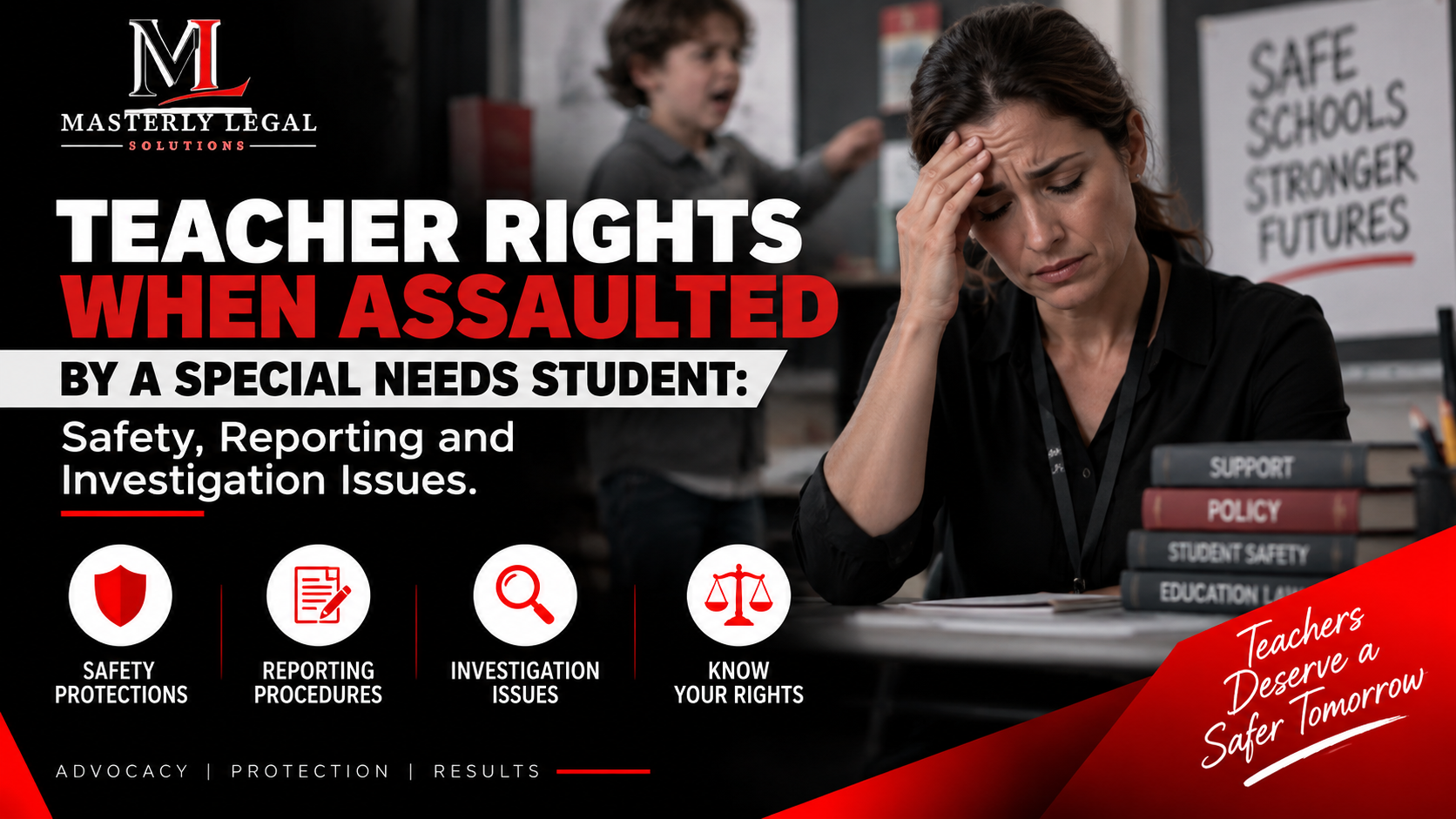
Teacher Rights When Assaulted by a Special Needs Student: Safety, Reporting and Investigation Issues



Looking for Legal & Business Solutions? Contact Us Now
Fill in the form or call us to set up a meeting





