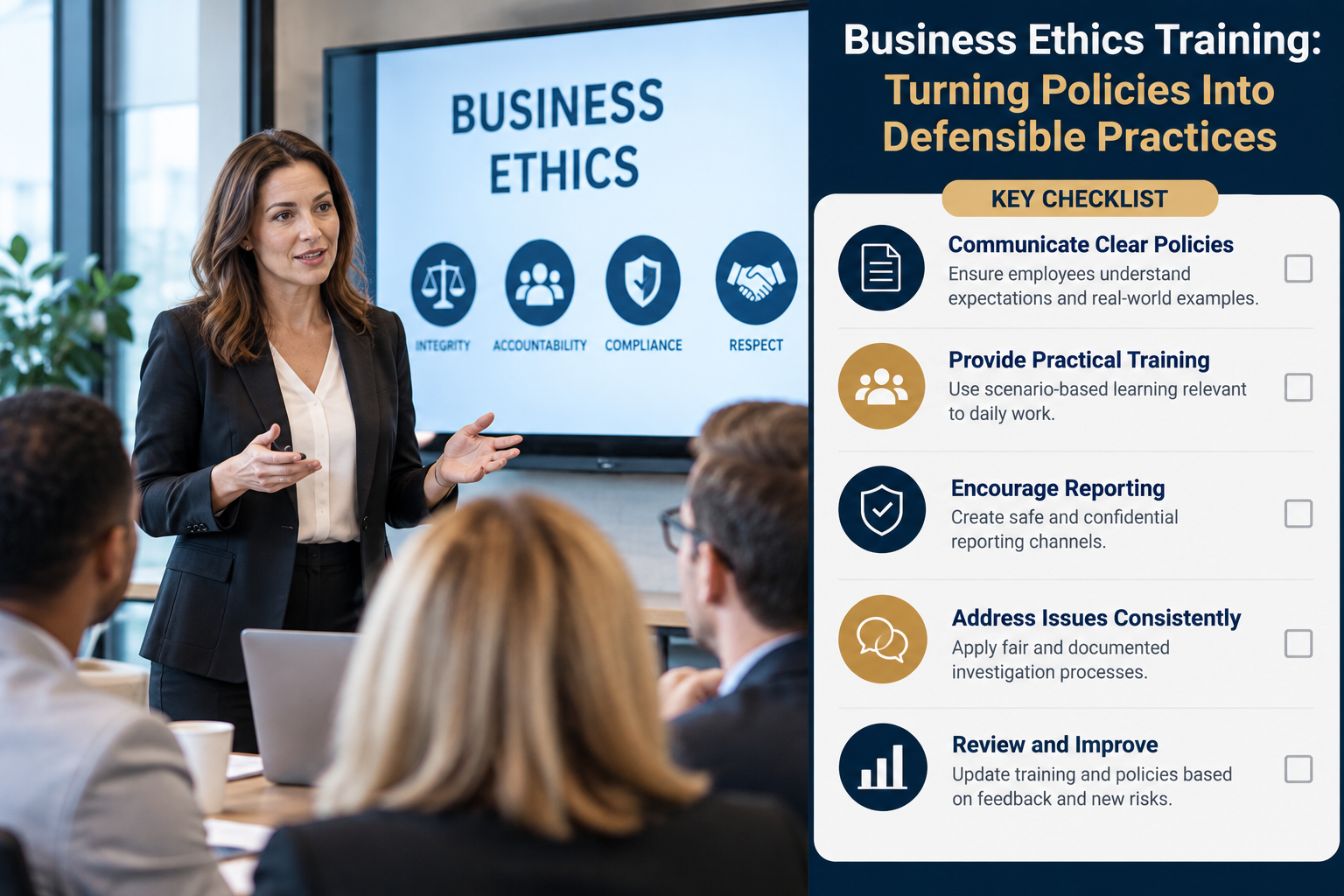
Business Ethics Training: Turning Policies Into Defensible Practices
An employee reports a conflict of interest, a supervisor ignores a workplace complaint, or a school administrator makes a decision without following established procedures. When these situations lead to disputes, an organization may discover that its written policies did not provide enough practical guidance.
Having a code of conduct is important, but it does not mean employees understand how to apply it.
Without clear expectations, managers may respond inconsistently, staff members may hesitate to report concerns, and leadership may struggle to explain how an important decision was made.
Business ethics training helps organizations connect workplace policies with responsible decisions, clear reporting procedures, and consistent management practices.
For school districts, educational institutions, and businesses, effective training can support stronger accountability while reducing uncertainty about workplace responsibilities.
At Masterly Legal Solutions, we provide customized legal training and compliance guidance for organizations seeking practical support with workplace standards, employee responsibilities, and management concerns.
Our goal is to help organizations understand where their policies may need attention and develop training that reflects their operations, risks, and professional responsibilities.
Where Workplace Policies Fail in Daily Decisions
Written policies establish expectations for employee conduct, but difficult situations rarely follow a perfect example.
A manager may receive an informal complaint during a meeting. An employee may question a financial decision. A department head may discover a possible conflict of interest involving a colleague.
Even when the organization has an employee handbook, the next step may not be clear.
When Employees Do Not Understand Reporting Expectations
Employees need to understand where they can report concerns, which reporting channels are available to them, and what happens after a report is received.
Unclear reporting procedures may create confusion about who should respond, whether information will remain confidential, and when concerns must be escalated. Clear reporting channels can help reduce fear of retaliation when employees raise concerns.
For schools and educational institutions, these questions can become especially important when allegations involve student welfare, workplace misconduct, misuse of resources, or employee behavior.
Business ethics training can help employees recognize the difference between an ordinary workplace disagreement and a concern that may require formal review, including when whistleblower protections may apply to reporting serious concerns.
Training should also explain that confidentiality is subject to applicable legal and investigative requirements.
When Managers Apply Policies Inconsistently
Two departments may respond differently to similar conduct because managers interpret the same policy in different ways.
This inconsistency can affect employee trust, undermine respect, and lead to questions about fairness.
A supervisor may believe an informal warning is appropriate, while another manager refers the same issue for disciplinary review.
Without clear guidance, these differences may expose weaknesses in the organization's decision-making process. Training helps managers apply ethical standards consistently across similar situations.
Ethics training for managers can address how supervisors interpret policies, recognize concerns, document decisions, and seek guidance when a situation is unclear so they can make better decisions.
When Ethical Concerns Become Legal Concerns
Not every unethical decision is illegal, but some ethical issues can also become legal concerns when they involve employment law, contractual obligations, privacy requirements, or regulatory duties.
For example, an employee complaint may involve discrimination, retaliation, harassment, or suspected financial misconduct. Some ethical challenges also require legal review because they involve regulatory, privacy, or employment obligations.
Organizations need to recognize when a matter requires legal review rather than ordinary workplace coaching.
A training program developed with legal guidance can help distinguish between everyday management responsibilities and situations that may require professional intervention.
Manager Responsibilities and Scenario-Based Ethics Training
Managers influence how workplace standards are understood and applied.
Employees often turn to supervisors first when they experience concerns or observe questionable conduct.
For this reason, leadership training should address more than general statements about honesty and professionalism.
Recognizing Conflicts of Interest
Conflicts of interest can arise when personal relationships, outside business interests, or financial arrangements affect professional decisions.
A school administrator may participate in a purchasing decision involving someone they know personally.
A company manager may have a financial interest in a potential supplier. Anti bribery concerns can also arise in vendor, customer, or government-facing roles.
These situations do not automatically establish misconduct, but they may require disclosure and review.
Manager training can clarify the organization's rules concerning conflicts, approvals, and documentation, and help managers recognize risk tied to gifts, favors, payments, or financial interests when reviewing conflicts.
Responding to Employee Complaints
When an employee raises a concern, a manager's response can affect whether the issue receives appropriate attention.
Supervisors may need guidance on recognizing serious allegations, avoiding premature conclusions, preserving relevant information, and involving the correct personnel.
They should also understand the organization's expectations concerning retaliation.
Employees must be able to speak up about legally protected concerns without facing prohibited adverse treatment. A strong speak up culture depends on employees knowing their concerns will be taken seriously.
An effective training program can address the responsibilities of supervisors who receive complaints, even when those supervisors are not responsible for conducting the investigation, including when employees need access to human resources, compliance personnel, or legal guidance.
Using Realistic Workplace Scenarios
Scenario-based learning is an interactive training approach that helps connect written policies with situations employees may actually encounter.
For example, a training session may examine how a manager should respond after receiving an allegation of favoritism or discovering inconsistent financial records. Interactive discussion is often more effective than lecture-only instruction for helping employees apply policy.
Participants can discuss the relevant policy, the limits of their authority, and when a concern should be referred for further review, while working through ethical dilemmas and making ethical decisions. Managers or teams can discuss the scenarios together.
For educational institutions, scenarios may involve administrative responsibilities, reporting concerns, conflicts of interest, or sensitive employment decisions.
These exercises, including case studies, help organizations assess whether managers understand the procedures they are expected to follow.
Building Employee Ethics Awareness Across the Organization
A workplace ethics program should not focus only on senior leadership.
Employees at different levels may encounter situations involving confidentiality, workplace conduct, conflicts of interest, and reporting responsibilities.
However, the information each person needs may vary according to their role.
Training for Frontline Employees
General employee training may address the organization's code of conduct, reporting procedures, professional expectations, company values, and the principles behind conduct that requires attention.
Clear communication is especially important so each employee understands what the standards mean in daily work, especially for employees who do not regularly work with legal or compliance materials.
Training should use understandable language and examples that reflect the workplace. The goal is to guide behavior before routine issues become larger problems.
Training for Supervisors and Department Leaders
Supervisors may need additional guidance because they make employment decisions, receive complaints, and oversee staff conduct, and their decisions influence ethical behavior across the workplace.
Their training may include documentation practices, escalation responsibilities, conflicts of interest, and the relationship between internal procedures and legal requirements. They may also need practical tools to handle ethical issues consistently.
School principals, district administrators, and department managers may also face specialized concerns tied to their leadership responsibilities.
Training for Senior Leadership
Executive leaders and governing bodies may need a broader understanding of organizational accountability.
This can include oversight responsibilities, policy consistency, internal reporting systems, and how significant concerns are reviewed, along with ethical leadership and the need for leaders to model the expectations they set.
Strong employee ethics awareness depends partly on whether leadership demonstrates the standards and integrity expected of the rest of the organization.
Training can support those efforts, but building an ethical culture also requires consistent decisions and appropriate follow-through.
Documenting Attendance, Training Results, and Escalation Procedures
Organizations often need records showing what training was provided, who participated, and which topics were addressed.
Documentation can support internal reviews, demonstrate organizational efforts, and identify areas where additional guidance may be useful.
However, attendance records alone do not prove that employees understand or follow the material.
Maintaining Useful Training Records
Depending on the organization's needs, training documentation may include:
- Session dates, training topics, and course materials
- Attendance and completion records
- Training materials and policy versions
- Employee acknowledgments
- Assessment results and participant feedback
- Records of required follow-up training
- Updates made after policy or legal changes
The appropriate records depend on the training program and any applicable regulatory requirements, and records for online ethics training may differ by delivery format.
Organizations should also consider privacy and retention obligations when storing employee information.
Establishing Clear Escalation Procedures
Employees and managers need to know when a concern must move beyond an immediate supervisor and which reporting channels to use.
Some matters may require review by human resources, compliance personnel, senior leadership, or legal counsel.
Escalation procedures should align with the company's code and actual internal responsibilities.
Other situations may involve separate reporting duties imposed by law.
A training program should reflect the organization's actual reporting structure rather than introduce procedures that do not exist in practice.
Legal review can help determine where existing policies need clarification.
Evaluating Whether Your Ethics Training Program Is Effective
Completion rates are useful, but they provide only part of the picture.
Organizations may also consider whether employees understand the material, recognize reporting channels, and apply ethical principles in realistic situations.
Participant feedback, knowledge assessments, and patterns identified through internal reviews can inform future training decisions.
Organizations may also watch for changes in morale or productivity when evaluating training results.
The purpose is to determine whether the organization is maintaining an effective ethics training program as it changes.
When Legal Review Strengthens a Business Ethics Training Program
Some organizations rely on general online courses or standard employee presentations.
These resources may help communicate basic workplace expectations, but they may not address the organization's specific legal risks.
Legal guidance becomes particularly valuable when policies involve regulated conduct, complex employment decisions, or past complaints.
Aligning Training With Workplace Policies
A training program should reflect the rules employees are actually expected to follow and the value those rules protect for the organization.
If the handbook describes one reporting procedure and training materials describe another, employees may become confused.
An attorney can review relevant policies and identify inconsistencies that deserve attention.
This may include codes of conduct, complaint procedures, anti-retaliation policies, conflict-of-interest rules, and disciplinary processes.
Aligned training helps employees apply the code of conduct to real situations rather than treating policies as abstract documents.
Addressing Compliance and Employment Risks
Corporate compliance training may involve legal requirements that differ depending on the organization's size, industry, workforce, location, role, and the type of company information employees can access.
Schools may also have obligations involving employee conduct, public accountability, discrimination complaints, or other education-specific requirements.
Some organizations should also address insider trading when employees may encounter confidential information or material nonpublic company information.
Intellectual property can also require attention when employees handle proprietary materials or digital resources.
A program should not assume that every workplace faces the same risks.
An organization with a history of reporting concerns may need a different training emphasis from one addressing recent policy changes or management growth.
Responding After an Internal Investigation
An investigation may reveal that employees misunderstood a policy or that supervisors were uncertain about their responsibilities.
Training can form part of an organization's response to those findings and help employees make more ethical choices after weaknesses are identified.
However, a training session does not replace an appropriate investigation, corrective action, or other legal obligations.
Counsel can help determine how training fits into the organization's broader response.
What to Discuss Before Hiring a Business Ethics Training Provider
Before engaging a legal training provider, organizations should identify the main concerns they want the program to address.
A school district may need management accountability training. A growing business may need a clearer reporting process. Another organization may want training that reflects updated policies following an investigation.
These differences affect the proposed scope of services.
Information Useful for an Initial Consultation
An organization may benefit from gathering its existing code of conduct, relevant employee policies, reporting procedures, an overview of the groups requiring training, and information about current ethics training topics and known areas of concern.
Other useful details include workforce size, locations, leadership structure, prior training programs, and known areas of concern.
Sensitive investigation records should be shared only through appropriate, authorized channels. Emerging issues such as artificial intelligence or responsible AI may also be relevant depending on the workplace.
Confirming Training Scope and Deliverables
A legal training proposal should clarify what the engagement includes.
Potential considerations include audience groups, subjects covered, delivery format, training materials, attendance tracking, participant assessments, and whether follow-up support is available.
Organizations should also discuss the expected schedule, fees, responsibilities, and process for reviewing training content.
These conversations help leadership evaluate whether the proposed program fits its operational and legal needs.
How Masterly Legal Solutions Supports Customized Ethics and Compliance Training
Masterly Legal Solutions provides legal services and customized training employees can apply in daily work for businesses and organizations.
Our published services include employee ethics training, compliance-related education, and guidance addressing workplace policies, management accountability, and organizational concerns.
We recognize that a school district, private company, and professional organization may have different responsibilities.
A useful training program should account for those differences and help create a stronger culture of accountability and support.
Depending on the engagement, our legal training services can help organizations address relevant policies, conflicts of interest, reporting expectations, practical ethical decision-making, and management responsibilities.
We focus on making legal and compliance topics understandable for the people expected to apply them.
Organizations seeking business ethics training can contact our team to discuss their objectives, including the importance of matching training scope to organizational needs, evaluate the appropriate training scope, and learn more about available services.
Training employees with realistic examples can help build trust and support long term success.
Training can strengthen understanding and support responsible practices, but it cannot guarantee that misconduct, regulatory violations, or employment disputes will never occur.
Frequently Asked Questions About Business Ethics Training
Who should receive manager ethics training?
Supervisors, department heads, school administrators, executives, and other employees with management responsibilities may benefit from manager ethics training. The specific topics should reflect their authority, reporting duties, and workplace risks.
How often should a compliance program be refreshed?
There is no single schedule that fits every organization. Training should be reviewed when laws, policies, business operations, or workplace risks change, and refresher sessions can help employees recognize changing ethical challenges over time. Periodic refresher sessions may also help employees maintain awareness of important responsibilities.
What is business ethics training?
Business ethics training helps employees and leaders understand workplace conduct standards, conflicts of interest, reporting expectations, and ethical decision making in everyday situations. The goal is to support ethical behavior and practical decisions, not just policy awareness. Programs may be tailored to the organization's policies and legal obligations.
Is business ethics training the same as corporate compliance training?
Not exactly. Business ethics training focuses on responsible conduct and workplace decisions. Corporate compliance training generally addresses applicable laws, regulations, and organizational requirements. The subjects often overlap.
Why is ethics training important for school administrators?
School administrators regularly make decisions involving employees, public resources, sensitive information, and institutional responsibilities. Ethics training can help clarify expectations and reinforce consistent management practices.
Can an attorney help customize employee ethics training?
Yes. An attorney familiar with workplace and compliance matters can review policies, identify legal considerations, and help develop training appropriate for an organization's needs.
Does completing ethics training protect an organization from lawsuits?
No. Training does not provide automatic protection against legal claims. However, appropriate training can support clearer workplace standards, better reporting practices, and a more organized compliance program.
Educate First: Discuss Business Ethics Training With Masterly Legal Solutions
Written policies are important, but organizations also need employees and managers who understand how those policies apply to real decisions.
Effective business ethics training helps employees face real workplace ethical issues with clearer guidance while supporting clearer expectations, responsible management practices, employee ethics awareness, and more consistent reporting procedures.
For schools, businesses, and professional organizations, the right approach begins with understanding the workforce, existing policies, and areas of legal concern.
Masterly Legal Solutions offers customized legal training and compliance guidance for organizations seeking professional support.
Whether your organization needs ethics training for managers, policy-related employee education, or a broader discussion about corporate compliance training, our team welcomes qualified inquiries.
Practical training can also support more consistent ethical decisions across the organization.
Contact Masterly Legal Solutions to discuss your training needs, explore available services, and determine an appropriate next step.
Phone: (972) 236-5051
Website:https://www.masterlylegal.com/
Request a consultation to discuss customized business ethics training for your organization.



Looking for Legal & Business Solutions? Contact Us Now
Fill in the form or call us to set up a meeting