

CPS Houston and Safety Plans: What You Should Understand Before Agreeing
The Moment Everything Changes for a Family
Few situations create more anxiety for parents than learning that Child Protective Services has become involved in their lives. One phone call, one home visit, or one conversation with a CPS caseworker can leave parents feeling confused, overwhelmed, and uncertain about what comes next.
Many families are introduced to CPS not through a courtroom or criminal allegation, but through a request to sign a safety plan. At first glance, the request may seem simple. A caseworker may explain that the agreement is voluntary and designed to protect a child while concerns are reviewed.
However, many parents do not fully understand how a safety plan can affect their family, their parental rights, and the direction of an ongoing CPS investigation. Before agreeing to any restrictions, requirements, or conditions, it is important to understand what is happening and how those decisions may impact your future.
Why CPS Houston Cases Often Begin With Safety Concerns
Every CPS Houston case begins with a report.
Child Protective Services receives reports from teachers, doctors, nurses, counselors, family members, neighbors, law enforcement officers, and other individuals who believe a child may be at risk. The report may involve allegations of child abuse, child neglect, unsafe living conditions, substance abuse concerns, domestic disputes, or other issues affecting a child's safety.
Once CPS receives a report, the agency evaluates the information and determines whether an investigation should begin. If investigators believe there may be concerns regarding abuse or neglect, a caseworker may be assigned to investigate further.
For many parents, this is the first time they learn that someone has raised concerns about their family.
Understanding the Role of Child Protective Services
Child Protective Services is part of the Texas Department of Family and Protective Services.
The agency's mission is to protect children while investigating allegations involving child abuse or neglect. When CPS investigates reports, its primary objective is determining whether a child faces safety risks that require intervention.
Many parents assume CPS only becomes involved in extreme situations. In reality, investigations can begin because of concerns raised by mandatory reporters, school personnel, healthcare providers, or other individuals who believe a child may need protection.
The agency has broad authority to investigate allegations, gather relevant information, and recommend services or interventions when deemed necessary.
What Is a CPS Safety Plan?
A safety plan is an agreement designed to address concerns identified during a CPS investigation.
The plan typically outlines specific actions that parents, family members, or caregivers are expected to follow while the investigation remains active. The goal is often to reduce perceived risks without immediately seeking court intervention.
A safety plan may address supervision requirements, living arrangements, contact restrictions, medical care, school attendance, or other concerns identified by the CPS caseworker.
Although many safety plans are described as voluntary, families should understand that these agreements can significantly influence how the investigation proceeds.
Why Parents Often Feel Pressured to Agree
When CPS becomes involved, emotions often run high.
Parents may feel afraid that refusing a safety plan could lead to child removal, foster care placement, or court action. In some situations, families agree to conditions they do not fully understand because they are trying to avoid conflict with investigators.
The fear of losing time with their kids can cause parents to make quick decisions without considering the long-term consequences.
Unfortunately, what seems like a temporary agreement can sometimes create challenges later in the investigation process.
The Difference Between a Safety Plan and a Court Order
Many families mistakenly believe a safety plan carries the same legal weight as a court order.
A court order is issued by a judge and carries legal authority enforced through the court system. A safety plan, by contrast, is generally an agreement between the family and Child Protective Services CPS during an active investigation.
Even though a safety plan may not initially be a court order, failure to comply can still create serious concerns. CPS may view noncompliance as evidence that additional intervention is necessary.
This is why understanding every provision before agreeing is so important.
Why Safety Plans Deserve Careful Review
A safety plan may seem straightforward when presented by a CPS caseworker.
However, these agreements often contain conditions that affect daily life, family relationships, parenting decisions, and living arrangements. Some parents agree simply because they want the investigation to end as quickly as possible.
The reality is that safety plans often become important pieces of evidence later in the case.
Before signing any document, parents should understand how the terms may affect their interests and the overall outcome of the investigation.
Common Requirements Found in Safety Plans
Every CPS case is different, but certain requirements appear frequently.
A safety plan may require:
- Supervised contact with a child
- Temporary relocation of a parent
- Restrictions involving certain family members
- Participation in counseling services
- Drug or alcohol testing
- Compliance with medical recommendations
- Specific school attendance requirements
While some conditions may seem reasonable, others can have significant consequences if accepted without careful consideration.
Why CPS Focuses on the Child's Safety
The agency's primary concern is the child's safety.
When CPS receives allegations involving abuse or neglect, investigators are trained to evaluate risks and determine whether protective services intervention is necessary. Every decision made during the investigation is generally framed around protecting children from potential harm.
Parents may disagree with the conclusions reached by investigators, but understanding the agency's perspective can help families navigate the process more effectively.
Knowing why certain requests are made often provides important context during interactions with CPS.
How CPS Investigates Reports
The CPS investigation process often begins quickly.
After a report is received, a CPS caseworker may contact parents, visit the home, interview the child, speak with family members, review medical records, and gather other relevant information.
Investigators may also contact schools, healthcare providers, social services agencies, or other individuals connected to the allegations.
The information collected during this phase often influences whether CPS findings support the allegations or whether the case is ultimately closed.
What a CPS Caseworker Is Evaluating
A CPS caseworker is responsible for gathering facts and assessing risks.
The caseworker may evaluate physical conditions within the home, parenting practices, supervision arrangements, educational concerns, medical care, and relationships among family members.
Investigators are also looking for evidence that may support or contradict allegations of child abuse or child neglect.
Every statement, document, and observation may become part of the case file.
Why Statements Matter During a CPS Investigation
Many parents believe that simply explaining their side of the story will resolve concerns.
While communication is important, statements made during an investigation can have lasting consequences. Comments made to a CPS caseworker may later appear in reports, findings, administrative hearings, or court proceedings.
This does not mean parents should refuse to cooperate.
Instead, families should understand that every conversation may influence how investigators interpret the circumstances.
When Medical Concerns Trigger CPS Involvement
Medical professionals are among the most common mandatory reporters.
Doctors, nurses, and healthcare providers may contact Child Protective Services if they suspect child abuse, child neglect, inadequate medical care, or other safety concerns.
In some situations, a misunderstanding regarding treatment decisions can lead to a report. In other cases, injuries, developmental concerns, or medical conditions may raise questions that require investigation.
Because medical records often become part of the evidence reviewed by CPS, these cases can become particularly complex.
School Reports and Safety Plan Recommendations
Schools also play a significant role in many CPS investigations.
Teachers, counselors, coaches, and administrators are often required to report suspected child abuse or neglect. A child's behavior, attendance, hygiene, statements, or physical condition may lead school personnel to file a report, and educators who become involved in these situations may benefit from guidance from a Texas education law firm focused on TEA license defense and school investigations.
Once CPS becomes involved, school records may become part of the investigation.
Information gathered from a school setting frequently influences safety plan recommendations and other decisions made by investigators.
Why Family Members Sometimes Become Part of a Safety Plan
Safety plans often involve more than just parents.
Grandparents, aunts, uncles, siblings, and other family members may be asked to assist with supervision or temporary living arrangements. CPS may view these individuals as resources that help address concerns while allowing children to remain connected to their family.
Although these arrangements may appear temporary, they can significantly affect family dynamics.
Parents should understand exactly what role each person will play before agreeing to any plan, and they should also consider how broader planning steps like securing essential legal documents for their family before age 40 can support long‑term stability.
How Safety Plans Can Affect Child Custody Issues
Many parents are surprised to learn that a safety plan may influence future child custody disputes.
If a divorce, custody modification, or child support matter arises later, documents created during a CPS investigation could become relevant. Allegations, findings, and safety plan agreements may be reviewed by attorneys, judges, or other decision-makers, just as they might be in matters handled by a Dallas estate planning firm that prepares personalized wills and trusts.
This does not mean every safety plan will affect future custody decisions.
However, families should recognize that these agreements often have implications extending beyond the immediate CPS investigation.
Why Early Legal Assistance Can Make a Difference
One of the biggest mistakes parents make is waiting too long to seek legal assistance.
Many believe they can handle the situation alone because they have done nothing wrong. Unfortunately, CPS investigations often move quickly, and important decisions may be made before families fully understand the process.
An experienced attorney can help review safety plan terms, evaluate allegations, protect parental rights, and identify potential risks before they become larger problems, especially when working with a comprehensive Texas law firm offering a wide range of legal services.
The earlier legal guidance is obtained, the more opportunities may exist to protect a family's future.
Understanding the Stakes Before Signing Anything
When parents are dealing with CPS, it is natural to focus on immediate concerns.
However, every decision made during the investigation can affect the outcome of the case. A safety plan may influence future CPS findings, custody disputes, court proceedings, and administrative hearings.
Before signing any agreement, families should take the time to understand what they are accepting and how those decisions may affect their life moving forward.
Being informed is one of the strongest forms of protection available during a CPS investigation.
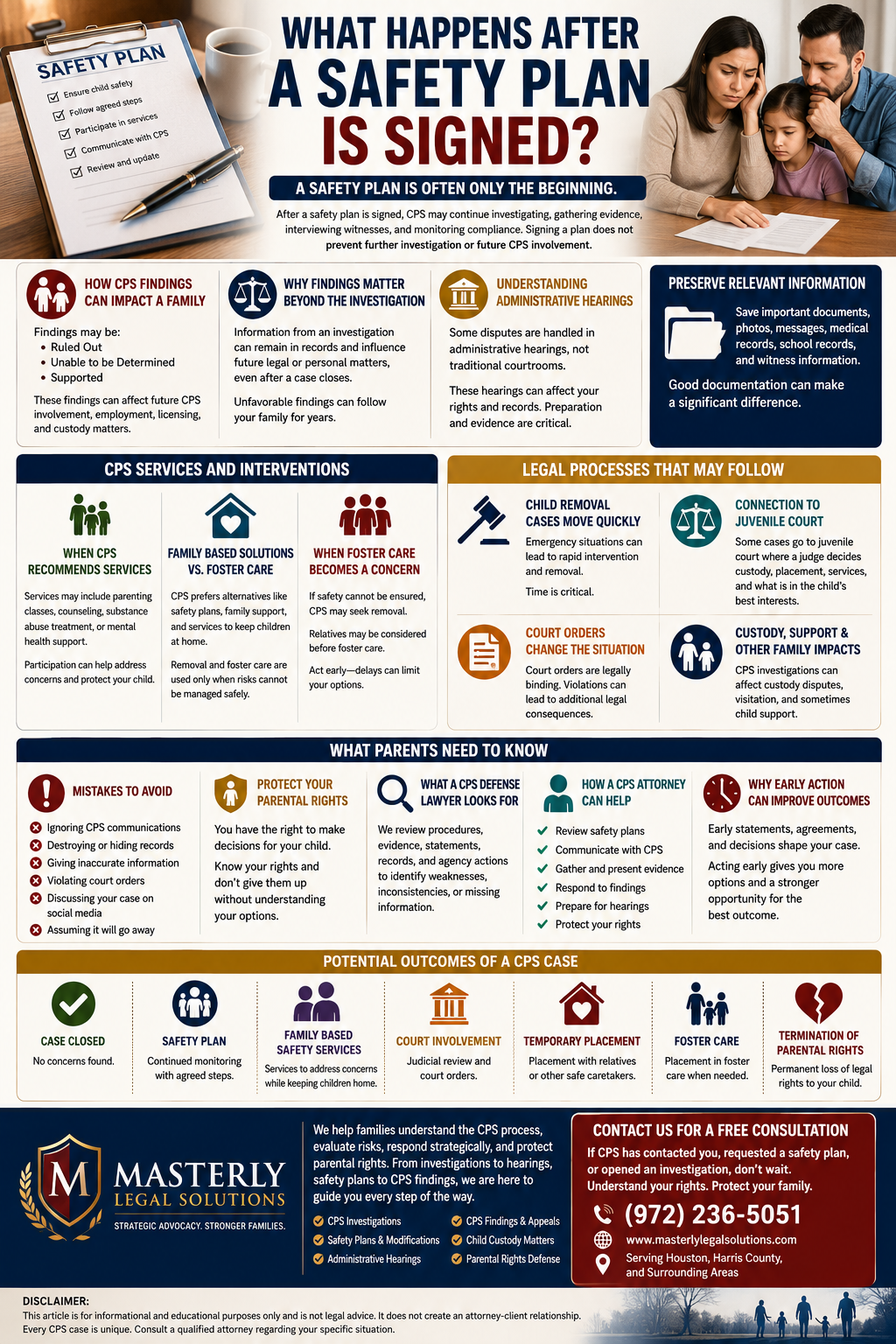
What Happens After a Safety Plan Is Signed?
Many parents believe signing a safety plan marks the end of the problem.
In reality, a safety plan is often only the beginning of a much larger process. Once an agreement is in place, CPS may continue gathering evidence, interviewing witnesses, reviewing records, and evaluating whether additional action is necessary.
The agency will typically monitor compliance with the plan and assess whether the concerns that triggered the investigation have been adequately addressed.
Parents should understand that signing a safety plan does not automatically prevent further investigation or future CPS involvement.
How CPS Findings Can Impact a Family
At the end of an investigation, CPS may issue findings regarding the allegations.
These CPS findings can have significant consequences depending on the circumstances. The agency may determine that allegations were ruled out, unable to be determined, or supported by the evidence gathered during the investigation.
Many families focus only on keeping their child at home, but the findings themselves can have lasting effects.
Understanding how CPS findings may affect future legal processes is critical when responding to allegations of abuse or neglect.
Why Findings Matter Beyond the Investigation
A CPS investigation does not always end when a case closes.
Certain findings may affect future interactions with Child Protective Services, employment opportunities, licensing matters, or custody disputes. Information generated during an investigation can remain relevant long after the immediate concerns have passed.
Parents sometimes assume that if their child remains in the home, the case no longer matters.
Unfortunately, unresolved concerns or unfavorable findings may continue affecting the family in unexpected ways.
Understanding Administrative Hearings
Not every dispute involving CPS takes place in a traditional courtroom.
Some cases involve administrative hearings where parents challenge certain CPS findings or agency decisions. These hearings follow specific legal processes and often require preparation, evidence, and a clear understanding of applicable procedures.
Families frequently underestimate the importance of these proceedings.
Administrative hearings can significantly impact future rights, records, and opportunities.
The Importance of Preserving Relevant Information
One of the most valuable things a parent can do during a CPS investigation is preserve relevant information.
Documents, photographs, medical records, school records, text messages, emails, and witness information may all become important evidence. The ability to present accurate information often influences how allegations are evaluated.
Families should avoid deleting records or assuming information will not matter later.
Proper documentation frequently becomes one of the strongest tools available during a CPS case.
When CPS Recommends Services
In many situations, CPS recommends services rather than immediate court intervention.
These services may include parenting classes, counseling, substance abuse treatment, mental health evaluations, or other support programs. The agency often views participation as a way to address concerns while protecting the child's safety, and some families also turn to a Texas firm that advises individuals, nonprofits, and corporations on employment and investigation matters for additional guidance.
Parents should carefully review what is being requested and understand how participation may affect the case.
Knowing why services are recommended can help families make informed decisions moving forward.
Family Based Solutions Versus Foster Care
Whenever possible, CPS generally seeks alternatives to foster care, while families may also seek support from a full‑service Texas law firm offering estate planning, HR consulting, and other legal services.
The agency may work with family members, develop safety plans, or recommend supportive services designed to allow children to remain connected to their families. These options are often viewed as less disruptive than removal from the home, and they may intersect with issues handled by a Texas law firm experienced in education law, estate planning, and business consulting.
However, if investigators believe risks cannot be managed through voluntary measures, more serious interventions may be considered.
This is why early action and preparation can be so important.
When Foster Care Becomes a Concern
Few fears are greater for parents than the possibility of foster care placement.
If CPS believes a child's safety cannot be protected through less restrictive measures, the agency may seek removal and placement outside the home. In some situations, relatives may be considered before foster care becomes necessary.
The possibility of removal creates tremendous stress for families.
Understanding available options before a crisis develops often provides the best opportunity to protect parental rights and family stability.
Child Removal Cases Move Quickly
Cases involving potential child removal often move faster than parents expect.
The agency may seek emergency intervention when it believes a child faces immediate risks. These situations frequently involve accelerated timelines and significant legal consequences.
Because so much can happen within a short period, parents should act quickly when serious allegations arise.
Delays can limit opportunities to respond effectively and present evidence supporting the family.
The Connection Between CPS and Juvenile Court
Certain CPS matters may eventually involve juvenile court proceedings.
When the agency seeks judicial intervention, a judge may review evidence, hear testimony, and make decisions regarding custody, placement, visitation, or services.
These proceedings often focus on what is considered to be in the child's best interests.
Parents should understand that court involvement introduces additional legal complexities.
Proper preparation becomes increasingly important when a case reaches this stage.
Why Court Orders Change the Situation
A court order carries legal authority that differs significantly from a voluntary safety plan.
Once a judge issues an order, parents are generally required to comply with its terms. Violations may create additional legal consequences and affect future proceedings.
For this reason, families should fully understand any orders affecting custody, visitation, or participation in services.
Legal representation often becomes especially important once court orders enter the picture.
How Child Custody Disputes Can Become More Complicated
A CPS investigation can create challenges in existing child custody arrangements.
Allegations involving abuse, neglect, supervision concerns, or safety issues may influence custody disputes between parents. Information gathered during the investigation may later be reviewed in family law proceedings.
This does not mean every CPS case changes custody arrangements.
However, families should understand how the investigation may affect related legal matters.
Child Support and CPS Cases
Although child support issues are separate from CPS investigations, the two matters occasionally intersect.
Changes in custody arrangements, temporary placements, or court decisions may influence support obligations in certain circumstances. Parents often focus on immediate safety concerns and overlook potential financial implications.
Understanding how various legal issues connect can help families prepare for the future.
A comprehensive approach often leads to better outcomes.
When Allegations Stem From Misunderstandings
Not every report involves intentional wrongdoing.
Many CPS investigations begin because of misunderstandings, incomplete information, medical concerns, school-related issues, or disagreements among family members. Unfortunately, once a report is made, the agency still has an obligation to investigate.
Parents should not assume that a misunderstanding will automatically resolve itself.
Responding appropriately remains important regardless of the circumstances surrounding the report.
Why Parents Need to Protect Their Parental Rights
Parental rights are among the most significant legal rights recognized under Texas law.
These rights include the ability to make decisions regarding a child's education, medical care, religious upbringing, and daily life. CPS involvement can create challenges that affect those rights if concerns are not addressed properly.
Understanding and protecting parental rights should remain a priority throughout the investigation, and some families also explore tools like a power of attorney for their children’s health and financial decisions as part of a broader protection plan.
Knowledge and preparation often make a meaningful difference.
What a CPS Defense Lawyer Looks for in a Case
A CPS defense lawyer evaluates far more than the allegations themselves.
The attorney may review investigation procedures, witness statements, documentation, medical records, school information, safety plans, and agency actions. Identifying weaknesses, inconsistencies, or missing information can be critical.
Every detail matters when defending against allegations involving child abuse or neglect.
A strong defense often begins with understanding the complete picture.
How a CPS Attorney Can Assist Families
A CPS attorney provides more than courtroom representation.
Legal counsel may assist with reviewing safety plans, communicating with investigators, preparing written responses, gathering evidence, responding to CPS findings, and preparing for hearings. The goal is to help families navigate the process strategically rather than react emotionally.
Having knowledgeable guidance often reduces confusion and uncertainty, especially when that guidance includes estate planning and trust creation services to protect family assets.
It also helps parents better understand their rights and options.
Why Early Action Can Improve the Outcome
The earliest stages of a CPS investigation are often the most important.
Statements made to investigators, agreements signed during interviews, and decisions regarding services can all influence the direction of the case. Waiting until serious consequences develop may limit available options.
Families who act early are often in a stronger position to protect their interests.
Preparation and informed decision-making frequently improve the overall outcome.
How Masterly Legal Solutions Helps Families Facing CPS Issues
At Masterly Legal Solutions, we understand how overwhelming a CPS investigation can feel. Many parents contact our law firm after receiving a call from a CPS caseworker, being asked to sign a safety plan, or learning that allegations have been made against them.
Our team focuses on helping families understand the process, evaluate risks, respond strategically, and protect parental rights. We work hard to help clients navigate Child Protective Services investigations, administrative proceedings, CPS findings, and related legal matters.
Whether you are dealing with a new investigation or trying to understand the implications of a proposed safety plan, our experience and expertise can help you make informed decisions about your family's future.
Why Families Choose Masterly Legal Solutions
Families facing CPS involvement often need more than general legal information.
They need practical guidance, honest answers, and professional support from attorneys who understand how Child Protective Services cases develop. Our office focuses on helping clients prepare for investigations, respond to allegations, protect their interests, and pursue the strongest possible outcome.
Every family deserves an advocate who understands the seriousness of CPS involvement, such as a Texas law firm that offers tailored, client‑centric legal and business services.
We are committed to helping our clients navigate these difficult circumstances with confidence and clarity.
Understanding Alleged Abuse Claims and CPS Requirements During an Investigation
One of the most stressful parts of a CPS investigation is learning that a report involves alleged abuse of a child. Even when parents strongly disagree with the allegations, Child Protective Services is generally required to investigate and gather information before making a determination. During this stage, families may receive requests for interviews, records, or other documentation as investigators work to evaluate the complaint that triggered the case. It is important to remember that allegations alone do not establish wrongdoing, but they can become the subject of a detailed review by the agency.
As the investigation moves forward, parents may be asked to comply with specific CPS requirements, including interviews, home visits, participation in services, or adherence to a particular visitation schedule. In some situations, families may choose to submit a written request seeking records, clarification, or additional information related to the case. Because every investigation is different, obtaining guidance from a qualified attorney can help families better understand their rights and responsibilities. An experienced law office familiar with CPS matters can help review allegations, explain agency requirements, and assist families in responding strategically while protecting their parental rights and long-term interests.
How CPS Receives Reports of Child Abuse or Neglect and Why Legal Representation Matters
Every CPS investigation begins when CPS receives a report alleging possible child abuse or abuse or neglect involving a minor. These reports may come from teachers, doctors, counselors, family members, neighbors, or other individuals who believe a child may be at risk. Once the report is submitted, Child Protective Services is required to evaluate the information and determine whether an investigation is necessary. Even when allegations are ultimately found to be unsubstantiated, the investigation itself can have a significant impact on a family and create concerns about parental rights, custody arrangements, and the future.
Because CPS investigations can move quickly, many families benefit from obtaining legal representation as early as possible. An experienced law firm can help parents understand the allegations, respond appropriately to requests from investigators, and protect their interests throughout the process. Whether the concerns involve alleged child abuse, neglect, or another safety issue, guidance from a knowledgeable law office can help families navigate the investigation with greater confidence. Early legal assistance often allows parents to make informed decisions while working to protect both their family and their child's future.
How the Right Law Firm and Law Office Can Help During a CPS Investigation
When Child Protective Services becomes involved, many parents quickly realize that the situation is more complicated than they initially expected. A CPS investigation can affect parental rights, family relationships, custody arrangements, and even future opportunities. Working with an experienced law firm can provide families with valuable guidance during a stressful and uncertain time. Understanding the investigation process, responding appropriately to requests from CPS, and protecting important legal interests often requires careful planning and informed decision-making.
An experienced law office can help families understand the allegations, evaluate available evidence, prepare responses, and navigate the challenges that frequently arise during CPS investigations. Whether the concerns involve a safety plan, allegations of abuse or neglect, custody issues, or potential court involvement, legal guidance can help families make informed decisions throughout the process. Having knowledgeable legal support can often make a significant difference in helping parents protect their rights, their children, and their family's future.
Contact Masterly Legal Solutions for a Free Consultation
If CPS has contacted you, requested that you sign a safety plan, opened an investigation, or raised concerns involving child abuse or neglect, it is important to understand your rights before making decisions that could affect your family for years to come.
At Masterly Legal Solutions, we know how quickly a CPS case can become overwhelming. Questions about safety plans, custody concerns, CPS findings, foster care risks, and parental rights often arise before families have time to understand the process. Our team is available to answer your questions, explain your options, and help you develop a strategy designed to protect your child, your rights, and your future.
Contact Masterly Legal Solutions today at (972) 236-5051 for a free consultation. We are ready to listen, provide guidance, and help you take proactive steps before a CPS investigation creates unnecessary challenges for your family and your life.
Disclaimer: This article is provided for informational and educational purposes only. It is not legal advice and should not be relied upon as legal guidance for any specific situation. Reading this article does not create an attorney-client relationship with Masterly Legal Solutions. Every CPS case involves unique facts and circumstances that may affect the outcome. If you need legal advice regarding a CPS investigation, safety plan, child custody matter, CPS findings, or any related legal issue, consult directly with a qualified attorney regarding your specific situation.





Looking for Legal & Business Solutions? Contact Us Now
Fill in the form or call us to set up a meeting