Business Consultant Employment Tactics That Reduce Risk and Boost Business Longevity
Why Employment Decisions Often Determine Whether a Business Thrives or Struggles
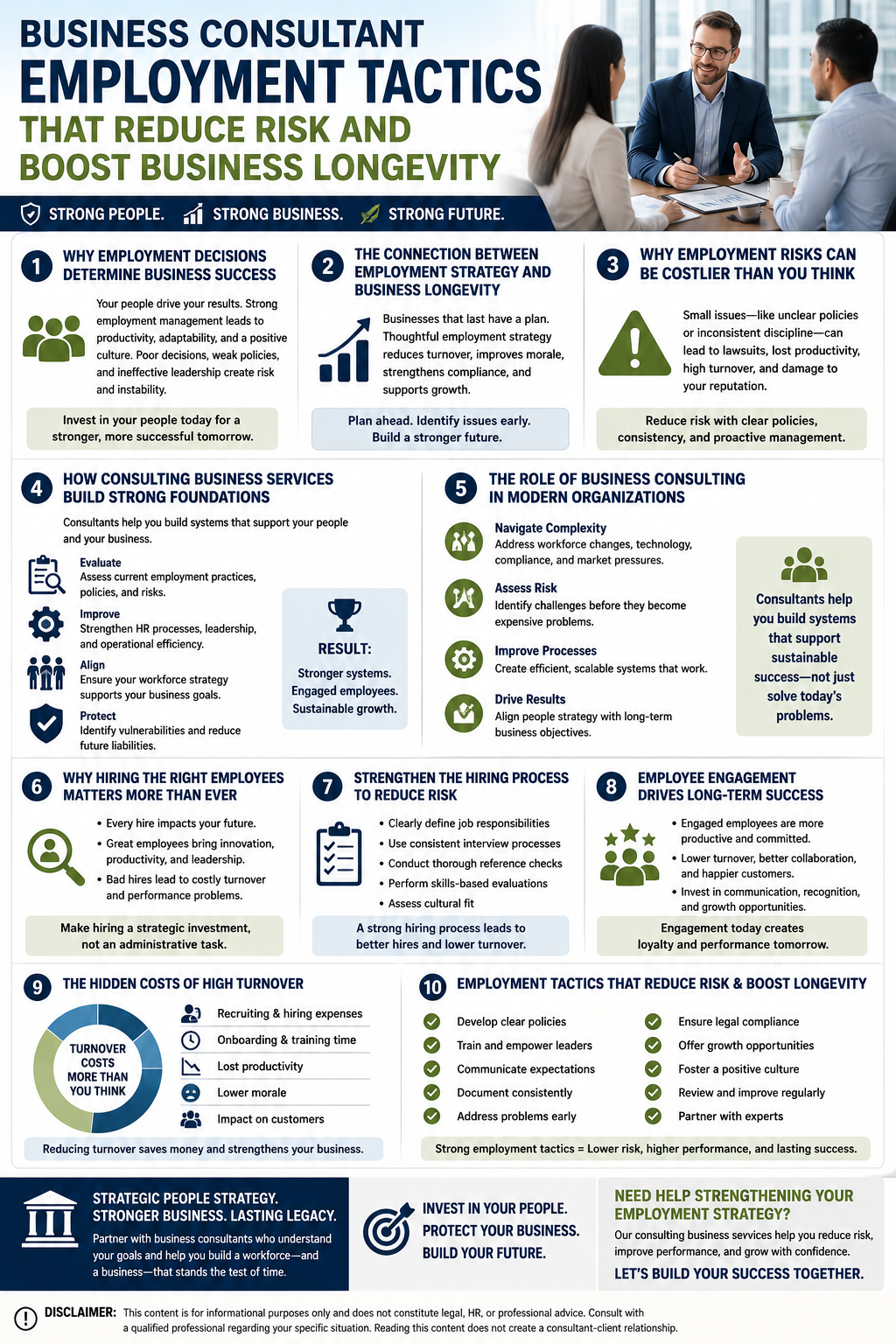
Many business owners spend countless hours focusing on sales, marketing, operations, and customer service. While those areas are critical, one of the most overlooked factors affecting long-term success is employment management. The people within an organization often determine whether a company experiences sustainable growth or ongoing instability.
A strong workforce can help a business adapt to changing market conditions, improve productivity, and create a positive culture. On the other hand, poor hiring decisions, weak policies, and ineffective leadership can expose a company to unnecessary risk. This is why many organizations seek professional guidance through consulting business services to strengthen their employment practices.
The reality is simple: businesses that invest in their people often place themselves in a better position for long-term success.
The Connection Between Employment Strategy and Business Longevity
Business longevity rarely happens by accident.
Companies that survive economic downturns, leadership transitions, workforce shortages, and changing customer expectations often have one thing in common: a thoughtful employment strategy. They understand that employees are not simply positions on an organizational chart but valuable contributors to the company's future.
Effective employment planning helps reduce turnover, improve morale, strengthen compliance, and support growth initiatives. A proactive approach often allows businesses to identify problems before they become expensive liabilities.
This is one reason why business leaders increasingly turn to business consulting services that address HR, marketing, and strategy challenges for guidance.
Why Employment Risks Can Be More Expensive Than Business Owners Realize
Many employment problems begin as small issues.
A poorly written policy, inconsistent disciplinary process, unclear job expectations, or inadequate hiring process may not appear significant at first. However, these issues can eventually lead to costly disputes, reduced productivity, and high turnover.
When employment challenges become widespread, they often affect operations, employee engagement, and customer satisfaction. The resulting financial impact can be substantial.
Reducing these risks requires more than good intentions. It requires planning, structure, and ongoing evaluation.
How Consulting Business Services Help Organizations Build Strong Foundations
Successful organizations understand that growth requires structure.
Professional consulting business services such as comprehensive business consulting that supports formation, planning, and operational efficiency often focus on helping companies establish systems that support both operational efficiency and workforce stability. This includes evaluating employment practices, leadership development, human resources procedures, and organizational strategy.
Rather than reacting to problems after they occur, consultants help organizations identify vulnerabilities and develop solutions before issues become disruptive.
This proactive approach often creates significant long-term value for businesses of all sizes.
The Role of Business Consulting in Modern Organizations
Today's workplace is far more complex than it was a generation ago.
Organizations must navigate changing workforce expectations, technology advancements, compliance obligations, and competitive labor markets. These challenges have increased demand for professional business consulting services across multiple industries.
Consultants help organizations assess risks, improve processes, and align workforce strategies with broader business objectives. Their role often extends beyond solving immediate problems.
The goal is to help businesses build systems that support sustainable growth and long-term success.
Why Hiring the Right Employees Matters More Than Ever
Every hiring decision affects the future of an organization.
A strong employee can contribute innovation, productivity, and leadership potential. A poor hiring decision can create performance issues, morale problems, and increased costs associated with turnover.
The hiring process should be viewed as a strategic investment rather than an administrative task. Businesses that approach hiring thoughtfully often experience stronger workforce stability.
This is one area where management consultants frequently provide valuable guidance and analysis.
Strengthening the Hiring Process to Reduce Risk
A well-designed hiring process helps organizations make informed decisions.
Many companies rush to fill vacancies without thoroughly evaluating candidates. While this may solve a short-term staffing need, it can create larger problems later.
Effective hiring practices often include:
- Clearly defined job responsibilities
- Consistent interview procedures
- Thorough reference checks
- Skills-based evaluations
- Cultural fit assessments
Businesses that strengthen their hiring process often reduce costly turnover and improve overall performance.
Why Employee Engagement Impacts Long-Term Success
Employees who feel valued are often more productive and committed to organizational goals.
Employee engagement is not simply about job satisfaction. It reflects the connection employees feel toward their work, leadership, and the company's mission.
Organizations with strong employee engagement often experience lower turnover, stronger collaboration, and improved customer experiences.
Investing in engagement initiatives can provide meaningful returns over time.
How High Turnover Creates Hidden Business Costs
Many organizations focus on visible expenses while overlooking the cost of employee turnover.
Replacing employees often requires recruiting expenses, training resources, onboarding efforts, and lost productivity. In some industries, high turnover can disrupt client relationships and weaken organizational knowledge.
The financial impact extends far beyond the cost of filling an open position.
Reducing turnover often begins with understanding why employees leave and addressing those underlying issues.
The Importance of Human Resources in Risk Reduction
Effective human resources practices help organizations create consistency and accountability.
Human resources professionals often play a critical role in recruitment, onboarding, training, performance management, and policy development. Strong HR systems, supported by specialized HR consulting and training services, help businesses manage risk while supporting employee development.
Unfortunately, some companies view human resources as an administrative necessity rather than a strategic asset.
Organizations that leverage HR effectively often create stronger workplace cultures and more stable operations.
Why Leadership Development Supports Business Growth
Strong leadership is one of the most important predictors of organizational success.
Employees often stay with organizations because of positive leadership and leave because of ineffective management. Developing leaders who communicate effectively, resolve conflicts, and support employee growth can significantly improve retention.
Leadership development is not limited to executives.
Managers throughout an organization influence workplace culture and employee performance every day.
Strategic Planning and Workforce Stability
Strategic planning should include workforce considerations.
Many organizations focus exclusively on financial goals, market expansion, and operational improvements while overlooking talent management. However, growth initiatives often depend on having the right people in place.
Strategic planning helps organizations anticipate future staffing needs, leadership transitions, and workforce challenges.
Businesses that integrate workforce planning into broader strategy often position themselves for more sustainable growth.
Learning From Industry Practices
Successful companies often study proven industry practices.
By examining what works across various sectors, organizations can identify opportunities for improvement and avoid common mistakes. This approach allows businesses to benefit from the experiences of others rather than learning solely through trial and error.
Many consulting firms specialize in analyzing industry trends and helping clients implement effective practices, especially when they combine legal expertise with strategic consulting.
The goal is not simply to follow trends but to apply proven strategies in a way that supports long-term success.
How Small Business Consulting Creates Competitive Advantages
Small businesses face unique challenges.
Limited resources, smaller teams, and competing priorities often make it difficult to focus on long-term workforce planning. However, these challenges also create opportunities for strategic improvement.
Small business consulting services, including legal business consulting that supports new and growing companies, help organizations identify weaknesses, improve processes, and develop practical solutions tailored to their needs.
For many businesses, these improvements create advantages that support future growth.
Why Business Leaders Need Objective Perspectives
Business leaders are often deeply invested in their organizations.
While that commitment is valuable, it can sometimes make it difficult to identify problems objectively. External consultants provide fresh perspectives that help organizations evaluate challenges more clearly.
Objective analysis often reveals inefficiencies, risks, and opportunities that may otherwise go unnoticed.
This outside perspective can be especially valuable during periods of growth or organizational change.
The Relationship Between Operations and Employee Performance
Operations and workforce performance are closely connected.
Inefficient processes often frustrate employees and reduce productivity. Likewise, unclear expectations can create confusion that affects operational effectiveness.
Organizations that improve workflows often experience improvements in employee satisfaction and performance as well.
Operational efficiency and workforce management should be viewed as complementary priorities rather than separate initiatives.
Continuous Improvement as a Business Strategy
Successful organizations rarely remain static.
They continually evaluate performance, identify opportunities for improvement, and adapt to changing conditions. This philosophy of continuous improvement helps businesses remain competitive in evolving markets.
Small improvements made consistently over time often produce significant results.
Organizations that embrace continuous improvement tend to be more resilient and better prepared for future challenges.
Why Employee Development Supports Retention
Employees want opportunities to grow.
Organizations that invest in training, mentorship, and professional development often create stronger retention rates than companies that neglect employee growth.
Development initiatives help employees expand skills, pursue career goals, and contribute more effectively to organizational objectives.
The result is often a more engaged workforce and stronger long-term stability.
Building a Culture That Supports Long-Term Success
Culture influences nearly every aspect of organizational performance.
A positive culture encourages collaboration, accountability, innovation, and employee engagement. It also helps attract talent and strengthen retention.
Culture is not created through mission statements alone. It is built through daily actions, leadership behaviors, and organizational priorities.
Businesses that intentionally shape culture often experience stronger performance and reduced employment risks.
Understanding Workforce Challenges in a Competitive Market
The labor market continues to evolve.
Employees have more options than ever before, and organizations must compete for talent in increasingly complex ways. Compensation remains important, but employees also evaluate workplace culture, development opportunities, flexibility, and leadership quality.
Businesses that understand these workforce challenges are better positioned to attract and retain strong employees.
Adapting to changing expectations is often necessary for long-term success.
How Management Consulting Firms Help Businesses Adapt
Many organizations turn to management consulting firms when facing workforce challenges.
These firms provide expertise in organizational design, workforce planning, operational efficiency, and strategic development. Their recommendations often help businesses address immediate concerns while preparing for future opportunities.
Consultants bring specialized knowledge that may not exist within the organization.
This expertise can help businesses navigate change more effectively.
The Value of Data-Driven Decision Making
Strong business decisions are often supported by data.
Organizations that rely on analysis rather than assumptions are better positioned to identify trends, evaluate performance, and measure results. Data-driven decision making helps reduce uncertainty and improve outcomes.
Workforce metrics can reveal valuable insights regarding turnover, engagement, productivity, and recruitment effectiveness.
Using data strategically often strengthens organizational performance.
Why Businesses Need Proactive Risk Management
Risk management is not limited to financial concerns.
Employment practices, leadership decisions, compliance issues, and workplace culture can all create significant organizational risks. Proactive planning, often supported by ongoing general counsel services for businesses, helps businesses identify potential problems before they escalate.
Reducing risk often requires collaboration among leadership, human resources, and professional advisors.
The earlier risks are identified, the easier they are often to address.
Preparing Organizations for Sustainable Growth
Growth creates opportunities, but it also creates challenges.
Expanding organizations must develop systems capable of supporting larger teams, increased operations, and more complex management structures. Without preparation, growth can strain resources and create instability.
Sustainable growth requires planning, leadership, and strong workforce practices.
Businesses that prepare for growth often experience more consistent success over time.
Understanding the Consulting Industry's Role in Workforce Success
The modern consulting industry has evolved far beyond basic operational advice.
Today's organizations face challenges involving workforce management, compliance, technology integration, leadership development, and long-term growth planning. As a result, businesses increasingly rely on consultants who can provide specialized expertise across various areas of operation.
Organizations that seek guidance before problems become crises often gain a competitive advantage. By addressing workforce concerns proactively with support from a comprehensive Texas-based law firm offering legal and business services, businesses can reduce risk and strengthen long-term performance.
This approach allows companies to focus on sustainable growth rather than constantly reacting to challenges.
Why Consulting Firms Continue to Grow in Demand
Businesses across multiple industries continue to seek outside expertise.
Many organizations recognize that internal teams may not always have the resources, experience, or perspective necessary to address complex workforce and operational challenges. This growing demand has contributed to the expansion of consulting firms throughout the country.
Consultants provide objective analysis that helps companies identify inefficiencies and opportunities for improvement.
Their recommendations often support better decision-making and stronger organizational performance.
What Management Consultants Bring to an Organization
Experienced management consultants help organizations evaluate systems, processes, leadership structures, and workforce strategies.
Rather than focusing on a single problem, they often examine how various aspects of the organization interact. This broader perspective can reveal hidden issues that may be affecting performance.
Their role frequently includes conducting research, evaluating data, and recommending practical solutions.
The ultimate goal is to improve organizational effectiveness while supporting long-term success.
Learning From Leading Strategy Consulting Firms
Some of the world's most recognized organizations have demonstrated the value of strategic business guidance.
Companies such as Boston Consulting Group, Booz Allen Hamilton, and other respected strategy consulting firms have helped organizations solve complex business challenges across multiple industries. While not every company requires large-scale consulting engagements, their success demonstrates the importance of strategic planning and informed decision-making.
Business leaders can apply many of the same principles on a smaller scale.
Thoughtful planning and expert guidance often produce meaningful results regardless of company size.
Why Business Strategy Should Include Employment Planning
An effective business strategy extends beyond revenue projections and market expansion.
Organizations must also consider workforce development, leadership succession, employee retention, and talent acquisition. These factors directly influence a company's ability to achieve its objectives.
Businesses that neglect employment planning often encounter challenges that slow growth and increase costs.
Integrating workforce considerations into broader strategic planning creates a stronger foundation for future success.
The Value of Strategy Consultants During Organizational Change
Periods of change often create uncertainty.
Whether a company is expanding, restructuring, entering a new market, or implementing new systems, strategic guidance can help reduce disruption. Strategy consultants frequently assist organizations in navigating these transitions while maintaining focus on long-term goals.
Their experience allows them to identify potential risks and recommend effective solutions.
This support can be especially valuable when significant business decisions must be made quickly.
How Information Technology Influences Workforce Management
Modern workplaces depend heavily on information technology.
From recruiting platforms and employee management systems to performance tracking and communication tools, technology affects nearly every aspect of workforce management. Businesses that leverage technology effectively often improve efficiency and employee experiences.
At the same time, technology requires thoughtful implementation and ongoing evaluation.
Organizations that align technology investments with operational goals often achieve stronger results.
Using Technology to Improve Operations
Technology can streamline operations in ways that benefit both employees and leadership.
Automation, reporting tools, and workflow systems help reduce administrative burdens and improve productivity. These improvements often allow employees to focus on higher-value activities.
However, technology alone does not solve organizational problems.
Successful implementation requires planning, training, and support from leadership.
Diversity Inclusion as a Long-Term Business Advantage
Organizations increasingly recognize the importance of diversity inclusion initiatives.
A diverse workforce often brings broader perspectives, stronger creativity, and improved problem-solving capabilities. Inclusive workplaces also tend to attract a wider range of talent.
Creating an inclusive culture requires more than policy statements.
It involves intentional leadership, equitable opportunities, and a commitment to continuous improvement.
Why Certification Programs Support Employee Development
Professional growth is an important component of workforce stability.
Many organizations encourage employees to participate in certification programs that expand knowledge and strengthen professional skills. These opportunities often contribute to employee satisfaction and retention.
Development initiatives also help organizations build internal expertise.
Employees who continue learning are often better equipped to support organizational goals.
Supporting Employees' Career Goals
People are more likely to remain with organizations that invest in their future.
When employers support employee career goals, they often create stronger engagement and loyalty. Development opportunities demonstrate that leadership values employee growth.
This investment benefits both the individual and the organization.
Employees gain new skills while businesses strengthen internal talent pipelines.
Why Many Employees Leave Organizations
Understanding why many employees leave is essential for improving retention.
Compensation matters, but it is rarely the only factor. Leadership quality, growth opportunities, workplace culture, communication, and work-life balance all influence employee decisions.
Organizations that regularly evaluate these factors often experience lower turnover.
Addressing concerns early can prevent larger workforce challenges later.
Managing Growth Without Sacrificing Culture
Rapid growth can create both opportunities and risks.
As organizations expand, maintaining culture becomes more difficult. New hires, additional management layers, and evolving operations can strain existing systems.
Businesses that intentionally protect their culture during growth often experience stronger employee engagement and better long-term performance.
Growth should strengthen an organization rather than undermine its foundation.
Why Enterprise-Level Thinking Benefits Smaller Companies
Many small businesses focus exclusively on immediate needs.
While understandable, this approach can limit long-term opportunities. Adopting an enterprise mindset encourages leaders to think strategically about systems, workforce planning, and future growth.
Enterprise-level thinking does not require a large budget.
It requires a commitment to planning, structure, and continuous improvement.
Access to Expertise Creates Competitive Advantages
No organization has all the answers internally.
Access to specialized expertise allows businesses to address challenges more effectively and make informed decisions. Consultants often provide knowledge gained from working across multiple industries and organizational environments.
This broader perspective can reveal opportunities that internal teams may overlook.
The ability to access specialized support, such as legal services and customized training for corporations and nonprofits, often creates significant value.
Why Legal Consultants Play an Important Role
Employment decisions often involve legal considerations.
Professional legal consultants help organizations evaluate policies, reduce liability, and strengthen compliance practices, often through employee handbook creation and review services. Their guidance can be particularly valuable when addressing workplace disputes, policy development, or risk management concerns.
Combining business strategy with legal awareness often creates stronger outcomes.
Proactive planning frequently prevents costly problems later.
How Masterly Legal Solutions Supports Business Owners
At Masterly Legal Solutions, we understand that employment decisions affect every aspect of a company's future. Business owners often focus on immediate operational demands while overlooking workforce risks that may create challenges later.
Our team assists organizations with consulting business services designed to strengthen employment practices, reduce liability, improve workforce management, and support long-term growth, drawing on the resources of a Texas-based law firm providing broad legal and business services. We work with business leaders to evaluate hiring practices, human resources systems, organizational policies, and strategic initiatives.
Whether your company is experiencing high turnover, leadership challenges, workforce growth, or operational inefficiencies, we help develop practical solutions tailored to your organization's goals.
Why Business Owners Partner With Masterly Legal Solutions
Successful businesses rarely achieve long-term stability through luck alone.
They succeed because leaders make informed decisions, invest in their people, and proactively address challenges before they become major problems. Our team partners with organizations to identify risks, strengthen processes, and position businesses for sustainable success.
We understand that every organization faces unique circumstances.
That is why our consulting approach focuses on practical solutions that align with each client's specific needs and objectives.
Why Specialized Expertise Matters for Business Growth and Long-Term Stability
As organizations grow, business owners often discover that managing people, operations, and strategic initiatives becomes increasingly complex. A qualified small business consultant can help identify risks, improve efficiency, and guide organizations toward sustainable growth. Whether a company is focused on increasing annual revenue, improving workforce performance, or expanding into other areas of the market, professional guidance can provide valuable insight and direction. Businesses that seek expert advice early are often better prepared to overcome challenges before they become costly problems.
Many consulting engagements also involve project management, helping organizations keep important initiatives on schedule and aligned with business objectives. Consultants may work with companies in multiple industries, including highly regulated sectors and even organizations that support defense agencies, where compliance and operational efficiency are critical. Some consultants possess an advanced degree or specialized training that allows them to provide deeper analysis and strategic recommendations. Business owners who are interested in improving performance should expect consulting recommendations to focus on measurable results, operational improvements, and workforce development. While organizations may initially focus on the cost of consulting services or employee pay, the long-term value often comes from reducing risk, improving productivity, and creating a stronger foundation for future success.
Contact Masterly Legal Solutions for a Free Consultation
Every business faces challenges, but not every challenge has to become a crisis. The decisions you make regarding hiring, workforce management, employee engagement, leadership development, and operational strategy can influence your company's success for years to come.
At Masterly Legal Solutions, we help organizations evaluate employment practices, reduce risk, improve organizational performance, and create stronger foundations for long-term growth. Whether you operate a small business, manage a growing company, or lead a larger enterprise, our consulting business services are designed to help you move in the right direction with confidence.
If you would like to discuss workforce challenges, strategic planning, business management concerns, or opportunities for organizational improvement, contact Masterly Legal Solutions today at (972) 236-5051 for a free consultation. We look forward to learning about your business, answering your questions, and helping you build a stronger path toward sustainable success.
Disclaimer: This article is provided for educational and informational purposes only. It is not legal advice and should not be relied upon as legal guidance for any specific situation. Reading this article does not create an attorney-client relationship with Masterly Legal Solutions. Business circumstances, employment matters, and legal requirements vary based on specific facts and situations. If you need legal or consulting advice regarding your organization, workforce, employment practices, or business operations, consult directly with a qualified professional regarding your particular circumstances.





Looking for Legal & Business Solutions? Contact Us Now
Fill in the form or call us to set up a meeting