Higher Education Legal Services for Campus Investigations and Policy Risk
Investigations and Policy Risk
Higher education is one of the most heavily regulated environments in the United States, and institutions that fall behind on compliance face real consequences - loss of federal funding, costly litigation, accreditation threats, and reputational damage that takes years to repair. Whether your university is navigating a Title IX investigation, managing faculty employment disputes, or trying to keep pace with evolving FERPA and immigration regulations, specialized higher education legal services exist to solve these exact problems. Universities, colleges, community colleges, and technical schools across the country need legal counsel that understands both the law and the unique culture of academic institutions.
Why Higher Education Institutions Trust Our Legal Team
Institutions seek attorneys who bring more than general legal knowledge - they need counsel embedded in the complexities of education law and able to advise the institution as an organization, not just a single department or affiliated company. Here's why administrators, trustees, and compliance officers rely on specialized higher education legal teams:
- Dedicated education law experience - full time counsel with years of practice focused exclusively on higher education legal matters, from student affairs to board governance
- Specialized credentials - attorneys with certifications and bar admissions relevant to education, employment, immigration, and regulatory compliance counsel jobs
- Proven compliance track record - successful implementations of Title IX processes, FERPA protocols, and accreditation readiness programs for dozens of institutions served
- Rapid response for urgent matters - defined response time commitments for crisis situations including Title IX complaints, data breaches, and faculty disputes
- Breadth of institutional knowledge - experience serving public universities, California state universities, California community colleges, private colleges, research institutions, and for-profit education organizations
Why Universities Choose Our Higher Education Legal Services
What separates effective education legal services from general practice firms is a deep understanding of how academic institutions actually operate - their governance structures, their mission-driven cultures, and the regulatory web they navigate daily.
- Academic culture fluency: Our attorneys understand shared governance, tenure systems, and the role of the chancellor, board of trustees, and faculty senate - so legal guidance fits your institutional reality rather than disrupting it
- Proactive compliance strategies: Rather than reacting to violations after they occur, we help institutions develop policies and training programs that prevent compliance failures before they start, saving significant resources
- Specialized regulatory expertise: From Title IX grievance procedures reshaped by recent court decisions to new Return of Title IV Funds (R2T4) regulations effective July 1, 2026, we track every change so your institution stays ahead
- Cost-effective solutions: Flexible fee structures - retainer, project-based, or advisory - tailored to educational budgets, whether you're a large public university or a small private college
Our Higher Education Legal Services
Higher education institutions face complex legal issues including student rights, regulatory compliance, employment law, immigration, intellectual property management, and research compliance. Our comprehensive legal services address every critical area where institutions face exposure.
Student Affairs & Title IX Compliance
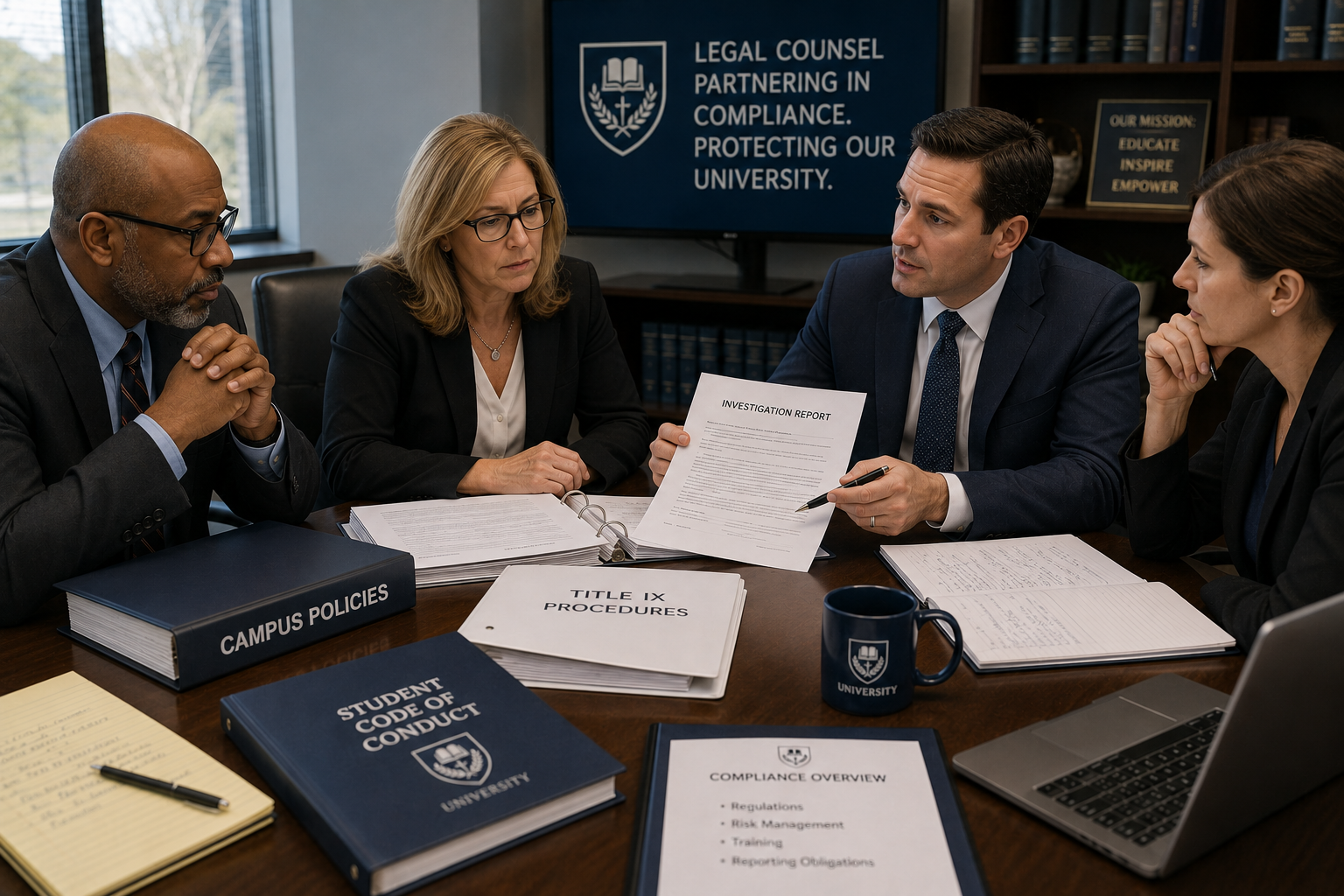
Key legal compliance areas include Title IX, FERPA, and the Clery Act - and each carries serious consequences when mishandled. We support student affairs offices, Title IX coordinators, and campus administrators with disciplinary proceedings, investigation management, and policy development. Institutions provide guidance on handling student conduct, including disciplinary actions, and colleges and universities must ensure fair processes in disciplinary proceedings.
Legal challenges in higher education increasingly involve civil rights and discrimination. Recent data illustrates the gap between reporting and resolution: the University of Nevada, Reno reported 17 new civil rights and Title IX complaints in February 2026 but launched only 3 formal investigations. Stanford's 2022–23 Title IX report showed reported incidents declining from 214 to 175 compared to the previous year, with 6 employee terminations among outcomes. Our team helps institutions close that gap by advancing justice through fair process, protection of student and employee civil rights, and legally sound outcomes while avoiding judicial findings of "deliberate indifference" that can lead to significant institutional liability.
The legal landscape remains in flux. The State of Tennessee v. Cardona decision vacated the 2024 Title IX rule nationwide, finding parts of it overbroad and vague - particularly regarding grievance procedures and definitions of harassment. Meanwhile, OCR resolved only four Title IX cases in the first year of the current administration from a backlog of thousands. Institutions need representation that accounts for this instability and builds resilient, adaptable processes.
Employment & Faculty Relations
Legal services include managing faculty contracts and employment disputes - from tenure disputes and wrongful termination claims to collective bargaining negotiations and discrimination complaints involving race, gender, or religion. We serve HR departments, academic deans, and faculty governance bodies, delivering resolved disputes, compliant hiring practices, and protected institutional interests.
Several states have enacted legislation directly affecting faculty employment. Ohio's "Advance Ohio Higher Education Act" banned DEI-based hiring and enrollment decisions, limited faculty strikes, and imposed civics education requirements under threat of losing state funding. Colleges must navigate evolving regulations around diversity, equity, and inclusion efforts while balancing federal civil rights obligations - a tension that increasingly generates litigation and requires careful legal planning.
Regulatory Compliance & Risk Management
Compliance and risk management form the backbone of institutional legal health. Data privacy compliance is essential for protecting sensitive student information, and colleges must maintain compliance with federal, state, and local laws to avoid penalties. Designated legal or compliance leaders oversee FERPA readiness, ADA and Section 504 obligations, accreditation preparation, and research regulatory requirements, and we provide counsel to support that effort for compliance officers, registrars, and research administrators.
The NACUA Compliance Matrix helps institutions track regulatory compliance deadlines, and we use similar tools to ensure nothing falls through the cracks. Developing institutional policies involves legal guidance to ensure compliance, and training for faculty and staff on compliance standards helps mitigate risks.
Critical regulatory changes are imminent. New R2T4 regulations effective July 1, 2026 require institutions to document withdrawal dates within 14 days after last attendance. FERPA rule changes (RIN 1875-AA15) are clarifying definitions of "education record," non-consensual disclosures to vendors and law enforcement, and enforcement remedies. The AIM accreditation reform consensus reached in May 2026 will reshape how accreditors evaluate institutions - emphasizing student outcomes, academic freedom, and intellectual diversity over input-based measures, with rules expected to take effect July 1, 2027. Institutions must begin preparing now.
Institutions regularly negotiate contracts to manage operational risks, and our team provides case support for transactions, vendor agreements, and technology procurement - ensuring legal protections are built in from the start. Intellectual property management and research compliance are critical legal areas in higher education, particularly as institutions increasingly use AI, analytics, and contracted vendors for student systems.
Immigration Services for Campus Communities
HELS provides free immigration legal services to college communities, with a mission to empower immigrants through education and support. Free immigration legal services are available to California Community Colleges, and HELS operates directly on campus within California border regions - including the San Diego area - as part of a California funded effort to protect campus communities.
Priority for HELS services is given to students and faculty, and eligible students and faculty can request an appointment for confidential immigration help. HELS maintains confidentiality of all submitted information, ensuring that international students and employees feel safe seeking the guidance they need.
Beyond these free immigration legal services, our broader immigration legal services address new DHS rules that have fundamentally changed the landscape for international students and scholars. The end of "Duration of Status" for F-1 and J-1 visa holders - replaced by a four-year cap on stays - means institutions must actively monitor program end dates, advise on extensions via USCIS, and manage OPT/CPT compliance with far greater precision.
The stakes are high: student visa denials nationwide reached approximately 35% in 2025 - the highest in a decade - and overseas student enrollment dropped by about 17%. These numbers translate directly into lost tuition revenue, reduced research capacity, and diminished campus diversity. Our attorneys help institutions develop proactive systems for managing visa compliance, assisting students and faculty through program changes, and mitigating the financial and administrative burden of these regulatory shifts.
How Our Legal Process Works
Our systematic approach to higher education legal matters ensures institutions receive responsive, transparent, and strategically sound counsel from first contact through resolution.
Step 1: Initial Assessment & Consultation
Contact our office with your legal concern, compliance question, or crisis management need. We assess the situation through a comprehensive review of applicable federal, state, and institutional regulations. Whether you're responding to a Title IX complaint, preparing for an accreditation review, or managing a faculty employment dispute, this initial consultation establishes scope, urgency, and the regulatory framework that applies to your unique case.
Legal counsel helps institutions by drafting policies and navigating investigations - but the first step is always understanding where you stand.
Step 2: Strategic Legal Planning
We develop a tailored legal strategy that considers your institutional culture, governance structure, budget, and timeline. Institutions receive clear milestones, defined outcomes, and transparent communication throughout. For ongoing matters like compliance counsel positions or regulatory monitoring, we establish advisory structures that scale with your needs - whether you need a full time embedded team or periodic strategic advice.
Step 3: Implementation & Resolution
We execute the agreed strategy with ongoing support and monitoring. This includes policy implementation, investigation management, litigation and dispute resolution, or regulatory filing as needed. After resolution, we provide compliance maintenance, policy updates, and preventive measures - including training programs for administrators, faculty, and employees - to reduce future exposure.
Effective legal services assist in preventing compliance failures, not just responding to them.
Results & Success Stories
Concrete outcomes define our value to institutions:
- Title IX compliance overhauls that withstand federal scrutiny and court challenge - including complete grievance procedure redesigns following the Cardona vacatur
- Successful accreditation defenses assisting institutions through review processes aligned with evolving standards, including credit transfer policy development and outcomes reporting
- Immigration compliance programs that maintain student and scholar visa status through regulatory transitions, reducing administrative burden on international student offices
- Employment dispute resolutions protecting institutional interests while preserving faculty relationships and academic freedom
- Crisis management responses delivering same-day legal guidance for urgent matters involving student safety, media exposure, or regulatory agency inquiries
All results referenced are based on verifiable outcomes. Contact us for detailed case information relevant to your institution type.
What Higher Education Clients Say
We welcome testimonials from university administrators, general counsel offices, compliance officers, directors, and educational leaders. Please contact us to share your experience with our team.
Testimonials should include the client's position, institution type, and specific outcomes achieved - because in higher education legal services, specifics matter more than superlatives.
Higher Education Institutions We Serve
We serve a broad range of educational organizations across diverse institutional types and governance structures:
- Public universities and California state universities
- California community colleges and two-year institutions
- Private colleges and universities - secular, religious, and mission-driven
- Research institutions with complex grant compliance and IP requirements
- Technical schools and vocational programs navigating Title IV eligibility
- For-profit education company managing regulatory scrutiny and accreditation
- Community college systems and multi-campus districts with centralized legal needs
- Graduate and professional schools including medical, law, and business programs
Our geographic reach covers institutions nationally, with particular depth in California border regions, San Diego, and New York. We also support institutions seeking remote jobs and remote legal counsel arrangements for ongoing advisory relationships.
Frequently Asked Questions
How quickly can you respond to urgent legal matters like Title IX investigations?
We maintain defined response commitments for crisis and time-sensitive matters. For Title IX investigations, student safety issues, and regulatory enforcement actions, our team provides initial guidance within 24 hours. For matters with statutory deadlines - such as the 14-day withdrawal documentation requirement under new R2T4 regulations - we build compliance calendars that flag deadlines well in advance.
What are your fee structures for ongoing compliance support versus one-time legal issues?
We offer three primary engagement models: institutional retainer agreements for ongoing compliance counsel and advisory services, project-based fees for defined matters like accreditation review or policy drafting, and hourly arrangements for litigation or unique case representation. Most institutions find a blended approach - retainer for day-to-day regulatory guidance plus project-based fees for specific initiatives - provides the best value. Contact us for a confidential quote based on your institution's size and needs, or schedule an appointment if you want to discuss scope before choosing a fee model.
Do you handle both public and private institution legal matters?
Yes. The legal frameworks differ significantly - public institutions face constitutional constraints (First Amendment, due process) that private institutions may not, while private institutions navigate different governance, religious liberty, and contractual considerations. Our attorneys have direct experience with both contexts and understand how applicable law variations affect strategy, from board of trustees governance to state regulators and agencies.
What credentials do your attorneys have in higher education law?
Our team includes attorneys with education law specializations, relevant bar admissions across multiple states including California and New York, and direct experience serving as university counsel, compliance counsel, and general counsel within higher education institutions. Several team members have held positions within institutions - including director-level compliance and ethics roles that helped them oversee institutional compliance functions - providing insight that outside firms typically lack.
How do recent regulatory changes affect my institution?
The regulatory landscape is shifting rapidly. Key changes include: new R2T4 regulations effective July 1, 2026 for Title IV fund management; FERPA rule revisions addressing vendor disclosures and enforcement; the AIM accreditation overhaul with rules expected by late 2026; DHS rules capping international student stays at four years; and state-level legislation restricting DEI programs and faculty governance. Each of these requires institutional policy review, and we help institutions plan for compliance across all of them simultaneously.
Request a Higher Education Legal Consultation
Colleges and universities face complex legal issues that require experienced guidance and thoughtful planning.
Masterly Legal Solutions provides higher education legal services for campus investigations, policy review, governance, regulatory compliance, employment matters, and institutional risk management offered by our Texas-based education law firm. We work alongside higher education leaders to protect their institutions while supporting sound, legally informed decision making.
If your institution needs experienced legal counsel, contact Masterly Legal Solutions today to request an appointment for a higher education legal consultation.
Masterly Legal Solutions
Website:https://www.masterlylegal.com/
Phone: (972) 236-5051





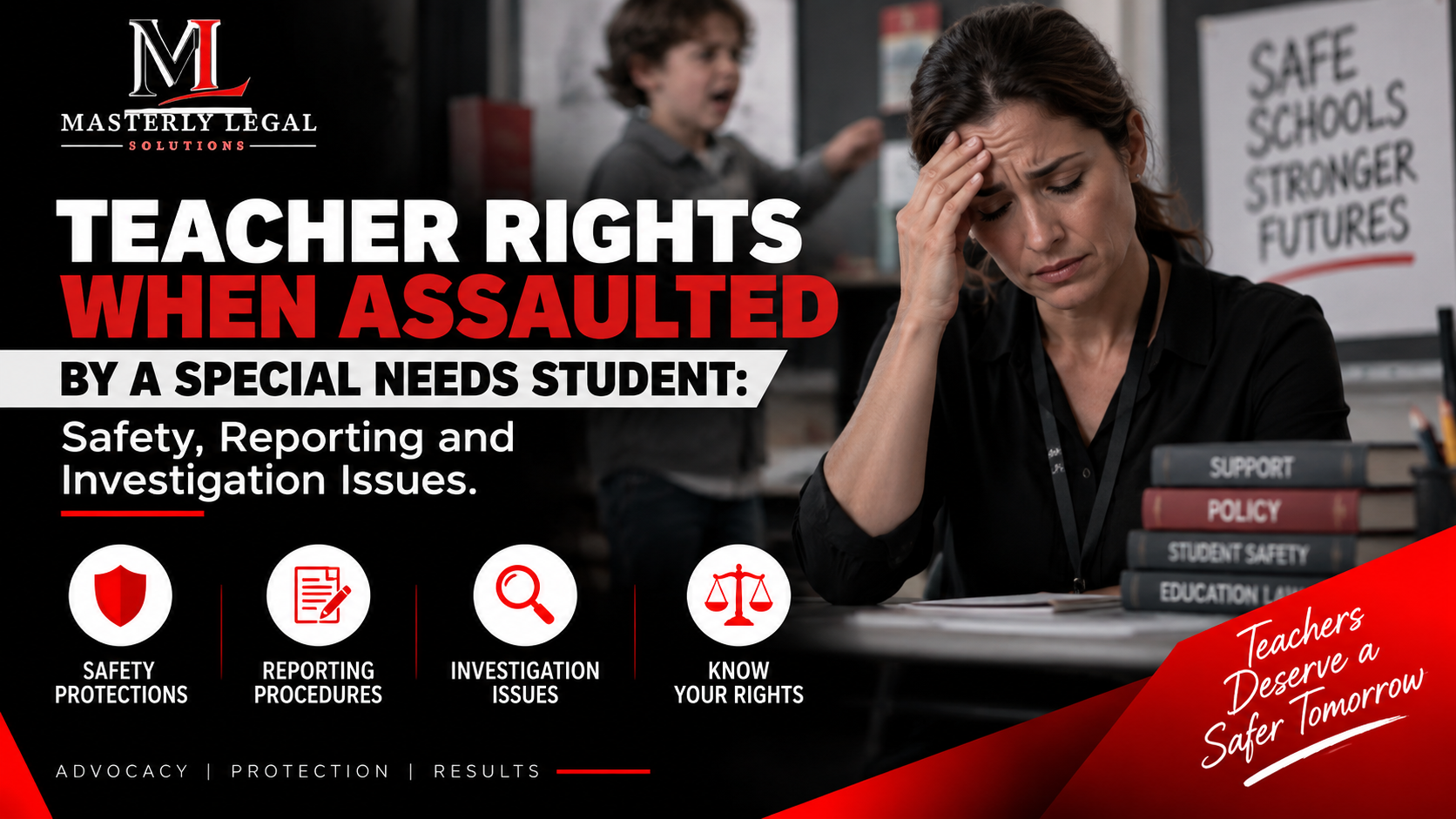
Teacher Rights When Assaulted by a Special Needs Student: Safety, Reporting and Investigation Issues
Looking for Legal & Business Solutions? Contact Us Now
Fill in the form or call us to set up a meeting