Crisis Response in Higher Education: Building a Legal Defense Before Problems Escalate
Higher education institutions face challenges that can emerge without warning and quickly become significant legal, financial, and reputational threats. A student complaint, allegations of sexual misconduct, a Title IX investigation, faculty employment dispute, campus safety incident, data breach, or government inquiry can place enormous pressure on administrators and senior leadership teams. What begins as a manageable concern can rapidly develop into a crisis that affects every aspect of campus operations.
Many educational institutions focus heavily on academic excellence, enrollment growth, and student success. While those goals are essential, leaders must also recognize that legal preparedness plays a critical role in protecting their institution's future. Effective crisis management requires more than reacting after problems arise. It requires developing a legal defense strategy long before a crisis occurs.
Colleges and universities that proactively address legal compliance, policy development, internal investigations, and risk management are often in a stronger position when facing scrutiny from federal agencies, government agencies, students, employees, parents, or the public. The ability to respond quickly and effectively can reduce liability, preserve institutional credibility, and help educational institutions continue fulfilling their mission.
At Masterly Legal Solutions, we work with higher education clients facing complex legal issues throughout the higher education sector. Our goal is to assist institutions in building proactive legal frameworks that reduce risk and strengthen their ability to respond when challenges arise. A skilled higher education lawyer can provide the legal guidance necessary to navigate difficult situations while protecting the interests of institutions of higher education.
The Growing Legal Challenges Facing Higher Education
The higher education arena has become increasingly complex over the past decade. Institutions must navigate evolving regulations, changing student expectations, workforce issues, and heightened public scrutiny.
Higher education institutions are expected to comply with countless federal laws, state law requirements, accreditation standards, and internal governance obligations. Failure to meet these expectations can expose institutions to lawsuits, government investigations, financial penalties, and reputational harm.
Today's colleges and universities operate in an environment where a single complaint can attract media attention, trigger government review, and create significant operational disruptions. As a result, legal preparedness has become an essential component of institutional leadership.
Many higher education clients seek legal services after a crisis has already begun. While legal representation remains important at that stage, institutions benefit significantly when legal counsel becomes involved before problems escalate.
Why Legal Defense Planning Matters Before a Crisis
A crisis rarely develops overnight. In many situations, warning signs appear long before litigation, government investigations, or public controversy occur.
Administrators may observe increasing student conduct issues, employee complaints, allegations of discrimination, concerns regarding student safety, or compliance deficiencies. These indicators often provide opportunities to address problems before they evolve into larger legal matters.
A proactive legal defense strategy helps institutions identify vulnerabilities, strengthen compliance programs, improve documentation practices, and establish response procedures. When a crisis occurs, institutions can act decisively rather than scrambling to create solutions under pressure.
/
A higher education lawyer can evaluate existing policies, review institutional procedures, and recommend improvements designed to reduce exposure to legal risk. Early intervention often results in better outcomes and lower overall costs.
Common Crises Facing Colleges and Universities
The range of potential crises affecting institutions of higher education is broad. Each situation requires careful analysis and a strategic legal response.
Title IX Investigations
Title IX compliance remains one of the most significant responsibilities for educational institutions. Allegations involving sexual harassment, sexual misconduct, discrimination, or retaliation can trigger formal investigations and substantial legal scrutiny.
Failure to conduct prompt and fair investigations can expose institutions to liability under federal and state law. Educational institutions must ensure that policies, procedures, and investigative practices align with current regulatory requirements.
A comprehensive Title IX framework should include training, documentation procedures, reporting protocols, and consistent enforcement mechanisms.
Student Discipline Disputes
Student discipline matters frequently involve complex legal considerations. Disciplinary proceedings can affect a student's educational opportunities, future employment prospects, and reputation.
Institutions must balance campus safety concerns with due process considerations. Inadequate procedures may result in legal challenges filed in federal and state courts.
Clear student handbooks and consistent student conduct processes help reduce disputes while supporting institutional fairness and transparency.
Campus Safety Incidents
Student safety remains a primary concern for colleges and universities. Emergencies involving violence, threats, hazing, criminal conduct, or facility safety issues can create significant liability exposure.
Educational institutions should maintain comprehensive emergency response plans that address communication procedures, reporting obligations, documentation requirements, and coordination with law enforcement agencies.
Strong preparation allows institutions to respond effectively while minimizing legal and operational disruptions.
Employment Disputes
Faculty and staff conflicts frequently create legal issues within the higher education sector. Employment relationship disputes may involve discrimination claims, contract disputes, retaliation allegations, wage concerns, or wrongful termination claims.
Many institutions face complaints before the Equal Employment Opportunity Commission or state agencies. Proper employment agreements, employment contracts, and personnel policies can significantly reduce legal exposure.
Early legal review often helps institutions resolve disputes before litigation becomes necessary.
Building a Strong Legal Foundation
Successful crisis management begins with a strong legal foundation. Institutions that invest in preventative measures often experience fewer legal challenges and stronger outcomes when problems arise.
Conducting Comprehensive Legal Audits
A legal audit allows institutions to evaluate policies, procedures, and operational practices. The process helps identify compliance gaps and areas requiring improvement.
Legal audits may examine:
- Student handbooks
- Employee policies
- Financial aid procedures
- Student housing regulations
- Title IX compliance measures
- Employment agreements
- Student records management
- Governance structures
- Risk management protocols
By identifying weaknesses early, institutions can implement corrective measures before a crisis develops.
Reviewing Institutional Policies
Policies provide the framework for institutional decision-making. Outdated or inconsistent policies often become significant liabilities during litigation or government investigations.
Regular policy development and review ensure that institutional practices align with current federal and state law requirements. Effective policies also create consistency across departments and reduce confusion during emergencies.
Institutions should periodically review all major policies with legal counsel to ensure continued legal compliance.
The Importance of Internal Investigations
Internal investigations play a critical role in crisis response and risk mitigation. When allegations arise, institutions must gather facts quickly and objectively.
Poorly conducted investigations can worsen legal exposure and undermine institutional credibility. Thorough investigations demonstrate that educational institutions take concerns seriously and are committed to accountability.
When Internal Investigations Become Necessary
Internal investigations may be required when institutions receive allegations involving:
- Sexual misconduct
- Sexual harassment
- Employee misconduct
- Student misconduct
- Financial irregularities
- Academic integrity concerns
- Civil rights investigations
- Regulatory compliance violations
Prompt action helps preserve evidence and supports informed decision-making.
Best Practices for Internal Investigations
Effective investigations require neutrality, documentation, confidentiality, and legal oversight. Investigators must gather information fairly while protecting the rights of all parties involved.
Legal counsel can help ensure that investigations comply with applicable federal laws, state law requirements, and institutional policies.
Many institutions benefit from involving outside counsel when allegations involve senior administrators, sensitive legal issues, or significant liability concerns.
Navigating Regulatory Compliance Requirements
Regulatory compliance represents one of the most demanding responsibilities for institutions of higher education. Federal agencies and government agencies maintain extensive oversight authority in numerous areas.
Compliance failures can result in financial penalties, loss of funding, negative publicity, and litigation.
Understanding Federal and State Law Obligations
Institutions must comply with numerous legal frameworks, including:
- Title IX
- Family Educational Rights and Privacy Act requirements
- Disabilities Act obligations
- Employment regulations
- Financial aid regulations
- Civil rights protections
- Labor relations requirements
- Tax obligations under the Internal Revenue Code
A deep understanding of these requirements helps institutions reduce risk and improve operational effectiveness.
Developing Effective Compliance Programs
Compliance programs should be proactive rather than reactive. Effective compliance programs include ongoing monitoring, employee training, policy review, reporting mechanisms, and periodic assessments.
Strong compliance programs demonstrate institutional commitment to ethical operations and legal compliance.
Institutions that invest in compliance infrastructure often experience fewer enforcement actions and stronger legal defenses.
Protecting Student Rights While Managing Risk
Student life remains central to the mission of higher education. However, institutions must balance student rights with legal obligations and risk management considerations.
Student affairs professionals frequently address sensitive issues involving discipline, housing, privacy, student organizations, and campus activities.
Clear procedures help institutions respond consistently while protecting student rights and institutional interests.
Managing Student Records Properly
Student records contain sensitive information protected by federal laws. Improper disclosure or mishandling of records can result in significant legal consequences.
Institutions should establish clear protocols governing access, storage, retention, and disclosure of student records.
Training programs can help employees understand their responsibilities regarding protected information.
Addressing Student Conduct Concerns
Student conduct matters require careful consideration of due process principles and institutional policies.
Consistent enforcement of conduct standards helps promote fairness while reducing legal challenges. Institutions should maintain clear disciplinary procedures that are communicated effectively to students.
Well-drafted student handbooks provide valuable guidance during disciplinary proceedings.
Title IX Compliance as a Crisis Prevention Tool
Many institutional crises stem from failures involving Title IX compliance. Allegations of discrimination, sexual harassment, and sexual misconduct often attract significant public attention.
Educational institutions should view Title IX not merely as a legal obligation but as an important risk management tool.
Training and Education
Faculty, staff, and students should receive ongoing training regarding reporting obligations, prohibited conduct, and institutional procedures.
Training creates awareness while reducing misunderstandings that may lead to legal disputes.
Consistent education efforts also strengthen institutional credibility during investigations.
Documentation and Reporting
Accurate documentation is essential for effective Title IX administration. Institutions should maintain detailed records of reports, investigations, findings, and corrective actions.
Comprehensive documentation often becomes critical evidence when responding to government inquiries or litigation.
Employment Law Risks in Higher Education
Employment-related legal issues represent a significant source of institutional liability.
The higher education sector faces unique workforce challenges involving faculty governance, tenure systems, collective bargaining agreements, and academic freedom concerns.
Faculty and Staff Disputes
Employment disputes may arise from contract disagreements, disciplinary actions, performance concerns, or discrimination allegations.
Legal counsel can help institutions evaluate risks, develop response strategies, and minimize potential liability.
Careful documentation remains one of the most effective defenses against employment claims.
Labor Relations Considerations
Labor relations issues continue to evolve across colleges and universities. Institutions may face union organizing efforts, collective bargaining negotiations, and disputes before the National Labor Relations Board.
A proactive legal strategy can help institutions address labor concerns while maintaining productive workplace relationships.
Early intervention often prevents disputes from escalating into costly litigation.
Academic Freedom and Institutional Responsibility
Academic freedom remains a foundational principle within higher education. However, institutions must balance freedom of expression with legal obligations and community expectations.
Controversial speech, protests, and campus events can create difficult legal and operational challenges.
Institutions should establish policies that support academic freedom while promoting safety and compliance with applicable laws.
Legal counsel can help administrators navigate these sensitive situations while reducing institutional risk.
Managing Risks Involving International Students
International students contribute significantly to campus diversity and academic excellence. However, institutions must address additional compliance requirements involving immigration regulations and federal oversight.
Failure to comply with applicable requirements can create legal and financial consequences.
Educational institutions should maintain systems that support accurate recordkeeping and regulatory compliance for international students.
Regular training and policy review can help institutions avoid preventable compliance issues.
The Role of Senior Leadership Teams During a Crisis
Senior leadership teams play a critical role in institutional crisis response. Leaders must make timely decisions while managing legal, operational, and reputational concerns.
Preparation is essential. Institutions that establish crisis management protocols before emergencies occur are better positioned to respond effectively.
Leadership training can improve coordination and reduce uncertainty during high-pressure situations.
Establishing a Crisis Response Team
An effective crisis response team often includes representatives from:
- General counsel's office
- Student affairs
- Academic affairs
- Communications
- Campus safety
- Human resources
- Senior administration
Cross-functional collaboration allows institutions to address multiple dimensions of a crisis simultaneously.
Communication Strategies During a Crisis
Communication decisions can significantly affect legal outcomes. Institutions should ensure that public statements are accurate, consistent, and legally appropriate.
Poor communication may increase liability or damage institutional credibility.
Legal review of crisis communications can help reduce unnecessary risks.
Working With Experienced Higher Education Counsel
The legal environment affecting educational institutions continues to evolve. Institutions benefit from partnering with professionals who possess extensive knowledge of higher education law.
An experienced higher education lawyer understands the unique challenges facing colleges and universities. This deep understanding allows counsel to provide practical solutions tailored to institutional needs.
Legal professionals familiar with the higher education arena can help institutions navigate complex regulatory environments while supporting long-term organizational goals.
How Legal Counsel Supports Institutional Success
Legal counsel can assist institutions through:
- Policy development
- Crisis management planning
- Internal investigations
- Employment disputes
- Title IX matters
- Regulatory compliance reviews
- Government contracts
- Risk assessments
- Litigation defense
These services help institutions reduce exposure while strengthening operational effectiveness.
The Value of Preventative Legal Guidance
Preventative legal guidance often costs significantly less than responding to litigation or government investigations after problems occur.
Institutions that prioritize legal preparedness frequently achieve stronger outcomes when facing challenges.
Proactive planning also allows leaders to focus on educational missions rather than crisis response.
How Institutions Benefit From Proactive Legal Partnerships
Many educational institutions discover that ongoing legal partnerships provide advantages beyond crisis response. Regular collaboration with legal counsel promotes stronger governance, improved compliance, and more effective decision-making.
Higher education clients often seek assistance when confronting immediate concerns. However, institutions benefit most when legal professionals become trusted advisors involved in long-term planning and risk management efforts.
By working closely with institutional leaders, legal counsel can identify emerging risks before they become costly problems.
Supporting General Counsel and Institutional Leadership
The general counsel and administrative leadership often face complex responsibilities requiring legal analysis and strategic planning.
Outside counsel can support internal teams by providing additional legal resources, specialized knowledge, and objective assessments of institutional risks.
This collaborative approach helps leaders make informed decisions while maintaining compliance with evolving legal requirements.
Strengthening Institutional Resilience
Institutions that invest in legal preparedness are often better equipped to withstand unexpected challenges.
Whether facing investigations, litigation, compliance reviews, or public controversies, prepared institutions can respond confidently and efficiently.
Strong legal infrastructure protects students, employees, leadership, and the institution itself.
Building a Culture of Compliance and Accountability
Creating a culture of accountability extends beyond written policies. Institutions should foster environments where compliance, transparency, and ethical conduct are integrated into daily operations.
When employees and students understand expectations, institutions reduce the likelihood of misconduct and legal disputes.
Leadership commitment remains essential to maintaining a culture that supports long-term success.
Institutions that prioritize accountability often strengthen trust among students, faculty, staff, alumni, and stakeholders.
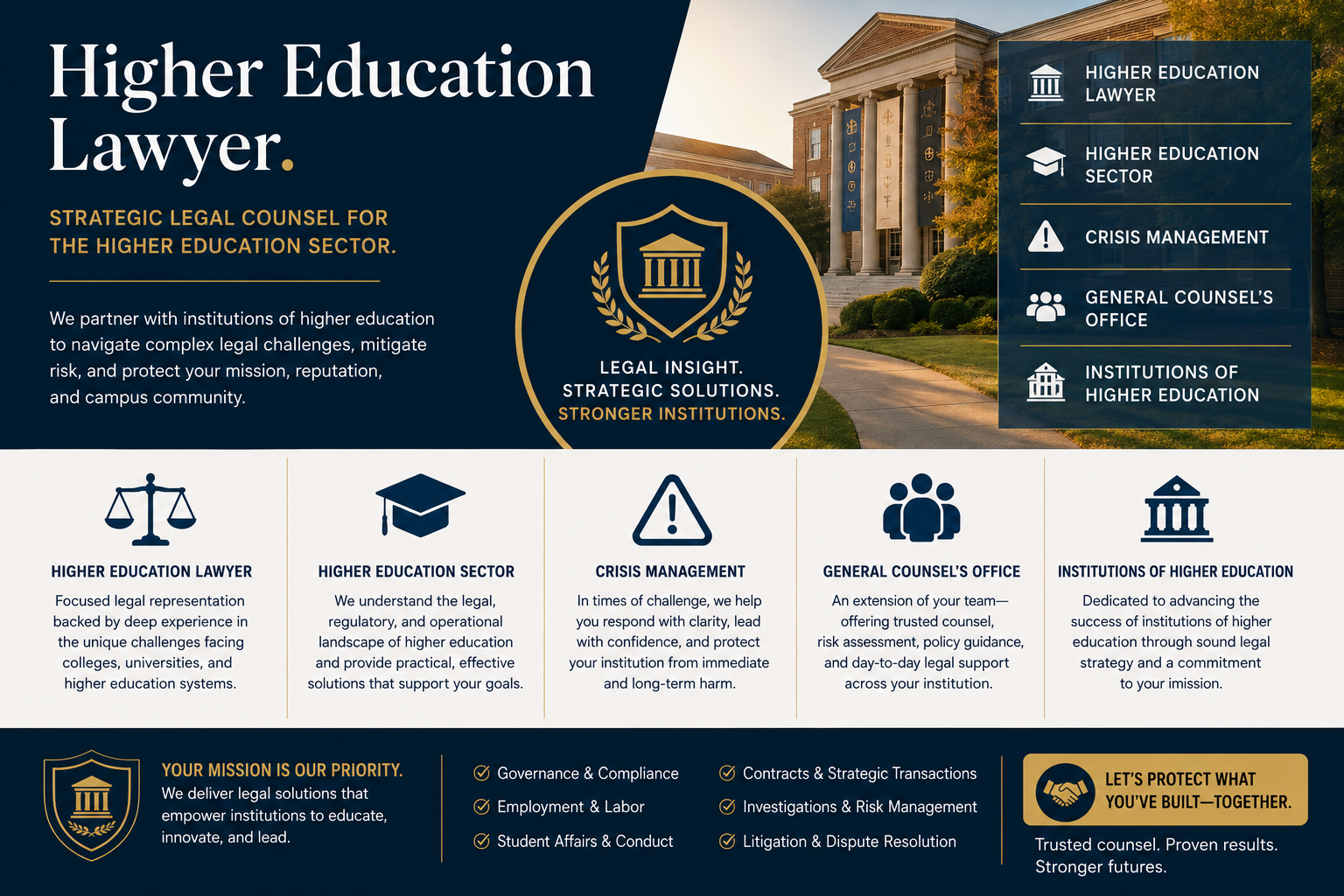
Understanding State and Federal Laws in Higher Education
Institutions of higher education operate within a complex legal environment shaped by both state and federal laws. Administrators must ensure that institutional policies align with evolving legal requirements affecting employment, student rights, campus safety, financial aid, and academic operations. Failure to comply with applicable regulations can expose institutions to costly litigation, government investigations, and reputational damage. Building a proactive compliance strategy allows colleges and universities to identify risks early and strengthen their legal position before challenges arise.
Managing Employee Benefits and Workplace Compliance
Employment-related concerns extend beyond hiring and termination decisions. Educational institutions must carefully manage employee benefits programs while maintaining compliance with applicable employment regulations. Issues involving healthcare coverage, retirement plans, leave policies, and workplace accommodations can quickly become sources of legal disputes if not handled properly. A comprehensive review of employment policies helps institutions reduce liability and promote a positive work environment for faculty and staff.
Addressing Discrimination Concerns and Protecting Campus Communities
Educational institutions have a responsibility to provide an environment free from unlawful discrimination. Complaints involving race, gender, disability, religion, or national origin can trigger investigations by federal agencies and create significant legal exposure. Institutions should establish clear reporting procedures, conduct prompt investigations, and provide ongoing training to employees and students. Strong compliance measures help reduce risk while reinforcing a culture of inclusion and accountability.
Working Effectively With Student Groups
Student groups contribute significantly to campus culture, leadership development, and student engagement. However, disputes involving student organizations can create complex legal issues related to free speech, student conduct, funding, and institutional policies. Colleges and universities should maintain clear guidelines governing student organizations while ensuring fair and consistent enforcement. Well-developed policies can help prevent conflicts from escalating into litigation or public controversy.
Unique Legal Challenges Facing the Private University Environment
A private university often faces many of the same legal challenges as public institutions while also navigating unique governance structures and contractual obligations. Private institutions must address issues involving student discipline, faculty employment, donor relations, and regulatory compliance while preserving their institutional mission. Legal preparedness is particularly important because a single crisis can affect enrollment, fundraising efforts, and public perception. Proactive legal planning helps private institutions respond effectively when challenges arise.
Why Experienced Law Firms Matter During a Crisis
When a significant legal issue emerges, institutions often turn to experienced law firms for guidance and representation. Outside counsel can provide objective assessments, conduct independent investigations, and assist leadership in making informed decisions during high-pressure situations. Institutions benefit from working with attorneys who possess extensive knowledge of the higher education sector and understand the unique legal challenges facing educational organizations. Early involvement by legal counsel can often prevent problems from becoming larger liabilities.
How Clients Benefit From Proactive Legal Partnerships
Educational institutions frequently discover that clients benefit most when legal counsel becomes involved before a crisis develops. Preventive legal strategies can reduce liability, improve compliance efforts, and strengthen institutional decision-making. By identifying vulnerabilities early, institutions can implement corrective actions that protect both their operations and reputation. A proactive approach often produces better outcomes than responding after a dispute has already escalated.
The Importance of Providing Legal Advice Before Problems Escalate
One of the most valuable functions of higher education counsel is providing legal advice before significant issues emerge. Administrators frequently encounter situations involving policy interpretation, employment matters, student conduct concerns, and compliance obligations that require immediate guidance. Early legal consultation allows leaders to evaluate risks and make informed decisions based on current legal requirements. Timely advice can often prevent disputes from developing into formal investigations or litigation.
The Value of an Experienced Higher Education Team
A dedicated higher education team understands the unique operational, regulatory, and governance challenges affecting colleges and universities. These professionals work closely with administrators, faculty leaders, and governing boards to address complex legal concerns before they become crises. Their experience across numerous institutional settings allows them to develop practical solutions tailored to each institution's needs. Effective legal counsel serves as a strategic partner rather than simply responding when problems occur.
Lessons Learned From Institutions We Have Advised
Throughout the higher education arena, experienced counsel have advised universities facing a wide range of legal and operational challenges. These matters often involve compliance reviews, internal investigations, employment disputes, student affairs concerns, and regulatory inquiries. Institutions that proactively addressed legal risks generally achieved stronger outcomes than those that delayed action. The lessons learned from these experiences reinforce the importance of preparation, documentation, and early intervention.
Understanding Summary Judgment and Litigation Risk
When disputes proceed to litigation, institutions may encounter legal procedures such as summary judgment. This process allows courts to resolve certain claims without a full trial when there are no genuine disputes regarding material facts. Strong documentation, well-developed policies, and consistent institutional practices can significantly improve an institution's ability to defend claims during litigation. Effective crisis preparation often creates the foundation for stronger legal defenses if court proceedings become necessary.
The Critical Importance of Such a Role in Institutional Leadership
Legal counsel plays a vital role in helping educational institutions navigate uncertainty and risk. Such a role extends beyond responding to lawsuits or investigations; it includes advising leadership, strengthening compliance programs, supporting policy development, and preparing institutions for future challenges. As regulatory requirements continue to evolve, colleges and universities increasingly rely on trusted legal advisors to help protect their mission and operations. Institutions that embrace proactive legal planning are often better positioned to succeed in an increasingly complex environment.
Contact Masterly Legal Solutions for a Free Consultation
Every institution hopes to avoid a crisis, but hope alone is not a legal strategy. The reality is that colleges and universities operate in an increasingly complex environment where legal issues can emerge quickly and escalate without warning. The strongest institutions are often those that prepare before problems arise rather than reacting after damage has already occurred.
Masterly Legal Solutions helps institutions of higher education build proactive legal defenses designed to reduce risk, strengthen compliance, and protect their mission. Whether your institution is facing a Title IX matter, employment dispute, regulatory investigation, student conduct issue, campus safety concern, or other complex challenge, our education team is prepared to counsel clients through every stage of the process.
Our experience serving higher education institutions, private colleges, private institutions, community colleges, academic medical centers, major universities, and numerous institutions allows us to provide practical legal guidance tailored to the unique needs of the higher education sector. We understand the pressures facing administrators, faculty, and senior leadership teams, and we are committed to helping institutions navigate difficult situations with confidence.
If your institution has questions about crisis management, regulatory compliance, internal investigations, student affairs, labor relations, policy development, employment agreements, government contracts, student housing concerns, or other legal issues, contact Masterly Legal Solutions today.
Call (972) 236-5051 for a free consultation. We would welcome the opportunity to discuss your concerns, answer your questions, and help your institution develop strategies that support long-term success and legal protection.
Disclaimer: This article is provided for educational and informational purposes only. It does not constitute legal advice and should not be relied upon as legal guidance for any specific situation. Reading this article does not create an attorney-client relationship with Masterly Legal Solutions. Laws and regulations may vary based on jurisdiction and individual circumstances. For legal advice regarding your institution's specific needs, please contact Masterly Legal Solutions directly for a consultation.


Looking for Legal & Business Solutions? Contact Us Now
Fill in the form or call us to set up a meeting