Essential Insights into Sports Law: Careers, Challenges, and Trends
Sports Attorney for Coaches, Athletic Departments, Athletes, and Sports Organizations
Introduction: When You Need a Sports Attorney Now
If you are a coach reviewing a contract, an athletic department responding to a compliance inquiry, a university navigating a 2025 NIL collective arrangement, or a family facing a transfer eligibility challenge that threatens a student athlete's 2026 season, you may need a sports attorney. This article is written for people and organizations who need legal representation or strategic counsel right now, not for those researching how to enter the legal field or exploring a career path in sports.
Consider these scenarios playing out across the sports world today: a college head coach facing a termination-for-cause review after allegations surface during a recruiting investigation; a Texas high school coach under UIL investigation following a parent complaint; a university compliance office evaluating whether a booster-funded NIL deal complies with updated NCAA guidance; or a Division I student athlete whose eligibility is at risk because of a contested residency change.
Many clients wait to contact a sports attorney until after statements have been made, documents have been signed, or deadlines are close. By that point, options may already be limited. Early legal guidance helps clients understand applicable rules, whether those come from the NCAA, UIL, FHSAA, conference bylaws, or institutional policies. It also helps clients review contracts, preserve evidence, coordinate communications, and protect their position before matters escalate.
Masterly Legal Solutions focuses on sports law issues affecting coaches, athletic departments, universities, athletes, and sports organizations. The rest of this article explains what a sports attorney does, when to contact one, and how this firm approaches sports-related legal issues.
What Is Sports Law?
Sports law is not a single code or statute. It is a multi-disciplinary field encompassing legal regulations impacting sports. Sports law applies traditional legal disciplines to the specific context of sports, drawing from contract law, labor and employment law, education law, intellectual property law, compliance frameworks, internal investigations, and dispute resolution.
Specific sports law issues include:
- Coach employment agreements at Division I universities and professional sports teams
- NIL contracts between collectives and collegiate athletes
- NCAA infractions investigations and eligibility appeals
- State athletic association transfer and residency disputes
- Professional team endorsement deals and sponsorship agreements
- Media rights negotiations that significantly contribute to sports revenue through broadcasting agreements
- Risk management for athletic departments and sports organizations
Sports law applies at every level of competition: youth sports organizations must comply with applicable regulations, high school governing bodies like UIL and FHSAA enforce eligibility standards, collegiate organizations follow NCAA or NAIA rules, and professional sports leagues operate under their own governance structures. Antitrust laws regulate competition within and among sports leagues, while antitrust law also targets monopolistic behavior in sports governing bodies. Major areas in sports law overlap with contract, labor, and regulatory law, creating a layered environment where multiple decision-makers, including schools, conferences, the NCAA, and state associations, may all have authority over the same issue. Legality ensures compliance with existing national and international laws in sports activities, and safety in sports includes regulatory measures for player health during events.
Sports law emphasizes fairness, integrity, and due process in competitions. A sports attorney helps clients navigate this complexity.
What Is a Sports Attorney (Sports Lawyer)?
A sports attorney is a licensed attorney who handles legal issues connected to athletics, sports teams, coaches, athletic departments, universities, professional sports organizations, and the business of sports. The terms "sports attorney" and "sports lawyer" refer to the same role. Sports attorneys advise on compliance with professional league regulations and provide strategic counsel across multiple areas of the sports sector.
A sports attorney represents and advises a wide range of sports clients, including:
- Coaches at the high school, college, and professional levels
- Athletic directors who oversee athletic programs and benefit from sports law knowledge
- Universities, colleges, and school districts
- Professional sports organizations, sports leagues, and professional sports teams
- Sports agencies, sports management companies, and sports businesses
- Event organizers, trainers, and private sports programs
- Individual athletes and families facing high-stakes eligibility, NIL, or disciplinary issues
A sports attorney differs from internal staff such as compliance officers or general counsel. While compliance officers ensure adherence to NCAA regulations and general counsels for sports teams manage broad institutional legal services, a sports attorney provides independent legal representation focused on the client's rights, risks, and strategy. Clients may engage a sports attorney for a discrete matter or for ongoing advisory support.
What Does a Sports Attorney Do?
Sports lawyers represent clients in contract negotiations and disputes, draft and review contracts for teams and athletes, and negotiate player contracts and endorsement deals. Contract law governs player contracts, sponsorships, and broadcasting rights in sports, and player contracts cover salary, bonuses, and performance expectations. A sports attorney reviews contracts for termination-for-cause language, buyout clauses, non-disparagement provisions, outside income terms, intellectual property ownership, non-compete clauses, confidentiality requirements, and reputation protections. Contract compliance specialists ensure athletes meet contract requirements, while contract negotiators focus on negotiating contracts for athletes at every level.
In investigations and disciplinary proceedings, a sports attorney organizes documents, advises on statements, prepares clients for interviews, and helps them understand applicable policies, whether those are found in an employee handbook, student code of conduct, conference rules, or NCAA bylaws. Disciplinary actions often involve arbitration in sports law, and governance in sports includes managing disciplinary actions and arbitration. Tort law addresses negligence and liability issues in sports, adding another layer of legal analysis when incidents occur during competition or training.
On eligibility and NCAA matters, a sports attorney helps interpret rules, coordinate document gathering, prepare written responses, and advise on interview preparation. Sports law encompasses dispute resolution for contract breaches and eligibility appeals, and NCAA compliance includes monitoring athlete eligibility and academic performance. For sports business clients, a sports attorney reviews sponsorship agreements, licensing agreements, endorsement agreements, and media rights contracts. Emerging issues in sports technology, digital platforms, and new stadium developments further expand the scope of modern sports law practice.
Sports attorneys do not control decisions made by the NCAA, UIL, conferences, or governing bodies, but can help clients follow procedures, meet deadlines, and present their strongest position.
Sports Attorney vs. Sports Lawyer: Any Real Difference?
The terms "sports attorney" and "sports lawyer" are used interchangeably. Both refer to a licensed attorney working on sports-related legal matters. Some sports law firms or directories may prefer one term over the other, but the underlying legal services are the same.
When evaluating a sport lawyer or sport attorney, clients should focus less on the label and more on the attorney's experience with investigations, contracts, NCAA and state association rules, and institutional decision-making. Sports law attorneys who understand coach representation, athletic department compliance, NIL structures, and high-stakes eligibility issues offer more practical value than a title alone can convey.
Why Practical Sports Experience Matters in a Sports Attorney
Sports law is not only about reading statutes and contracts. It also requires a thorough understanding of practice schedules, recruiting cycles, booster pressure, media timelines, and institutional politics. Coaches face pressure from athletic directors, presidents, parents, boosters, athletes, and local media, especially during a losing season or a high-profile investigation. Athletic departments must balance winning with compliance, student welfare, institutional reputation, and budget limitations.
Andrew Rhoden, Esq. brings a rare perspective to sports law. Before representing clients in sports-related legal matters, he experienced athletics from multiple angles, including as a college athlete, college football coach, college director of operations, and high school head coach. That background helps Masterly Legal Solutions understand the real-world pressure coaches, athletic departments, student athletes, families, and sports organizations face when legal issues arise. An attorney who knows how a 5 a.m. practice, recruiting weekend, or playoff schedule actually works can better advise on realistic timelines for document production, interviews, and policy changes.
Andrew Rhoden, Esq. has also been recognized by respected legal publications, including Super Lawyers and Best Lawyers, for his work in sports law and related legal matters.
Legal Representation for Coaches at Every Level
Coaches often contact a sports attorney at critical moments: before signing a new contract, during performance reviews, when an internal investigation begins, after a suspension, or when negotiating severance and buyout terms. A coaching contract typically includes base salary, supplemental pay, bonuses, duties and expectations, termination-for-cause and without-cause language, buyout calculations, morality clauses, media obligations, camp and clinic income provisions, NIL-related restrictions, executive compensation structures, and post-employment limitations.
High school coaches may need help with district HR investigations, parent complaints, UIL or other state association rules, and employment matters tied to coaching allegations. A Texas high school football coach in 2026, for example, may face a UIL complaint and district investigation where the process, documentation, and response strategy directly affect the outcome. College coaches may need support with NCAA allegations, NIL concerns, transfer portal issues, recruiting practices, and Title IX matters. Professional coaches may require contract review, separation agreements, protection of reputation, and guidance on public statements after discipline or dismissal.
The value of experienced attorneys in high-stakes coaching disputes often far exceeds a financial figure in terms of what they protect. Coaches should involve a sports attorney before signing or renewing contracts and before giving detailed statements in any investigation to preserve options and avoid unnecessary risk.
Sports Attorney for Athletic Departments, Universities, and Sports Organizations
Athletic directors, compliance officers, general counsel offices, and professional sports executives should consider engaging outside sports law counsel for matters that require independent analysis. Masterly Legal Solutions supports athletic departments with policy review, NCAA compliance assessments, NIL frameworks, coach and staff training, and documentation practices. Compliance officers play a vital role, but compliance involves ensuring adherence to league rules and regulations that often require legal interpretation. Regulatory compliance involves adhering to rules set by organizations like the NCAA, and integrity and fairness regulations ensure fair competition in sports.
Proactive reviews of handbooks, staff contracts, reporting lines, and risk management processes can reduce exposure when complaints arise. Professional sports organizations and sports businesses may need help with sponsorship deals, joint ventures, media rights, licensing, and internal investigations related to staff or executive conduct. Doping controls are part of compliance in sports governance, and sports autonomy allows organizations to self-organize within legal limits. Labor and employment law addresses collective bargaining agreements in sports, adding another dimension for professional teams and professional sports leagues.
Institutions should view legal involvement as preventative and strategic, not just reactive.
NCAA Sports Attorney Services
As an NCAA sports attorney, Masterly Legal Solutions assists with recruiting rules, extra benefits questions, NIL collectives and third-party agreements, transfer portal requirements, countable athletically related activities (CARA), and student athlete eligibility certification. The College Sports Commission has rejected over 524 NIL deals valued at about $14.94 million while clearing 17,321 deals worth $127.21 million, illustrating the growing scrutiny of deal content and compliance.
An NCAA sports attorney can help interpret bylaws, coordinate document gathering, prepare written responses, advise on interview preparation, and help institutions evaluate self-reporting and corrective action options. NCAA processes have strict timelines and unique procedures, and early legal guidance can help coaches and institutions avoid missteps that could worsen potential sanctions.
Every NCAA case depends on specific facts and bylaws. The NCAA retains decision-making authority, and no outcome can be guaranteed.
State Athletic Associations and High School Eligibility
Sports law is not limited to college and professional levels. High school athletes, coaches, and schools often face critical eligibility and compliance issues with state athletic associations, including UIL in Texas, FHSAA in Florida, and NCHSAA in North Carolina, among others.
Common issues include challenges to a student athlete's residency, alleged athletic-motivation transfers, alleged improper recruiting by a coach, discipline affecting athletic participation, and age or fifth-year eligibility questions. Youth sports governance involves protecting young athletes' rights, and youth sports face challenges in fair play and governance. Investments in youth sports include sports academies and leagues, and the youth sports market is a highly segmented growth area.
Masterly Legal Solutions assists with preparing for UIL District Executive Committee (DEC) hearings, reviewing documentation, crafting appeal letters, and advising on communications with school districts and state associations. Eligibility decisions can affect scholarship opportunities, recruitment, and entire seasons, making early legal involvement important for families and coaches alike.
Sports Attorney for Athletes, NIL, and Sports Business Contracts
NIL rights pertain to college athletes earning compensation for their likeness, including use of an athlete's name in a social media campaign, appearance at a camp, inclusion in video content, or co-branded merchandise. Sports law includes managing endorsements and protecting athletes' intellectual property. Intellectual property law protects trademarks, copyrights, and patents, and athletes can trademark phrases like "Tebowing" for profit. Intellectual property law helps prevent infringement on brands, and sports organizations rely on intellectual property law for licensing.
Key contract issues a sports attorney reviews include payment timing, exclusivity, duration, termination rights, moral clauses, use of social media accounts, and conflict with school or conference sponsorships. Endorsement deals and sponsorship agreements must be carefully structured. Understanding contract law is crucial for sports agents and for the athletes and coaches they work alongside. Equality promotes gender equity in sports, evidenced through Title IX requirements that intersect with NIL and endorsement structures for collegiate athletes.
Sports businesses and event organizers may need help with vendor contracts, facility use agreements, waivers, risk allocation, and sponsorship packages. Athletes, coaches, and sports entities should avoid signing NIL or endorsement agreements without legal review. A sports law group with practical experience can identify problematic clauses before they create tax, compliance, or eligibility issues.
Why Early Legal Guidance from a Sports Attorney Matters
Coaches, athletic departments, athletes, and sports businesses often try to handle issues informally, only contacting a sports attorney when an investigation is underway, a contract has been signed, or an eligibility ruling has been issued. Legal regulations prioritize the protection of athletes' health and safety, but the same principle of early protection applies to legal rights.
Risks of delay include making unscripted statements in interviews, sending emails that become key exhibits, missing internal appeal deadlines, or entering into separation agreements that waive important rights. The Court of Arbitration for Sport is a high court for international sports disputes, demonstrating that dispute resolution structures exist at every level, but they all share one common feature: procedural deadlines that, once missed, cannot be recovered.
Early legal guidance does not guarantee a particular outcome, but it can help clients understand risk, avoid preventable mistakes, and respond strategically before decisions are made.
Masterly Legal Solutions: Sports Law Services and Geographic Reach
Masterly Legal Solutions is based in Texas but assists sports clients with matters that may have regional or national implications. Andrew Rhoden, Esq. is licensed in Texas, North Carolina, and Washington, D.C., and the firm may coordinate with colleagues or local counsel in other states when appropriate.
Many sports law issues, including NCAA matters, NIL deals, media rights, sponsorships, and professional sports contracts, cross state lines. Whether assisting a Texas university with NCAA compliance, advising a North Carolina coach on contract language, or working with local counsel in another state on an eligibility appeal, the firm is careful not to overstep licensing boundaries. Any representation outside its direct licensing footprint is handled in coordination with appropriate local counsel when required.
How to Choose a Sports Attorney or Sports Law Firm
When coaches, athletic departments, athletes, or families search for the best sports law firms or top sports attorneys, they should look beyond slogans and ask whether the attorney understands the actual rules, contracts, processes, documents, and stakes involved.
Key factors to evaluate in sports attorney firms and law firms:
- Experience with coach representation, athletic department matters, and sports organizations
- Familiarity with NCAA rules, NIL, UIL, FHSAA, and other sports governing bodies
- History of handling internal investigations and disciplinary proceedings
- Understanding of the timing and pressures of sports seasons
- Willingness to provide candid risk assessments without unrealistic promises
- Professional recognition (such as Super Lawyers and Best Lawyers listings) as one signal among many
- Responsiveness when deadlines or emergency suspensions require quick action
Sports Attorney vs. Sports Agent and Other Common Client Misconceptions
A sports agent generally focuses on marketing, contract opportunities, and career development for professional athletes or coaches. Sports agents negotiate contracts for athletes. Agents help athletes secure the best possible deals, sports agents represent athletes during contract negotiations, and agents often recruit new talent at sporting events. Agents must understand contract and agency law.
A sports attorney, by contrast, provides legal advice, contract analysis, compliance guidance, investigation support, athlete representation in legal proceedings, and dispute resolution strategy. Some professionals may be both licensed attorneys and agents, but clients should ask in what capacity the professional is acting.
Common mistakes clients make before hiring a sports attorney include assuming their agent can handle all legal issues, signing complex NIL or endorsement contracts without legal review, treating school or association hearings as informal, and believing that verbal assurances carry the same weight as written contract terms. Civil litigation and even criminal charges can arise from sports-related disputes, making independent legal counsel essential.
How Masterly Legal Solutions Helps: From Initial Call to Strategic Plan
When a coach, athletic department, athlete, or sports organization contacts Masterly Legal Solutions, the firm begins with an initial discussion, conflict checks, and review of key documents including contracts, letters, emails, and policies. The firm then identifies applicable rules and deadlines.
From there, the firm works with the client to clarify goals and develops a strategic plan. Services include detailed review and negotiation of coaching contracts, representation during internal investigations, assistance with NCAA, UIL, FHSAA, and other state association matters, NIL and sponsorship contract review, drafting contracts, and support for sports business agreements. The firm works toward provide strategic counsel tailored to each situation, whether the client is negotiating contracts, responding to an inquiry, or building a compliance framework.
Every sports law matter depends on the specific facts, governing rules, contracts, documents, policies, and decision-making body involved. Past results do not guarantee future outcomes.
Masterly Legal Solutions combines legal training, practical athletics experience, and recognition by trusted legal publications to provide thoughtful, realistic guidance for clients facing high-stakes sports law problems.
Frequently Asked Questions About Sports Attorneys
What is sports law? Sports law is not a single statute. It is a collection of legal issues, including contract disputes, compliance issues, eligibility appeals, employment matters, and intellectual property concerns, applied in the context of athletics at all levels. It covers the sports industry from youth leagues to professional sports.
What is a sports attorney? A sports attorney is a licensed attorney who helps clients with legal issues connected to athletics, including coaches, athletic departments, universities, sports organizations, team owners, private equity firms investing in sports entities, and individual athletes.
What does a sports attorney do? A sports attorney reviews and negotiates contracts, represents clients in investigations and disciplinary proceedings, advises on NCAA and state association compliance, reviews NIL and endorsement agreements, and helps with dispute resolution. Sports lawyers negotiate player contracts and endorsement deals, representing clients across the playing field of modern athletics.
Is there a difference between a sports attorney and a sports lawyer? No. Both terms refer to a licensed attorney handling sports-related legal issues. Some law school programs or legal directories may use one term more frequently, but the services are the same.
When should a coach contact a sports attorney? Before signing a new contract, during contract renewal, when facing an investigation, after suspension or termination, or when negotiating severance. Coaches should also seek guidance when facing allegations involving recruiting, boundaries, or compliance.
Can a sports attorney help with NCAA, UIL, FHSAA, or other state athletic association eligibility issues? Yes. A sports attorney can help interpret rules, prepare documentation, advise on communications, and represent clients in hearings and appeals. Each matter depends on the specific facts, applicable rules, and the governing body involved.
What is a sports management lawyer? A sports management lawyer handles legal issues related to sports business operations, including sports management agreements, sponsorship contracts, event agreements, camp and clinic contracts, and partnerships involving sports agencies, minor league affiliate relationships, professional teams, and investor group structures.
Can a sports attorney guarantee a specific outcome? No. Every matter depends on specific facts, contracts, policies, and decision-makers. No attorney can guarantee results.
What should I bring to a consultation? Contracts, letters, emails, policies, timelines, notices, and any relevant documents. The more organized your materials, the more efficiently a sports attorney can evaluate your situation.
Contact Masterly Legal Solutions: Speak With a Sports Attorney
If you are a coach, athletic director, university, athletic department, professional sports organization, sports business, athlete, or family facing a sports-related legal issue, contact Masterly Legal Solutions at 972-236-5051 to discuss your options.
Whether the issue involves reviewing a coaching contract, responding to an NCAA inquiry, navigating a UIL or FHSAA eligibility dispute, handling an internal investigation, managing NIL or sponsorship contracts, addressing equal treatment concerns, or resolving a sports business partnership matter, early legal guidance can help you understand the rules, organize the facts, and protect your position from the beginning.
Masterly Legal Solutions is based in Texas, assists clients with sports law matters that may have regional or national implications, and may coordinate with colleagues or local counsel in other jurisdictions when needed. While no outcome can be guaranteed, consulting a sports attorney can help you respond strategically and avoid preventable mistakes before decisions are finalized.

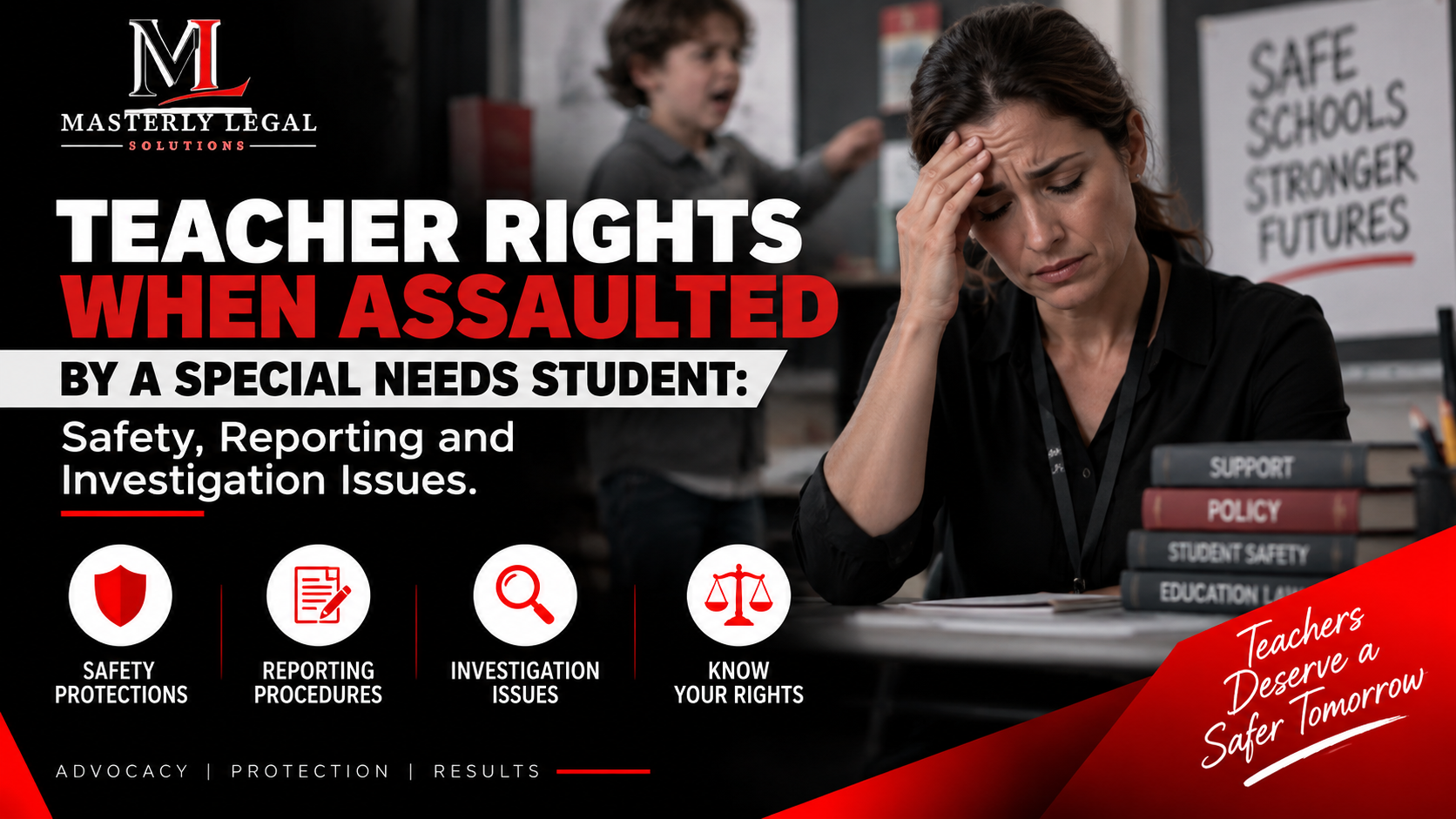
Teacher Rights When Assaulted by a Special Needs Student: Safety, Reporting and Investigation Issues

Looking for Legal & Business Solutions? Contact Us Now
Fill in the form or call us to set up a meeting