
UIL Rule Violations: What Happens Next and How to Defend Yourself
Few situations create more uncertainty for educators, coaches, parents, and students than receiving notice of a possible UIL violation. Whether the issue involves eligibility, documentation, or participation requirements, the outcome can affect an individual student, an entire team, or even a school's reputation. Knowing what happens next can help you respond with confidence instead of reacting out of fear.
The University Interscholastic League has established standards that help ensure fair competition among participating schools throughout Texas. These standards govern a wide variety of activities, including academic contests, athletic contests, and music contests. Because these rules are detailed and continually applied across the state, even well-intentioned mistakes can lead to serious questions.
If your school has been notified of a potential violation, acting quickly and understanding the review process can make a meaningful difference. Taking the time to gather accurate information, review applicable rules, and seek knowledgeable guidance often provides the strongest foundation for responding effectively.
Understanding the UIL Meaning and Its Purpose
Before discussing violations, it helps to understand the UIL meaning and why these standards exist. The University Interscholastic League is an organization connected with the University of Texas and administered through Texas at Austin. Its primary purpose is to oversee educational extracurricular academic and athletic programs for participating schools across Texas.
The University Interscholastic League establishes consistent guidelines so students have equal opportunities to participate in fair and organized competition. These standards apply to academic, music, speech, debate, athletics, and numerous other school-sponsored activities.
Understanding the organization's role makes it easier to recognize why compliance matters. The objective is not simply enforcement but maintaining integrity throughout every contest and every participating school year.
Why Schools Must Carefully Follow UIL Rules
Every participating school agrees to comply with the policies established by the University Interscholastic League. These rules promote fairness while protecting the integrity of every competition, whether it involves classroom achievement, athletics, or performing arts.
For administrators and coaches, compliance involves more than submitting paperwork. It requires verifying student eligibility, maintaining accurate records, and ensuring participants remain eligible throughout the school year.
Because requirements sometimes change, schools should routinely review updated guidelines and communicate them clearly to staff, parents, and students. Careful preparation helps reduce the risk of avoidable violations.
Common Situations That Lead to UIL Investigations
Not every reported issue involves intentional misconduct. Many investigations begin because someone notices inconsistent documentation or questions whether a participant satisfies eligibility requirements.
Common examples include enrollment questions, residency concerns, transfer documentation, attendance requirements, and participation during periods when a student may not be eligible. Some investigations also involve academic standing, athletic participation, or documentation connected to music contests.
Even administrative errors can trigger additional review. That is why maintaining organized records throughout the school year remains an essential responsibility for every participating school.
Eligibility Remains One of the Most Important Requirements
One of the most frequently examined issues involves eligibility. Before students can participate in UIL events, schools must confirm they satisfy all applicable requirements established by the University Interscholastic League.
These requirements may include academic performance, residency, enrollment status, age requirements, and other standards outlined in official guidelines. In many situations, students must also remain enrolled on a full time basis to continue participating.
Failing to verify student eligibility before a contest can affect both the individual participant and the entire team. Taking proactive steps before competition begins helps avoid unnecessary disputes later.
How Records Become Critical During an Investigation
When questions arise, documentation often becomes the strongest source of evidence. Schools should maintain organized records that accurately reflect enrollment, attendance, grades, participation, and other required documentation.
Well-maintained records help administrators demonstrate compliance with UIL requirements while reducing confusion during an investigation. Missing or incomplete documentation may delay the review process or create additional questions that could have been avoided.
Accurate recordkeeping benefits everyone involved. It provides transparency while allowing schools to respond confidently when concerns arise.
Academic, Athletic, and Music Programs Share Responsibility
The University Interscholastic League oversees much more than athletics. It supports numerous educational extracurricular academic opportunities that encourage students to develop leadership, creativity, and discipline.
Programs include academic contests, music contests, speech competitions, debate, journalism, and many athletic events. Every contest follows specific rules designed to create fair opportunities for all participating schools.
Because expectations vary across different activities, administrators should ensure coaches, directors, and sponsors fully understand the requirements that apply to their respective programs.
Understanding the Role of State Oversight
Although the University Interscholastic League establishes operational standards, participating schools also function within broader educational requirements established under state law. Depending on the circumstances, other agencies, including the Texas Education Agency, may also play important roles when questions involve broader educational responsibilities.
This layered oversight helps protect both students and institutions while reinforcing accountability throughout Texas education. Schools should remain familiar with both UIL expectations and other applicable legal obligations.
Remaining informed allows administrators to respond appropriately whenever concerns arise instead of making decisions based on assumptions.
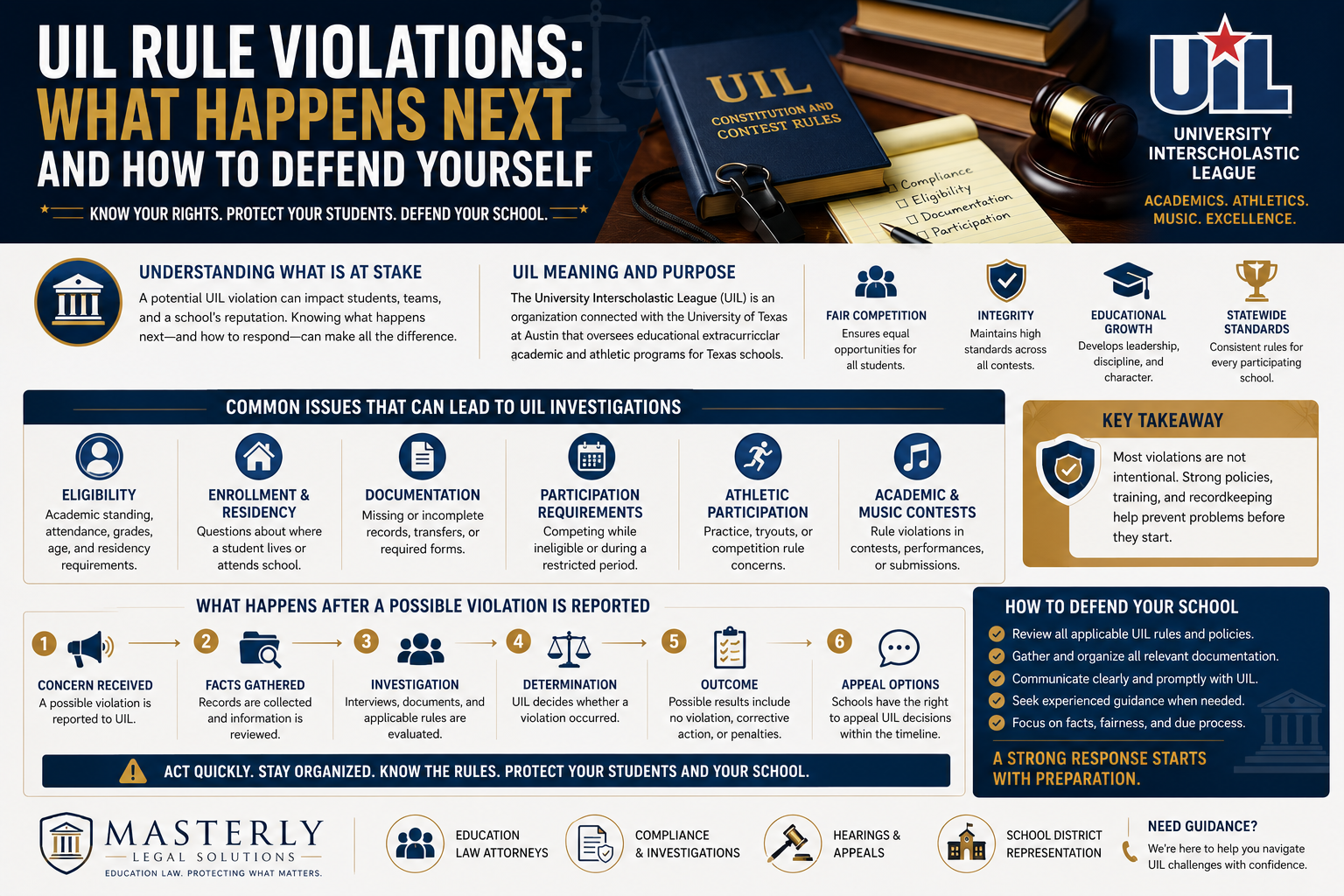
What Happens After a Possible Violation Is Reported
Once a concern has been identified, the review process generally begins with gathering facts rather than immediately imposing consequences. Administrators may collect records, review applicable rules, interview individuals involved, and verify whether all participation requirements were satisfied.
The objective is to understand exactly what occurred before determining whether a violation actually exists. Every situation deserves careful evaluation because even similar circumstances may involve different facts.
Responding promptly while preserving relevant documentation often places schools in a much stronger position throughout the review process. Clear communication and organized preparation remain valuable from the very beginning of any investigation.
Responding Carefully During a UIL Review
Receiving notice of a possible UIL issue can feel overwhelming, but thoughtful preparation is often the best response. Before making statements or submitting additional documentation, schools should carefully review the circumstances and compare them with the applicable guidelines established by the University Interscholastic League.
Every situation is different, and rushing to respond without understanding the facts can create unnecessary complications. Gathering enrollment documents, attendance records, eligibility forms, and communication related to the contest provides a clearer picture of what occurred.
Taking an organized approach also demonstrates that the school is committed to fairness and accuracy throughout the review process.
Why Accurate Documentation Matters
Documentation is one of the strongest tools available when responding to questions about eligibility or participation. Well-maintained records can verify enrollment dates, academic standing, participation history, and compliance with University Interscholastic League requirements.
Administrators should also preserve emails, internal communications, meeting notes, and other supporting materials whenever they relate to the issue under review. These documents may help explain why certain decisions were made during the school year.
Maintaining complete documentation before concerns arise is always easier than attempting to reconstruct events after the fact.
Working Together as a School Team
Responding to a UIL matter should never become the responsibility of one individual alone. Administrators, coaches, teachers, directors, and other staff members all play important roles in gathering facts and ensuring accurate communication.
Open collaboration helps reduce misunderstandings while ensuring everyone is working from the same verified information. This is especially important when multiple departments oversee different activities, including academic, athletic, and music programs.
A coordinated response often produces a more accurate understanding of the situation than isolated decision-making.
Special Considerations for Music Contests
Participation in music contests requires schools to follow the same commitment to fairness expected in every other University Interscholastic League activity. Directors must verify eligibility, maintain accurate records, and ensure students satisfy participation requirements before every contest.
Because music contests often involve travel, rehearsals, and multiple performance categories, careful planning becomes even more important. Organized documentation helps answer questions quickly if concerns arise during the school year.
Strong preparation allows directors to focus on student growth instead of administrative uncertainty.
Athletic Programs Face Similar Responsibilities
Coaches supervising athletic contests understand that compliance extends beyond preparing athletes for competition. Every participant must remain eligible, properly enrolled, and qualified under applicable UIL policies before taking part in an event.
Verifying documentation before each season helps prevent avoidable complications later. Coaches should also communicate regularly with administrators responsible for monitoring academic standing and enrollment requirements.
Working together helps protect both individual students and the integrity of every athletic program.
Academic Competitions Require Careful Oversight
Participation in academic contests is subject to the same commitment to fairness found throughout the University Interscholastic League. Whether students compete in science, mathematics, journalism, writing, or debate, compliance with established rules remains essential.
Sponsors should regularly verify participation requirements while maintaining accurate documentation throughout the school year. Small administrative oversights can sometimes create larger concerns if they remain unnoticed.
Consistent review helps ensure students remain focused on learning instead of unexpected procedural issues.
Understanding Eligibility Questions
Eligibility concerns are not always straightforward. Some situations involve transfer documentation, while others relate to attendance, enrollment status, residency, or academic performance. Understanding the specific issue helps determine the most appropriate response.
Schools should avoid assumptions and instead compare the available facts with official University Interscholastic League guidelines. When questions remain, seeking experienced guidance can help clarify complicated situations.
Protecting eligibility begins with understanding the standards that apply before participation occurs.
When Exceptions May Apply
Although UIL policies establish consistent expectations, certain exceptions may exist depending on the circumstances. These situations should always be reviewed carefully using official documentation rather than assumptions or informal advice.
Understanding available exceptions requires careful attention to the language contained within current guidelines. Every situation depends on its own facts, making individualized review especially important.
Schools should never assume that one previous decision automatically applies to another case with different circumstances.
Preparing for Meetings and Reviews
At some point during the process, administrators, coaches, or sponsors may need to meet with school officials or others involved in reviewing the matter. Preparation is important because these conversations often help clarify facts that are not immediately apparent from written documents alone.
Before the meeting, organize supporting records, verify timelines, and review applicable rules carefully. Remaining professional and factual helps keep the discussion focused on accurate information rather than speculation.
Taking the time to prepare thoroughly often leads to more productive conversations.
Understanding Appeals and Future Compliance
In some situations, schools may have opportunities to pursue appeals depending on the circumstances and applicable procedures. Understanding available options requires careful review of official University Interscholastic League requirements and any deadlines that may apply.
Regardless of the outcome, every review provides an opportunity to strengthen internal procedures. Updating documentation practices, improving communication, and providing additional staff training can reduce future compliance concerns.
Learning from each experience helps schools continue supporting students while maintaining confidence in every future competition.
Building Strong Compliance Practices for the Future
The best way to reduce future UIL concerns is to establish consistent internal procedures before each school year begins. Administrators, coaches, fine arts directors, and sponsors should regularly review University Interscholastic League requirements together so everyone understands their responsibilities. A proactive approach helps schools identify potential issues before they affect a contest or student participation.
Many successful schools create checklists for enrollment verification, eligibility, travel approvals, and required documentation. Reviewing these procedures throughout the year encourages consistency while reinforcing the purpose of fair competition. Preventive planning is almost always easier than responding after questions arise.
Keeping Coaches, Directors, and Staff Informed
Rules and procedures can change over time, making regular training an important part of compliance. Everyone responsible for supervising academic, athletic, and music activities should stay informed about updates issued by the University Interscholastic League.
Encouraging staff members to ask questions before a situation develops creates a stronger culture of accountability. Open communication also helps ensure everyone interprets the guidelines consistently across different departments. When people share accurate information, schools are better prepared to support their students.
Understanding Resources Available to Schools
Administrators do not have to navigate every question alone. Official resources published by the University Interscholastic League and gov agencies provide valuable guidance on eligibility requirements, contest procedures, and compliance expectations. Reviewing official materials helps schools rely on accurate information instead of assumptions.
Many educators begin by visiting the appropriate page within the organization's online resources to review current policies. These materials often include eligibility requirements, frequently asked questions, forms, and procedural updates designed to help schools remain compliant throughout the school year.
Clearing Up Common Misunderstandings
Misunderstanding terminology can sometimes create unnecessary confusion during a review. For example, references to the image of white crest, white crest following text, following text that reads, reads the university, maxpreps logo which spells, and spells out maxpreps may appear on certain webpages or digital resources as accessibility descriptions rather than policy language. These phrases should not be confused with the actual rules governing participation.
Likewise, references to University Interscholastic, the University Interscholastic League, the University of Texas, Texas at Austin, Austin, or TX generally identify the organization and its administrative connection rather than create additional eligibility requirements. Understanding the context behind these references helps administrators focus on the policies that truly affect compliance.
Supporting Students Through the Process
A possible UIL investigation can be stressful for students, families, coaches, and educators alike. Clear communication helps reduce uncertainty while reminding everyone that gathering facts is an important part of a fair review. Keeping students informed, when appropriate, also demonstrates respect and professionalism throughout the process.
Schools should continue emphasizing the educational value of academic, athletic, and music contests while protecting the integrity of every competition. Maintaining fairness benefits everyone involved and reinforces the mission of the University Interscholastic League.
Protecting Your School's Reputation
Every decision made during a compliance review can influence how parents, students, and the broader community view a school. Responding with transparency, professionalism, and careful attention to documentation demonstrates a commitment to fairness rather than simply reacting to allegations.
Strong leadership means taking concerns seriously while avoiding unnecessary conclusions before the facts are known. By maintaining organized records, following established rules, and communicating responsibly, schools place themselves in a stronger position regardless of the outcome.
Why Experienced Guidance Can Make a Difference
Questions involving UIL, eligibility, or compliance often involve detailed facts and procedural requirements. Understanding how those facts relate to University Interscholastic League policies can be challenging, particularly when multiple individuals or departments are involved.
Experienced guidance can help administrators better understand applicable guidelines, organize supporting records, and prepare thoughtful responses. Every situation is unique, making careful review more valuable than relying on assumptions or past experiences alone.
Promoting Fair Competition Across Every School Program
The University Interscholastic League serves as the governing authority for a wide range of extracurricular programs that enrich the educational experience of high school students throughout Texas. From academics and athletics to cheer and fine arts, the organization works to create a fair and consistent environment where participants can develop valuable skills while competing with integrity. In today's competitive world, following established rules is essential because it helps protect both students and schools from unnecessary disputes. When administrators maintain organized procedures and verify eligibility in the proper order, they strengthen confidence in every contest and support the educational mission behind UIL participation.
Contact Masterly Legal Solutions for a Free Consultation
If your school, educator, coach, parent, or student has questions about what is UIL, a possible UIL rule violation, eligibility concerns, University Interscholastic League procedures, or responding to an investigation, Masterly Legal Solutions is here to help. We understand that these situations can affect academic opportunities, athletic participation, school reputations, and future educational goals, which is why timely legal guidance can make a significant difference.
Our team is committed to helping clients understand their rights, evaluate their options, and develop a thoughtful strategy based on the specific facts of each case. Whether you're facing questions involving academic contests, athletic contests, music contests, or other University Interscholastic League matters, we'll work with you to navigate the process with clarity and confidence.
Contact Masterly Legal Solutions today at (972) 236-5051 to schedule your free consultation. We proudly assist educators, students, families, coaches, and schools throughout Texas and across the country, providing experienced legal guidance tailored to the unique challenges of UIL-related matters.



Teacher Rights When Assaulted by a Special Needs Student: Safety, Reporting and Investigation Issues



Looking for Legal & Business Solutions? Contact Us Now
Fill in the form or call us to set up a meeting