
How a School Complaint Can Reshape Your Entire Employment Record
When One Complaint Follows an Employee for Years
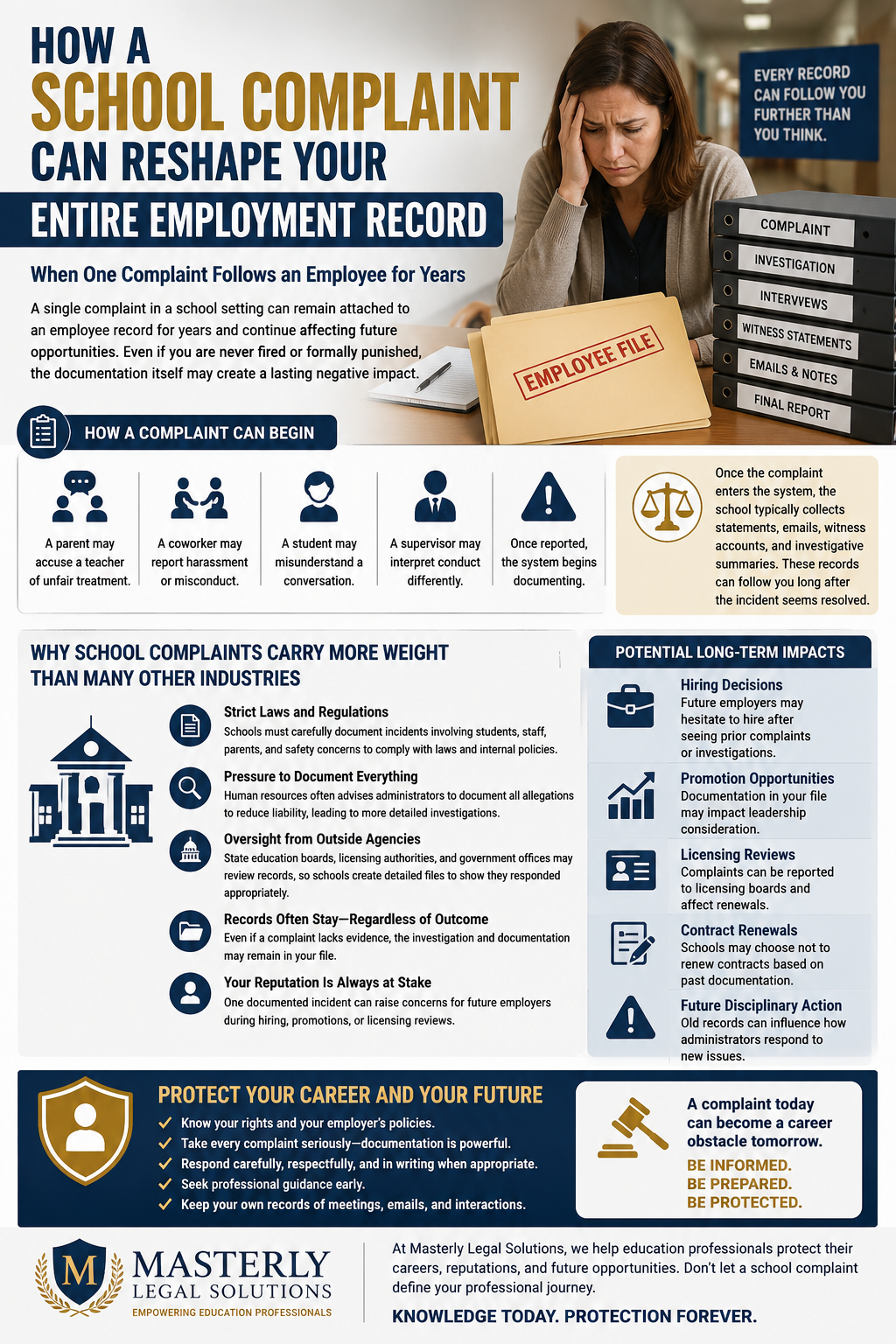
Many people assume a workplace complaint disappears once a meeting ends or an investigation closes. In reality, a single complaint in a school setting can remain attached to an employee record for years and continue affecting future opportunities. Teachers, administrators, coaches, paraprofessionals, counselors, and other school workers are often surprised to learn how much documentation an employer keeps after even a minor incident. A written report may later influence hiring decisions, promotion opportunities, licensing reviews, or future disciplinary action.
In many schools, every concern, allegation, interview note, and internal email becomes part of a larger employment history. Even if an employee is never fired or formally punished, the documentation itself may create a lasting negative impact. School districts, private schools, charter schools, and educational agencies often maintain records far longer than employees realize. That is why understanding documentation permanence matters so much in today’s workforce.
A workplace complaint can begin with something simple. A parent may accuse a teacher of unfair treatment. A coworker may report harassment. A student may misunderstand a conversation. A supervisor may interpret conduct differently than intended. Once the complaint enters the system, the employer usually starts collecting statements, emails, witness accounts, and investigative summaries. Those records can continue following the employee long after the incident appears resolved.
For many education professionals, the greatest danger is not always the original accusation. The larger problem is how the employer documents the situation and how future administrators interpret the file years later. One sentence written in an investigation summary may create scrutiny every time the employee applies for a new role. In some circumstances, the documentation may even affect licensing agencies, contract renewals, or promotion decisions.
At Masterly Legal Solutions, we have seen how documentation issues can reshape careers throughout the education workforce. Many employees wait too long before seeking guidance because they assume the matter is temporary. Unfortunately, records created during a school investigation can become permanent parts of employment history. Understanding how these records work may help employees better protect their careers and professional reputations.
Why School Complaints Carry More Weight Than Many Other Industries
Schools operate under strict laws, regulations, and internal policies. Unlike many private businesses, educational institutions must carefully document incidents involving students, parents, staff members, safety concerns, and workplace disputes. Because schools serve minors and public interests, administrators often create extensive records even when allegations appear minor.
An employer in the education field may feel pressure to investigate every complaint thoroughly. Human resources departments frequently advise administrators to document all allegations to reduce future liability. As a result, school employees may face more detailed investigations than workers in other industries. Even small incidents may trigger written reports, interview summaries, or administrative leave procedures.
Schools also face pressure from outside agencies. State education boards, licensing authorities, and government offices may review records involving harassment, discrimination, retaliation, or student safety issues. Because of this oversight, administrators often create detailed files designed to show the school responded appropriately. Unfortunately, these records can sometimes unfairly damage an employee’s reputation.
A reasonable employee may believe a false accusation will simply disappear once proven inaccurate. However, many employers keep the documentation regardless of the outcome. Even if a complaint lacks evidence, the investigation itself may still remain in the employee file. Future supervisors reviewing the records may not fully understand the original circumstances.
The education industry also relies heavily on references and professional reputation. One documented incident can create concerns for future employers during hiring decisions. A teacher or administrator may lose opportunities without ever knowing why. In some situations, schools quietly avoid hiring candidates whose records contain prior investigations, complaints, or disciplinary action.
The Lasting Effect of Documentation Permanence
Documentation permanence refers to the long-term storage and use of employment records after a complaint or investigation occurs. Many employees do not realize how permanent these records can become. A complaint filed today may continue influencing decisions years later.
An employer may store investigation materials electronically and physically. Emails, witness statements, interview notes, and internal reports may all become part of the employee record. Even if the employee resigns, transfers, or changes school districts, some records may remain accessible to future administrators or agencies.
The long-term consequences often surprise school workers. An employee who was never formally disciplined may later discover the investigation affected a promotion or transfer request. In some cases, the employer may place the employee in a less desirable position after concerns arise. The employee may never receive a direct explanation.
Documentation can also influence licensing reviews. State agencies reviewing educator credentials may request information about prior complaints or investigations. Even if the employee disputes the allegations, the records themselves can still create additional scrutiny. This becomes especially serious when complaints involve harassment, discrimination, or student interactions.
Many employees mistakenly believe administrative leave means the employer has already decided guilt or wrongdoing occurred. However, paid administrative leave sometimes occurs simply because the school wants time to investigate. Still, the existence of administrative leave documentation may later create assumptions by future decision-makers reviewing the file.
How Complaints Begin Inside Schools
School complaints can begin in many ways. Parents, students, coworkers, supervisors, administrators, and community members may all submit concerns. In some circumstances, complaints arise from misunderstandings rather than intentional misconduct.
Common complaints in schools may involve:
- Harassment allegations
- Classroom management concerns
- Student discipline disputes
- Social media activity
- Communication misunderstandings
- Attendance or scheduling issues
- Claims of discrimination
- Retaliation accusations
- Payroll or pay disputes
- Alleged policy violations
Sometimes a complaint begins after an employee engages in protected activity. For example, an employee may report discrimination, raise safety concerns, request disability accommodations, or participate in an investigation. Afterward, the employee may notice negative treatment, schedule changes, or increased scrutiny from a supervisor or manager.
Retaliation occurs when an employer takes adverse action because an employee engaged in legally protected conduct. In schools, retaliation allegations may involve schedule changes, demotions, poor evaluations, reduced hours, removal from committees, or transfer into a less desirable position. In severe situations, the employee may eventually be fired, and many workers seek help from an attorney who handles workplace retaliation claims.
School environments can become emotionally charged workplaces. Parents worry about children, administrators worry about regulations, and teachers manage enormous responsibilities. Under pressure, misunderstandings may escalate quickly into formal complaints. Once documentation begins, the situation can become difficult to reverse.
The Role of Human Resources During Investigations
Human resources departments play a major role in school investigations. Once a complaint reaches administration, human resources often helps determine how the investigation proceeds. They may collect witness statements, review emails, interview staff members, and prepare reports for decision-makers, functions that often overlap with broader HR consulting services and training that help schools navigate complex employment laws.
Many employees assume human resources exists primarily to protect workers. In reality, the department often focuses on protecting the employer from liability and ensuring compliance with laws and regulations. This does not mean human resources acts unfairly in every situation, but employees should understand the department’s role during an investigation.
A manager or supervisor may contact human resources immediately after receiving a complaint. The department may then determine whether the issue requires formal investigation, disciplinary action, or administrative leave. In some situations, the employee may not receive full details regarding the allegations right away.
Human resources may also advise administrators on documentation practices. Written reports often include timelines, witness accounts, and summaries of alleged conduct. Even if no formal punishment occurs, these records may still remain in the employee file.
Employees sometimes unknowingly damage their own position during investigations. Emotional responses, incomplete statements, or poorly written emails can later appear in official records. Every statement made during an investigation may eventually become part of the permanent documentation.
Understanding Paid Administrative Leave
Paid administrative leave creates fear and confusion for many school employees. Being removed from regular work hours while an investigation continues can feel humiliating and stressful. Coworkers may begin spreading false rumors about what occurred, even when the employer has not reached any conclusions.
Administrative leave does not automatically mean misconduct occurred. Schools sometimes place employees on paid administrative leave simply to separate individuals while investigating concerns. This may happen during allegations involving student safety, harassment, workplace retaliation, or policy disputes.
However, the documentation surrounding administrative leave can still affect an employee later. Future administrators reviewing records may only see that leave occurred, without fully understanding the circumstances. Even if the investigation clears the employee, the record itself may continue creating concerns.
Employees placed on administrative leave often experience emotional and financial strain. Some worry about lost promotion opportunities, damaged reputations, or future employment prospects. Others fear coworkers and community members will assume wrongdoing occurred simply because the employer initiated leave procedures.
The experience may also impact employee morale and overall employee morale within the school. Other workers witnessing the situation may become fearful about reporting concerns or engaging in protected activity themselves. In some environments, workers begin avoiding communication out of concern that complaints could permanently damage their records.
When Retaliation Becomes Part of the Problem
Retaliation is a major concern in educational workplaces. An employee who files a complaint, reports harassment, or participates in an investigation may later face negative treatment from management or coworkers. Sometimes retaliation occurs subtly rather than openly.
An employer may begin closely monitoring the employee after a report is filed. A supervisor might suddenly criticize performance more aggressively. A manager may reduce responsibilities, remove leadership opportunities, or deny promotion requests. In some cases, the employee gets transferred into a less desirable position without clear explanation.
Workplace retaliation can also involve changes to pay, benefits, or hours. Employees may experience schedule disruptions, increased workload, or exclusion from meetings and committees. Sometimes retaliation occurs through social isolation, negative evaluations, or increased disciplinary action.
Schools must comply with laws protecting workers who engage in protected activity. Protected activity may include reporting harassment, discrimination, safety concerns, wage violations, or other related protected activity. Employees generally have legal protections against retaliating conduct by employers, and some turn to retaliation lawyers focused on school and workplace protections when they believe those rights have been violated.
Unfortunately, proving retaliation can become difficult once documentation begins favoring the employer’s version of events. Administrators may claim decisions resulted from performance concerns rather than retaliation. That is one reason why careful documentation and early legal guidance can become important.
How Documentation Can Influence Future Opportunities
Many school employees focus only on immediate discipline after a complaint. However, long-term career consequences often become the larger issue. Documentation may quietly affect future opportunities without the employee realizing it.
An employer reviewing internal records may hesitate before offering promotion opportunities to an employee with prior complaints or investigations. Even if allegations were never proven, administrators may view the employee as a risk. This can lead to lost leadership opportunities, denied transfers, or reduced responsibilities.
Some employees discover they are repeatedly passed over for desirable position assignments. Others may lose coaching roles, committee leadership, or mentoring opportunities. In certain circumstances, employees are reassigned into positions with fewer responsibilities or lower visibility.
Documentation can also affect external hiring decisions. Schools frequently contact prior employers during hiring processes. Even carefully worded reference information may influence how future administrators view a candidate. A prior investigation may create hesitation even if formal discipline never occurred.
Workers sometimes experience a negative impact on professional relationships as well. Coworkers may avoid association with someone connected to prior investigations. Rumors can continue circulating long after the original incident ends. In education environments where reputation matters greatly, this damage can become difficult to repair.
The Danger of Incomplete or Inaccurate Reports
One major issue during school investigations involves incomplete or inaccurate documentation. Administrators sometimes prepare reports quickly while handling multiple responsibilities. Important details may be omitted, misunderstood, or poorly explained.
An employee may later discover the official report does not fully reflect what actually happened. Witness statements may contain assumptions rather than facts. A manager may summarize conversations incorrectly. Context may disappear from the written documentation entirely.
These problems become serious because future decision-makers often rely heavily on written records. A supervisor reviewing the file years later may accept the report as accurate without hearing the employee’s side of the story. This can reshape employment opportunities long after the incident occurred.
Employees should understand that even casual conversations may become documented. Emails, text messages, meeting notes, and verbal discussions can all appear in investigative records. Once entered into the file, correcting inaccurate information may become difficult.
In some circumstances, employees fail to provide additional information during investigations because they assume the truth will eventually become obvious. Unfortunately, silence sometimes allows incomplete narratives to dominate the final report. Documentation created early in the process often carries lasting influence.
Harassment Allegations in Educational Settings
Harassment allegations carry especially serious consequences in schools. Educational employers often respond aggressively because complaints involving students or staff can create legal exposure and public attention. Even unproven allegations may trigger extensive investigation, and many schools now rely on regular sexual harassment training to reduce risk and improve workplace culture.
An employer may immediately place the employee on administrative leave while investigating harassment claims. Human resources departments frequently interview multiple witnesses and collect detailed documentation. Administrators may also contact outside agencies depending on the nature of the allegations.
The emotional toll on employees can become severe. Coworkers may distance themselves. Parents may begin asking questions. False rumors sometimes spread throughout the workplace before the investigation concludes. Even if allegations are later disproven, the damage to reputation may continue.
Harassment investigations also create permanent documentation concerns. Reports may remain in employee records for years. Licensing agencies, future employers, or school administrators may later review these records when evaluating future opportunities.
Employees facing harassment allegations should take the situation seriously from the beginning. Statements made during interviews, written responses, and email communication may all become important later. Careful preparation during the investigation process may help protect future career opportunities.
Why School Workers Must Take Every Complaint Seriously
Some employees dismiss early complaints because they seem minor or informal. Unfortunately, small issues can quickly escalate once documentation begins. A simple parent concern may evolve into formal investigation procedures involving multiple administrators and agencies.
School employees should recognize that documentation often grows over time. One complaint may later become connected to unrelated concerns, creating a larger narrative in the employee file. A supervisor reviewing multiple reports may incorrectly assume patterns exist even when incidents were unrelated.
Educational employers frequently operate under strict reporting obligations. Administrators may feel pressure to document everything to demonstrate compliance with regulations and workplace policies. This often results in large investigation files containing extensive records.
Even when the employee believes accusations are unfair, emotional reactions can worsen the situation. Angry emails, confrontational meetings, or hostile responses may later appear in official reports. Employees should approach investigations carefully and professionally whenever possible.
Workers should also understand that retaliation claims sometimes emerge after complaints are filed. An employee who challenges management decisions or reports misconduct may later believe retaliating behavior has occurred. Careful documentation becomes important for both sides during these disputes.
The Connection Between Complaints and Licensing Agencies
Many school employees hold professional licenses or certifications issued by a state agency. Complaints involving misconduct, harassment, discrimination, or policy violations may eventually reach those agencies depending on the circumstances.
Licensing boards often investigate allegations independently from the school district. Even if the employer decides not to terminate the employee, the agency may still review the matter separately, especially in states like Texas where the education agency can investigate and discipline educators’ licenses. This creates another layer of potential career consequences that may require legal defense during TEA investigations and disciplinary proceedings.
Employees sometimes assume resignation solves the problem. However, agencies may still investigate prior incidents after the employee leaves the school. Reports, witness statements, and disciplinary records may remain available for review, which is why many teachers consult an education law attorney for guidance during investigations and discipline.
Certain complaints also trigger mandatory reporting obligations. Schools may be required to report allegations involving student safety, professional misconduct, or ethical violations. Once an agency receives the report, the employee may face interviews, requests for records, or licensing review proceedings.
The existence of permanent documentation becomes especially important during agency investigations. Written reports prepared by administrators may heavily influence how outside investigators view the situation. That is why early response strategies and, when appropriate, guidance from experienced education law attorneys matter so much for educational professionals.
How Coworker Complaints Can Escalate
Not every school complaint comes from parents or students. Many investigations begin after concerns raised by coworkers. Workplace disputes between staff members can escalate quickly in educational environments where stress levels remain high.
Coworkers may file complaints involving communication problems, harassment, scheduling disputes, or disagreements about responsibilities. A manager or supervisor may then involve human resources to investigate the matter formally.
In some cases, retaliation concerns develop after an employee files a report about workplace conditions or misconduct. The employee may later feel isolated, excluded, or treated differently. Workplace retaliation allegations often become emotionally complicated because both sides may claim unfair treatment occurred.
Educational workplaces sometimes develop political divisions among staff members. Alliances form, rumors spread, and employees fear becoming targets themselves. This can severely damage employee morale and overall employee morale within the school.
Unfortunately, once complaints become formalized, relationships between coworkers often change permanently. Even when the investigation ends without discipline, the documentation may continue influencing future interactions and employment decisions.
The Hidden Impact on Mental Health and Career Stability
Long investigations and permanent documentation can create tremendous stress for school employees. Many workers experience anxiety, sleep problems, embarrassment, and fear about the future. The uncertainty surrounding employment records may become emotionally exhausting.
Employees placed on administrative leave often describe feeling isolated from the workplace community. Some fear losing their careers entirely. Others worry constantly about how the investigation may affect future job opportunities, wages, or benefits.
Family life may also suffer. Financial concerns increase when workers fear termination or reduced pay. Some employees spend months wondering whether they will be fired or transferred into a less desirable position. Even after returning to work, ongoing scrutiny may continue.
The stress can also affect professional confidence. Employees who once loved teaching or administration may begin questioning whether they want to remain in education at all. Fear of future complaints sometimes changes how workers interact with students, parents, and coworkers.
Schools rarely discuss these emotional consequences openly. However, the reality is that investigations and documentation issues often reshape lives far beyond the workplace itself.
The Importance of Preserving Your Own Documentation
Employees should never assume the employer’s records tell the full story. Keeping personal documentation may become extremely important during disputes involving retaliation, harassment, discrimination, or other workplace concerns.
Workers should carefully preserve:
- Emails and written communication
- Performance evaluations
- Schedule records
- Witness information
- Written complaints or reports
- Meeting summaries
- Relevant policies and job descriptions
Maintaining organized records may help employees respond effectively if disputes arise later. Documentation can help determine whether adverse action occurred after protected activity or whether retaliating conduct developed over time.
Employees should also document timelines carefully. Dates involving complaints, meetings, disciplinary action, administrative leave, and supervisor communication may later become important during investigations or legal review.
However, workers must remain mindful of confidentiality rules and school policies when preserving information. Certain student records or protected materials may involve additional regulations. Seeking legal guidance before collecting sensitive information may help avoid additional problems.
When Employees Feel Forced to Resign
Sometimes an employee is not officially fired but feels pressured to resign after a complaint or investigation. Constant scrutiny, reassignment, reduced hours, hostile treatment, or damaged reputation may create unbearable working conditions.
An employer may avoid direct termination while still creating an environment that pushes the employee out. Workers sometimes lose leadership responsibilities, suffer pay reductions, or face ongoing disciplinary action after engaging in protected activity.
These situations often create complicated legal and professional issues. Employees may wonder whether resignation protects their record or worsens future employment opportunities. The answer frequently depends on how the employer documents the separation and the surrounding circumstances.
Resignation does not automatically erase prior records. Investigation files, complaints, and internal reports may still remain accessible to the employer or outside agencies. Future hiring managers may continue reviewing those records years later.
That is why employees facing serious workplace disputes should carefully evaluate their options before making major employment decisions. Emotional reactions during stressful situations can sometimes create additional long-term consequences.
The Growing Role of Digital Records in Schools
Modern schools maintain extensive digital records regarding employees and workplace incidents. Emails, security systems, online communication platforms, and electronic personnel files all contribute to documentation permanence.
Digital systems make it easier for employers to store records indefinitely. Years after an incident occurs, administrators may still access investigation notes, complaint summaries, and disciplinary documentation with a few computer searches.
Electronic communication also creates additional risks for employees. Casual messages sent during stressful situations may later appear in investigations. Comments made through text messages, internal platforms, or social media may become part of formal reports.
Some employees underestimate how closely schools monitor digital activity. Depending on workplace policies, employers may review certain communications conducted on school devices or systems. A single message sent in frustration may later create serious professional problems.
Digital documentation also increases the speed at which information spreads inside organizations. Rumors and assumptions may circulate quickly throughout the workforce after an incident occurs. Even when allegations remain unproven, reputational damage may happen rapidly.
Why Early Legal Guidance Matters
Many employees wait until termination before speaking with legal professionals. Unfortunately, by that point, damaging documentation may already exist throughout the employee file. Early legal guidance can sometimes help employees better understand risks, rights, and response strategies.
Retaliation lawyers often help employees evaluate whether workplace retaliation, discrimination, harassment, or adverse action may have occurred. Legal review may also help workers understand how documentation could affect future employment opportunities.
An attorney may help employees prepare written responses, preserve evidence, or recognize procedural concerns during investigations. In some situations, early intervention may reduce misunderstandings before they escalate further.
School employees frequently underestimate how complicated educational employment laws can become. Multiple agencies, regulations, policies, and reporting requirements may apply simultaneously. Employees navigating these issues alone sometimes make decisions that unintentionally harm their future position, and many benefit from working with an education lawyer who supports teachers and schools during investigations.
Seeking guidance does not automatically mean filing a lawsuit or starting aggressive legal action. Often, employees simply need information to better protect their careers and professional records during difficult workplace situations.
The Long-Term Reputation Damage Complaints Can Cause
One of the hardest aspects of school complaints involves reputation damage. Education careers depend heavily on trust, communication, and professional relationships. Once allegations appear in the workplace, reputations can suffer quickly.
Even when investigations end without major discipline, employees may notice changed treatment from coworkers, parents, or administrators. A supervisor who once offered support may become distant. Coworkers may avoid conversations out of fear or uncertainty.
False rumors create especially harmful consequences in school environments. Communities often spread information rapidly, particularly in smaller districts or close-knit schools. Employees may feel powerless to correct inaccurate assumptions once stories begin circulating.
Some workers eventually leave schools not because formal discipline occurred, but because the environment becomes emotionally exhausting. Ongoing suspicion, scrutiny, and damaged relationships may make remaining in the workplace difficult.
The lasting nature of employment documentation means reputational concerns may continue following employees long after they change jobs. That is why addressing complaints carefully and professionally from the beginning becomes so important.
How Employers Attempt to Protect Themselves
Educational employers often focus heavily on liability prevention. Administrators understand that failure to investigate complaints can create legal risks for the school or agency. As a result, schools frequently document incidents extensively.
An employer may create detailed investigation files to demonstrate compliance with laws and workplace regulations. Human resources departments often encourage written documentation of all meetings, witness interviews, and employee statements.
From the employer’s perspective, documentation may help protect the organization against future claims. However, employees sometimes feel the process prioritizes institutional protection over fairness or accuracy. Some schools and districts work with outside counsel that provide broader education, labor, and internal investigation legal services to improve how these processes are handled.
Schools also worry about public relations concerns. Complaints involving students, harassment, or discrimination may attract community attention. Administrators often act cautiously to show they took concerns seriously.
While thorough investigation is important, employees should understand that institutional priorities may not always align with protecting individual reputations. That reality makes professional guidance especially valuable during serious disputes.
Recognizing Warning Signs After a Complaint
Employees should pay close attention to workplace changes after filing a complaint or participating in protected activity. Certain warning signs may suggest retaliation or increased scrutiny is developing.
Possible concerns may include:
- Sudden negative evaluations
- Removal from leadership duties
- Schedule disruptions
- Reduced hours or pay
- Increased monitoring
- Exclusion from meetings
- Transfer to a less desirable position
- Hostile treatment from management
- Unexpected disciplinary action
Not every negative workplace event automatically means retaliation occurred. However, employees should carefully review patterns and timing after complaints or investigations begin. Timing often becomes important when evaluating whether adverse action may have occurred.
Workers should also avoid assuming verbal assurances guarantee protection. Even supportive conversations with administrators may not prevent future documentation issues. Written records often carry far greater influence than informal discussions.
Recognizing problems early may help employees better preserve evidence and understand their rights before situations escalate further.
Why Employees Should Never Ignore Small Incidents
Minor workplace issues sometimes become major employment problems over time. A small misunderstanding today may later appear in larger investigative reports if additional complaints arise. Documentation tends to accumulate throughout an employee’s career.
An employee who ignores early concerns may later struggle to explain incomplete records or missing context. Administrators reviewing files years later may not understand the original situation accurately.
This becomes especially important when employees repeatedly engage in protected activity or raise workplace concerns. Employers sometimes begin viewing certain workers as “problem employees” even when the employee simply exercised legal rights appropriately.
Workers should also recognize that policies and leadership change over time. A new administrator reviewing old records may interpret situations very differently than prior management. Documentation that seemed harmless years ago may later create serious concerns.
Careful attention to workplace issues, professional communication, and documentation practices may help employees better protect long-term career stability.
Building a Strategy to Protect Your Career
Employees cannot always prevent complaints from happening. Schools involve stressful environments where misunderstandings and disputes naturally occur. However, workers can take steps to better protect themselves when concerns arise.
Professional communication remains extremely important. Emails, meeting discussions, and written statements should remain calm and factual whenever possible. Emotional reactions often create additional documentation problems later.
Employees should also understand workplace policies and reporting procedures. Knowing how investigations work may help workers avoid unnecessary mistakes during stressful situations, and well-drafted employee handbooks and workplace policies can make expectations and complaint procedures clearer for everyone.
Seeking clarification during investigations can also matter. Employees sometimes assume administrators understand their perspective when important details were never actually documented. Asking thoughtful questions and providing organized responses may help create a more complete record.
Most importantly, employees should recognize that complaints rarely disappear completely once documentation begins. Long-term career protection requires careful attention from the earliest stages of any investigation or workplace dispute.
Protecting Your Future Starts Before the Investigation Ends
Many school employees focus only on surviving the immediate crisis after a complaint arises. However, protecting long-term employment records often matters just as much as resolving the current investigation.
Every written response, interview statement, and meeting summary may influence future opportunities. The documentation created today may follow the employee throughout future schools, agencies, and licensing reviews.
Understanding how schools maintain records can help workers make more informed decisions. Employees who approach investigations strategically may better protect their professional reputations, future promotion opportunities, and career stability.
Workplace disputes involving retaliation, harassment, discrimination, or administrative leave can become overwhelming quickly. Employees often feel isolated, confused, and uncertain about how to respond. Unfortunately, mistakes made early in the process may continue affecting careers for years.
That is why employees should take workplace complaints seriously from the very beginning. Documentation permanence is real, and the consequences can extend far beyond a single incident or investigation.
How a Single Incident Can Change Where an Employee Works
After a school investigation begins, many education professionals notice changes in where the employee works or how responsibilities are assigned. In some situations, administrators may transfer a teacher, coach, counselor, or staff member to another campus while concerns are being reviewed. Even if no final finding has been made, the transfer itself can create long-term damage to the employee’s reputation and future opportunities. Coworkers and parents may assume wrongdoing occurred simply because the school moved the worker to another environment. Over time, these changes can affect professional relationships, leadership opportunities, and overall confidence within the workplace.
School Investigations Often Begin After a Possible Violation Is Reported
Many school investigations start because administrators believe there may have been a possible violation of district policies, professional standards, or workplace expectations. In some cases, the concern involves student interactions, communication problems, or allegations of harassment and retaliation. Even when the facts remain unclear, schools often feel pressure to investigate quickly to protect students, staff, and the employer from future liability. Once an investigation begins, written reports, emails, and interview summaries may become part of the employee’s permanent file. A possible violation does not automatically mean misconduct occurred, but the documentation created during the process can still follow an employee for years.
The Long-Term Harm Caused by Negative Action
A negative action taken after a complaint or investigation can reshape an employee’s entire career path. Schools sometimes respond to concerns by changing schedules, reducing responsibilities, limiting promotion opportunities, or increasing workplace scrutiny. Even when the employer claims these decisions are unrelated to the original complaint, the employee may still experience emotional and professional consequences. In some situations, workers begin feeling isolated from coworkers or unsupported by management after concerns are reported. Over time, repeated negative action can create lasting stress and may affect how future employers view the employee’s record.
When Schools Involve Police During Workplace Investigations
Certain school complaints may become serious enough for administrators to contact police during the investigation process. Allegations involving threats, student safety, physical altercations, or potential criminal conduct often receive additional scrutiny from outside agencies. Even if no criminal charges are filed, the involvement of police can significantly affect an employee’s professional reputation and emotional well-being. Parents, coworkers, and community members may quickly assume wrongdoing occurred simply because law enforcement became involved. The documentation created through these investigations may remain in employment records long after the incident itself has ended.
Determining Who Is Responsible During a School Investigation
One of the most difficult parts of a workplace investigation involves determining who is responsible for the alleged conduct or communication breakdown. School environments are fast-paced, emotional, and often filled with conflicting accounts from students, staff members, and administrators. A supervisor or manager may interpret events differently from the employee involved, especially when stress and workplace tension already exist. Unfortunately, written reports sometimes focus heavily on protecting the employer rather than fully explaining all circumstances surrounding the incident. That is why employees should take every investigation seriously and carefully review how their actions and statements are documented throughout the process.
How Information Shared Online Can Affect a School Site and Employee Reputation
Modern schools rely heavily on technology, communication platforms, and digital reporting systems, which means online activity can quickly affect both the employee and the school site itself. Emails, internal messages, and social media posts may all become part of a workplace investigation if administrators believe the communication violated workplace expectations. Even comments made outside regular work hours may create professional concerns if parents, students, or coworkers view the material publicly. Schools often preserve digital evidence for years, making online communication a permanent part of many employment records. Employees should remain cautious about what they post or share because digital documentation can continue affecting careers long after the original incident disappears from public attention.
Why Employees Should Understand the Difference Between Unfair Treatment and Illegal Conduct
Many workers feel frustrated after workplace conflicts, but not every unfair situation automatically becomes illegal under employment laws. Schools and educational agencies have broad authority to investigate complaints, enforce workplace policies, and make staffing decisions. However, retaliation, discrimination, harassment, and certain adverse actions may cross legal boundaries when they target an employee for engaging in protected activity. Understanding the difference between unfair treatment and illegal conduct is important because employees must recognize when additional guidance may be necessary to protect their careers. Early legal review can sometimes help workers better understand whether their rights may have been violated during an investigation or disciplinary process.
Complaints Involving One Issue Can Quickly Expand Into Another Type of Investigation
A school complaint that begins over one issue may later evolve into another type of investigation entirely. For example, a disagreement about classroom management may later involve allegations of retaliation, harassment, policy violations, or professional misconduct. As additional interviews and reports are collected, administrators may widen the scope of the investigation beyond the original concern. This expansion often creates larger documentation files and additional scrutiny for the employee involved. Workers should understand that even small incidents can grow into much more serious workplace matters once multiple departments, agencies, or administrators become involved in the review process.
Speak With Masterly Legal Solutions About Your Workplace Concerns
A school complaint can affect far more than your current position. The records created during an investigation may influence your future opportunities, reputation, promotion potential, and professional standing for years to come. If you believe you are facing workplace retaliation, harassment, discrimination, adverse action, or unfair documentation practices, it may be important to understand your rights before the situation escalates further.
At Masterly Legal Solutions, we understand how stressful school investigations and employment disputes can become for an employee and their family. Whether you are dealing with administrative leave, retaliation concerns, disciplinary action, or damaging workplace allegations, our team can help review your circumstances and discuss possible options for protecting your future.
Contact us at (972) 236-5051 for a free consultation. We can answer questions about workplace concerns, retaliation issues, school investigations, employment documentation, and other related matters affecting your career. Taking action early may help protect your professional reputation and long-term opportunities within the education workforce.
Disclaimer: This article is provided for educational and informational purposes only and should not be considered legal guidance or legal advice. Reading this article does not create an attorney-client relationship with Masterly Legal Solutions. Every workplace situation involves unique facts, laws, regulations, and circumstances. Individuals facing employment concerns, retaliation, harassment, discrimination, administrative leave, or other workplace issues should consult qualified legal counsel regarding their specific situation.


Teacher Rights When Assaulted by a Special Needs Student: Safety, Reporting and Investigation Issues


Looking for Legal & Business Solutions? Contact Us Now
Fill in the form or call us to set up a meeting