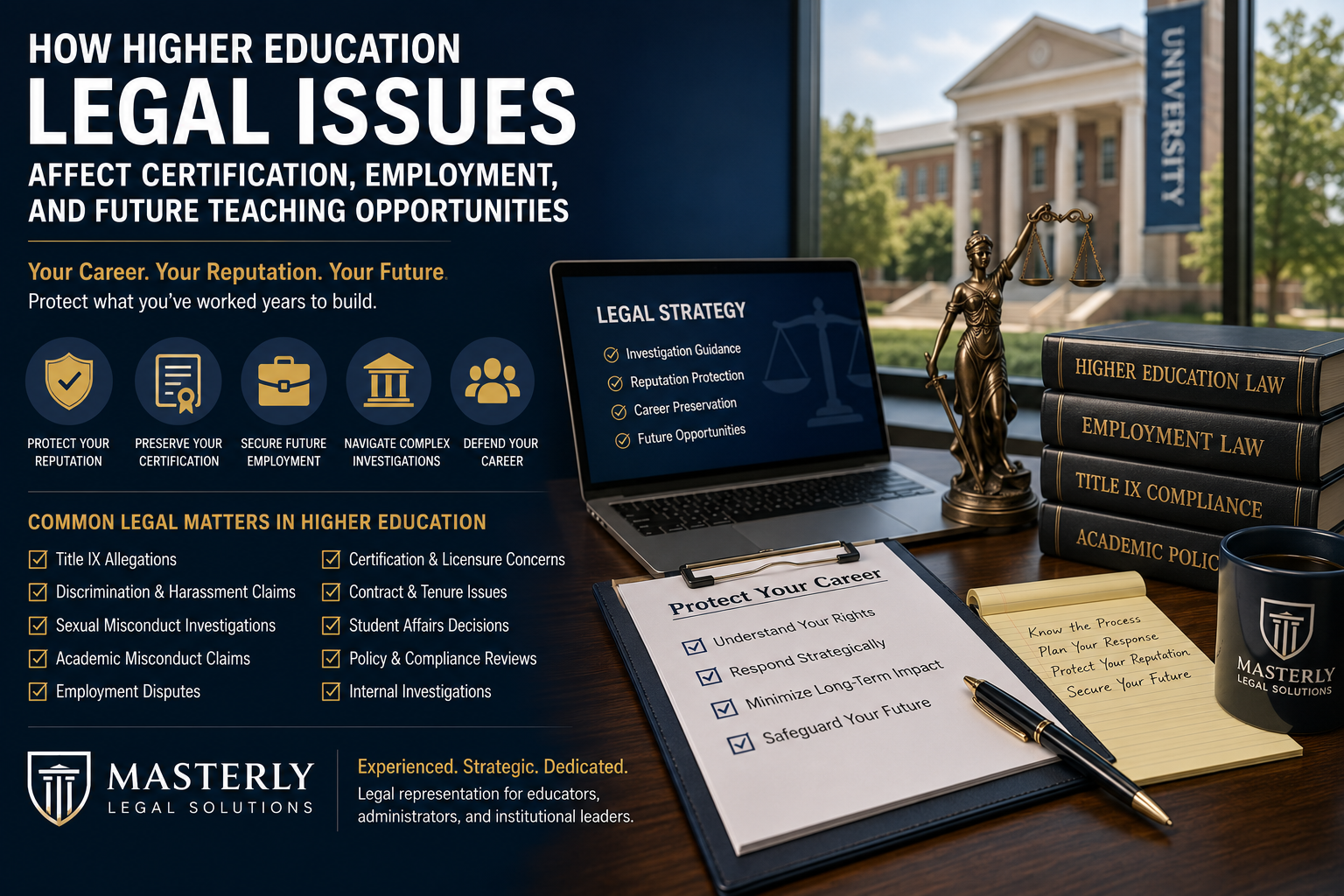
How Higher Education Legal Issues Affect Certification, Employment, and Future Teaching Opportunities
Building a career in higher education often requires years of dedication, advanced degrees, practical experience, and an unwavering commitment to students. Professors, administrators, coaches, advisors, and staff members invest countless hours developing their expertise with the expectation that their careers will continue growing over time. Unfortunately, a single allegation, investigation, or disciplinary matter can suddenly place everything they have worked to achieve at risk. Even before the facts are fully understood, reputational harm may begin affecting future employment opportunities.
For many professionals, the consequences of a legal dispute extend well beyond their current position. Licensing concerns, certification reviews, hiring decisions, and professional references may all be influenced by unresolved allegations. In today's competitive higher education environment, institutions often review an applicant's employment history with greater scrutiny than ever before. Addressing legal concerns early may help reduce long-term professional consequences.
At Masterly Legal Solutions, we understand that careers in higher education are built over decades but can be threatened in a matter of days. Our education team works with educators, administrators, faculty members, and institutional leaders facing complex legal matters that may affect both current employment and future career opportunities, providing expert legal support for teachers and schools. Protecting professional reputations requires thoughtful legal strategy, timely action, and experienced representation.
Higher Education Careers Depend on Professional Reputation
Success within higher education is built on credibility, trust, and demonstrated professional judgment. Faculty members are expected to mentor students, contribute to scholarship, participate in governance, and uphold institutional policies. Administrators must balance operational responsibilities while maintaining confidence among students, colleagues, and governing boards.
When allegations arise, even before formal findings are issued, those expectations can become difficult to maintain. Colleagues may hesitate to collaborate, committees may reconsider appointments, and promotion opportunities may be delayed. Professional relationships that took years to establish can suddenly become uncertain.
Many professionals assume their careers will recover automatically once an investigation ends. Unfortunately, hiring committees and institutional decision-makers often review prior disciplinary history when evaluating future applicants. Early legal intervention can make a meaningful difference in protecting long-term opportunities.
Legal Issues Can Follow You Beyond One Institution
Many professionals believe that changing employers allows them to leave past disputes behind. Unfortunately, careers within higher education often involve extensive background reviews, reference checks, credential verification, and professional networking.
Employment records, separation agreements, public reports, and institutional findings may all become part of future hiring discussions. Even when allegations do not result in formal discipline, unresolved questions may influence hiring decisions made by colleges and universities.
Professional mobility has become increasingly important within higher education, making reputation management an essential part of career protection.
Future Employers Often Ask Difficult Questions
Hiring committees frequently review more than resumes and publication records. Interviews often include questions regarding prior investigations, disciplinary actions, administrative leave, or litigation involving previous employers.
Applicants who are unprepared for these discussions may unintentionally create additional concerns. Developing an appropriate legal strategy before future interviews helps professionals respond accurately while protecting their interests.
Our education team regularly assists professionals preparing for these situations so they can approach future employment opportunities with greater confidence.
Certification and Licensure May Also Be Affected
Many educators hold professional licenses, certifications, or credentials that require ongoing compliance with ethical and professional standards. Certain allegations may trigger reporting obligations even before employment matters have been fully resolved.
Licensing agencies may conduct independent reviews separate from institutional investigations. As a result, resolving workplace concerns alone may not completely eliminate professional risk.
Protecting certification often requires coordinated legal representation that considers both employment matters and regulatory responsibilities.
Internal Investigations Can Create Long-Term Consequences
Many disputes begin with internal investigations conducted by schools or universities. These reviews frequently involve interviews, document collection, witness statements, electronic communications, and institutional policy analysis.
Although these investigations are presented as fact-finding processes, the information gathered may later influence employment decisions, licensing reviews, or litigation. Statements made early in an investigation can remain relevant long after the process concludes.
Our education team helps clients understand investigative procedures before responding to institutional requests.
Early Decisions Often Shape Later Outcomes
Professionals sometimes underestimate the importance of initial responses during an investigation. Emails, written statements, interview responses, and document submissions may all become part of the permanent institutional record.
Seeking experienced legal counsel before participating in interviews may help reduce misunderstandings while protecting important legal rights. Careful preparation often produces stronger long-term outcomes than attempting to respond without guidance.
Title IX Allegations Carry Significant Professional Risk
Among the most serious matters affecting higher education professionals are allegations involving Title IX. Faculty members, coaches, administrators, graduate assistants, and staff may become subjects of investigations involving discrimination, retaliation, or sexual misconduct.
Even when allegations remain unproven, institutions frequently implement interim measures while investigations continue. Administrative leave, restrictions on student contact, or modifications to teaching responsibilities may occur before final findings are issued.
Because Title IX matters often involve extensive procedural requirements, legal representation should begin as early as possible.
Sexual Misconduct Allegations May Affect Future Employment
Allegations involving sexual misconduct frequently receive heightened institutional attention due to public expectations and regulatory requirements. Investigations may involve multiple offices, outside investigators, and institutional leadership.
Future employers often inquire about prior disciplinary history involving Title IX matters. Even when allegations do not result in formal findings, applicants may face difficult questions during future hiring processes.
Protecting both legal rights and professional reputation requires careful planning throughout every stage of the investigation.
Title IX Compliance Affects Both Institutions and Employees
Universities maintain extensive Title IX compliance obligations designed to protect students while ensuring fair investigative procedures. Employees accused of misconduct must also understand the procedural protections available throughout these investigations.
Balancing institutional responsibilities with individual rights often requires experienced legal analysis. Our education team assists clients in navigating these complicated proceedings while protecting long-term career interests.
Employment Decisions Extend Beyond Current Jobs
Many professionals understandably focus on preserving their current positions. However, employment disputes frequently affect opportunities that extend well beyond one institution.
Future employers may evaluate:
- Prior disciplinary findings
- Administrative investigations
- Performance evaluations
- Separation agreements
- Litigation history
- Professional references
Preparing for these issues early often provides stronger long-term protection than responding only after employment has already ended.
Colleges and Universities Face Increasing Regulatory Demands
Today's colleges and universities operate within an increasingly complex legal environment. Institutional policies continue evolving as legislatures, courts, and government agencies adopt new requirements affecting employment, student conduct, discrimination, privacy, and campus safety.
As regulatory expectations expand, employees also face greater scrutiny regarding policy compliance. Actions that previously received informal resolution may now result in formal investigations.
Understanding these evolving standards helps professionals better protect both their careers and their institutions.
Higher Education Institutions Must Balance Multiple Obligations
Every decision made by higher education institutions involves competing legal responsibilities. Administrators must consider institutional policy, accreditation requirements, federal guidance, employment law, student rights, and public accountability.
Faculty and staff frequently find themselves navigating these overlapping obligations while continuing to fulfill their educational responsibilities. Legal disputes often arise when competing expectations become difficult to reconcile.
Masterly Legal Solutions provides experienced representation for individuals working within these challenging environments, offering higher education law counsel for colleges and universities.
Student Affairs Decisions Can Become Employment Issues
Professionals working in student affairs regularly manage situations involving student conduct, accommodations, campus activities, crisis response, and conflict resolution. These responsibilities often require difficult judgment calls made under significant time pressure.
When complaints arise, decisions made by student affairs professionals may later become subjects of institutional review or litigation. Employment consequences sometimes follow even when professionals acted in good faith.
Understanding institutional procedures before disputes escalate may help reduce unnecessary career risks.
Educational Institutions Face Constant Legal Change
Modern educational institutions continually revise policies in response to changing legal standards, judicial decisions, and regulatory guidance. Employees must remain aware of these developments while balancing daily operational responsibilities.
Legal requirements affecting educational institutions today are significantly more complex than those of previous decades. Employment disputes increasingly involve overlapping issues related to discrimination, disability accommodations, privacy, free speech, and campus safety.
Our education team works closely with professionals seeking practical legal solutions, including experienced education law and teacher license defense services, before legal problems become career-defining events.
Student Discipline Decisions May Create Unexpected Liability
Professionals responsible for student discipline often work in situations where every decision is carefully reviewed by students, parents, administrators, and legal counsel. What may initially appear to be a routine disciplinary matter can quickly become a dispute involving institutional policies, procedural fairness, or allegations of unequal treatment.
Many educational institutions have detailed disciplinary procedures designed to promote consistency, yet misunderstandings or procedural errors can still occur. When those situations develop, faculty members and administrators may find themselves answering difficult questions about decisions made months earlier.
Our education team helps clients evaluate these matters before they create additional employment concerns.
Student Records Require Careful Handling
Maintaining accurate student records is an essential responsibility within higher education. Improper access, unauthorized disclosure, or documentation mistakes may expose both employees and institutions to legal scrutiny.
Questions involving family educational rights frequently arise when institutions respond to requests for educational records or attempt to balance privacy obligations with campus safety concerns. Understanding applicable procedures helps reduce unnecessary legal exposure while protecting both students and employees.
Financial Aid Compliance Extends Beyond Administrative Offices
Many professionals assume financial aid matters involve only specialized departments. In reality, faculty members, administrators, coaches, and institutional leadership may all become involved when eligibility, scholarship administration, or compliance questions arise.
Errors involving financial aid may trigger institutional reviews, regulatory inquiries, or internal audits. These matters sometimes extend beyond campus administrators and involve outside reviewers examining institutional practices.
Early legal guidance often helps professionals understand their responsibilities while minimizing unnecessary risk.
State and Federal Regulations Continue Expanding
Modern higher education operates under an extensive framework of state and federal laws governing employment, discrimination, privacy, accessibility, and institutional operations. Professionals working in educational institutions frequently encounter overlapping legal responsibilities that continue evolving each year.
Compliance often requires understanding both federal and state law, institutional policy, and industry best practices. Remaining informed helps employees recognize potential concerns before they become larger legal disputes.
Collective Bargaining Creates Additional Employment Considerations
Many faculty members and staff work in environments where collective bargaining agreements influence employment rights, grievance procedures, compensation, and disciplinary processes. Understanding these agreements becomes especially important when employment disputes arise.
Questions involving collective bargaining frequently intersect with institutional policies and employment contracts. Employees should understand both contractual protections and institutional procedures before responding to disciplinary actions or proposed employment changes.
Our attorneys regularly evaluate employment matters that involve overlapping contractual and institutional obligations, supported by HR consulting and workplace training services.
Labor Relations Affect Daily Operations
Healthy labor relations contribute to productive campuses, but disagreements occasionally arise regarding working conditions, evaluations, promotions, or disciplinary actions. These disputes may involve administrators, employee representatives, and institutional leadership.
Professionals navigating labor relations concerns should understand how workplace communications and procedural decisions may influence future employment opportunities. Careful legal planning often reduces unnecessary conflict while protecting long-term career interests.
Academic Freedom Does Not Eliminate Legal Responsibilities
The principle of academic freedom remains an important foundation within higher education, encouraging research, scholarship, and open discussion. At the same time, institutions continue balancing these principles with workplace expectations, institutional policies, and applicable legal requirements.
Disputes occasionally arise when faculty members believe academic expression has affected employment decisions. Resolving these matters often requires careful evaluation of institutional policies, employment agreements, and applicable legal standards.
Every situation deserves individual analysis rather than broad assumptions.
General Counsel Plays a Critical Institutional Role
Every institution depends upon experienced general counsel to advise leadership regarding legal obligations, policy implementation, employment matters, and institutional risk. These legal professionals help administrators evaluate difficult situations before they develop into larger disputes.
Employees should also recognize that general counsel represents the institution itself rather than individual faculty or staff members. Understanding this distinction becomes important when personal legal interests differ from institutional objectives.
Independent legal representation may therefore become appropriate in many employment investigations.
Higher Education Practice Group Experience Matters
Legal disputes involving universities differ significantly from those arising in many other industries. Attorneys working within a dedicated higher education practice group understand the policies, regulations, governance structures, and employment expectations unique to colleges and universities.
Our higher education practice group combines litigation experience with practical knowledge of institutional operations. That experience allows us to develop legal strategies tailored specifically to the realities of modern campuses.
Legal Compliance Supports Long-Term Career Protection
Maintaining legal compliance benefits both institutions and individual employees. Faculty members and administrators who understand applicable policies are often better positioned to avoid misunderstandings before they escalate into formal disputes.
Effective compliance programs provide practical guidance regarding reporting obligations, workplace conduct, investigations, and institutional procedures. Employees who actively participate in these programs frequently strengthen both their professional credibility and institutional effectiveness.
Prevention often remains the most effective legal strategy.
Crisis Management Requires Immediate Attention
Unexpected allegations frequently require immediate crisis management decisions. Public statements, internal communications, media attention, and institutional responses may all influence the outcome of a developing dispute.
Poor communication during a crisis sometimes creates additional legal challenges beyond the original allegation. Early legal representation helps professionals evaluate available options before making important decisions.
Our education team assists clients during sensitive situations where prompt action is essential.
Government Agencies May Conduct Independent Reviews
Some employment disputes extend beyond institutional investigations and involve outside government agencies or federal agencies responsible for enforcing applicable laws. These reviews often require careful preparation and complete documentation.
Professionals should understand that institutional findings do not always determine how outside regulators evaluate a situation. Separate investigations may involve different legal standards and procedural requirements.
Coordinated legal representation becomes especially valuable when multiple investigations proceed simultaneously.
Academic Medical Centers Present Additional Legal Challenges
Professionals working within academic medical centers often navigate responsibilities involving education, patient care, research, and employment simultaneously. These environments create unique legal considerations not commonly found elsewhere within higher education.
Employment disputes affecting academic medical centers may involve faculty appointments, clinical responsibilities, accreditation standards, and contractual obligations. Addressing these issues requires attorneys familiar with both educational and healthcare regulatory frameworks.
Private Colleges and Universities Face Similar Risks
Although governance structures differ, private colleges frequently encounter many of the same employment and compliance challenges affecting public campuses. Faculty members and administrators remain subject to institutional policies, contractual obligations, and applicable legal standards.
Likewise, a private university may conduct investigations involving employment concerns, sexual harassment, or Title IX matters that carry significant professional consequences. Professionals should not assume private status limits legal exposure or reduces the need for experienced representation.
Public and Private Institutions Share Common Responsibilities
Both public and private institutions strive to maintain safe learning environments while complying with evolving legal obligations. Regardless of governance structure, institutions must balance employee rights, student welfare, regulatory expectations, and institutional integrity.
Professionals working within community colleges, major research universities, and smaller campuses all face similar risks when allegations arise. Careful legal planning helps protect careers regardless of institutional size.
Policy Development Helps Prevent Future Disputes
Effective policy development remains one of the strongest tools available for reducing institutional risk. Clearly written policies establish expectations, improve consistency, and provide guidance when difficult situations arise.
Our attorneys assist institutions by reviewing existing policies, identifying areas of concern, and recommending practical improvements that strengthen legal compliance while supporting institutional objectives.
Preventative legal planning frequently reduces the likelihood of future litigation.
Legal Services Designed for Higher Education Professionals
Professionals facing employment disputes often need more than general legal representation. They need attorneys with extensive knowledge of the unique challenges affecting the higher education sector.
Masterly Legal Solutions provides focused legal services for faculty members, administrators, coaches, and institutional leaders confronting complex employment and regulatory matters, including legal services for higher education, labor and employment, and internal investigations. We work closely with our clients to understand their goals while developing strategies that protect both immediate interests and future career opportunities.
Employment Contracts Deserve Careful Review
Every professional position in higher education is shaped by written agreements that define responsibilities, expectations, and institutional obligations. Employment contracts frequently address appointment terms, evaluations, renewal procedures, compensation, and disciplinary standards. Small provisions that seem routine at the beginning of employment may become critically important if a dispute later develops.
Before signing or responding to proposed contract changes, professionals should understand how those provisions may affect future opportunities and when to seek education law and Title IX defense counsel. Our attorneys work closely with clients to review agreements and identify potential concerns before they become costly legal problems. Careful planning today may help prevent unnecessary disputes tomorrow.
Student Organizations and Campus Activities Present Unique Risks
Faculty advisors and administrators often support student organizations that contribute significantly to campus life. While these roles can be rewarding, they may also involve difficult decisions concerning funding, discipline, event planning, and institutional policy.
Questions involving student groups occasionally become the subject of complaints or administrative review. Understanding institutional procedures before disagreements escalate helps professionals protect both their positions and the students they serve.
Disabilities and Accommodation Requirements Continue Expanding
Modern educational institutions must comply with numerous accessibility requirements, including obligations under the Disabilities Act. Faculty members and administrators regularly encounter accommodation requests involving academics, employment, housing, and campus programs.
Responding appropriately requires careful evaluation of institutional policy, applicable law, and individual circumstances. Misunderstandings can quickly develop into significant legal issues when accommodation requests are handled inconsistently or without proper documentation.
Our education team assists professionals facing these challenging situations while helping them understand their legal responsibilities, similar to our legal support for educators and TEA license defense.
Employment Matters May Involve Multiple Federal Agencies
Employment disputes sometimes involve investigations by organizations beyond the institution itself. The Equal Employment Opportunity Commission may review allegations involving discrimination, retaliation, or workplace practices, while other matters may involve the National Labor Relations Board when employment rights or collective bargaining questions arise.
These proceedings operate under their own procedural rules and legal standards. Professionals should recognize that institutional investigations and agency investigations often occur independently of one another.
Having experienced legal counsel helps ensure responses remain consistent throughout every stage of the process.
Government Contracts and Institutional Responsibilities
Some higher education institutions receive funding through government contracts, grants, or other public programs that create additional compliance obligations. Faculty members, researchers, and administrators involved in these programs may encounter specialized reporting requirements and regulatory expectations.
Understanding these obligations becomes especially important when questions arise regarding funding, research administration, or institutional accountability, underscoring why colleges need dedicated higher education attorneys. Preventative legal planning helps reduce unnecessary exposure while supporting responsible institutional management.
Academic Medical Centers and Clinical Partnerships Require Careful Oversight
Many universities collaborate with hospitals and healthcare providers through clinical affiliation agreements that support education and professional training. These arrangements are especially common within academic medical centers, where educational objectives intersect with patient care and regulatory oversight.
Disputes involving these partnerships may affect employment, accreditation, and institutional relationships. Professionals working within these environments benefit from attorneys who understand both educational operations and healthcare-related legal concerns.
Tax and Financial Compliance Affect Institutions
Institutional decision-making frequently involves questions extending beyond academics. Compliance with provisions of the Internal Revenue Code, employee compensation structures, and employee benefits programs may all influence administrative decisions.
Professionals responsible for budgeting or institutional governance should understand how financial compliance intersects with employment and operational policies. Legal planning often reduces uncertainty while supporting responsible institutional leadership.
Sexual Harassment Allegations Require Immediate Attention
Claims involving sexual harassment demand careful, timely responses because they may affect employment, professional reputation, and future opportunities. Many investigations also overlap with Title IX, creating additional procedural requirements for both institutions and employees.
Waiting to seek legal assistance may limit available options. Our education team helps clients understand investigative procedures while protecting their rights throughout the process.
Civil Rights Investigations Can Shape Careers
Institutions occasionally conduct or participate in civil rights investigations involving discrimination, retaliation, or alleged policy violations. These matters often involve detailed document reviews, witness interviews, and procedural analysis.
Professionals should approach every investigation carefully because findings may influence employment decisions, licensing concerns, and future career opportunities. Experienced representation helps ensure important issues are properly addressed.
Leadership Decisions Carry Long-Term Consequences
Members of senior leadership teams regularly make decisions affecting institutional operations, faculty employment, student welfare, and campus governance. These responsibilities frequently involve balancing legal obligations with operational priorities.
Even well-intentioned decisions may later receive legal scrutiny. Our attorneys work closely with institutional leaders to evaluate risks before significant decisions are implemented.
Experienced Counsel Makes a Difference
Many law firms provide general employment representation, but disputes involving higher education require attorneys who understand institutional governance, academic policies, and campus procedures. A deep understanding of university operations often proves invaluable when developing effective legal strategies.
Masterly Legal Solutions represents higher education clients across a wide range of legal matters affecting employment, investigations, and institutional compliance. Our attorneys combine extensive knowledge with practical experience to help counsel clients facing difficult professional decisions.
Working with Numerous Educational Institutions
Over the years, our attorneys have assisted many educational institutions, including private colleges, private institutions, and major universities confronting complicated legal challenges. We have also advised universities on matters involving compliance, employment, investigations, and institutional policy.
This experience allows us to understand how numerous institutions approach similar issues while recognizing that every case requires an individualized legal strategy, consistent with our broader comprehensive legal and business services for diverse clients.
Litigation May Continue Beyond Campus
Some employment disputes eventually proceed into federal and state courts, where legal arguments, evidence, and procedural rules become increasingly important. Decisions made during institutional investigations often influence later litigation.
Courts may evaluate whether institutions complied with state law, contractual obligations, and applicable federal laws. In certain cases, motions seeking summary judgment become important because they may resolve disputes before trial when the facts and applicable law support such relief.
Preparing for possible litigation requires careful documentation from the earliest stages of a dispute.
Every Employment Relationship Deserves Protection
The employment relationship between professionals and their institutions involves mutual responsibilities built upon trust and accountability. When disagreements arise, preserving that relationship—or protecting future opportunities—often requires thoughtful legal planning.
Whether the matter involves promotion, discipline, investigation, contract interpretation, or Title IX, early legal assistance frequently provides more options than waiting until decisions have already been made.
International Students and Campus Responsibilities
Many institutions serve international students, creating additional responsibilities involving immigration compliance, academic policies, and student support services. Faculty and administrators working with these students often encounter unique legal and administrative considerations.
Addressing these matters effectively helps maintain an inclusive campus while reducing unnecessary institutional risk. Understanding applicable procedures benefits both employees and the students they support.
Practical Representation for Higher Education Professionals
Our higher education team understands that careers within academia are built through years of commitment, scholarship, and professional service, and we guide clients through the Title IX investigation process and other higher education legal services. Allegations involving Title IX, sexual misconduct, employment disputes, investigations, or other significant legal issues can place those careers at serious risk if they are not addressed appropriately.
We believe our clients benefit from representation that combines practical experience with responsive communication. Rather than offering generic solutions, we counsel clients based upon the specific facts, institutional policies, and legal standards affecting their situations. Our attorneys assist institutions and individuals with strategic planning, legal resources, and practical guidance designed to reduce unnecessary risk while protecting professional futures.
Student Handbooks Play a Critical Role in Campus Compliance
Well-written student handbooks do much more than outline campus expectations. They establish standards that support student life, promote student safety, and help create a consistent educational environment across the institution. Because policies are often reviewed during investigations or disciplinary proceedings, colleges and universities should regularly update their handbooks to reflect current regulatory compliance requirements and evolving legal standards. Clear policies not only guide students but also provide faculty and administrators with a stronger framework for making fair, consistent decisions.
Navigating Legal Responsibilities Across the Higher Education Arena
The higher education arena continues evolving as institutions respond to changing laws, regulatory expectations, and the needs of increasingly diverse campus communities. Matters involving student housing, discrimination based on national origin, accessibility, and campus operations require careful attention from institutional leadership. Organizations such as the National Association of higher education professionals regularly provide resources that help institutions strengthen policies and remain informed about emerging legal developments. At Masterly Legal Solutions, we focus on providing legal advice that helps educational professionals and institutions address complex legal challenges while protecting their missions, supporting compliance, and reducing long-term risk.
Protect Your Career Before Problems Grow Larger
Every decision made during an investigation or employment dispute may influence future teaching opportunities, certifications, and professional advancement. Whether you work for colleges and universities, a private university, or other educational institutions, seeking experienced legal representation early may help protect the career you have worked so hard to build.
At Masterly Legal Solutions, we provide experienced representation for professionals throughout the higher education community. We proudly represent higher education clients nationwide, helping faculty members, administrators, coaches, and institutional leaders address complex legal matters with confidence. If you have questions about higher ed law, employment concerns, Title IX investigations, or other matters affecting your professional future, contact Masterly Legal Solutions today at (972) 236-5051 to schedule a free consultation. We are ready to discuss your situation, answer your questions, and help you explore practical legal options tailored to your circumstances.
Disclaimer: This article is provided for informational purposes only and does not constitute legal guidance, legal advice, or create an attorney-client relationship. Every legal matter is unique. You should consult with a qualified attorney regarding your specific circumstances before making legal decisions.

Teacher Rights When Assaulted by a Special Needs Student: Safety, Reporting and Investigation Issues

Looking for Legal & Business Solutions? Contact Us Now
Fill in the form or call us to set up a meeting