How Internal Investigations Law Firms Help Businesses Navigate Employee Misconduct and Fraud
An employee misconduct complaint can quickly create serious concerns for an organization. Allegations of fraud, harassment, discrimination, or misuse of company resources may raise questions about legal compliance, leadership decisions, and workplace trust.
When management receives a complaint involving serious misconduct, the response matters. An investigation that is delayed, poorly documented, or influenced by personal relationships may create additional legal and reputational risks.
An internal investigations attorney can help businesses evaluate allegations, establish an appropriate investigation process, and understand their legal responsibilities before making important employment decisions.
For school administrators and superintendents, similar concerns may involve teacher misconduct, administrative leave, employee grievances, or allegations involving district leadership.
These situations often require careful attention to confidentiality, employee rights, and organizational policies.
Masterly Legal Solutions offers internal investigation services for organizations facing sensitive workplace concerns. Independent legal guidance can help leadership address allegations while maintaining a fair and professional process.
When Independent Counsel Is Useful in Workplace Investigations
Not every workplace complaint requires an outside investigation. Some concerns can be addressed through established HR procedures or routine management review.
However, outside counsel may be appropriate when allegations involve senior leadership, significant financial concerns, potential legal violations, or questions about the independence of internal decision-makers.
An attorney can assess the nature of the complaint and determine what legal considerations may affect the investigation.
Allegations Involving Senior Management
When a complaint concerns a supervisor, executive, or school administrator, employees may question whether internal investigators can remain impartial.
A manager accused of misconduct may also have authority over witnesses, personnel records, or the individuals responsible for investigating the complaint.
This can create conflicts of interest or concerns about the fairness of the process.
Independent workplace investigation counsel can provide a separate legal perspective and assess whether an investigation can be conducted without improper influence.
The objective is to establish a credible process that evaluates the facts rather than assumes a particular result.
Employee Fraud and Financial Misconduct
Businesses may also require independent legal guidance when allegations involve theft, expense reimbursement fraud, unauthorized transactions, or misuse of organizational funds.
These matters may involve accounting records, electronic communications, employee policies, and possible reporting obligations.
A corporate misconduct investigation lawyer can help evaluate the legal issues surrounding the allegations, including whether additional financial or regulatory professionals should be involved.
The appropriate investigation depends on the seriousness of the concerns and the evidence available.
Investigations Within Schools and Education Organizations
School districts face additional responsibilities when allegations involve teachers, administrators, or other employees.
Depending on the circumstances, an investigation may raise questions about administrative leave, student safety, employment contracts, educator certification, or mandatory reporting.
An investigation involving a teacher does not automatically establish misconduct.
Likewise, placing an employee on administrative leave does not necessarily mean the district has reached a final disciplinary decision.
Independent legal guidance can help school leaders understand how the investigation relates to applicable employment policies and education law requirements.
Scope, Confidentiality, and Independence
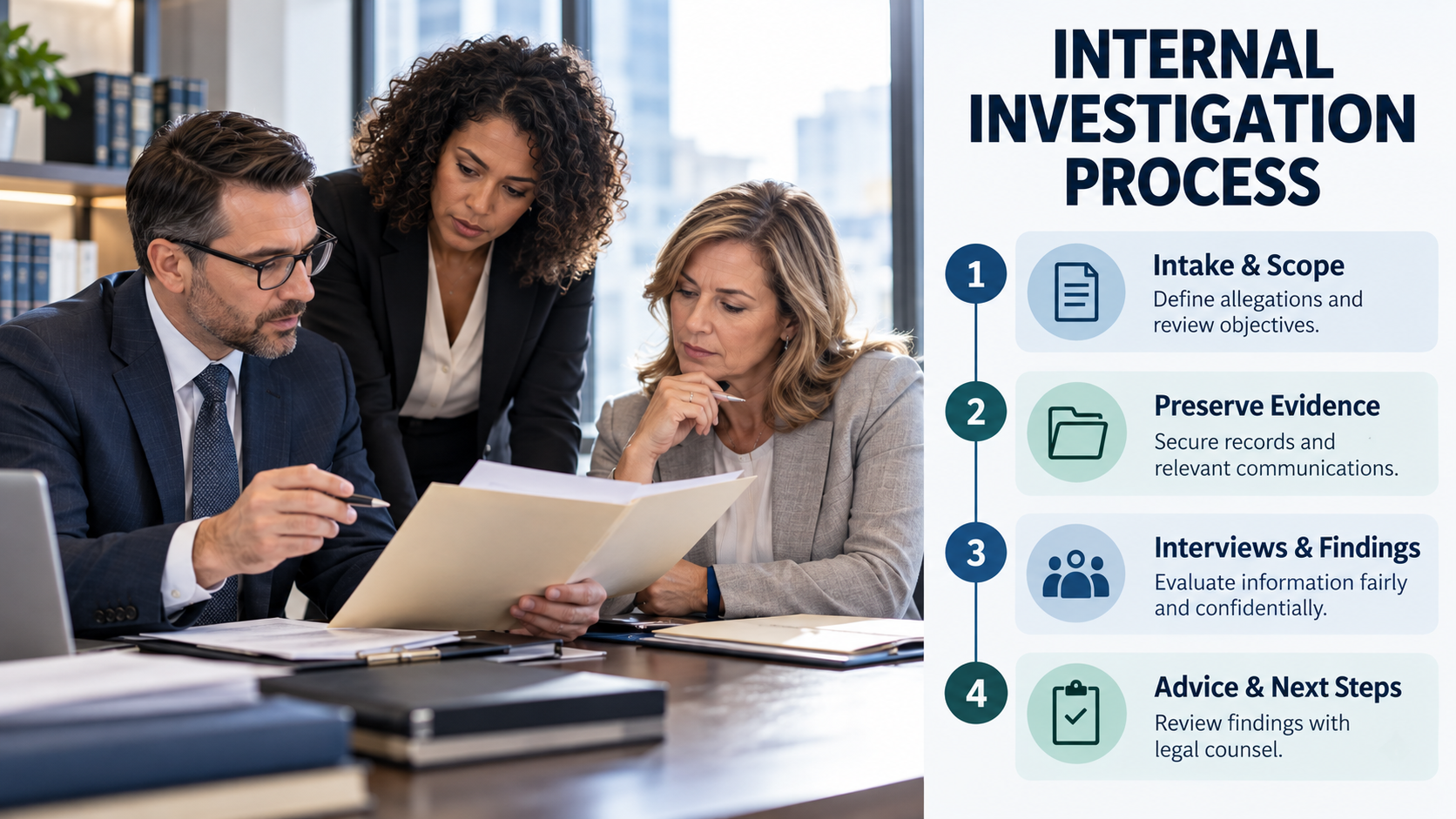
An effective internal investigation begins with a clear understanding of the allegations and the purpose of the review.
Leadership should know what issues require investigation, who will oversee the process, and how findings may be used.
Without clear boundaries, an investigation can expand into unrelated disputes or leave important questions unanswered.
Defining the Scope of an Investigation
The investigation's scope depends on the nature of the complaint and the organization's legal responsibilities under applicable laws and regulations.
For example, a harassment complaint may require review of workplace communications, witness accounts, and relevant employment law requirements.
A financial misconduct allegation may require examination of accounting information, approval records, and internal controls.
A business internal investigation attorney can advise on the legal scope within the workplace investigation process and identify federal, company policies, and other issues that may require specialized review.
Clear service expectations also help leadership understand which tasks outside counsel will perform and which decisions remain the organization's responsibility. Written procedures for conducting investigations help ensure consistency and compliance.
Understanding Confidentiality and Attorney-Client Privilege
Confidentiality is especially important during investigations involving sensitive employee information and other sensitive matters affecting the organization and its people.
However, an organization should not promise absolute confidentiality.
Relevant information may need to be shared with witnesses, investigators, regulators, or other parties when required by law or necessary to conduct a fair investigation, and an internal investigations attorney can help clients navigate those decisions.
Attorney-client privilege may protect certain confidential communications made for the purpose of obtaining legal advice, but it does not automatically protect every document or fact collected during an investigation, so in-house counsel and outside counsel may need to assess how communications and findings are handled.
An internal investigations attorney can evaluate the applicable rules and advise leadership about appropriate information-handling procedures. Findings may ultimately be reported to organizational leadership, but privilege and disclosure issues should be evaluated first.
Why Investigator Independence Matters
An investigation should be based on relevant facts rather than pressure from management or personal relationships.
Independent counsel may be particularly useful when the accused employee holds a leadership position or when the complaint involves several departments. Independence should also be paired with strong interviewing and credibility-assessment skills.
A fair investigation should consider information that supports or challenges the allegations.
The investigator's independence, professional judgment, and access to necessary information can affect the credibility of the findings. In workplace matters involving human resources concerns, investigative expertise can also influence how credible the findings appear to employees and leadership.
For organizations concerned about employee confidence and public trust, counsel with labor and employment experience may be uniquely equipped to handle these matters with the judgment internal investigators may not bring.
Interview and Documentation Protocols
Employee interviews and documentary evidence often form the foundation of an internal investigation.
The quality of the investigation may depend on whether relevant records were preserved, whether witnesses had an appropriate opportunity to provide information, and whether the findings accurately reflect the available evidence.
Preserving Relevant Workplace Records
Organizations may need to preserve documents when they become aware of allegations that could lead to legal proceedings.
Relevant materials may include:
- Emails, workplace messages, and other communications.
- Employee complaints and written statements.
- HR policies and disciplinary records.
- Financial transactions and approval documents.
- Meeting notes, schedules, and attendance records.
- Relevant electronic records and investigation notices.
In some circumstances, voluntary audits of workplace practices may help identify problems early and reduce potential negative publicity from government investigations.
Preservation duties vary depending on the allegations and whether litigation or regulatory action is reasonably anticipated.
Management should also consider applicable privacy obligations and access restrictions.
Legal counsel can advise on preservation requirements and appropriate handling of sensitive information.
Conducting Fair Employee Interviews
Witness interviews may involve the reporting employee, accused individual, supervisors, and relevant witnesses when conducting workplace investigations into workplace complaints such as sexual harassment.
The process should provide appropriate opportunities for individuals to explain what they know. Written interview procedures can help ensure consistency and compliance.
Interview procedures may differ depending on whether the organization is a private business, public school district, or another type of employer.
Employment agreements, public employee protections, and organizational policies may also affect the process.
An attorney can help evaluate these requirements and advise on procedures that support a fair assessment of the allegations. Fair interviews also depend on strong interviewing and credibility-assessment skills.
Avoiding Premature Conclusions
A complaint is not the same as a finding of misconduct.
Similarly, an employee's denial does not automatically resolve the allegations.
Investigators should consider relevant evidence, possible inconsistencies, and the reliability of available information before reaching conclusions.
Leadership decisions based on incomplete information can create legal concerns, particularly when disciplinary action or termination is being considered.
A documented investigation provides a clearer basis for evaluating the available facts and possible responses.
It may conclude with a written report explaining the findings and, where appropriate, recommendations for corrective action so leadership can take appropriate action.
Practical Next Steps for Leadership
When serious misconduct allegations arise, business leaders may face pressure to act quickly.
Some situations require immediate measures to address safety concerns or prevent further harm. Others require a careful review before disciplinary decisions are made.
An internal investigations attorney can help leadership distinguish urgent concerns from matters that require additional fact-finding.
Leadership Decision Checklist
Legal consultation may be appropriate when:
- A complaint involves executives or senior administrators.
- Allegations include harassment, discrimination, retaliation, or fraud.
- The organization has concerns about the independence of internal investigators.
- Important employment or disciplinary decisions are being considered.
- There is a risk of lost records or disputed evidence.
- The complaint may involve regulatory reporting or litigation.
- School district procedures or educator employment rights may apply.
These circumstances do not necessarily require the same investigation process.
The appropriate response depends on the organization's size, legal obligations, and the specific allegations.
Evaluating Findings and Taking Appropriate Action
When an investigation is complete, leadership may need to evaluate the findings reported to organizational leadership and decide whether corrective measures or other appropriate action are warranted.
Possible actions may include policy changes, additional training, personnel decisions, or referral of certain issues for further review. Counsel may also provide recommendations for corrective action based on the findings.
Any employment action should be evaluated under applicable law, company policies, relevant agreements, and potential liability.
An investigation does not guarantee that every dispute will be resolved or that legal claims will be prevented.
However, a fair and well-documented process can help leadership make decisions based on the information available.
Protecting Organizational Reputation
Businesses and educational institutions depend on the confidence of employees, customers, families, and other stakeholders.
Allegations of misconduct can affect that confidence, particularly when concerns involve leadership or public responsibilities.
Responding responsibly means taking complaints seriously, respecting employee rights, and avoiding unsupported public statements.
An independent investigation can help establish a clearer factual record while allowing leadership to consider appropriate organizational action.
How an Internal Investigations Attorney Can Support Your Organization
Organizations facing sensitive misconduct allegations may benefit from legal counsel with experience in workplace investigations and related legal matters.
Depending on the engagement, an attorney may review the allegations, advise on the scope of the investigation, assess relevant policies, or conduct an independent review.
A corporate misconduct investigation lawyer may also evaluate legal risks relating to employment decisions, potential regulatory obligations, or anticipated litigation.
For schools and educational institutions, legal counsel may need to consider teacher employment rights, administrative leave procedures, and other education-specific requirements.
What to Expect From Professional Legal Services
A legal consultation may begin with a discussion of the complaint, the individuals involved, and any immediate legal concerns.
The attorney may request relevant policies, compliance materials, investigation notices, organizational records, or information about pending employment decisions to assess applicable laws and regulations where relevant.
The proposed scope of services should identify the attorney's responsibilities, reporting arrangements, and expected deliverables. Counsel may also advise whether an effective compliance program is needed as part of corporate defense based on the organization's business needs and potential liability. In appropriate matters, such measures can help ensure compliance, reduce penalties under sentencing guidelines, and help companies avoid severe sanctions, including in some federal matters.
Masterly Legal Solutions provides internal investigation services for organizations dealing with sensitive professional concerns. A consultation can help determine whether the firm's services fit the nature and scope of the matter.
How Workplace Investigations Attorneys Address Discrimination and Harassment Claims
Workplace investigations attorneys help organizations investigate allegations involving workplace discrimination, harassment, retaliation, and other forms of potentially illegal conduct. These matters may involve complaints filed with the Equal Employment Opportunity Commission (EEOC), state employment agencies, or other government agencies. An internal investigations attorney can evaluate relevant workplace policies, witness statements, and applicable state employment laws to help employers understand their legal responsibilities. Effective harassment prevention also requires organizations to address complaints fairly and evaluate such claims without making premature conclusions. Independent legal counsel can help management assess potential exposure and determine appropriate next steps.
Internal Investigations Involving Government Contracts and Federal Compliance
Organizations that maintain government contracts may face additional responsibilities involving federal contract compliance programs and workplace regulations. Depending on the nature of the allegations, investigations may involve federal agencies, an inspector general, or oversight bodies within the United States Department of Labor or other government departments. Certain concerns may also involve occupational safety requirements enforced by the Occupational Safety and Health Administration, workplace misconduct, or suspected violations of contractual obligations. Government contractors and educational institutions may benefit from legal guidance when responding to regulatory inquiries, internal affairs investigations, or potential adverse findings. An attorney can help assess applicable compliance requirements and the appropriate scope of an investigation.
Experienced Legal Counsel for Complex Workplace and Regulatory Investigations
Organizations facing serious misconduct allegations may seek legal counsel with extensive experience in employment law, regulatory compliance, and internal investigations. Attorneys with significant experience handling these matters can evaluate complex documentation, interview witnesses, and advise leadership about potential legal consequences. Some investigations may also involve professional associations, regulatory authorities, or government agencies with separate reporting and disciplinary requirements. Masterly Legal Solutions welcomes inquiries from businesses, school districts, and other organizations seeking legal guidance about sensitive workplace concerns. A consultation can help determine whether the firm's services align with the allegations, applicable legal requirements, and organizational needs.
Frequently Asked Questions About Internal Investigations Attorneys
When should a company use outside counsel for an investigation?
Outside counsel may be appropriate when allegations involve senior management, serious misconduct, possible legal violations, or conflicts of interest that could affect an internal investigator's independence.
What should management preserve before interviews?
Relevant records may include employee complaints, emails, workplace messages, policies, financial documents, and other evidence connected to the allegations. Legal counsel can advise on preservation duties and lawful access to records.
What does an internal investigations attorney do?
An internal investigations attorney provides legal guidance on workplace investigations and may conduct investigations, evaluate evidence, advise on employee rights, or assess potential legal consequences, depending on the engagement.
Can a business internal investigation attorney investigate employee fraud?
Yes. A qualified attorney may advise on or conduct investigations involving suspected financial misconduct, and depending on the matter may also represent clients responding to workplace complaints, government investigations into alleged violations, or requests from government officials, including federal, state and local agencies. Some matters may also require forensic accounting or other specialized assistance.
Are internal investigations confidential?
Confidentiality may be maintained to the extent possible and permitted by law, but complete secrecy cannot always be guaranteed. Attorney-client privilege also depends on the purpose and circumstances of particular communications.
Can a school district hire independent workplace investigation counsel?
Yes. School districts may engage outside counsel to address appropriate personnel or misconduct investigations, subject to applicable procurement, conflict-of-interest, and legal requirements.
Does an internal investigation automatically lead to employee termination?
No. An investigation gathers and evaluates information. Employment decisions depend on the findings, relevant laws, contracts, and organizational policies.
Can an internal investigations attorney help prevent retaliation claims?
An attorney can advise on retaliation risks, applicable legal duties, and appropriate organizational responses. Legal representation cannot guarantee that a future claim will not occur.
Contact Masterly Legal Solutions for an Internal Investigations Attorney Consultation
Employee misconduct allegations can create serious legal, operational, and reputational concerns for businesses and educational institutions.
Whether your organization is facing suspected fraud, harassment allegations, leadership misconduct, or a sensitive personnel dispute, understanding the legal risks is important before making significant decisions.
Masterly Legal Solutions offers professional internal investigation services for organizations seeking independent legal guidance.
If your business, school district, or institution needs an internal investigations attorney, contact the firm to discuss your circumstances and determine whether its services are appropriate.
A consultation can help clarify the investigation's scope, relevant documentation, confidentiality considerations, and applicable next steps, including retaliation concerns that may arise alongside other workplace complaints such as sexual harassment allegations, as well as counsel for clients facing related employment law risks or other sensitive matters.
Masterly Legal Solutions
Phone: (972) 236-5051
Website: https://www.masterlylegal.com/
Contact Masterly Legal Solutions to request a consultation about your organization's internal investigation needs and available legal representation.
Legal Disclaimer: This article provides general educational information and does not constitute legal advice. Investigation duties, confidentiality protections, employment rights, and reporting obligations vary depending on the facts and applicable law. Contacting the firm does not automatically establish an attorney-client relationship.


Looking for Legal & Business Solutions? Contact Us Now
Fill in the form or call us to set up a meeting