
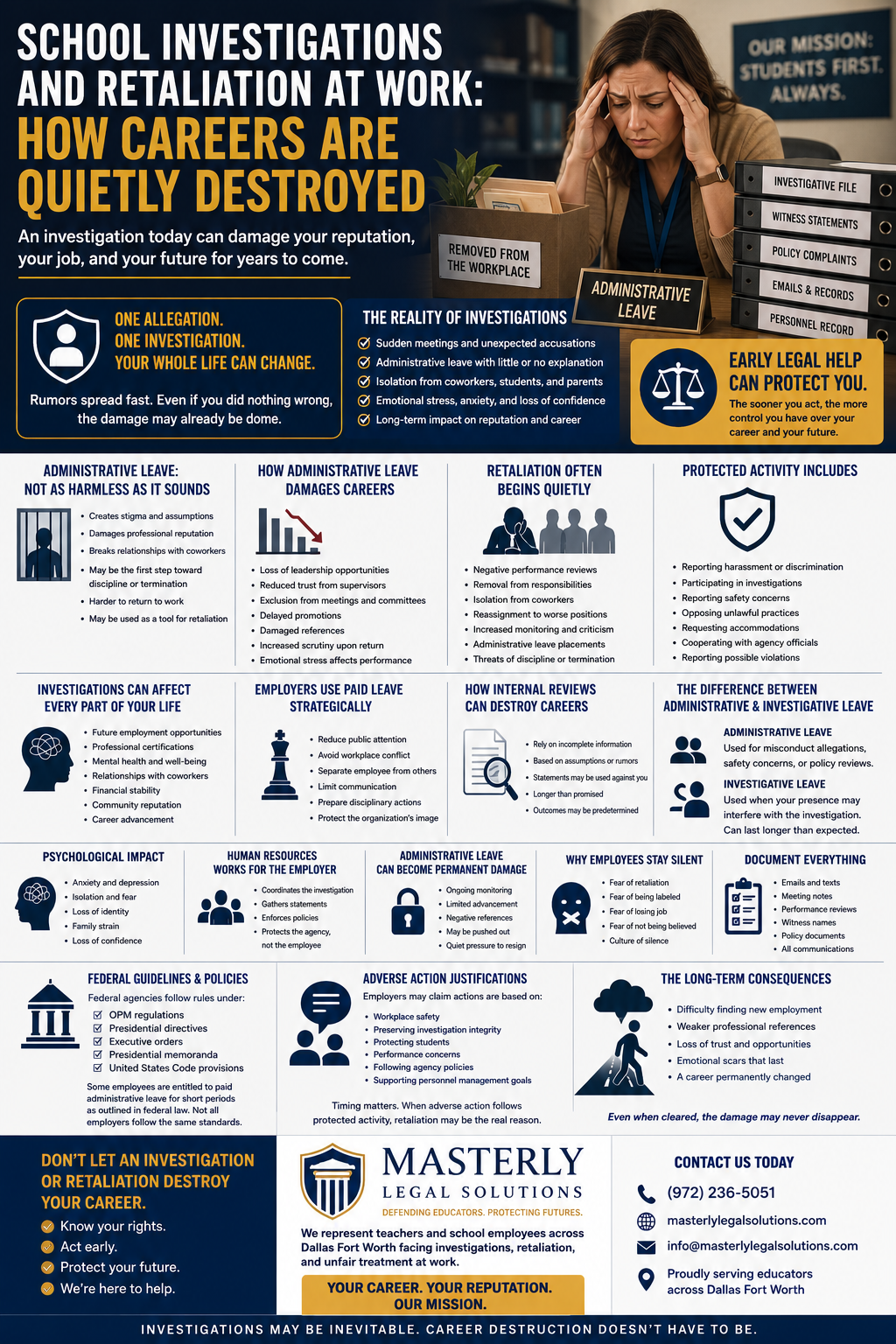
School Investigations and Retaliation at Work: How Careers Are Quietly Destroyed
When a School Investigation Changes Everything
Most educators never expect a normal workday to become the beginning of a professional nightmare. One unexpected meeting with a supervisor or human resources department can instantly change a teacher’s career, reputation, and future employment opportunities. In many cases, the process begins quietly. An employee is suddenly removed from campus, placed on administrative leave, or told not to speak with coworkers while an investigation takes place. What may appear temporary often becomes the start of long-term professional damage that follows workers for years.
Across dallas fort worth school districts, employees are increasingly facing investigations tied to alleged misconduct, workplace complaints, policy disputes, and accusations involving student interactions. Some employees are ultimately cleared of wrongdoing, yet the damage to their careers has already been done. Rumors spread quickly in educational environments, and even an unproven allegation can permanently affect professional relationships, future job opportunities, and employee morale.
For many workers, the most frightening part is how fast everything happens. An employer may place an employee on paid administrative leave with little warning and very little explanation. While the leave may initially sound harmless because the employee continues receiving pay, the emotional and professional consequences can become devastating. Many employees quickly realize that administrative leave is not simply a temporary pause from work. In some situations, it becomes the first step toward retaliation, disciplinary action, or termination.
At Masterly Legal Solutions, we understand how investigations and retaliation quietly destroy careers over time. Many employees do not recognize the seriousness of the situation until critical mistakes have already been made. Early legal guidance can help protect workers before the investigation process causes irreversible harm.
The Hidden Fear Behind Administrative Leave
Most employees assume that paid leave sounds favorable compared to immediate termination. However, administrative leave often carries consequences that are not immediately visible. Once an employee is removed from the workplace, coworkers begin asking questions, parents become suspicious, and rumors spread rapidly throughout the community.
In many situations, administrative leave creates an assumption that the employee did something wrong, even before the investigation has concluded. This stigma can permanently damage a person’s professional reputation. Teachers who spent years building trust with students, parents, and administrators may suddenly find themselves isolated and treated differently.
Some employees are placed on administrative leave for alleged misconduct involving student interactions, policy disputes, harassment allegations, or internal complaints. Others are placed on investigative leave after participating in protected activity such as reporting discrimination or raising workplace safety concerns. Even when no formal violation is ultimately found, the employee may still experience long-term consequences.
Employees often discover that returning to work after administrative leave is far more difficult than expected. Relationships change, coworkers become distant, and supervisors may begin treating the employee differently. In some cases, the employer transfers the worker into a less desirable position or removes important responsibilities altogether.
How Administrative Leave Quietly Damages Careers
Many employees underestimate how damaging administrative leave can become over time. The emotional impact often begins immediately. Workers suddenly lose daily interaction with students, coworkers, and professional routines that shaped their identity for years.
The professional damage may include:
- Loss of leadership opportunities
- Negative assumptions among coworkers
- Reduced trust from supervisors
- Exclusion from meetings or committees
- Delayed promotions
- Damaged professional references
- Increased scrutiny upon return
- Emotional stress affecting future performance
Some employers claim administrative leave is necessary to protect workplace safety or preserve the integrity of an investigation. While there are circumstances where leave may be appropriate, some employees feel the employer is using the process to quietly push them out.
When retaliation occurs after an employee raises concerns or files a complaint, administrative leave may become part of a broader pattern of retaliatory behavior. Workers who once held a desirable position may suddenly find themselves marginalized within the workplace.
Why Investigations Create Long-Term Fear
School investigations are different from ordinary workplace disputes because educators understand how fragile professional reputations can be. Teachers often worry that a single allegation may permanently define their career, even if the claims are never proven.
An investigation can affect:
- Future employment opportunities
- Professional certifications
- Mental health
- Relationships with coworkers
- Financial stability
- Community reputation
- Career advancement
Many workers feel trapped because they are told not to discuss the matter with other employees during internal reviews. This isolation creates tremendous emotional pressure, especially when the employee does not fully understand the allegations.
Employees frequently describe the experience as emotionally exhausting. Some lose sleep, develop anxiety, or experience depression while waiting for answers. The uncertainty surrounding the investigation process can become overwhelming.
The Difference Between Administrative Leave and Investigative Leave
Not every form of leave operates the same way. Some employees are placed on investigative leave while allegations are reviewed. Others receive paid administrative leave during internal reviews or external inquiries involving police or authorized agency officials.
Administrative leave may occur for:
- Alleged misconduct investigations
- Safety concerns
- Internal complaints
- Policy reviews
- Harassment allegations
- Disputes involving students or parents
Investigative leave sometimes occurs when an employer believes an employee’s presence may interfere with the investigation. In certain circumstances, agency officials or other authorized agency officials may become involved in reviewing the allegations.
Some employers argue they may grant administrative leave on a time limited basis while they gather facts. However, employees often discover the process lasts far longer than expected. What begins as brief periods away from work can extend into months of uncertainty.
How Employers Use Paid Administrative Leave Strategically
Many employees believe paid administrative leave exists solely to protect fairness during an investigation. In reality, some employers use administrative leave strategically to protect the agency's mission or reduce public scrutiny while deciding how to proceed.
An employer may place an employee on leave to:
- Reduce public attention
- Avoid workplace conflict
- Separate the employee from students
- Limit communication with other employees
- Prepare disciplinary recommendations
- Protect the organization’s image
Although the employee continues receiving pay, the professional consequences may still be severe. Workers often feel powerless because they are removed from their employee's current position while the employer controls the investigation process.
In some situations, employees later discover that internal discussions about their future occurred long before the investigation concluded. This creates concerns that the outcome may have been predetermined from the beginning.
Retaliation Often Begins Quietly
Retaliation rarely starts with dramatic actions. Instead, it usually develops slowly through subtle workplace changes. An employee who previously received praise may suddenly face criticism, exclusion, or increased scrutiny after reporting concerns or engaging in protected activity.
Examples of retaliation may include:
- Negative performance reviews
- Removal from leadership opportunities
- Increased monitoring
- Isolation from coworkers
- Reassignment to a less desirable position
- Reduction in responsibilities
- Threats of disciplinary action
- Administrative leave placements
Retaliation often becomes difficult to recognize because employers rarely admit their motives directly. Instead, they may claim the actions are tied to performance issues, workplace needs, or agency policies.
Employees should understand that retaliation may violate state laws, federal protections, and workplace policies when it occurs because a worker engaged in protected activity.
What Counts as Protected Activity?
Protected activity includes actions employees are legally allowed to take without fear of punishment or retaliation. Unfortunately, many workers are unaware of these protections until they are already facing professional consequences.
Protected activity may include:
- Reporting harassment
- Filing discrimination complaints
- Participating in investigations
- Reporting workplace safety concerns
- Cooperating with agency officials
- Opposing unlawful practices
- Requesting accommodations
- Reporting possible violation concerns
Some workers are placed on administrative leave shortly after engaging in related protected activity. This timing can raise serious questions about whether retaliation influenced the employer’s decision.
When retaliation follows protected activity, employees should seek legal guidance immediately. Delaying action may make it harder to preserve evidence and challenge improper conduct later.
How Internal Reviews Can Become Career Destroying
Internal reviews often appear routine at first. Employees may be told the matter is simply procedural or that the employer needs time to review the circumstances. Unfortunately, these reviews can quickly evolve into career-threatening investigations.
Human resources departments often work closely with supervisors and agency officials during these processes. While employees may assume the review is neutral, the employer’s priorities frequently focus on reducing institutional risk and protecting the agency's mission.
Some investigations rely heavily on incomplete statements, assumptions, or rumors rather than verified evidence. In emotionally charged situations, even weak allegations may result in administrative leave or disciplinary action.
Employees should never assume that cooperation alone will protect them. Statements made during internal reviews may later be used against the employee in future proceedings.
The Psychological Impact of Being Removed From the Workplace
For many educators, work is deeply connected to personal identity and purpose. Being suddenly removed from the workplace creates emotional trauma that extends far beyond lost income or professional embarrassment.
Workers placed on administrative leave often experience:
- Anxiety
- Isolation
- Depression
- Fear of public judgment
- Financial stress
- Loss of confidence
- Family strain
Even when the employee continues receiving pay during paid administrative leave, the emotional burden remains intense. Some workers begin questioning whether they will ever recover professionally, and Texas educators nearing retirement may also worry about how leave status could impact their TRS retirement benefits and service credit.
This negative impact frequently affects both the employee and their family. Spouses, children, and loved ones may also feel the pressure created by rumors, uncertainty, and fear about the future.
The Role of Human Resources During Investigations
Many employees mistakenly believe human resources exists primarily to protect workers. In reality, human resources departments generally work to protect the employer and ensure compliance with agency policies.
Human resources personnel often coordinate:
- Administrative leave notices
- Internal interviews
- Documentation reviews
- Witness statements
- Policy enforcement
- Communication restrictions
While some human resources professionals attempt to remain fair, employees should remember that the employer’s interests may not align with their own interests. Statements made during meetings can later become part of the official investigation record.
Workers should approach these situations carefully and seek legal guidance before participating in interviews or signing documents.
When Administrative Leave Becomes a Permanent Career Problem
Some employees assume that once administrative leave ends, everything will return to normal. Unfortunately, that is rarely the case. Even after returning to work, many employees discover their careers have been permanently altered, which is why Texas teachers facing administrative leave must take proactive steps early in the process.
An employer may continue:
- Monitoring the employee closely
- Limiting advancement opportunities
- Excluding the employee from leadership roles
- Reassigning the worker to less favorable duties
- Damaging professional references
In some situations, the employee eventually resigns because the workplace becomes intolerable. This quiet pressure can create long-term professional harm without any formal termination taking place.
Employees who previously held a desirable position may feel pushed aside while other employees move forward professionally.
Federal Guidelines and Administrative Leave Policies
Certain federal agencies operate under detailed administrative leave rules established through opm regulations, presidential directive guidance, executive order requirements, and presidential memorandum policies. These rules often influence how agencies issue internal policies consistent with broader federal standards and highlight the importance of clear, compliant employee handbook policies and procedures.
The united states code includes provisions governing administrative leave practices for some public sector employees. Certain forms of paid leave are specifically authorized under federal guidelines for brief or short periods involving investigations, emergencies, blood donations, or officially sponsored activities.
However, not all educational employers follow the same standards. Agency judgments regarding administrative leave may vary significantly depending on agency policies, leadership priorities, and the nature of the allegations.
Employees often assume the employer must follow consistent procedures. In reality, many decisions are made on an ad hoc basis depending on the circumstances surrounding the investigation.
Why Administrative Leave Can Feel Like Punishment
Although employers frequently describe administrative leave as non-disciplinary, many employees experience it as punishment from the very beginning. Being escorted off campus, losing access to coworkers, and becoming the subject of rumors creates enormous emotional distress.
Even when administrative leave is technically considered an excused absence, the public perception may be far different. Coworkers, parents, and community members may assume the employee committed serious wrongdoing.
For educators, reputation matters deeply. A teacher may spend decades building credibility only to see it questioned within days after being placed on leave.
The fear of permanent professional damage causes many employees to remain silent about retaliation or unfair treatment. Unfortunately, silence often allows the situation to worsen, especially when workers do not understand how a dedicated retaliation lawyer for workplace investigations can help them respond.
How Employers Justify Adverse Action
Employers rarely admit retaliatory motives directly. Instead, they often justify adverse action using vague explanations involving policy concerns, workplace disruption, or operational needs.
Common explanations may include:
- Maintaining workplace safety
- Preserving the integrity of the investigation
- Protecting students
- Addressing performance concerns
- Following agency policies
- Supporting personnel management goals
These explanations may sound reasonable on the surface, but timing often tells a different story. When adverse action closely follows protected activity, employees may have valid concerns about retaliation.
An attorney can help determine whether the employer’s explanations appear legitimate or whether evidence suggests retaliatory motives influenced the decisions.
Why Some Employees Never Fully Recover Professionally
Even when investigations close without findings of wrongdoing, some workers never fully recover professionally. The emotional damage, damaged reputation, and loss of trust may continue long after the case ends.
Some employees struggle to:
- Secure new employment
- Obtain strong references
- Rebuild confidence
- Restore workplace relationships
- Return to leadership opportunities
This is particularly true in educational environments where reputations spread quickly across districts and professional networks.
Workers often describe feeling permanently marked by the investigation, even when no formal violation was established.
The Danger of Waiting Too Long to Seek Legal Help
Many employees wait too long before speaking with an attorney. They hope the employer will eventually recognize the truth or resolve the issue fairly. Unfortunately, critical evidence may disappear while the employee delays taking action.
Early legal guidance helps employees:
- Preserve important records
- Prepare for interviews
- Understand workplace rights
- Avoid damaging statements
- Respond strategically
- Protect professional reputations
An attorney can also help determine whether retaliation, discrimination, or improper administrative leave procedures may exist.
Administrative Leave and Workplace Isolation
One of the most damaging effects of administrative leave is isolation. Employees are often instructed not to communicate with coworkers, students, or parents during the investigation.
This separation creates emotional hardship while also preventing the employee from defending themselves publicly. Rumors continue spreading while the employee remains unable to respond.
Isolation may also weaken professional relationships over time. Coworkers may distance themselves out of fear, uncertainty, or pressure from supervisors.
This gradual breakdown of workplace relationships often becomes one of the lasting consequences of administrative leave.
How Agency Judgments Affect Careers
Agency judgments during investigations can shape an employee’s future permanently. Decisions regarding leave, discipline, and workplace status often rely heavily on internal perceptions rather than proven facts.
Some agency judgments may prioritize protecting the agency's mission over protecting individual employees. In high-profile situations, employers may feel pressure to act quickly regardless of whether the evidence fully supports the allegations, making it critical for schools and organizations to seek comprehensive education and employment law counsel when navigating complex investigations.
Employees should not assume the process will automatically be fair simply because internal procedures exist.
The Fear of Being Viewed as a Problem Employee
Once an employee becomes associated with an investigation, some supervisors begin viewing that worker as a liability rather than an asset. This shift in perception may influence future assignments, evaluations, and promotion opportunities.
Even if the employee acted appropriately, the stigma surrounding the investigation may remain. Workers who previously received positive feedback may suddenly feel unwanted within the organization.
This fear causes many employees to remain silent about workplace concerns rather than risk becoming the subject of scrutiny themselves.
Retaliation and the Chilling Effect on Workers
Retaliation creates fear not only for the targeted employee but also for other workers observing the situation. Coworkers who witness retaliation may become afraid to report concerns or participate in investigations themselves, even though legal protections against workplace retaliation exist to safeguard employees who speak up.
This chilling effect damages overall employee morale and creates a culture where employees fear speaking honestly about workplace problems.
When workers believe protected activity will lead to punishment, workplace transparency and accountability suffer significantly.
Why Workplace Safety Complaints Sometimes Trigger Retaliation
Employees who report workplace safety concerns sometimes become targets for retaliation, especially when complaints create administrative pressure or public attention, which is why employers often need experienced HR consulting and investigation support to address issues lawfully.
A supervisor may view the complaint as disruptive or damaging to the organization’s image. In some cases, workers who raise concerns find themselves subjected to increased scrutiny or administrative leave shortly afterward.
Although safety complaints are generally protected under various laws and policies, retaliation still occurs in many workplaces.
Administrative Leave Policies Are Not Always Applied Equally
Some employees notice that administrative leave decisions appear inconsistent. One worker may receive paid leave for a serious allegation, while another faces immediate disciplinary action for a less severe concern.
This inconsistency creates frustration and raises concerns about fairness. Employees may question whether retaliation, favoritism, or discrimination influenced the outcome.
Because agency determines procedures differently depending on the situation, employees often feel uncertain about what standards actually apply.
The Importance of Documenting Everything
Employees facing investigations or retaliation should document events carefully from the beginning. Small details often become important later when evaluating whether retaliation or improper conduct occurred.
Helpful documentation may include:
- Emails
- Text messages
- Meeting notes
- Performance evaluations
- Witness names
- Administrative leave notices
- Policy documents
An attorney can help determine which records may become important in future proceedings.
How Administrative Leave Impacts Employee Morale
Administrative leave affects more than the targeted employee. Other workers often become anxious when they see coworkers suddenly removed from the workplace, particularly in school environments where education law attorneys for teachers and schools are frequently needed to navigate complex policies.
Employees may begin worrying about:
- Job security
- Retaliation risks
- Internal politics
- Investigation procedures
- Reporting concerns
This fear damages employee morale and may discourage workers from participating in internal reporting processes.
Why Early Legal Intervention Matters
Employees should never assume investigations will resolve fairly without legal guidance. Early intervention allows attorneys to protect the employee’s interests before the employer fully controls the narrative.
Legal representation may help employees:
- Protect professional reputations
- Respond strategically
- Challenge unfair treatment
- Preserve evidence
- Understand agency policies
- Avoid costly mistakes
Taking action early often creates stronger legal and professional outcomes.
How Masterly Legal Solutions Helps Employees Protect Their Careers
At Masterly Legal Solutions, we understand how investigations and retaliation quietly damage careers throughout dallas fort worth school districts. Employees often feel isolated, frightened, and uncertain about what steps to take next.
Our team helps workers facing:
- Administrative leave
- Investigations
- Retaliation
- Harassment allegations
- Workplace disputes
- Adverse action
- Internal complaints
We are committed to helping employees protect their careers, reputations, and professional futures before the damage becomes permanent.
How Notice Leave Policies and Federal Standards Can Affect School Employees
Many school employees do not realize that notice leave procedures and administrative investigations are often influenced by broader employment standards that also apply within private sectors and federal agencies, including those governing higher education law and institutional compliance. Under certain circumstances, an agency head may determine that placing an employee on safety leave or notice leave is necessary while reviewing allegations or workplace concerns that are directly related to the employee’s conduct or responsibilities.
However, a reasonable employee may question whether these actions are truly justified when discrimination claims or retaliation concerns arise shortly after protected complaints are made, and many benefit from guidance provided by an experienced education law attorney for teachers. Federal standards such as title vii, opm guidance, and other provision requirements have shaped how employers are expected to handle investigations with fairness and respect for employee rights.
In some cases, agency head decisions involving leave status, reassignment, or restrictions may also involve other related protected activity connected to prior complaints or workplace reporting. Employers are generally expected to issue procedures that balance workplace safety with fairness to the employee, especially when investigations continue for extended periods within a single calendar year. At Masterly Legal Solutions, we help employees evaluate whether leave decisions, investigations, or workplace actions may violate employment protections or unfairly damage their careers.
Speak With Masterly Legal Solutions Before the Situation Gets Worse
If you are facing administrative leave, retaliation, or a workplace investigation, do not assume the situation will simply resolve on its own. Many employees wait too long before seeking legal guidance, only to discover that the professional and emotional damage has already spread far beyond the original complaint.
At Masterly Legal Solutions, we help workers understand their rights, evaluate their options, and protect their future during difficult workplace situations. Whether you are dealing with alleged misconduct allegations, adverse action, internal reviews, or retaliation after protected activity, our team is prepared to help you respond strategically and professionally.
Contact Masterly Legal Solutions at (972) 236-5051 for a free consultation. We proudly assist employees throughout dallas fort worth school districts and surrounding communities who need experienced legal support during investigations and workplace disputes. Speaking with an attorney early may help protect your career before temporary administrative leave turns into lasting professional harm.
Disclaimer: This article is provided for educational and informational purposes only and does not constitute legal advice. Reading this article does not create an attorney-client relationship with Masterly Legal Solutions. Individuals facing legal concerns should consult directly with a qualified attorney regarding their specific circumstances.








Looking for Legal & Business Solutions? Contact Us Now
Fill in the form or call us to set up a meeting