
Signs a School Investigation May Be Turning Into a TEA Case in School Districts Dallas
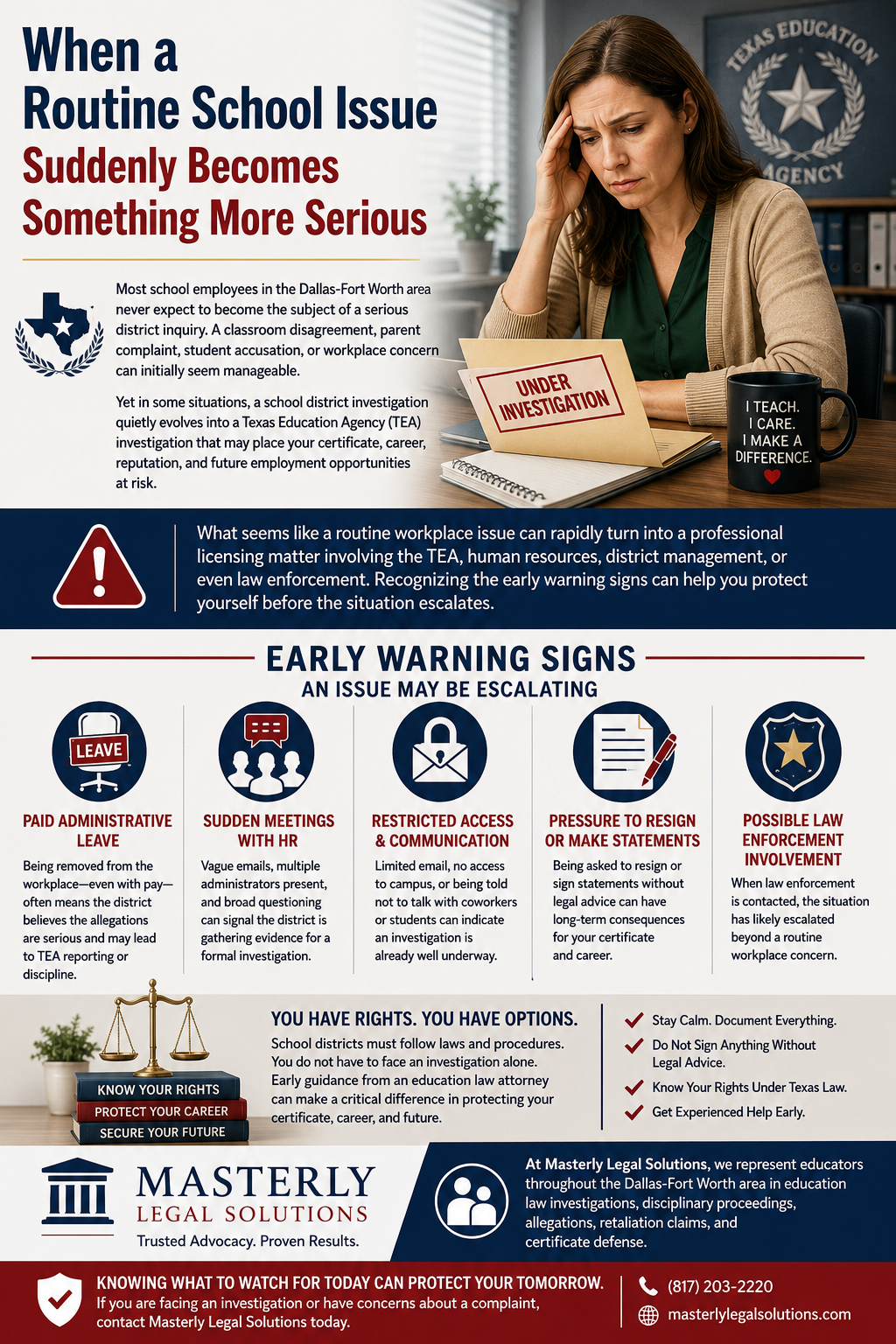
When a Routine School Issue Suddenly Becomes Something More Serious
Most school employees in the Dallas-Fort Worth area never expect to become the subject of a serious district inquiry. A classroom disagreement, parent complaint, student accusation, or workplace concern can initially seem manageable. In many cases, teachers, administrators, coaches, counselors, paraprofessionals, and support staff believe the issue will remain internal. Unfortunately, that is not always what happens. In some situations, a school district investigation quietly evolves into a Texas Education Agency investigation that may place an educator’s certificate, career, reputation, and future employment opportunities at risk.
Many employees do not recognize the warning signs early enough. By the time retaliation begins or the district starts gathering evidence for a formal referral, the employee may already be under heavy scrutiny. What initially appeared to be a routine workplace complaint can rapidly turn into a professional licensing issue involving the TEA, human resources, district management, or even law enforcement. Understanding the early indicators can help educators protect themselves before the situation escalates.
At Masterly Legal Solutions, we work with educators throughout the Dallas-Fort Worth school districts who are facing education law investigations and disciplinary proceedings, allegations, retaliation claims, and possible certificate actions. We understand how quickly a workplace issue can change from an internal discussion into a career-threatening investigation. Knowing what to watch for may help protect your professional future.
Understanding How School District Investigations Escalate
Not every complaint becomes a TEA case. School districts regularly handle concerns involving employee conduct, workplace harassment, policy disputes, student discipline, discrimination allegations, and performance concerns internally. However, certain allegations trigger mandatory reporting obligations under Texas law.
A district may decide to report an employee to the TEA when administrators believe there may have been misconduct, inappropriate communication, contract abandonment, student safety concerns, possible criminal behavior, or policy violations that could trigger a TEA educator discipline case or TEA teacher license defense investigation. Sometimes the district is legally required to make a report even if the allegations are disputed. In other cases, a supervisor or manager may recommend reporting an employee after internal pressure or political concerns within the district.
Many educators are shocked when they learn that a district can submit information to the TEA before the employee has a fair opportunity to defend themselves, even though experienced TEA investigation lawyers can help educators respond effectively and explain immediate steps after a TEA investigation notice. Once that process begins, the employee may face additional scrutiny, possible suspension, disciplinary actions, or even termination. Understanding how retaliation occurs during these situations is extremely important for educators trying to protect their careers.
Paid Administrative Leave Can Be a Major Warning Sign
One of the clearest signs an investigation may be escalating involves being placed on paid administrative leave. Many employees assume paid leave means the district is simply conducting a neutral review. In reality, administrative leave often signals that district leadership believes the allegations are serious enough to remove the employee from the workplace immediately.
In Dallas Fort Worth school districts, paid administrative leave frequently occurs when administrators believe a case could lead to TEA reporting, police involvement, or future disciplinary action. Even though the employee continues receiving pay and benefits, the leave itself may indicate that the district is preparing for formal proceedings.
Employees should pay close attention to how the leave is described. For example, if the district suddenly limits communication, blocks access to school property, restricts email access, or directs coworkers not to communicate with the employee, the matter may already be progressing beyond a routine workplace concern.
An employer may also instruct the employee not to discuss the situation with students, parents, or co workers. While districts often describe these restrictions as standard procedure, they can also indicate the district is gathering evidence for a larger investigation.
Sudden Meetings With Human Resources Should Never Be Ignored
Another serious warning sign involves unexpected meetings with human resources or district management. Many employees receive vague emails requesting an immediate meeting without explanation. Some are instructed to report to a district office instead of their campus. Others discover that multiple administrators are present when they arrive.
These meetings are often designed to gather statements before the employee fully understands the allegations. A manager or supervisor may ask broad questions while documenting every answer. In some situations, employees are pressured into making written admissions or responding without legal guidance.
A reasonable employee should recognize that these meetings can carry significant consequences. Statements made during internal interviews may later be forwarded to the TEA or used in future disciplinary proceedings. Employees who assume the meeting is informal sometimes unintentionally provide information that harms their defense later.
Human resources personnel may also ask whether the employee wishes to resign. This can be another sign that the district believes termination or TEA reporting is possible. Employees should be extremely cautious before signing resignation paperwork or agreeing to statements prepared by district officials.
Requests for Written Statements Often Signal Escalation
A request for a written statement may seem harmless, but it can become a critical part of a future TEA case. District investigators often ask employees to prepare a detailed timeline, respond to allegations, or explain interactions involving students, parents, coworkers, or supervisors.
Many educators believe they must immediately comply without understanding the legal risks. In reality, these written responses can later be used during licensing proceedings, employment disputes, retaliation claims, or lawsuits. Once an employee submits a written statement, it becomes part of the official record.
School districts sometimes frame these requests as opportunities for the employee to “tell their side of the story.” While that may sound reasonable, districts are also building documentation that could support disciplinary recommendations or TEA reporting obligations.
Employees should especially pay attention if they are given short deadlines, pressured to respond immediately, or discouraged from seeking representation. Those tactics may indicate the district is moving aggressively.
Confiscation of Devices May Mean the Situation Is Serious
When a school district confiscates district-issued devices, the situation often becomes far more serious. Administrators may take laptops, phones, tablets, classroom cameras, or district credentials during the early stages of an investigation.
Districts frequently review electronic communications involving students, staff members, social media accounts, or emails. They may search for evidence involving harassment, discrimination, inappropriate conduct, retaliation, policy violations, or alleged misconduct.
In some cases, districts also examine deleted messages, cloud storage, browsing history, and communication with coworkers. Employees are often surprised by how much information districts attempt to collect during these investigations.
Confiscation of devices can also indicate coordination with police or outside investigators. If law enforcement becomes involved, the employee may face additional risks beyond employment discipline. Understanding your rights before answering additional questions is extremely important.
Student Interviews Often Indicate the Investigation Is Expanding
A major red flag occurs when administrators begin interviewing students. Once students are pulled from classrooms to provide statements, districts are usually attempting to gather corroborating evidence.
Student interviews may involve allegations related to classroom conduct, communication issues, bullying, harassment, discrimination, boundary concerns, or inappropriate behavior. Sometimes students are interviewed individually without the employee being informed about the allegations beforehand.
District officials may also ask students to prepare written statements or identify other witnesses. In some situations, administrators speak with parents before notifying the employee involved.
When districts start expanding interviews to students and witnesses, the investigation often moves beyond routine personnel management. At that point, the district may already be evaluating whether a formal report to the TEA is required based on common TEA investigation causes and teacher protections.
Increased Scrutiny From Supervisors and Administrators
Employees should also recognize patterns of increased scrutiny. A supervisor who suddenly begins documenting every interaction, monitoring classroom activities, or criticizing routine performance may be building a disciplinary file.
This change in behavior often confuses employees because the same conduct may have previously been ignored or praised. For example, an employee who consistently received positive evaluations may suddenly receive a negative performance review shortly after a complaint, disagreement, or protected activity.
When an employer retaliates against an employee for engaging in protected behavior, this is known as retaliation, and many employees benefit from advice from a retaliation and workplace law employment attorney regarding workplace retribution. This can include filing a complaint, reporting discrimination, reporting harassment, cooperating in an investigation, or participating in other related protected activity.
Examples of retaliatory conduct in schools may include:
- Increased classroom observations
- Removal from committees
- Reduced responsibilities
- Schedule changes
- Loss of leadership opportunities
- Assignment to a less desirable position
- Sudden disciplinary write-ups
- Exclusion from meetings
- Negative treatment from management
These acts may appear small individually, but together they can signal workplace retaliation.
The Connection Between Complaints and Retaliation
Many TEA-related investigations begin shortly after an employee raises concerns about workplace discrimination, bullying, harassment, wages, disability accommodations, or policy violations, especially in the wake of high-profile Texas teacher discipline cases. Employees who report misconduct sometimes become targets themselves.
Federal laws and state laws prohibit retaliation against workers who engage in protected activity. Filing a complaint involving discrimination, sexual advances, harassment refusing inappropriate conduct, or reporting unlawful acts can legally protect employees from retaliatory conduct, and some employees may need guidance from a retaliation lawyer for workplace retaliation claims.
Unfortunately, retaliation begins subtly in many schools. A manager may reduce the employee’s hours, remove responsibilities, deny promotion opportunities, or isolate the employee from coworkers. In other situations, false rumors begin circulating within the workplace.
The employee may notice a sudden negative impact on employee morale or overall employee morale within their department. Coworkers who previously communicated openly may become distant after management issues warnings or instructions behind the scenes.
Protected Activity in School District Employment Matters
Educators often do not realize how broad protected activity can be under employment laws. Protected activity does not only involve filing a formal EEOC charge or lawsuit or retaliation and labor complaints with the Department of Labor. It may also include internal reports and workplace complaints.
Examples of protected activity may include:
- Reporting workplace harassment
- Reporting workplace discrimination
- Participating in an internal investigation
- Cooperating as a witness
- Filing a discrimination claim
- Reporting sexual advances
- Requesting disability accommodations
- Reporting policy violations
- Opposing prohibited conduct
- Assisting another employee with a complaint
Employees who engage in protected activity are legally protected from retaliation under many federal employment laws.
Signs the District May Already Be Preparing a TEA Referral
Certain behaviors strongly suggest a district may already be preparing documentation for the Texas Education Agency. Employees should pay attention if administrators suddenly begin gathering records unrelated to the original complaint.
For example, districts may request years of evaluations, disciplinary records, attendance information, prior complaints, training records, or communication history. Management may interview multiple witnesses across campuses or involve outside investigators.
A supervisor may also stop communicating directly and instead direct all interactions through human resources. This often indicates the district is attempting to limit liability exposure while building a formal record.
Another warning sign occurs when district officials repeatedly ask whether the employee plans to resign. Some employers believe voluntary resignations simplify the reporting process or reduce future legal exposure.
Why Employees Should Take Every Investigation Seriously
Many educators underestimate how quickly these situations escalate. An employee may believe the issue is minor because no police report has been filed or because the district initially described the matter as informal. However, school districts often avoid revealing the seriousness of investigations early in the process.
Even allegations that are false or exaggerated can create serious employment consequences. An employee can face suspension, contract nonrenewal, teacher certificate sanctions during a TEA case, or termination before all evidence is reviewed.
Some employees also make the mistake of assuming honesty alone will resolve the issue. While honesty is important, employees must also recognize that districts are protecting institutional interests. Administrators, managers, and legal departments often focus on minimizing district liability first.
Retaliation in Educational Workplaces Can Be Difficult to Spot
Retaliation in schools is not always obvious. Many employees expect retaliation to involve immediate termination or demotion. In reality, workplace retaliation often develops gradually through smaller negative actions.
For example, a teacher who reports discrimination may suddenly lose access to resources, receive unfavorable assignments, or experience unusual classroom observations. A coach who files a complaint may be excluded from meetings or denied additional support.
A counselor who participates as a witness during an investigation may suddenly face criticism from a supervisor. An administrator who raises concerns about policy violations may experience reduced authority or changes in responsibilities.
These acts can create a hostile workplace environment that pressures the employee to resign voluntarily. Employers sometimes rely on indirect pressure instead of openly retaliating.
The Role of the EEOC and Employment Protections
The Equal Employment Opportunity Commission, commonly called the EEOC, investigates certain employment discrimination and retaliation claims. Employees who experience retaliation after engaging in protected activity may have rights under federal law and may benefit from speaking with an education law attorney for teachers.
The EEOC addresses issues involving discrimination based on disability, race, gender, religion, national origin, age, and other legally protected categories. Employees who report prohibited conduct may also receive legal protections against retaliation.
For example, an employee who reports workplace harassment involving sexual advances may be protected from retaliatory conduct afterward. Similarly, workers who cooperate during an investigation involving discrimination concerns may also receive protection under federal laws.
The EEOC does not handle every school district dispute, but retaliation claims involving protected activity may fall within its authority.
How District Investigations Affect Future Employment
One of the most damaging aspects of school investigations is the long-term effect on future employment opportunities. Even if an employee is never fired, the existence of an investigation can create obstacles during future job searches.
Some educators struggle to secure interviews after resigning during an investigation. Others encounter difficulties obtaining references from former supervisors or managers. In some cases, districts provide limited information that still raises concern for future employers.
Employees who face TEA proceedings may also encounter delays renewing certificates or obtaining positions in other schools, making comprehensive legal services for educators and professionals especially important. These professional consequences can continue long after the original complaint is resolved.
This is why proactive steps are extremely important once warning signs appear, including consulting with experienced education law and teacher license defense counsel.
When Coworkers Suddenly Stop Communicating
A noticeable shift in coworker behavior can also signal an escalating investigation. Coworkers may avoid conversations, stop responding to messages, or appear uncomfortable interacting with the employee.
Sometimes management instructs workers not to discuss the matter. In other situations, fear spreads throughout the workplace because employees worry about becoming involved as witnesses.
False rumors may also circulate quickly within schools. An employee may notice unusual gossip, changes in treatment, or social isolation. These developments often increase emotional stress while damaging professional relationships.
The emotional toll can become overwhelming, especially when the employee still lacks clear answers about the allegations or the status of the investigation.
How School Districts Use Documentation During Investigations
Documentation plays a major role in school investigations. Districts carefully gather emails, evaluations, attendance records, witness statements, and training materials.
Employees should understand that every communication may later become evidence. Text messages, emails, social media interactions, and internal reports can all become part of the district’s investigation file.
This is especially important when retaliation claims arise. Employees who believe retaliation occurs should carefully preserve records involving complaints, disciplinary actions, schedule changes, and communication from supervisors.
Detailed records may later help establish timelines showing that adverse action followed protected activity.
Why Training and Policy Reviews Suddenly Increase
Sometimes districts begin assigning mandatory training sessions during an investigation. An employee may suddenly be instructed to complete policy reviews, harassment prevention training, or ethics courses.
While training itself may appear routine, it can also indicate the district is documenting compliance efforts before taking disciplinary action. Employers often attempt to show they provided resources, warnings, or corrective opportunities before escalating matters.
Employees should never assume these assignments are meaningless. The timing and context matter significantly.
What Happens When Police Become Involved
Some school district investigations eventually involve police or outside agencies. This may happen when allegations involve student safety, technology misuse, alleged assault, inappropriate communication, or potential criminal acts.
Employees often panic when police involvement occurs. However, it is important to remain calm and avoid making rushed decisions. Statements given during school investigations can later affect criminal investigations and vice versa.
Even if criminal charges are never filed, the district may still proceed with employment discipline or TEA reporting. Employment consequences often continue independently from criminal proceedings.
Disability Issues and Accommodation Concerns
Employees with disability-related concerns may face additional complications during investigations. Some educators report retaliation after requesting accommodations or medical leave.
Federal laws protect employees who request reasonable accommodations related to disability. An employer generally cannot retaliate against an employee for engaging in protected activity involving accommodation requests.
However, disputes sometimes arise when districts question medical documentation, attendance issues, or performance concerns connected to disability accommodations. Employees may suddenly face increased scrutiny shortly after requesting assistance.
These situations require careful handling because disability rights intersect with employment laws and workplace protections, and some districts rely on higher education, labor, and internal investigation counsel to navigate these overlapping issues.
How Adverse Action Appears in School Districts
Adverse action can take many forms in educational workplaces. Employees often assume adverse action only means being fired, but the legal definition is much broader.
Examples of adverse action may include:
- Suspension
- Contract nonrenewal
- Demotion
- Reduced pay
- Changes in hours
- Loss of benefits
- Transfer to undesirable assignments
- Exclusion from professional opportunities
- Increased disciplinary actions
- Removal from leadership roles
A reasonable employee would likely view these acts as harmful to their career or working conditions.
Why Employees Should Avoid Informal Conversations About the Case
Employees sometimes believe informal conversations with administrators are harmless. Unfortunately, casual discussions can become documented evidence later.
A supervisor, manager, or human resources representative may summarize conversations in written reports. Employees who speculate, guess, or attempt to defend themselves emotionally may unintentionally create inconsistencies.
It is often safer to remain professional, factual, and cautious when discussing an ongoing investigation. Employees should also avoid discussing the case publicly or on social media.
Understanding the Emotional Pressure During Investigations
School investigations create enormous emotional strain. Employees may feel isolated, embarrassed, anxious, or fearful about losing their careers.
Some districts rely heavily on pressure tactics during investigations. Employees may be told resignation is their “best option” or warned that fighting the allegations could worsen the outcome.
These situations can affect sleep, family relationships, finances, and mental health. The uncertainty surrounding employment and certification issues often becomes overwhelming.
Educators should remember they do not have to navigate these situations alone and can seek help from Texas education law attorneys for educators or speak with an education law attorney for teachers and administrators.
How Retaliation Can Affect Long-Term Career Stability
Workplace retaliation can damage far more than a current position. It can affect future employment, professional reputation, financial stability, and emotional wellbeing.
For example, an employee who files a complaint about discrimination may later struggle to secure recommendations or leadership opportunities. Retaliatory conduct can quietly limit career advancement even without formal termination.
Retaliation claims may arise when employers punish employees for engaging in legally protected activity. Understanding these protections is critical for educators facing hostile workplace conditions.
Employees should also understand that retaliation is prohibited even if the original complaint is ultimately unproven, provided the employee acted in good faith.
The Importance of Acting Early
One of the biggest mistakes employees make is waiting too long to seek guidance. Many educators only seek help after they are fired or formally reported to the TEA.
By that point, critical evidence may already be lost. Witnesses may become harder to contact, timelines may blur, and district narratives may become firmly established.
Taking proactive steps early can help employees better protect their rights, careers, and professional licenses. Early action may also help reduce the risk of damaging statements or procedural mistakes during investigations, especially when responding to a TEA complaint notice as a Texas educator.
Building a Professional Response Strategy
Employees facing investigations should focus on remaining calm, organized, and professional. Emotional reactions can sometimes worsen already difficult situations.
Important response strategies may include:
- Preserving communication records
- Documenting meetings and requests
- Avoiding speculation
- Remaining respectful during interactions
- Tracking timelines carefully
- Seeking guidance before submitting written statements
- Protecting personal records and evidence
These steps may help employees better navigate the process while reducing unnecessary risks.
Why School District Cases Require Careful Attention
School district investigations are different from many private sector employment disputes. Educators face not only employment discipline but also possible certificate sanctions and long-term professional consequences.
A single complaint can trigger multiple overlapping processes involving human resources, district administration, the TEA, outside investigators, and sometimes the EEOC. Employees may simultaneously face retaliation concerns, discrimination issues, and licensing threats.
Because of these overlapping risks, educators should never assume internal school investigations are minor matters.
Protecting Your Career During a School Investigation
Educators dedicate years building their careers, reputations, and relationships within schools. Watching an investigation threaten everything they worked for can feel devastating.
Whether the issue involves harassment allegations, retaliation concerns, discrimination complaints, student accusations, or workplace disputes, employees deserve to understand their rights and options. Early warning signs matter, and recognizing them can make a significant difference in how a case develops.
School districts often move quickly once investigations begin. Employees who recognize the signs early may place themselves in a stronger position to respond appropriately and protect their professional future.
Recognizing a Possible Violation Before the Situation Escalates
Many educators do not realize that a routine workplace concern can quickly turn into a serious matter involving a possible violation of district policies or professional standards. In some school investigations, administrators begin collecting additional records, interviewing witnesses, and reviewing prior complaints to determine whether the employee’s conduct violated district expectations or state regulations. Even if the employee believes the allegations are exaggerated or false, the district may still move forward with disciplinary actions while gathering additional information. A person facing these allegations should take the situation seriously from the beginning because school districts often act quickly once concerns are formally reported. Early intervention may help protect an employee’s career, especially when allegations involve claims that an employee discriminated against someone, engaged in illegal conduct, or failed to foster a safe and professional workplace environment.
Speak With Masterly Legal Solutions About School Investigations in Dallas-Fort Worth
If you are an employee in one of the Dallas Fort Worth school districts and believe an internal investigation may be turning into a TEA case, it is important to take the situation seriously. Warning signs like paid administrative leave, requests for written statements, student interviews, device confiscation, sudden meetings with human resources, or increased scrutiny from a supervisor should never be ignored.
At Masterly Legal Solutions, we help educators, administrators, coaches, counselors, and school workers facing workplace retaliation, employment disputes, harassment allegations, discrimination concerns, and TEA-related investigations. We understand how quickly these cases escalate and how much your career, reputation, wages, and future opportunities matter.
Our team can answer questions, explain the process, and help you better understand your situation during a free consultation. Contact Masterly Legal Solutions at
(972) 236-5051 to discuss concerns involving school district investigations, retaliation, workplace issues, or possible TEA actions throughout the Dallas-Fort Worth area.
Disclaimer: This article is for educational and informational purposes only and should not be considered legal advice. Reading this article does not create an attorney-client relationship with Masterly Legal Solutions. Every case is different, and individuals should seek professional legal guidance regarding their specific circumstances.




Teacher Rights When Assaulted by a Special Needs Student: Safety, Reporting and Investigation Issues



Looking for Legal & Business Solutions? Contact Us Now
Fill in the form or call us to set up a meeting