

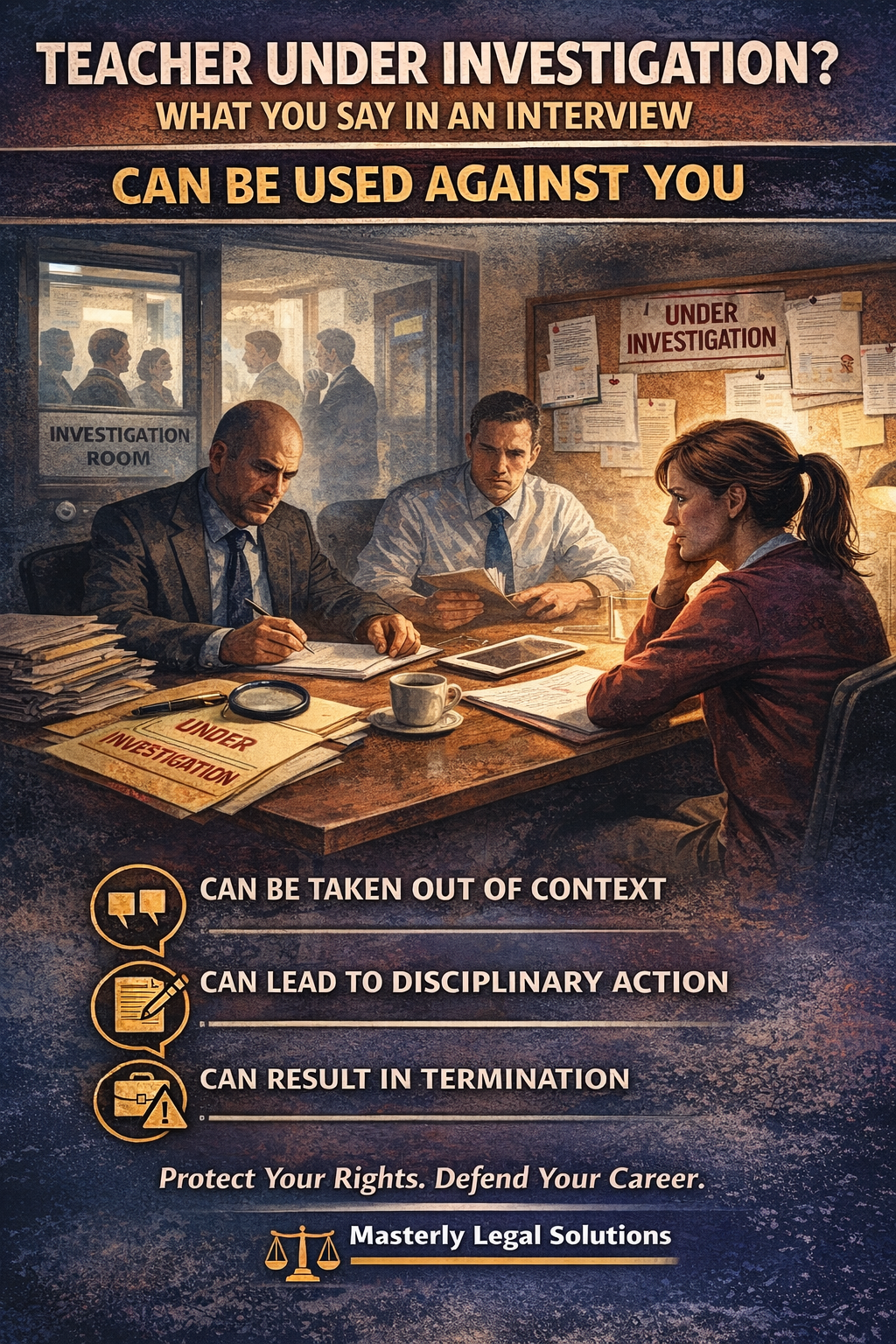
Teacher Under Investigation? What You Say in an Interview Can Be Used Against You
When a teacher is told they are “under investigation,” the moment can feel unreal. You may believe the issue is minor, a misunderstanding, or simply a routine inquiry. Many employees assume that if they cooperate fully and explain their side, everything will clear up. Unfortunately, what you say in an interview can later be used against you in ways you never expected.
At Masterly Legal Solutions, we have seen how quickly internal interviews turn into serious employment disputes. A simple conversation with a supervisor or human resources representative can become the foundation for disciplinary action, license consequences, or even termination. If you are facing questioning, you need to understand your rights before you speak.
This article explains why immediate legal guidance matters, how workplace retaliation often begins during investigations, and what steps can help protect your career.
The Reality of Internal Investigations in Dallas Employment
In dallas employment settings, school districts and medical care institutions conduct internal investigations for a wide range of allegations. These can involve classroom management, procurement issues, complaints from a co worker, or allegations of discrimination. The employer may frame the process as informal, but the consequences can be serious.
An interview is not just a conversation. It is part of a record. Notes are taken, statements are summarized, and conclusions are often drafted before you realize the direction the investigation is heading.
Many dallas workers do not realize that an internal investigation can later support retaliation claims or wrongful termination claims.
What Happens During an Investigation Interview
During an investigation, the employer may ask about your job performance, communications, and any prior complaints. The questions may feel friendly at first. However, the goal is often to gather statements that can justify adverse employment decisions.
You may be asked whether you engaged in certain conduct or whether you reported concerns. If you previously filed a complaint based on discrimination or reported sexual harassment, that information becomes part of the narrative.
Without preparation, you might unintentionally provide details that shift blame onto you.
Why Your Words Matter
Every statement you make can be interpreted through the lens of policy violations. Even a small admission can be labeled as misconduct. Once written in a report, your words may be quoted in a way that does not reflect your intent.
If the employer later takes an adverse employment action, such as suspension or termination, your interview responses may be cited as justification. That is why speaking with an employment lawyer before answering detailed questions is critical.
Proving unlawful retaliation often begins with examining what was said during that first interview.
Understanding Protected Activity
Teachers are protected when they engage in certain actions under federal law and the texas labor code. Protected activity includes reporting discrimination, filing discrimination claims, participating in investigations, or opposing illegal acts in the workplace.
Protected activity also includes reporting sexual harassment, requesting reasonable accommodation under the disabilities act, or taking leave under the medical leave act. When an employee engaged in protected activity, the employer cannot lawfully punish them for it.
However, retaliation claims often arise when an employer retaliated shortly after such activity.
How Workplace Retaliation Begins
Workplace retaliation does not always look dramatic at first. It can begin with subtle changes in attitude or assignments. An employer participating in an investigation may suddenly question your job performance or reassign you to less favorable duties.
An adverse action can include job reassignment, reduced responsibilities, or closer scrutiny. Over time, these adverse employment steps can escalate into formal discipline.
Many employees do not connect the dots until it is too late.
What Counts as an Adverse Employment Action
An adverse employment action may include termination, demotion, suspension, or denial of promotion. It can also include adverse employment decisions affecting pay, benefits, or work conditions.
Under federal law and most anti discrimination laws, the action must be materially harmful. That means it would discourage a reasonable employee from engaging in protected activity.
Understanding the difference between minor workplace tension and unlawful retaliation is essential.
The Link Between Discrimination and Retaliation
Discrimination based on national origin, age discrimination, disability, or sex is prohibited under the civil rights act and other anti discrimination laws. When an employee files discrimination claims or reports sexual harassment, that reporting discrimination is protected activity.
If adverse employment actions follow, unlawful retaliation may be occurring. Employer retaliation can overlap with employer's discrimination, making the case more complex.
Both discrimination and retaliation are prohibited under federal law and the texas labor code.
The Role of Human Resources
Human resources and a human resources representative often conduct interviews during investigations. While they may appear neutral, they represent the employer’s interests.
Statements given to human resources can later be used in disciplinary proceedings. If a human resources representative drafts a report, your words may be summarized in a way that supports adverse action.
You should not assume HR is acting as your advocate.
Why Immediate Legal Help Matters
An experienced employment attorney can help you understand what questions to answer and how to protect your rights. An employment lawyer can attend meetings, review policies, and ensure that your employee's protected activity is clearly documented.
Waiting too long can limit your options. Very short deadlines often apply when filing with federal agencies like the equal employment opportunity commission or the texas workforce commission.
If an employee waits, important evidence can disappear.
Proving Unlawful Retaliation
Proving unlawful retaliation requires showing that the employee engaged in protected activity, suffered an adverse action, and that a connection exists between the two.
The following factors often matter:
- Timing between the complaint and the adverse employment action
- Statements made by a manager or supervisor
- Treatment of similarly situated employees
- Inconsistencies in the employer’s explanation
To prove retaliation, documentation and strategy are key.
When an Employer Retaliated After Reporting
If an employer retaliated after you reported sexual harassment or discrimination participating in an investigation, that may create a viable retaliation claim.
For example, if a teacher reported discrimination based on national origin and was later reassigned to a less favorable position, that could qualify as workplace retaliation.
Similarly, if a complaint based on unlawful discrimination led to disciplinary action, retaliation claims may arise.
Workplace Retaliation in Dallas TX Schools
In dallas tx and surrounding districts, workplace retaliation cases often involve teachers who spoke up about policy violations or harassment. Dallas employment disputes frequently center on adverse employment decisions following protected activity.
Dallas workers have rights under both federal law and the texas labor code. Consulting a retaliation lawyer dallas professionals trust can help clarify your options.
A dallas workplace retaliation lawyer understands local procedures and agency requirements.
Medical Leave and Retaliation
Taking medical leave under the medical leave act is protected activity. If full time employees return from medical leave only to face adverse action, questions arise.
An employer cannot lawfully punish an employee for seeking medical leave or requesting reasonable accommodation under the disabilities act.
Unlawful retaliation tied to medical leave can result in serious legal consequences for the employer.
The Risk of Wrongful Termination
When retaliation escalates to termination, wrongful termination claims may follow. An adverse employment action such as firing a teacher for reporting sexual harassment or unlawful discrimination can violate the civil rights act and the texas labor code.
A workplace retaliation attorney can evaluate whether the termination supports a legal claim.
Proving employer retaliation requires careful analysis of the evidence.
Legitimate Fears and Career Impact
Teachers often experience legitimate fears when placed under investigation. Concerns about certification, reputation, and future employment are real.
Workplace retaliation can damage your standing even if you are not terminated. Adverse employment actions such as negative evaluations or job reassignment can affect long term opportunities.
These fears should not stop you from asserting your rights.
How Retaliation Lawyer Dallas Professionals Can Help
A retaliation lawyer can review your case during an initial consultation and assess whether unlawful retaliation may have occurred. A retaliation lawyer dallas educators rely on will understand dallas employment procedures and agency filing requirements.
Our law firm regularly represents teachers facing retaliation claims and discrimination claims. As a workplace retaliation lawyer team, we focus on protecting employees from unlawful retaliation.
An experienced employment attorney can guide you through filing with the equal employment opportunity commission or the texas workforce commission.
Filing With Federal Agencies
If workplace retaliation continues, filing with federal agencies may be necessary. The equal employment opportunity commission investigates discrimination claims and retaliation under federal law.
Federal employees have their own procedures, but most public school teachers must comply with strict timelines. Very short deadlines apply.
Legal action may require careful preparation before filing.
Building a Strong Legal Strategy
To prove retaliation, you must show that the employee's participation in protected activity led to adverse employment consequences. That may include showing that similarly situated employees who did not complain were treated differently.
Documentation, emails, witness statements, and performance evaluations can become important evidence.
An employment lawyer can help organize and present this information effectively.
Do Not Face the Investigation Alone
When you are told you are under investigation, your instinct may be to handle it quietly. Many employees believe cooperation will resolve the matter.
However, workplace retaliation often begins after an employee engaged in protected activity and speaks openly during interviews. What feels like honesty can be used to justify adverse employment decisions.
Early legal guidance can prevent missteps.
Protecting Your Career Before It Is Too Late
Unlawful retaliation can unfold gradually. First comes questioning, then increased scrutiny, then adverse action. By the time termination occurs, the record may appear stacked against you.
Taking proactive steps now can protect your future. Consulting a dallas workplace retaliation lawyer sooner rather than later can make a measurable difference.
You deserve to work in an environment free from discrimination and retaliation.
Recognizing Workplace Discrimination During an Investigation
An internal investigation can sometimes reveal deeper concerns about workplace discrimination. If a teacher is questioned more aggressively than others or singled out after raising concerns, that pattern may point to unequal treatment. Federal and state laws prohibit discrimination in the workplace, especially when it is tied to race, sex, disability, or other protected characteristics. Identifying signs of unfair treatment early can help protect your rights and prevent the situation from escalating further.
How the Employment Act Shapes Your Rights
Various provisions under federal and state employment act standards govern how investigations must be handled. These laws outline protections for employees who report misconduct, participate in inquiries, or assert their rights. When an employer ignores these standards, disciplinary action may cross the line into unlawful conduct. Understanding how the employment act applies to your situation can strengthen your response strategy.
Acting on a Good Faith Belief
Teachers are protected when they report concerns based on a good faith belief that wrongdoing occurred. Even if the allegation is later unproven, the law still protects employees who honestly believed a violation took place. Retaliation against someone who acted in good faith can support a legal claim. This protection is critical when investigations involve sensitive matters such as harassment, discrimination, or policy violations.
The Role of Workplace Policies in Investigations
School districts rely on written workplace policies to justify interviews and disciplinary action. These policies often outline reporting procedures, investigative steps, and employee expectations. However, when workplace policies are applied inconsistently or used selectively against one employee, concerns about fairness arise. A careful review of those policies can reveal whether the investigation followed proper procedures.
Why Acting in Dallas Sooner Can Protect You
When facing an investigation, timing matters. Speaking with a qualified attorney in Dallas sooner rather than later can preserve evidence and prevent damaging misstatements. Early legal guidance helps ensure that your rights are protected before formal disciplinary action occurs. Acting quickly can make a significant difference in the outcome of your case.
Speak With Masterly Legal Solutions Today
If you are a teacher under investigation in dallas tx, do not wait until disciplinary action is finalized. Whether you suspect workplace retaliation, discrimination, or unlawful retaliation, immediate action matters.
At Masterly Legal Solutions, our law firm represents dallas workers facing retaliation claims and adverse employment actions. We understand the complexities of employment law, federal law, and the texas labor code. If you believe your employer retaliated against you after protected activity, speaking with an employment lawyer can help you protect your rights.
Call (972) 236-5051 to schedule your free initial consultation. We are ready to listen, evaluate your situation, and help you determine the next steps. The sooner you act, the stronger your position may be.
This article is for informational purposes only and does not constitute legal advice. Reading this content does not create an attorney-client relationship. For guidance regarding your specific situation, please contact Masterly Legal Solutions directly.



Teacher Rights When Assaulted by a Special Needs Student: Safety, Reporting and Investigation Issues



Looking for Legal & Business Solutions? Contact Us Now
Fill in the form or call us to set up a meeting