

Texas Educators Facing a Restraint or Seclusion Investigation: What to Document First
Texas educators face growing scrutiny over how restraint and seclusion are used in public schools. Here's a practical breakdown of the investigation process, legal requirements, and what every teacher, principal, and campus leader should understand to protect students and their own careers.
Immediate Summary: What Is Being Investigated and Why It Matters
Texas lawmakers, the Texas Education Agency, and federal civil rights officials are actively examining how Texas educators use physical restraint and seclusion with students, with particular focus on students with disabilities. Investigations target improper or excessive use of restraint, unreported incidents, and seclusion practices that may violate state law, the Individuals with Disabilities Education Act (IDEA), or Section 504. The TEA oversees compliance with restraint and seclusion regulations statewide, and educator misconduct investigations may lead to certificate suspensions or revocations for Texas teachers and principals who fail to follow legal requirements.
What this article covers:
- Current Texas laws and TEA rules governing restraint, seclusion, and time-out
- How investigations begin and escalate from campus to state agency
- Day-to-day responsibilities and rights of educators in emergency and reporting contexts
- Documentation and parent notification expectations under recent statutory changes
- Consequences for individual certification, districts, and broader Texas education policy
- Practical resources for teachers, parents, and advocates
Background: Restraint and Seclusion in Texas Education
- Texas has a long history of regulating restraint and seclusion in Texas public schools, particularly for students receiving special education services.
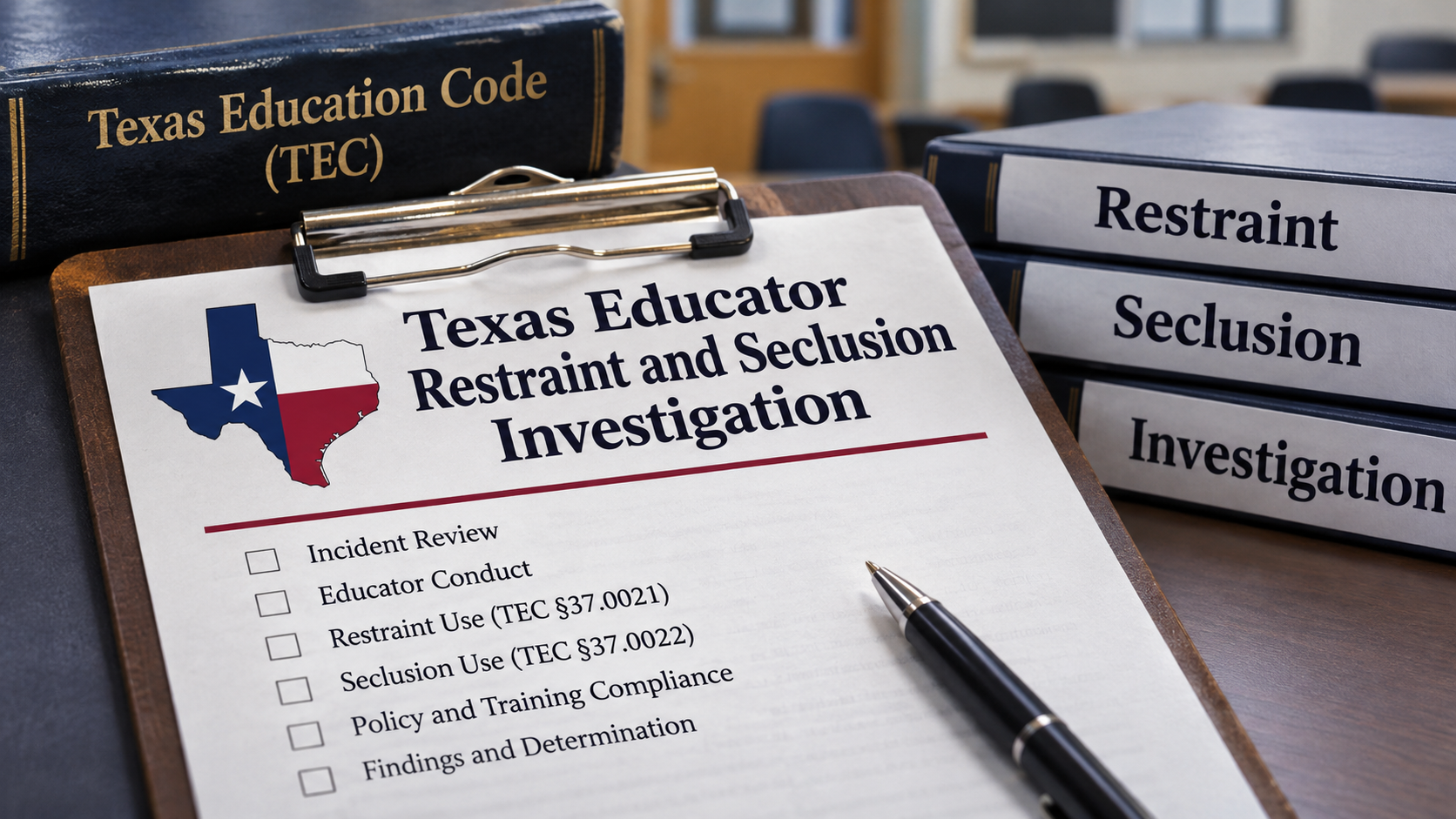
- Under Texas Education Code §37.0021 and TEA rule 19 TAC §89.1053, restraint is defined as the use of physical force or mechanical devices to significantly restrict a student's free movement. Seclusion is defined as confining a student in a locked space less than 50 square feet from which the student is physically prevented from leaving.
- The TEA first adopted specific restraint rules for special education students in the early 2000s and has revised guidance multiple times, including major amendments in 2014, 2022, and 2024, in response to federal scrutiny and high-profile incidents.
- Between 2019 and 2024, media reports and legislative hearings raised alarms about injuries, emotional trauma, and unreported incidents involving educators in districts across the state, including investigations into Midland ISD's special education program.
- Students with disabilities are disproportionately affected by restraint and seclusion practices, which has intensified debate about balancing classroom management, student safety, and civil rights protections.
- Growing scrutiny of restraint and seclusion practices has led to stricter Texas regulations, and Texas law emphasizes the dignity and human rights of all students during any use of restraint or seclusion.
Legal Framework: Texas Law, TEA Rules, and Federal Requirements
- Restraint and seclusion in Texas are governed by a combination of state statutes, TEA regulations, and federal disability and civil rights laws.
- Key Texas legal sources include Texas Education Code §37.0021, which defines restraint, seclusion, and time-out; 19 TAC §89.1053, which details procedures for restraint and time-out for students with disabilities; and TEA guidance documents and FAQs on restraint reporting and parent notification, revised as recently as 2024.
- Texas law prohibits using restraint as a disciplinary measure or for convenience. Physical restraint may only be used in emergencies posing imminent danger of serious physical harm. Restraint must be discontinued immediately once the emergency ends, and Texas law mandates minimal necessary force during restraint incidents.
- Seclusion is strictly prohibited for special education students in Texas schools. Senate Bill 133 (2023) further restricted use of physical restraint and chemical irritants by peace officers and security personnel on younger students.
- Federal law overlays these state rules: IDEA requires safe, appropriate behavior interventions in IEPs; Section 504 and Title II of the ADA prohibit disability discrimination; and federal oversight involves investigations into the treatment of students with disabilities in schools, including U.S. Department of Education guidance letters on restraint and seclusion.
- Teachers must undergo training in positive behavioral interventions according to Texas laws. The TEA can investigate districts and individual Texas educators for professional misconduct when restraint or seclusion violates these standards-directly affecting teacher certification and professional responsibility.
Triggers for a Texas Educator Restraint and Seclusion Investigation
- A Texas educator restraint and seclusion investigation can be triggered by multiple sources, and each path can lead from a campus review to a formal state or federal inquiry.
- Parent complaints to the campus, district, TEA, or federal OCR about improper restraint or seclusion are a common trigger, especially when a child with a disability is involved.
- Mandatory reporting by school staff following a serious incident-such as injury requiring medical care, police involvement, or a pattern of restraints-can escalate review. Written notice of restraint incidents must be provided to parents within one school day.
- Whistleblower reports from other teachers, paraprofessionals, or related service providers who witness policy violations have prompted district and TEA action in real cases.
- Media coverage or video evidence, such as surveillance footage of a restraint used on a young student with autism during a behavioral crisis, has led to legislative and agency review.
- Investigations into restraint concerns involve both internal district reviews and state agency reporting. In practice, a classroom incident can escalate as follows: campus documentation and principal review; district-level special education or student services review; and, if warranted, a formal TEA professional discipline investigation or federal OCR complaint affecting the educator's certification.
Investigation Process: From Incident Report to TEA Action
- This section walks through the life cycle of an investigation involving a Texas educator.
- Immediately after a restraint incident, campus administration must be notified the same day. A good-faith effort to verbally notify the parent must occur the same day, and written notification must follow within one school day. Each instance of physical restraint must be documented separately.
- Documentation must include the student's name, who administered the restraint, date and time, location, nature of the restraint, the behavior preceding it, and whether a behavior improvement plan may need revision. Documentation of restraint incidents is required to identify patterns and ensure accountability, and must be placed in the student's special education eligibility folder by the third school day.
- Students' basic human necessities must not be deprived during restraint in Texas schools. School staff must receive training in crisis intervention and de-escalation techniques; those who use restraint without prior training must complete it within 30 school days.
- District internal investigation procedures include interviews with the certified teacher, aides, and campus administrators; review of video footage if available; and assessment of whether the IEP or Behavior Intervention Plan was followed.
- When findings suggest a violation, the district superintendent may report to TEA's Educator Investigations division. The agency may interview educators and witnesses, review training records and continuing education logs, and compare the incident to statewide rules and local policy.
- Possible outcomes at this stage: no violation found; required corrective action for the district or campus; or adverse findings leading to sanctions against a certified teacher's license.
Consequences for Texas Educators, Districts, and Teacher Certification
- A restraint and seclusion investigation can carry real professional consequences for Texas educators at every level.
- Individual-level outcomes may include placement of letters of reprimand in personnel files, mandatory remedial training in restraint, de-escalation, and special education law, or formal TEA disciplinary actions including certificate suspension, probation, or revocation.
- Findings can affect a teacher's ability to renew or upgrade Texas teacher certification, and discipline records are accessible statewide, impacting future employment prospects in other school districts. Additional continuing education on classroom management and student safety may be required.
- As of 2024-25, 88 percent of Texas teachers are certified, while Texas has over 42,000 uncertified teachers. In 2024, 12 percent of Texas teachers were uncertified, and research shows that uncertified teachers are less likely to stay in the profession-making certification and compliance even more critical to retention; the majority of new teachers enter through alternative certification pathways. There are also concerns that teachers trained through weaker or largely online pathways may not receive enough clinical preparation before handling high-risk student behavior situations.
- District-level consequences include required corrective action plans approved by TEA, monitoring or audits of restraint and seclusion data, and potential loss or conditions placed on federal special education funds if OCR finds systemic violations.
- Uncertified educators, aides, and contractors hired in support roles can face non-renewal or termination, even if they do not hold formal teacher certification through TEA.
Responsibilities and Best Practices for Texas Teachers and Campus Leaders
- This is the practical compliance section for teachers, assistant principals, and special education coordinators committed to protecting students and their own careers.
- Understand your district's policies and TEA rules on restraint and seclusion before the school year begins. Ensure IEPs and Behavior Intervention Plans prioritize positive behavioral interventions and de-escalation strategies to minimize the need for restraint.
- Follow all documentation and parent notification timelines required under Texas education rules after a restraint or seclusion incident. Annual committee reviews of restraint effectiveness are required under Texas regulations, and Texas law mandates annual reviews of behavioral intervention plans following restraint incidents.
- Use continuing education and professional development hours to complete quality training in crisis prevention, trauma-informed practices, and special education law. For new teachers entering the profession and candidates in alternative educator preparation programs, integrate restraint and de-escalation training into induction and mentoring experiences.
- Collaborate closely with special education teams, school psychologists, and behavior specialists to review data on restraint use. Involve parents early in conversations about behavior supports to prevent crises that might lead to restraint or seclusion. Leverage district policy manuals and TEA guidance to discuss expectations with your campus community and strengthen compliance efforts.
Implications for Texas Education Policy and the Teaching Profession
- Legislative hearings in recent Texas legislative sessions have examined restraint and seclusion data from TEA and led to reform efforts including SB 133 and House Bill 2, which allocates over $400 million annually for teacher recruitment and retention efforts. The agency now plays a heavier role in collecting statewide data, issuing guidance, and tying compliance to district accountability.
- Texas has a teacher attrition rate higher than the national average. Over 40,000 teachers are hired annually to replace those leaving, and the number of uncertified teachers in Texas tripled from 2019 to 2024. Texas faces persistent teacher shortages in critical subject areas, and the state must recruit, retain, and track well prepared educators in every subject area.
- The Raising Texas Teachers program launched in 2017 with $50 million in financial support to help paraprofessionals and other district staff working toward a bachelor’s degree move into the teacher pipeline, and higher retention rates are found in districts with mentoring programs. Texas requires passing the TExES certification exams for teacher certification, and teachers must complete 30 hours of field-based experience, after which candidates may become eligible for employment or intern credentials as they progress through certification. House Bill 2 mandates all foundational subject teachers be certified by 2027-28, which could strengthen the quality of educators in the classroom.
- High-profile investigations influence public trust in Texas teachers, principals, and administrators. Stricter oversight may increase stress on educators but also encourage better preparation, learning, and support for classroom management. Educator preparation programs in Texas have an opportunity to strengthen training on behavior supports and crisis intervention-ensuring that teachers entering the profession are well prepared for the realities of the job.
- Possible future legislative proposals may further limit or ban seclusion, restrict certain types of restraint, or expand parent notification requirements. Districts can leverage professional learning communities and continuing education to address concerns and reduce reliance on restraint and seclusion over the past decade and into the future.
Resources for Texas Educators, Parents, and Advocates
- Texas Education Agency webpages and guidance documents on restraint, time-out, and special education discipline provide the foundation for compliance. Contact your district for local policy manuals (often the FO or FNC series) that govern student discipline and use of force.
- The U.S. Department of Education and Office for Civil Rights offer resources explaining federal protections for students with disability.
- Professional associations for Texas educators, such as the Texas State Teachers Association, offer legal advice, training, and support on student discipline. Parent advocacy groups including Disability Rights Texas and the Arc of Texas help families understand their rights, file complaints, and review services available in their community.
- Certified teachers, aspiring educators, and school leaders should use these resources to stay informed, complete continuing education expectations, and reduce the likelihood of harmful incidents and investigation. Success in this profession depends on understanding both your responsibilities and your rights in Austin and across every district in the state.
Frequently Asked Questions
What records should an educator preserve after a restraint allegation?
Relevant records may include incident reports, training certificates, administrator communications, parent notification records, applicable district policies, and witness information. An attorney can advise how to preserve or request these materials without violating student privacy laws or school access restrictions.
Can a district investigation affect a teaching certificate?
Yes. A district investigation may lead to a TEA review if the allegations involve conduct within the agency's authority. SBEC may impose certificate discipline when supported by the evidence and applicable law. A district complaint alone does not automatically result in certificate sanctions.
Does every restraint complaint lead to educator discipline?
No. The outcome depends on the facts, applicable legal standards, relevant evidence, and investigation findings. A complaint is an allegation, not proof that misconduct occurred.
Should an educator contact an attorney before an investigative interview?
Legal consultation may be valuable before a formal interview, particularly when employment, certification, or possible abuse allegations are involved. An attorney can assess the interview request, applicable rights, and response obligations.
Request a Confidential Educator-Defense Consultation
If you are a Texas teacher, classroom aide, or school administrator facing a Texas educator restraint and seclusion investigation, your professional future deserves careful legal attention.
A restraint complaint can affect employment, certification, and reputation. You do not have to evaluate these legal concerns without professional guidance.
Masterly Legal Solutions provides education-law representation for educators facing misconduct allegations, district investigations, and professional disciplinary matters.
Contact our firm to discuss the allegations, understand the available legal options, and determine an appropriate response for your circumstances.
Call (972) 236-5051 or visit https://www.masterlylegal.com/ to request a confidential educator-defense consultation.
This article provides general legal information and does not constitute legal advice. The applicable requirements and potential outcomes depend on the facts and governing law.







Looking for Legal & Business Solutions? Contact Us Now
Fill in the form or call us to set up a meeting