

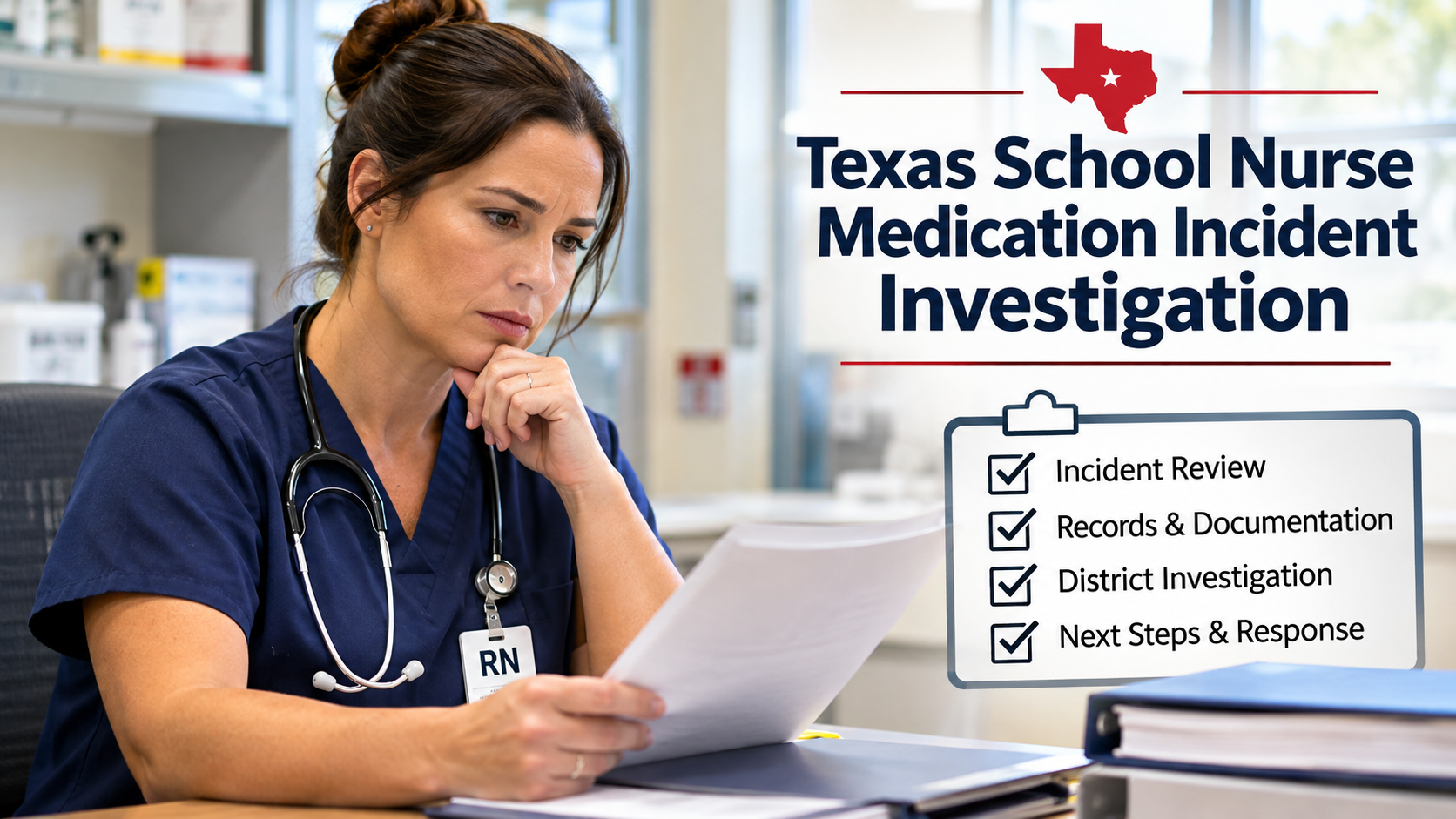
Texas School Nurse Investigations After a Medication Incident: What to Preserve Before Responding
A reported medication error can put a Texas school nurse in a difficult position. One unexpected phone call, parent complaint, or meeting with a school administrator may raise questions about student safety, professional judgment, and job security.
A nurse may be asked to explain a missed dose, incorrect medication, documentation concern, or alleged failure to follow a student's treatment instructions. What begins as a school-level review may lead to administrative leave, disciplinary action, or questions about professional licensure.
A Texas school nurse medication incident investigation requires careful attention because employment and nursing license concerns may involve different rules and decision-makers.
Not every medication incident leads to a licensing complaint. However, statements made during an employer investigation may become relevant if a separate professional review develops.
Masterly Legal Solutions provides legal guidance for Texas education professionals facing workplace investigations and career-related allegations. An attorney can help evaluate the circumstances, protect relevant records through appropriate procedures, and prepare a response that considers both employment and professional responsibilities.
1. What Should Be Preserved Immediately Without Changing Clinical Records
When a medication incident is reported, the first concern is student safety. Any required clinical response, notification, and reporting should follow applicable nursing standards and school procedures.
Once those immediate responsibilities are addressed, the accuracy and preservation of records become important.
Why Original Medication Records Matter
School nurse medication documentation may help establish what happened before, during, and after a reported event.
Important records may include:
- Medication administration records showing recorded doses, dates, and times.
- Physician orders and medication instructions.
- Parent or guardian medication authorization forms.
- Individualized healthcare plans and relevant student health instructions.
- Incident reports and required notification records.
- Medication storage, labeling, or inventory records.
- District medication administration policies.
- Relevant staff assignments, training records, and supervision instructions.
These documents may help determine whether the concern involves an actual medication error, an unclear instruction, a reporting issue, or a disagreement about the nurse's assigned responsibilities.
The Texas Department of State Health Services provides guidance on school medication administration, while the Texas Board of Nursing establishes professional nursing standards.
Both may be relevant when reviewing a school medication event.
Never Alter or Backdate Clinical Documentation
A nurse should not delete, rewrite, backdate, or otherwise improperly change an existing clinical record to make the incident appear different.
If a legitimate correction or late entry is necessary, it should follow applicable professional standards and the school's authorized documentation procedures. The original record and audit history should remain intact.
A medication incident may involve several people, including administrators, healthcare providers, parents, and other school staff. Accurate records help establish each person's involvement without relying only on memory.
Student health information must also remain protected. Nurses should not download restricted student records, send confidential files to personal email accounts, or remove documents without authorization.
An attorney can help identify relevant evidence and seek its preservation or production through lawful procedures.
2. Different Employer and Professional-Licensure Processes
A medication incident may raise two separate questions:
Did the nurse comply with the school's employment policies and assigned responsibilities?
Did the nurse meet the professional standards required to hold a Texas nursing license?
The answers are not always the same.
Texas School Employment Investigation
A Texas school employment investigation generally focuses on workplace conduct and compliance with applicable school policies and regulations.
Administrators and supervisors may review whether the nurse:
- Followed district medication procedures.
- Documented medication administration accurately.
- Completed required notifications.
- Acted within assigned responsibilities.
- Followed applicable student safety requirements.
- Complied with employment policies and professional expectations.
- Was accused of employee misconduct tied to the incident.
Depending on the facts and employment arrangement, an investigation may result in additional training, corrective action, administrative leave, discipline, or termination. Educators, including teachers, are protected from retaliation under federal law when they report concerns, raise discrimination or harassment complaints, or participate in an investigation, and such actions should not cost them wages, benefits, or their jobs.
Employment protections and available response procedures may differ between public school districts, charter schools, and private schools.
A nurse's contract, handbook, job classification, and applicable law can affect the available options, and different employers may use different procedures when responding to complaints or allegations.
Texas Board of Nursing Review
The Texas Board of Nursing (BON) is responsible for regulating nursing practice and enforcing the Texas Nursing Practice Act.
The Board may investigate complaints involving alleged unsafe nursing practices, professional misconduct, or violations of nursing standards, and it evaluates the nurse’s conduct under the Texas Nursing Practice Act and applicable Board rules.
However, not every school medication error results in a BON investigation or disciplinary action. The Texas Board of Nursing provides guidance on when some errors may be classified as minor incidents. A minor incident must not show a practice-related risk of harm to students.
The Board distinguishes between matters that may
violate nursing law and ordinary employment disputes. Mandatory reporting is required for significant errors involving reckless conduct or major harm.
If a separate Board investigation begins, the nurse may receive notice of allegations and an opportunity to respond under applicable procedures.
Depending on the evidence, a case may close without discipline or proceed toward further action. A separate Texas Education Agency review may also evaluate criminal history in education misconduct matters, even though that process is handled by a different agency.
Why the Distinction Matters
A district decision does not automatically determine whether a nursing license will be disciplined, and outcomes depend on the specific facts and evidence in each case.
Likewise, a matter that does not result in Board discipline may still have employment consequences.
This distinction matters because a statement prepared only to address an employment concern could raise additional questions about nursing practice.
Masterly Legal Solutions can review the employment allegations and identify whether separate licensure counsel or a coordinated legal response is appropriate, including guidance on the importance of protecting your position, preserving accountability, and navigating the disciplinary process when both employment and licensure issues are in play.
3. Responding to Interviews and Preserving Correspondence
A school nurse may receive an unexpected request to meet with a principal, human resources representative, nursing supervisor, or district investigator.
The meeting may initially be described as an opportunity to explain what happened.
However, the information gathered could become part of the employer's official investigation record.
Understand the Purpose of the Interview
Before making a detailed statement, it is important to understand the nature of the meeting.
An attorney can help assess whether the nurse is being asked to participate in a routine incident review, an employment investigation, or another formal process involving a principal, human resources representative, nursing supervisor, or one or more district investigators, depending on the employer.
Relevant questions may involve the incident date, alleged error, records under review, and potential employment consequences. As part of the process, investigators may review records and speak with witnesses.
A nurse should follow applicable reporting and cooperation duties while seeking legal advice when appropriate. Representation rights and procedural protections depend on the employment setting and circumstances.
Written Statements May Carry Lasting Consequences
A rushed written explanation can create problems if the nurse does not yet have access to accurate records.
For example, a nurse may remember administering medication at a particular time while the electronic administration record shows something different.
That difference does not automatically establish misconduct. A just culture approach supports error reporting and system improvement rather than automatic individual blame. It may require a closer review of documentation practices, system entries, or other evidence.
A legal review can help distinguish verified facts from assumptions or incomplete recollections.
Responses should remain truthful, accurate, and consistent with applicable professional obligations and ethics. Regular audits and training for medication administration can help prevent future errors, but the immediate focus should remain on accurate fact development in the current investigation.
Preserve Relevant Communications
Correspondence may establish when the allegation was raised, what information the nurse received, and whether the employer established a response deadline.
Relevant communications may include:
- Emails requesting an investigative meeting.
- Written allegations or incident notices.
- Human resources correspondence.
- Administrative leave or reassignment notices.
- Requests for written explanations.
- Communications about reporting obligations.
- Written findings and disciplinary decisions.
These materials may help clarify whether the employer followed applicable procedures.
A nurse should preserve communications they are legally permitted to retain and avoid deleting relevant information. Access to restricted school systems or confidential student records should remain within authorized limits.
Legal counsel can help evaluate the requested response before the nurse makes an important employment decision.
4. Timeline, Documentation, and When to Retain Counsel
A reported medication incident may develop in stages.
A concern could first arise when a parent contacts the school, a medication record is questioned, or another employee reports a possible error.
The school may then collect records, interview staff, review procedures, and decide whether corrective action is appropriate.
These stages do not necessarily follow the same sequence in every district.
Why the Timeline Matters
The timing of events can help distinguish the medication incident from later decisions about documentation, supervision, or employment.
A legal review may examine:
- When the medication was ordered or authorized.
- When the dose was scheduled and what was recorded.
- When the alleged error was discovered.
- What clinical response and notifications occurred.
- When the employer began reviewing the incident.
- When the nurse was asked to provide a statement.
- Whether disciplinary or licensing-related correspondence followed.
In texas schools, school nurses may cover multiple campuses or high student-to-nurse ratios, which can affect workflow, timing, records involving students, and how investigators interpret them.
A timeline should be based on existing evidence rather than an attempt to reconstruct facts as though they were known with certainty.
When Legal Representation Becomes Important
A nurse may benefit from retaining counsel when an incident leads to a formal investigation, administrative leave, a request for a detailed written statement, or possible disciplinary action.
Legal guidance becomes particularly important when allegations concern patient safety, professional judgment, inaccurate records, or possible violations of nursing standards, and it is essential when the matter could affect future employment, educator-facing roles in Texas schools, or professional standing.
If the Texas Board of Nursing sends a complaint notice or investigation correspondence, the nurse should also seek advice from an attorney qualified to address nursing licensure matters. Legal counsel can advocate for the nurse’s interests while helping preserve an accurate response.
An attorney can review applicable deadlines, examine relevant employment documents, identify missing evidence, and explain possible consequences.
How Masterly Legal Solutions Can Help
Masterly Legal Solutions works with Texas educators and education-related investigations in Texas schools.
For a school nurse facing a medication allegation, this consulting service may include reviewing employment documents, evaluating investigation notices, assessing available response procedures, helping prepare for employer interviews or written submissions, and supporting accountable, informed decision-making.
The firm can also help identify whether the matter presents separate nursing licensure concerns that require additional legal review or coordinated representation.
The goal is to support an accurate, informed response while protecting the nurse's legal interests, professional life, and career reputation.
How School Nurse Investigations Affect Student Safety and Professional Responsibilities in Texas
School nurses support the health and learning needs of kids across Texas, including students with disabilities who may require medication during school hours. When a medication incident involves a child, the school must consider student safety, family concerns, and applicable district policies. Nurses working in Houston and other Texas communities may also face questions about professional standards, clinical knowledge, and responsibilities within the school environment. Unlike teaching positions that may require educator certification through the State Board for Educator Certification, school nursing practice is regulated by the Texas Board of Nursing. Professional organizations, including the Texas Association of School Nurses, also provide resources for school health professionals. If an investigation raises questions about employment, medication administration, or professional responsibilities, Masterly Legal Solutions can help nurses understand their legal options and respond to allegations while protecting their careers.
Frequently Asked Questions About Texas School Nurse Medication Incident Investigations
Can a district investigation affect a school nurse license?
Yes, in some circumstances. A district investigation may uncover concerns that lead to a report or complaint involving the Texas Board of Nursing. However, a school investigation does not automatically trigger Board action or license discipline. The outcome depends on the conduct, evidence, reporting requirements, and any separate Board process.
What documents should be preserved after a medication incident?
Relevant records may include medication administration logs, physician orders, parent authorization forms, incident reports, healthcare plans, district policies, and investigation correspondence. Preserve records through authorized procedures. Do not alter clinical documentation or improperly copy confidential student information.
Should a school nurse respond to an investigation without an attorney?
Not every routine incident review requires legal representation. However, legal advice may be valuable when the nurse faces formal allegations, disciplinary action, a detailed written statement request, or possible licensing concerns. An attorney can explain the applicable procedures and response options.
Can a nurse be disciplined by a district without Board of Nursing action?
Yes. Employment discipline and professional license discipline are separate matters. A school employer may take action under applicable employment rules even when the Board of Nursing does not open a case or impose discipline.
What happens during a Texas school nurse medication incident investigation?
An employer may review medication records, interview staff, examine district policies, and evaluate whether required procedures were followed. The findings may result in no action, corrective measures, or employment discipline. A separate licensing investigation occurs only when applicable circumstances lead to Board review.
Request a confidential education-employment and licensure consultation
A medication allegation can create uncertainty about your job, professional reputation, and nursing license.
You do not have to evaluate complex employment documents and investigation notices without legal guidance.
Masterly Legal Solutions provides legal support for Texas education professionals in TX facing workplace investigations, related licensure concerns, and career-related issues.
If you are involved in a Texas school nurse medication incident investigation, an attorney can review the circumstances in Texas schools, help identify relevant evidence, evaluate employment-related response options, and help protect your job, benefits, and professional standing where appropriate while assessing whether separate nursing licensure advice is needed.
Request a confidential consultation to discuss the allegations, investigation deadlines, and legal options available in your situation.
Call Masterly Legal Solutions: (972) 236-5051
Website: https://www.masterlylegal.com/
Contact Masterly Legal Solutions today to discuss your school employment investigation and potential professional licensing concerns.





Looking for Legal & Business Solutions? Contact Us Now
Fill in the form or call us to set up a meeting