
Texas Charter School Educators: Investigation and Contract Rights
A complaint at a Texas charter school can quickly place an educator's employment, professional reputation, and future career opportunities at risk. A written allegation, unexpected leave notice, or contract dispute may leave teachers and staff unsure about their rights or what the school can legally require.
Unlike traditional public school districts, Texas charter schools operate under different governance and employment rules. These differences can affect how investigations proceed, whether an employee has certain contract protections, and which grievance procedures apply.
Understanding texas charter school educator investigation rights is important for certified teachers, administrators, and noncertified employees facing workplace allegations.
A charter school investigation may involve internal policies, employment agreements, state education regulations, or professional certification concerns. The applicable rules depend on the school's structure and the employee's position.
Masterly Legal Solutions provides legal guidance for Texas educators facing investigations, employment disputes, and professional disciplinary concerns. Early consultation allows an attorney to examine the relevant documents, identify possible deadlines, and assess the educator's legal options before important decisions are made.
How Charter School Governance and Employment Documents Differ From Traditional Districts
Texas open-enrollment charter schools are public schools, but their employment relationships do not automatically follow the same rules as independent school districts (ISDs).
Traditional school districts generally employ certain educators under probationary, term, or continuing contracts governed by the Texas Education Code. These arrangements provide statutory rights and procedures that may apply to contract renewal, termination, or other employment decisions.
Charter schools often operate differently.
Some charter schools use written employment agreements with specific terms. Others employ staff under at-will arrangements, subject to applicable laws and contractual limits.
As a result, an educator should not assume that the protections available to an ISD teacher automatically apply to a charter school position.
Why Charter School Employment Agreements Matter
A charter school's governing documents, employment agreement, and adopted policies may help determine:
- Whether employment is at-will or governed by a fixed-term agreement.
- Who has authority to investigate or make employment decisions.
- What procedures apply to employee complaints or discipline.
- Whether an employee has internal appeal or grievance rights.
- How contract renewal, nonrenewal, or termination decisions are handled.
- Whether specific notice requirements or deadlines apply.
The school's legal structure also matters. An open-enrollment charter school, a district-authorized charter campus, and a campus operated through a district partnership may involve different legal arrangements.
Charter schools are not simply private schools. They operate within Texas public education and remain subject to applicable state and federal requirements.
However, public school status does not automatically provide every employment protection available in a traditional district.
Masterly Legal Solutions can review the educator's employment relationship and applicable school policies to determine which legal protections may apply to the dispute.
Early Steps After an Educator Misconduct Complaint, Temporary Removal, or Written Allegation
An educator may first learn about an investigation through an email from human resources, a meeting request, a written complaint, or a notice of temporary administrative leave tied to alleged educator misconduct.
Sometimes, the notice provides little information about the allegations, including claims involving abuse, and being placed on leave is not a final determination.
The school may ask for a written statement, request an interview, restrict campus access, or place the employee on leave while reviewing the complaint.
These actions can create serious uncertainty, which is why immediate legal review is often critical.
Why an Investigation Notice Deserves Legal Attention
Temporary removal does not automatically mean an employee has committed misconduct. Schools may use administrative leave while collecting information or reviewing complaints involving alleged educator misconduct or suspected abuse.
However, the terms of that leave may affect compensation, benefits, access to records, and employment status, and leave is not a final determination.
An attorney may need to determine whether the notice is consistent with the employee's agreement, applicable policies, and due process protections.
Legal review is especially important when the allegations involve:
- Student safety or inappropriate conduct.
- Professional boundary concerns.
- Workplace harassment, discrimination, or civil rights complaints.
- Failure to follow school policies.
- Alleged contract violations or performance concerns.
- Misuse of school resources or confidential information.
- Conduct that could trigger a report to the Texas Education Agency.
Certified educators may face concerns beyond their current employment. Certain misconduct allegations can lead to review by the Texas Education Agency (TEA), and the available evidence may affect possible action involving the State Board for Educator Certification (SBEC) and an educator's certificate.
Noncertified employees may also face state-level employment eligibility concerns in certain misconduct cases.
An internal school investigation and a state regulatory investigation are separate matters. Their legal standards, procedures, and possible consequences may differ, especially where Texas law, state law, or school district reporting requirements may require a principal or superintendent to provide notice, ensure a report is filed within seven business days, or address related reports while administrators comply with agency rules.
Obtaining legal advice before providing a detailed written response can help an educator understand which process is involved, protect process rights, prepare for possible disciplinary actions or administrative hearings, and assess whether allegations tied to children, special education services, procedural errors, or other issues could expand beyond an internal employment matter.
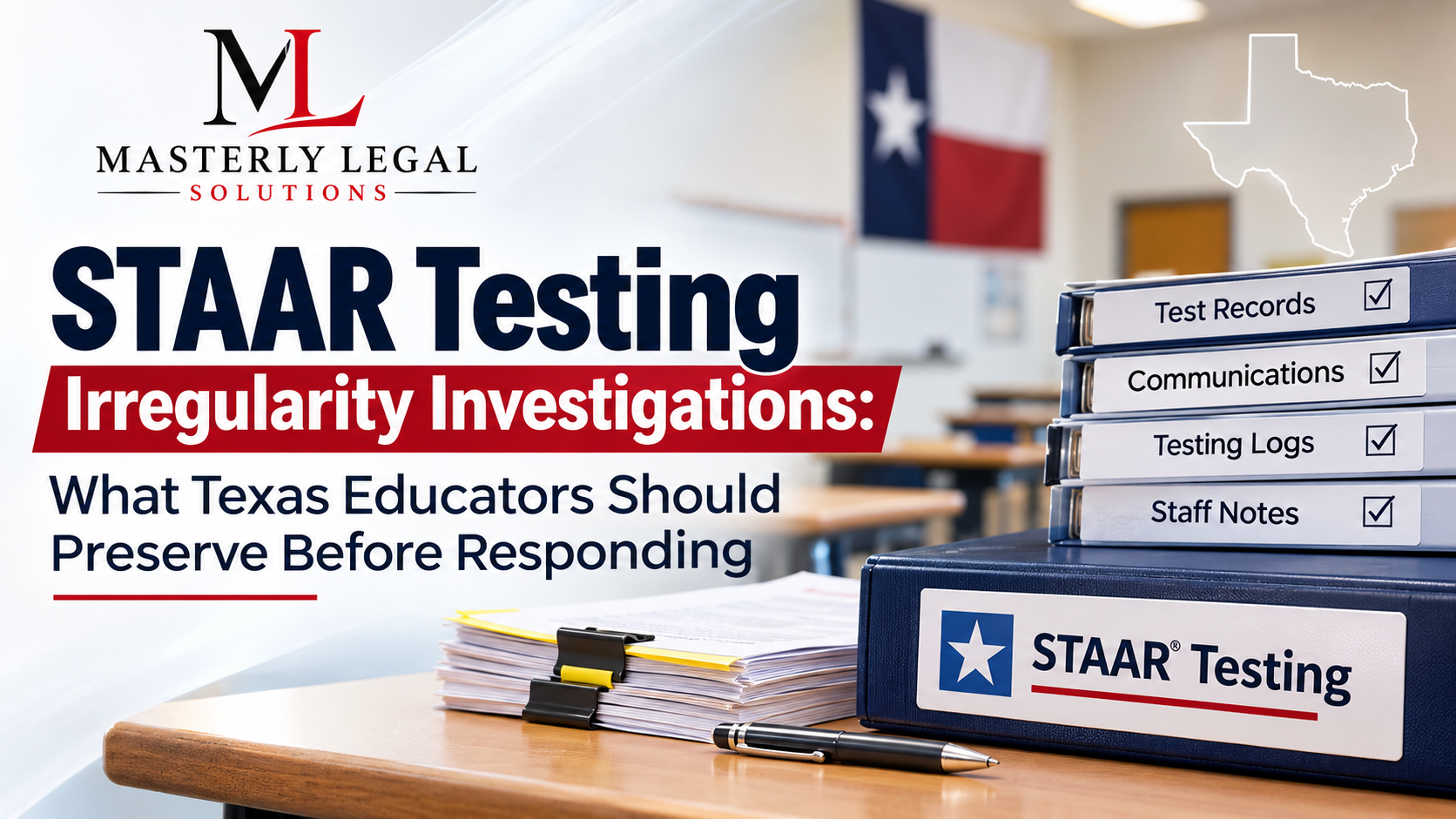
What to Preserve: Contract, Handbook, Assignment, Communications, and Notices
Texas charter school educator investigation rights often depend on documents that explain the employee's responsibilities, the school's policies, and the decisions made during an investigation.
A legal consultation becomes more useful when counsel can examine reliable records rather than relying only on verbal descriptions.
Several categories of documents may be especially important.
Employment Contracts and Appointment Documents
Signed contracts, offer letters, renewal agreements, and employment amendments can establish the terms of the working relationship.
These records may show whether employment is at-will, whether notice provisions apply, and what contractual obligations exist.
They can also help counsel evaluate allegations involving contract violations or termination.
Employee Handbooks and Governance Policies
Employee handbooks may explain workplace conduct rules, investigation procedures, grievance processes, and disciplinary standards.
The version in effect when the relevant events occurred may be particularly important.
An attorney can examine whether the school's actions are consistent with applicable policies and whether those policies create enforceable obligations.
Job Assignments and Performance Records
Job descriptions, assignment letters, duty schedules, evaluation records, and previous performance notices may help explain an educator's responsibilities.
These materials can provide context when an allegation concerns supervision, workplace expectations, professional duties, or performance.
Emails, Messages, and Written Communications
Relevant communications may include messages from administrators, human resources personnel, supervisors, and other individuals involved in the matter.
Dates, wording, and context may help establish a timeline.
Educators should preserve records they are legally permitted to retain. They should not access restricted systems, remove confidential student information, or forward protected records to personal accounts without proper authorization.
Investigation Notices, Disciplinary Actions, and Contract Actions
Written allegations, leave notices, meeting invitations, disciplinary letters, proposed separation agreements, and termination notices may establish important facts and deadlines.
These documents can help counsel determine whether immediate legal action or a timely response may be necessary. Related reports or other evidence tied to the communication chain may also matter when evaluating the investigation timeline, response, and any resulting disciplinary actions, including situations where school action may continue after a resignation.
Preserving records does not mean collecting every school document. It means identifying relevant, lawfully accessible information while respecting student privacy and confidentiality requirements.
Masterly Legal Solutions can help educators determine which materials are relevant to their legal circumstances and whether additional records should be requested through appropriate procedures.
Questions for Counsel Before a Written Statement or Grievance Decision
An educator may feel pressure to respond immediately after receiving an allegation.
However, statements made during an employment investigation can become part of the school's decision-making record. In some circumstances, information may also be reviewed by outside agencies.
Before responding, legal counsel can examine the allegations, the employment relationship, and any deadlines.
Does the Charter School Have Authority to Take the Proposed Action?
A lawyer can review whether the relevant administrator or governing body has authority under the school's policies and employment arrangements.
The review may also address whether required notices or procedures apply.
Is a Written Statement Required?
The answer depends on the applicable employment terms, policies, and legal circumstances.
Counsel can assess the request, the scope of the allegations, and the potential consequences of providing a statement.
The goal is to make an informed decision without overlooking an existing duty to cooperate or respond.
Is a Formal Grievance the Appropriate Response?
Not every employment dispute follows the same grievance route.
Texas charter schools may maintain their own employee complaint procedures, with specific filing requirements and deadlines.
TEA directs many local employment concerns to the school or charter operator's internal grievance process rather than handling the underlying workplace dispute itself.
Missing an applicable deadline can limit available options.
An attorney can review whether a grievance, contractual claim, agency complaint, or another legal process may be appropriate.
Could the Investigation Affect Professional Certification or Texas Education Agency Reporting?
Certified educators should consider whether the allegations may involve TEA or SBEC review.
An employment decision and a certification matter can have different consequences.
Counsel can evaluate the relationship between these proceedings and help determine what representation or response may be needed.
Why Legal Representation Matters Before a Decision
An employment investigation can involve several connected issues, including contracts, workplace policies, regulatory duties, and professional reputation.
Without a careful legal review, an educator may misunderstand which procedures apply or overlook a significant provision in an employment agreement.
Masterly Legal Solutions provides individualized legal guidance based on the educator's documents, allegations, and professional circumstances.
The firm can assess applicable rights, explain available legal options, and assist with appropriate responses or proceedings based on the scope of representation.
Frequently Asked Questions About Texas Charter School Educator Investigation Rights
Does a charter school employee always have the same grievance route as an ISD teacher?
No. Charter school employees do not automatically follow the same grievance procedures as traditional ISD teachers. The applicable process depends on the charter school's policies, employment documents, and relevant law.
What should an educator bring to an initial legal consultation?
Bring available employment agreements, handbooks, written allegations, leave notices, relevant communications, performance records, and grievance notices. Include any approaching response deadlines. Share only records you are legally authorized to possess or disclose.
Can a Texas charter school place an educator on administrative leave during an investigation?
Yes, depending on applicable law, policies, and employment terms. Whether the leave is paid, unpaid, or subject to particular procedures requires review of the specific circumstances.
Do noncertified charter school employees have investigation rights?
Yes. Noncertified employees may have protections under applicable employment laws, contracts, and school policies. However, their rights may differ from those of certified educators.
Can a charter school investigation affect a Texas teaching certificate?
Yes. Certain misconduct allegations may be reported to TEA and reviewed for possible certification consequences. Not every workplace complaint results in state disciplinary action.
Should an educator speak with an attorney before submitting a written statement?
Legal advice can be valuable before providing a formal response, particularly when allegations could affect employment, certification, or future career opportunities. Counsel can assess the request and any applicable response obligations.
Can Masterly Legal Solutions assist with charter school contract disputes?
Masterly Legal Solutions handles education law and educator-defense matters. A consultation can help determine whether the firm can assist with a specific charter school investigation, contract dispute, or related employment concern.
How Charter School Investigations Can Affect Employment and Professional Standing
In Texas, public school employment investigations may involve school staff, campus administrators, and school attorneys reviewing alleged violations of workplace policies, professional standards, or state law. The school system has a responsibility to protect students and determine the appropriate action when concerns involve student health, safety, a possible criminal offense, or other misconduct. Allegations involving an educator's parental relation to a student or another person connected to a complaint may also require careful review of the facts and potential conflicts of interest.
Depending on the circumstances, an investigation may involve the Texas Education Agency, its inspector general function, or employment eligibility records such as the Do Not Hire Registry. A school may temporarily suspend an employee from duties while reviewing allegations, subject to applicable law and employment terms. Certain disputes may require review by a district court, although not every employment disagreement qualifies for court action. An educator's professional standing and future employment opportunities may be affected, making early legal guidance important. Masterly Legal Solutions helps Texas charter school educators understand the applicable procedures, evaluate their rights, and respond to employment investigations with informed legal counsel.
Request a Confidential Educator-Defense Consultation
A charter school complaint, investigation notice, or contract action can place important professional interests at risk.
You deserve to understand which employment rules apply, what the school's documents require, and whether legal protections are available in your circumstances.
Masterly Legal Solutions works with Texas educators facing professional and employment concerns. Our legal team can review relevant records, assess the allegations, and discuss appropriate legal options.
If you have questions about texas charter school educator investigation rights, consider seeking legal advice before submitting a written statement, signing a separation agreement, or allowing an important grievance deadline to pass.
Texas educator-misconduct reporting requirements can be strict and may require administrators to provide notice to parents in some cases; under Senate Bill 7, effective September 1, 2017, failure to report misconduct can lead to penalties up to $10,000.
Schedule a confidential educator-defense consultation with Masterly Legal Solutions to discuss your situation.
Call: (972) 236-5051
Website:https://www.masterlylegal.com/
An initial consultation can help clarify your legal position and possible next steps. Representation and outcomes depend on the facts, applicable law, and circumstances of each matter.



Looking for Legal & Business Solutions? Contact Us Now
Fill in the form or call us to set up a meeting