
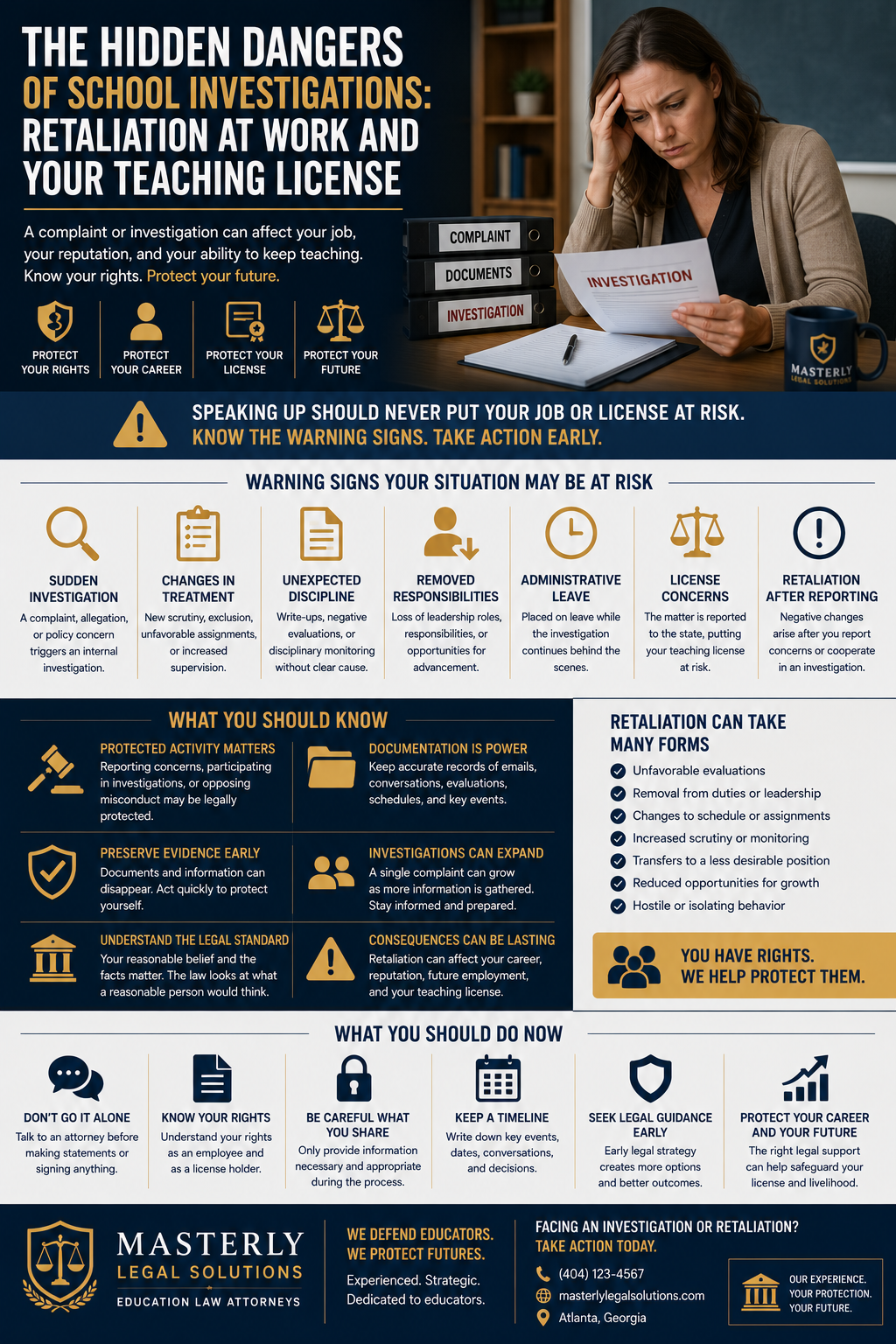
The Hidden Dangers of School Investigations: Retaliation at Work and Your Teaching License
Teaching is built on trust. Every day, educators make decisions that affect students, coworkers, and the communities they serve. Most teachers begin their careers focused on helping students succeed, not on defending themselves during an internal investigation. Unfortunately, school investigations can begin unexpectedly, often leaving an employee unsure of what to say, what to do, or how the situation could affect a teaching license.
Many educators believe that if they have done nothing wrong, the process will naturally work itself out. While honesty and cooperation are important, they do not always prevent serious professional consequences. A complaint, misunderstanding, policy concern, or allegation may trigger an investigation that extends beyond the school district. In some situations, what begins as a workplace issue can eventually place an educator's certification and long-term career at risk.
One of the greatest dangers is that many teachers fail to recognize when retaliation may also become part of the situation. After reporting concerns, participating in an investigation, or speaking up about possible misconduct, an educator may notice subtle changes in assignments, supervision, evaluations, or workplace treatment. These changes are not always obvious at first, but they should never be ignored.
At Masterly Legal Solutions, we understand how quickly school investigations can affect both your employment and your professional future. Our goal is to help educators understand potential risks, protect their rights, and respond strategically before a difficult situation becomes even more serious.
A School Investigation Can Affect More Than Your Current Job
Many teachers initially believe an internal investigation is only about resolving a workplace concern. In reality, the outcome may extend far beyond your current position. Depending on the allegations, findings, or district actions, licensing agencies may also become involved.
When that happens, your teaching certificate, professional reputation, and future employment opportunities may all be affected. Understanding the process early gives educators more opportunities to protect both their current position and their long-term career.
License Risk Often Begins Before Teachers Realize It
One of the biggest misconceptions is that license concerns only arise after disciplinary action. In reality, licensing questions may develop long before any final employment decision has been made.
An internal investigation, referral, or administrative review may eventually lead state licensing authorities to request records or additional information. Waiting until that point to seek legal guidance may significantly reduce your available options.
Retaliation Can Be Difficult to Recognize
Not every act of workplace retaliation happens immediately after a complaint is made. Sometimes the changes are gradual, making it difficult for a reasonable employee to determine whether the treatment is connected to earlier events.
An educator may suddenly receive increased scrutiny, unexpected write ups, unfavorable assignments, reduced responsibilities, or exclusion from meetings. While each situation is different, these changes deserve careful attention when they occur after protected workplace activity.
Recognizing concerns early often allows teachers to respond more effectively.
Protected Activity Matters Under the Law
Both state and federal law recognize that certain employee actions deserve protection. Reporting concerns about safety, discrimination, misconduct, or other workplace issues may qualify as protected activity depending on the specific circumstances.
Participation in investigations, cooperating with official inquiries, or opposing conduct believed to violate the law may also qualify as other related protected activity. Every situation depends on its own facts, making individualized legal evaluation especially important.
Retaliation Does Not Always Look the Same
Many educators expect retaliation to involve immediate termination. However, retaliation occurs in many different ways.
Examples may include:
- Removal from leadership responsibilities
- Unfavorable classroom assignments
- Changes to regular work hours
- Increased disciplinary monitoring
- Negative performance evaluations
- Transfers to a less desirable position
- Reduced opportunities for advancement
Even subtle changes may become significant when viewed within the larger timeline of events.
Paid Administrative Leave Is Not Always the End of the Story
Being placed on paid administrative leave often creates tremendous uncertainty. While many educators assume this step simply allows the district to review facts, the situation may continue developing behind the scenes.
During administrative leave, investigators may interview witnesses, collect documents, review electronic communications, and evaluate district policies. Teachers should understand that important decisions affecting both employment and licensing may occur while they remain away from campus, especially when a school or district investigation may develop into a broader Texas Education Agency (TEA) investigation.
Seeking guidance early helps educators better understand the process.
Every Complaint Should Be Taken Seriously
Many school investigations begin with a single complaint. Regardless of whether the allegations ultimately prove accurate, districts generally have an obligation to review reported concerns.
Educators should avoid assuming that minor complaints will disappear on their own. Providing accurate information while protecting your rights remains important throughout every stage of the legal process.
Preparation often matters as much as the underlying facts.
Documentation Can Protect Your Career
One of the most important steps educators can take is preserving documentation. Accurate records often become valuable when reviewing timelines, communications, assignments, and workplace events.
Whenever appropriate, save emails, maintain personal notes, preserve calendars, and organize other relevant evidence. Good documentation frequently helps attorneys better understand the sequence of events while supporting a more effective legal strategy and can be critical when protecting your Texas teaching license during disciplinary proceedings.
Preserve Evidence Before It Disappears
Many teachers wait until formal proceedings begin before organizing documents. Unfortunately, valuable information may no longer be available.
Whenever concerns arise, it is wise to preserve evidence that may become relevant later. This may include written communications, evaluation records, schedules, district policies, and other employment documents.
Acting promptly often provides significant advantages.
Internal Investigations Can Expand Quickly
A review that begins with one allegation may eventually include additional interviews, policy questions, or unrelated concerns uncovered during the process.
As investigators continue gathering information, educators may discover that the scope has expanded beyond the original issue. Remaining informed throughout the investigation allows teachers to respond thoughtfully rather than react emotionally.
Early legal guidance can help clarify expectations, and working with an education law attorney who understands teacher investigations ensures that those expectations are grounded in the realities of district policies and state regulations.
Understanding the Legal Standard
Every workplace investigation involves specific legal considerations. Different claims require different evidence, and the applicable legal standard depends upon the circumstances surrounding each case, which is why many educators rely on education law attorneys to help protect their rights and licenses.
An educator's reasonable belief that misconduct occurred may also become important when evaluating retaliation or reporting concerns. Courts often consider how a reasonable person would interpret similar circumstances rather than relying only on personal opinion.
Understanding these principles helps educators make informed decisions throughout the process.
Workplace Retaliation Can Have Lasting Consequences
Workplace retaliation does more than create temporary stress. It may affect future employment opportunities, professional references, promotion potential, and even teacher certification.
Educators should never dismiss repeated changes in treatment simply because no formal disciplinary action has occurred yet. Early recognition often creates more opportunities to respond before additional adverse action occurs.
Retaliation Often Begins With Small Changes
Many educators expect retaliation to be dramatic or immediate, but that is rarely the case. In many situations, retaliation begins with subtle changes that seem easy to dismiss. A teacher may suddenly receive additional observations, increased scrutiny from a supervisor, or assignments that differ significantly from previous responsibilities.
Over time, these seemingly minor actions can create a significant negative impact on both professional performance and career opportunities. Paying attention to changes in treatment allows educators to recognize potential concerns before the situation becomes even more difficult.
Adverse Employment Actions Can Take Many Forms
An adverse action is not limited to termination. Depending on the circumstances, changes affecting responsibilities, evaluations, compensation, or career advancement may also become important.
For example, an educator might lose leadership opportunities, experience changes in pay or benefits, be reassigned to a desirable position they did not request, or unexpectedly transferred to a less desirable position. Every case is different, but understanding how these actions may affect your career is essential.
Filing a Complaint Should Not Result in Punishment
Employees have important rights when reporting workplace concerns. In many situations, the law is designed to prohibit retaliation against individuals who engage in legally protected activities.
Whether an educator is filing a report involving discrimination, harassment, safety concerns, or another possible violation, no one should assume that reporting misconduct automatically protects them from future workplace challenges. Understanding your legal options early may help reduce unnecessary risk.
Federal Protections May Apply
Several workplace protections exist under federal law, depending on the circumstances involved. Agencies responsible for enforcing employment protections review a wide variety of workplace complaints every year.
The Equal Employment Opportunity Commission (EEOC) investigates allegations involving unlawful employment practices, while other federal agencies may become involved depending on the facts. Knowing which protections may apply often requires careful legal evaluation.
EEOC Claims and Workplace Investigations
The EEOC reports that retaliation claim allegations remain among the most frequently alleged basis for workplace complaints. In many federal sector cases, retaliation has become the frequently alleged basis raised by employees seeking protection under employment laws.
While every claim depends on its own facts, educators should understand that retaliation allegations are taken seriously by enforcement agencies. Schools and employers should carefully review concerns whenever protected activities are involved.
Protected Activity Covers More Than Formal Complaints
Many educators assume legal protections apply only after filing official paperwork. In reality, protected activity may include reporting concerns internally, participating in interviews, cooperating during an investigation, or opposing practices believed to violate the law.
Whether protection applies depends upon specific facts and the applicable legal framework. A careful review helps determine whether legal protections may exist in your particular situation.
Medical Leave and Disability Concerns
School investigations sometimes overlap with health-related concerns. An educator may already be on medical leave, managing a disability, or requesting workplace accommodations when an investigation begins.
These situations often involve additional legal considerations that require careful review. Decisions affecting leave, accommodations, discipline, or continued employment should be evaluated within the broader context of applicable employment laws.
Family Circumstances Should Never Be Ignored
Investigations occasionally affect more than the educator involved. In some situations, workplace decisions may also have consequences for a family member, particularly when scheduling, insurance, or financial stability becomes uncertain.
The stress associated with these investigations often extends well beyond the classroom. Understanding available legal protections may help educators make informed decisions during difficult times.
Preserve Records Throughout the Process
One of the most effective ways to protect yourself is maintaining organized documentation from the beginning. Emails, evaluations, schedules, notes, written communications, and policy documents may all become valuable later.
Do not wait until formal hearings begin. Continue to save emails, maintain records of conversations whenever appropriate, and preserve documents that may help explain the timeline of events.
Accurate documentation frequently strengthens legal representation.
Communication Should Be Thoughtful
During an investigation, emotions often run high. It can be tempting to defend yourself immediately, confront coworkers, or respond impulsively.
Instead, carefully consider every written statement, interview response, and conversation with your manager, supervisor, or district representatives. Thoughtful communication helps avoid misunderstandings while protecting your interests throughout the investigation.
Training Can Prevent Future Problems
Many school districts invest in compliance training because prevention is almost always more effective than responding after problems develop. Administrators, teachers, and staff members benefit from understanding reporting procedures, workplace expectations, and professional responsibilities.
Regular education also improves employee morale, strengthens overall employee morale, and helps reduce confusion regarding district policies. Institutions that prioritize education often create healthier workplace environments.
School Districts Face Growing Responsibilities
Educators working within Dallas Fort Worth school districts operate in an increasingly complex legal environment. Changes involving employment policies, student safety, reporting obligations, and professional standards require districts to respond carefully whenever concerns arise, often with support from an education lawyer providing expert legal support for teachers and schools.
School leaders must balance protecting students, supporting employees, complying with state requirements, and conducting fair investigations. Those responsibilities make legal guidance valuable for both institutions and educators.
Timing Matters More Than Many Teachers Realize
One of the biggest mistakes educators make is waiting until disciplinary decisions have already been made before seeking legal advice. Unfortunately, by that point many important conversations, interviews, and document reviews have already occurred.
The earlier you understand your rights and responsibilities, the more effectively you can participate in the legal process. Early preparation frequently creates more opportunities to protect your employment and your professional license.
Investigations Can Reach Beyond the School District
Many educators assume an internal school review will remain within the district. In some situations, however, information gathered during an investigation may later be shared with licensing authorities, state education agencies, or other governmental entities with appropriate authority. What begins as an employment matter can gradually develop into a licensing concern with long-term professional consequences.
That possibility is one of the reasons educators should take every investigation seriously from the very beginning. Protecting your teaching license often requires careful planning long before any final employment decision is made.
Every Situation Deserves an Individual Review
No two school investigations are exactly alike. The facts, district policies, witness statements, available evidence, and surrounding circumstances all influence how a case develops. An action that appears minor in one situation may carry very different consequences in another.
For that reason, educators should avoid relying on advice from coworkers or online discussions that do not reflect the specific details of their own case. A careful review of the facts is often the best way to identify potential risks and available options.
Responding Strategically Can Protect Your Career
It is understandable to want to explain everything immediately after learning about an investigation. However, responding without understanding the potential implications may unintentionally complicate the situation.
Taking time to review available documents, organize relevant information, and obtain appropriate legal guidance allows educators to make informed decisions rather than emotional ones. A thoughtful response often places teachers in a stronger position throughout the investigative process, particularly when they work with counsel who understand why every teacher needs a lawyer for legal protection.
Professional Representation Can Make a Meaningful Difference
School investigations often involve district policies, employment rules, licensing regulations, and procedural requirements that can be difficult to navigate alone. Working with experienced employment lawyers gives educators access to guidance that reflects both workplace issues and the potential impact on a teaching license, especially when facing TEA investigations and potential license discipline in Texas.
Legal representation can assist with reviewing allegations, evaluating evidence, preparing responses, and protecting an educator's interests throughout the process. Having knowledgeable counsel early may help reduce unnecessary risks while improving communication with the district.
Protect Your Teaching License Before Problems Escalate
Your teaching certificate represents years of education, professional development, classroom experience, and personal dedication. Waiting until disciplinary action has already occurred may significantly limit the options available to protect that investment.
Whether you have been placed on paid administrative leave, received unexpected write ups, been asked to participate in an investigation, or believe you may be experiencing workplace retaliation, early legal guidance can help you better understand the situation. Acting promptly does not mean assuming wrongdoing—it means protecting your future before circumstances become more difficult, and an experienced education law attorney and lawyer can help you respond quickly and strategically.
Masterly Legal Solutions Helps Educators Protect Their Careers
School investigations can move quickly, and the decisions made during the early stages often have lasting effects on your employment and professional license. At Masterly Legal Solutions, we understand the pressure educators face when responding to workplace investigations, allegations, disciplinary proceedings, and licensing concerns. Our team works with teachers, administrators, and education professionals throughout Dallas Fort Worth school districts, helping them navigate complex legal issues with careful planning and strategic guidance as part of our broader services as an education law attorney for teachers and administrators.
Whether you are responding to an internal investigation, concerned about retaliating behavior from an employer, facing allegations of unlawful discrimination, addressing a retaliation claim, or seeking guidance after reporting a workplace concern, we are prepared to help you understand the process. We also assist educators who need help evaluating documentation, responding to district actions, understanding the potential consequences, and protecting their teaching licenses before problems escalate.
If you have questions about an investigation or believe your career may be at risk, contact Masterly Legal Solutions today at (972) 236-5051 for a free consultation. We proudly assist educators, administrators, and school employees throughout the region and across Dallas Fort Worth school districts, providing experienced legal guidance designed to protect both your career and your future.
Disclaimer: This article is provided for general informational purposes only and should not be interpreted as legal advice or legal guidance. Reading this article does not create an attorney-client relationship. Every investigation involves unique facts and legal considerations. You should consult a qualified attorney regarding your specific circumstances before making decisions related to employment, retaliation, school investigations, or your teaching license.
Teacher Rights When Assaulted by a Special Needs Student: Safety, Reporting and Investigation Issues






Looking for Legal & Business Solutions? Contact Us Now
Fill in the form or call us to set up a meeting