
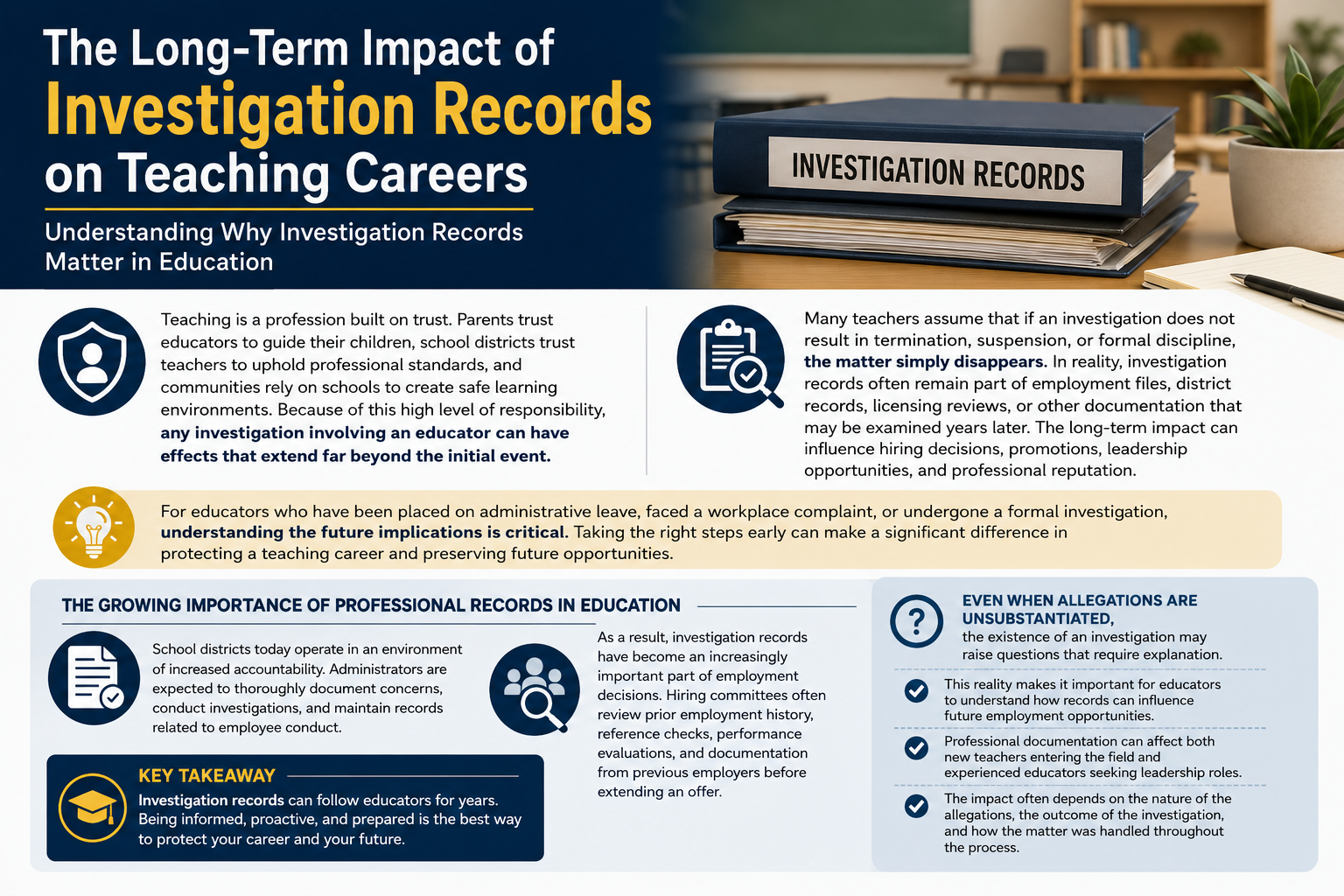
The Long-Term Impact of Investigation Records on Teaching Careers
Understanding Why Investigation Records Matter in Education
Teaching is a profession built on trust. Parents trust educators to guide their children, school districts trust teachers to uphold professional standards, and communities rely on schools to create safe learning environments. Because of this high level of responsibility, any investigation involving an educator can have effects that extend far beyond the initial event.
Many teachers assume that if an investigation does not result in termination, suspension, or formal discipline, the matter simply disappears. In reality, investigation records often remain part of employment files, district records, licensing reviews, or other documentation that may be examined years later. The long-term impact can influence hiring decisions, promotions, leadership opportunities, and professional reputation.
For educators who have been placed on administrative leave, faced a workplace complaint, or undergone a formal investigation, understanding the future implications is critical. Taking the right steps early can make a significant difference in protecting a teaching career and preserving future opportunities.
The Growing Importance of Professional Records in Education
School districts today operate in an environment of increased accountability. Administrators are expected to thoroughly document concerns, conduct investigations, and maintain records related to employee conduct.
As a result, investigation records have become an increasingly important part of employment decisions. Hiring committees often review prior employment history, reference checks, performance evaluations, and documentation from previous employers before extending an offer.
Even when allegations are unsubstantiated, the existence of an investigation may raise questions that require explanation. This reality makes it important for educators to understand how records can influence future employment opportunities.
Professional documentation can affect both new teachers entering the field and experienced educators seeking leadership roles. The impact often depends on the nature of the allegations, the outcome of the investigation, and how the matter was handled throughout the process.
How an Investigation Typically Begins
An investigation may start for many different reasons. A student concern, parent complaint, coworker report, supervisor observation, or policy violation allegation can all trigger a review.
In some situations, an employer may place a teacher on paid administrative leave while gathering facts. In other cases, an employee may continue working during the investigation process.
School administrators generally seek to determine whether policies, professional standards, or laws were violated. During this stage, investigators collect evidence, conduct interviews, review records, and prepare findings.
The outcome can range from complete exoneration to disciplinary action, depending on the facts uncovered during the investigation.
Administrative Leave Does Not Always Mean Wrongdoing
One of the most misunderstood employment actions in education is administrative leave. Many people incorrectly assume that being placed on leave automatically indicates misconduct.
In reality, administrative leave is often used as a temporary measure while an investigation is conducted. It may allow administrators to review evidence without disrupting school operations or influencing witness statements.
A teacher placed on paid administrative leave may continue receiving pay and benefits while the investigation proceeds. The leave itself is not necessarily proof that a violation occurred.
However, because records of the leave and investigation may remain documented, educators should take the situation seriously from the beginning. Early decisions can affect the eventual outcome and future career opportunities.
The Difference Between Paid and Unpaid Leave
Not all leave situations are the same. Paid administrative leave generally allows an employee to continue receiving wages and benefits while an investigation is pending.
Unpaid leave may create additional financial and professional concerns. Losing income while attempting to defend against allegations can place significant stress on an educator and their family.
The distinction between paid administrative leave and unpaid leave may also influence how future employers view the situation. Documentation explaining the circumstances often becomes important.
Regardless of whether leave is paid or unpaid, teachers should understand their rights and seek appropriate legal guidance when necessary.
What Information May Be Included in Investigation Records
Investigation records often contain much more than a final determination. They may include reports, witness interviews, correspondence, administrative notes, evidence summaries, and findings.
A complaint filed by a student, parent, coworker, or supervisor may remain part of the documentation even if the allegations are later disproven.
Records can also include responses submitted by the employee, written statements, emails, meeting summaries, and recommendations from administrators.
Because these materials may be reviewed in future employment decisions, accuracy matters. Incomplete or misleading information can create long-term challenges for an educator's professional reputation.
Why Future Employers Review Investigation Histories
School districts invest significant resources in hiring educators. Administrators want confidence that new employees will serve students effectively and uphold professional standards.
When reviewing candidates, employers often seek information that helps them evaluate potential risk. Investigation records can become part of that evaluation.
A district may ask questions about prior employment actions, workplace investigations, or disciplinary matters. Applicants who fail to disclose required information can face additional concerns.
For this reason, understanding how records may be interpreted is an important part of career planning for educators.
The Impact on Professional Reputation
Reputation is one of the most valuable assets a teacher possesses. Years of dedication, classroom success, and community involvement can help build a strong professional standing.
Unfortunately, an investigation record may create questions even when no wrongdoing occurred. Colleagues, administrators, and future employers may form opinions based on limited information.
The negative impact of unresolved concerns can sometimes continue long after the investigation has concluded. This is especially true when documentation lacks important context or clarification.
Protecting professional reputation requires careful attention to how investigations are handled and documented.
Licensing and Certification Considerations
Many educators focus primarily on employment consequences without considering licensing implications. In some circumstances, investigation findings may be reviewed by state education authorities.
Licensing agencies often examine conduct issues involving student safety, ethics, professional responsibility, discrimination, harassment, or other serious concerns.
Even when a school district resolves a matter internally, certification authorities may conduct their own review. The process can become complex depending on the allegations involved.
Teachers facing potential licensing consequences should understand the importance of obtaining informed counsel, such as legal defense for educator misconduct investigations, and responding appropriately to requests for information.
The Role of Evidence in Protecting a Teaching Career
Evidence often determines the direction of an investigation. Documents, emails, text messages, attendance records, witness statements, and classroom materials can all become relevant.
Teachers should maintain professional records whenever possible. Organized documentation may help clarify misunderstandings and provide important context, especially when schools or districts rely on outside counsel to conduct internal investigations.
For example, a report alleging inappropriate communication may be evaluated differently when supported by complete records showing professional intent.
Strong evidence can help determine whether allegations are supported, unsupported, or require additional investigation.
How Misunderstandings Become Formal Complaints
Not every complaint begins with intentional misconduct. Sometimes routine classroom interactions are misunderstood by students, parents, or coworkers.
Communication challenges, differing expectations, and incomplete information can create concern where no violation actually exists.
A simple misunderstanding may escalate into a formal investigation if questions remain unanswered. Once a complaint enters the system, documentation often follows.
This is one reason educators should approach every investigation carefully, even when they believe the allegations lack merit.
Student Allegations and Long-Term Consequences
Student complaints often receive significant attention because schools prioritize student welfare and safety.
Even when allegations are not substantiated, the existence of an investigation can influence future employment reviews. Administrators may evaluate whether concerns were isolated incidents or part of a broader pattern.
The context of each situation matters. Factors such as witness credibility, documentation, communication history, and investigative findings can influence outcomes.
Teachers should avoid assuming that a favorable result automatically eliminates future concerns related to the record.
Parent Complaints and Professional Scrutiny
Parents play an important role in the educational process, and their concerns are often taken seriously by school administrators.
A complaint from a parent may involve grading disputes, classroom management issues, communication concerns, or allegations of inappropriate conduct.
Although many complaints are resolved quickly, some lead to extensive investigations. Documentation generated during these reviews may remain part of personnel records.
Responding professionally and maintaining accurate records can help protect an educator's interests throughout the process.
Workplace Harassment Allegations
Harassment allegations can create particularly serious challenges for educators. Schools are expected to investigate claims thoroughly and take appropriate action when necessary.
An investigation involving harassment may examine witness accounts, workplace communications, policies, and prior concerns.
Even if allegations are ultimately unsupported, the investigation record itself may become part of future employment reviews.
Teachers facing such allegations should understand both the immediate and long-term implications of the process and consider obtaining legal protection against disciplinary actions and wrongful termination.
Discrimination Investigations in Educational Settings
Claims involving discrimination often require careful review of workplace practices, communications, and decision-making.
Schools must address allegations involving protected activity, related protected activity, or other workplace rights recognized by applicable laws.
Investigators may examine whether adverse action occurred and whether a possible violation affected an employee's opportunities or treatment.
Because these matters can carry significant consequences, obtaining legal guidance may help educators better understand their rights and obligations.
Retaliation Claims and Career Risks
Retaliation occurs when an employee experiences negative treatment after engaging in protected activity. This can involve filing a complaint, participating in an investigation, or reporting concerns.
Examples may include reassignment to a less desirable position, denial of opportunities, disciplinary actions, or other adverse action.
Educators should understand that retaliation claims often involve detailed factual analysis. Documentation and evidence become critical, and working with an expert education lawyer for schools and teachers can help ensure those facts are presented effectively.
When concerns arise, prompt action may help protect professional interests and future employment opportunities.
Constructive Discharge and Educational Employment
Constructive discharge refers to situations where workplace conditions become so difficult that a reasonable employee feels compelled to resign.
In educational environments, concerns may arise from repeated conflicts, retaliation, discrimination, or other workplace issues.
Although each situation is unique, investigation records related to these disputes may influence future employment reviews.
Teachers considering resignation during an ongoing investigation should carefully evaluate the potential consequences, including possible wrongful termination and contract dispute issues in education, before making a decision.
Leadership Opportunities Can Be Affected
Many educators aspire to become department heads, instructional coaches, assistant principals, or administrators.
When districts evaluate candidates for leadership roles, they often review employment history in greater detail than they would for standard teaching positions.
Past investigations, even those that did not result in discipline, may receive additional scrutiny. Decision-makers may seek clarification regarding the circumstances.
A well-documented response and favorable outcome can help minimize long-term obstacles when pursuing advancement opportunities.
The Importance of Professional Responses During Investigations
The way an employee responds during an investigation can significantly influence perceptions and outcomes.
Professional communication, cooperation, and accuracy often strengthen credibility. Emotional reactions, incomplete statements, or inconsistent explanations may create challenges.
Teachers should carefully review requests for information and provide truthful responses supported by available evidence.
Maintaining professionalism throughout the process can help protect both current employment and future opportunities.
Social Media and Investigation Records
Social media activity increasingly appears in workplace investigations. Posts, comments, messages, and shared content may become relevant evidence.
Even personal accounts can create professional concerns when content affects workplace relationships, student interactions, or public perception.
Teachers should recognize that online activity may remain accessible long after it is posted.
Maintaining professional boundaries online is an important part of protecting a long-term teaching career.
The Effect on Employee Morale
Investigations often affect more than the individual teacher involved. They can influence employee morale across an entire campus.
Coworkers may become uncertain about procedures, workplace expectations, or future employment stability.
When investigations are handled fairly and transparently, overall employee morale may remain stronger. Poor communication, however, can create confusion and concern.
School leaders often recognize that the process itself can impact workplace culture and team dynamics.
Maintaining Professional Relationships After an Investigation
Returning to work after an investigation may present unique challenges. Colleagues may have questions, assumptions, or concerns regarding what occurred.
Rebuilding trust often requires professionalism, consistency, and patience. Teachers should focus on performance, communication, and positive workplace interactions.
In many cases, successful reintegration depends on maintaining a forward-looking perspective while addressing any lingering concerns appropriately.
Strong professional relationships can help reduce the long-term effects of workplace investigations.
The Value of Early Legal Guidance
One of the most common mistakes educators make is waiting too long to seek legal guidance.
Teachers sometimes assume that cooperating with an investigation alone will resolve the issue. While cooperation is important, understanding legal rights and obligations can be equally important.
An experienced lawyer may help evaluate documentation, identify potential concerns, and explain available options, particularly an education law attorney who guides teachers through investigations.
Early guidance often allows educators to make informed decisions before problems become more difficult to address.
Why Documentation Matters Years Later
Many educators focus on the immediate outcome of an investigation and overlook future implications.
Years later, records may resurface during employment applications, promotions, licensing reviews, or reference checks.
A well-documented response can provide important context and help prevent misunderstandings. Conversely, missing information may leave decision-makers with unanswered questions.
Maintaining copies of relevant records can be an important part of long-term career protection.
School District Transfers and Investigation History
Teachers who change districts often assume that past issues will remain with their former employer.
However, reference requests, employment verifications, and professional disclosures may reveal information about prior investigations.
Future employers may seek clarification regarding circumstances surrounding administrative leave, complaints, or disciplinary actions.
Understanding what information may be shared is an important part of preparing for career transitions.
How Administrators Evaluate Past Concerns
An administrator reviewing a candidate with a prior investigation record typically considers several factors.
The seriousness of the allegations, quality of evidence, findings, corrective actions, and subsequent employment history may all influence the evaluation.
One isolated incident may be viewed differently than repeated concerns involving similar conduct.
Context matters, which is why accurate records and professional responses remain important long after an investigation concludes.
Balancing Employee Rights and School Responsibilities
Schools must balance competing responsibilities during investigations. They must protect students, maintain workplace safety, and respect employee rights.
This balance is not always easy to achieve. Administrators must gather evidence, evaluate credibility, and comply with applicable laws and policies.
Teachers should understand that investigations often involve multiple interests and perspectives.
Recognizing this broader context can help educators navigate the process more effectively.
The Connection Between Investigations and Future Employment Markets
The education job market continues to evolve. Competition for desirable positions can be significant in many districts.
When administrators compare qualified candidates, investigation history may become one factor among many considered during hiring decisions.
Even highly skilled educators can face additional questions if records contain unresolved concerns.
Addressing issues proactively can improve long-term career prospects and professional mobility.
Protecting Professional Interests During an Investigation
Protecting professional interests requires thoughtful action from the beginning.
Educators should preserve relevant evidence, follow district policies, maintain professional communication, and seek appropriate advice when necessary.
Every statement, document, and interaction may influence the final record.
Taking the right steps early can make a substantial difference in both the immediate outcome and future career opportunities.
Why Comprehensive Legal Support Can Make a Difference
Employment investigations often intersect with multiple legal issues. Depending on the circumstances, matters may involve employment law, business law, licensing concerns, discrimination claims, retaliation allegations, or other legal questions.
A full service law firm can evaluate how different legal issues interact and affect a client's interests, especially one focused on education law and rapid teacher license defense.
This broader perspective may be especially valuable when investigations involve complex facts, multiple parties, or potential long-term consequences.
Understanding available options can help educators make informed decisions during challenging situations.
Looking Beyond the Immediate Outcome
Many teachers focus solely on whether they will keep their current job. While that concern is understandable, future-focused planning is equally important.
An investigation record may influence future applications, leadership opportunities, certification reviews, and professional reputation years later.
Thinking beyond the immediate outcome allows educators to make strategic decisions that support long-term success.
Protecting a career requires attention not only to today's challenges but also to tomorrow's opportunities.
Building a Stronger Future After an Investigation
An investigation does not automatically define an educator's future. Many teachers continue to build successful and rewarding careers after difficult professional challenges.
What often matters most is how the situation was handled, documented, and resolved. Professionalism, accountability, and informed decision-making can help minimize long-term consequences.
Educators who take proactive steps to protect their rights and interests are often better positioned to move forward confidently.
With the right approach, it is possible to preserve professional standing and continue serving students effectively for years to come.
How a Full Service Law Firm Can Support Educators
Employment investigations can involve a variety of legal issues that extend beyond a teacher's immediate workplace concerns. A full service law firm may be able to assist clients with matters related to employment disputes, professional licensing issues, contract review, and other legal challenges that arise during or after an investigation. Having access to comprehensive legal services can be beneficial when multiple areas of law intersect. Educators facing complex situations often find value in working with a firm that can evaluate the broader impact of an investigation on both their professional and personal interests.
The Role of Business Law in Educational Employment Matters
Although many people associate business law with corporations and commercial transactions, it can also influence employment-related issues within educational institutions. School districts and private educational organizations operate under policies, contracts, and regulations that may involve business law principles. Questions regarding employment agreements, workplace policies, administrative procedures, and organizational decision-making can sometimes arise during an investigation. Understanding these legal considerations may help educators better navigate disputes and protect their professional interests.
Understanding Paid Administrative Leave During an Investigation
Paid administrative leave is frequently used by school districts when concerns arise that require further review. This employment action allows an employee to remain away from the workplace while continuing to receive pay and benefits during the investigation process. Being placed on paid administrative leave does not automatically indicate wrongdoing or guarantee a particular outcome. However, because records related to the leave may become part of an educator's employment history, it is important to understand the process and respond appropriately from the beginning.
Recognizing Potential Adverse Action in the Workplace
An adverse action occurs when an employee experiences a negative employment consequence that affects their job, compensation, responsibilities, or career opportunities. Examples may include demotion, disciplinary measures, reassignment to a less desirable position, denial of promotions, or termination. In some situations, educators may question whether an adverse action was connected to a complaint, participation in an investigation, or another protected activity. Understanding how these actions are evaluated can help employees recognize potential concerns and take appropriate steps to protect their rights and professional future.
Employment investigations can involve a variety of legal issues that extend beyond a teacher's immediate workplace concerns. A full service law firm may be able to assist clients with matters related to employment disputes, professional licensing issues, contract review, and other legal challenges that arise during or after an investigation. Having access to comprehensive legal services can be beneficial when multiple areas of law intersect. Educators facing complex situations often find value in working with a firm that can evaluate the broader impact of an investigation on both their professional and personal interests.
The Role of Business Law in Educational Employment Matters
Although many people associate business law with corporations and commercial transactions, it can also influence employment-related issues within educational institutions. School districts and private educational organizations operate under policies, contracts, and regulations that may involve business law principles. Questions regarding employment agreements, workplace policies, administrative procedures, and organizational decision-making can sometimes arise during an investigation. Understanding these legal considerations may help educators better navigate disputes and protect their professional interests.
Understanding Paid Administrative Leave During an Investigation
Paid administrative leave is frequently used by school districts when concerns arise that require further review. This employment action allows an employee to remain away from the workplace while continuing to receive pay and benefits during the investigation process. Being placed on paid administrative leave does not automatically indicate wrongdoing or guarantee a particular outcome. However, because records related to the leave may become part of an educator's employment history, it is important to understand the process and respond appropriately from the beginning.
Recognizing Potential Adverse Action in the Workplace
An adverse action occurs when an employee experiences a negative employment consequence that affects their job, compensation, responsibilities, or career opportunities. Examples may include demotion, disciplinary measures, reassignment to a less desirable position, denial of promotions, or termination. In some situations, educators may question whether an adverse action was connected to a complaint, participation in an investigation, or another protected activity. Understanding how these actions are evaluated can help employees recognize potential concerns and take appropriate steps to protect their rights and professional future.
When Personal Matters Intersect With Professional Responsibilities
Educators are not immune to personal challenges outside the workplace. Matters involving personal injury claims, divorce proceedings, or child support obligations can create additional stress during an employment investigation. While these issues are often separate from a teacher's professional duties, they may affect scheduling, availability, or the ability to respond promptly to requests during an investigation. Understanding how personal and professional obligations intersect can help educators better manage both responsibilities while protecting their careers and family interests.
Communication Records and the Importance of Consent
Modern investigations frequently involve reviewing electronic communications. Emails, text messages, and phone records may become relevant when investigators seek to determine what occurred. In some situations, questions may arise regarding consent to communications, access to records, or the sharing of information between parties. Educators should remain mindful that workplace communications can become evidence and should always communicate professionally and appropriately.
Why School Districts Review Information From Multiple Sources
An investigation may require administrators to gather information from several sources to obtain a complete understanding of the facts. Depending on the circumstances, records may be reviewed from the company employing the educator, statements from workers, reports from a manager, or documentation provided by outside agencies. Some investigations may even involve cooperation with police when allegations extend beyond workplace policy concerns. Reviewing information from multiple perspectives helps investigators reach more informed conclusions.
Understanding Protected Activity and Other Related Protected Activity
Employment laws often protect workers who engage in certain legally recognized actions. In addition to filing a complaint or participating in an investigation, other related protected activity may include reporting misconduct, cooperating with government agencies, or raising workplace concerns in good faith. Educators should understand that retaliation for engaging in protected activity or other related protected activity can raise significant legal concerns. Proper documentation often plays a critical role when these issues arise.
Technology, Data Rates, and Electronic Communications
Many school districts rely on digital communication systems to facilitate workplace operations. Employees may receive updates through text messages, email notifications, or mobile applications. Depending on the communication method used, standard data rates may apply to certain mobile services. Teachers should review district policies regarding electronic communications and maintain professional records of important messages that may become relevant during an investigation.
The Significance of Professional Credentials and Recognition
Professional reputation often extends beyond classroom performance. Some educators pursue additional recognition through professional organizations, certifications, publications, or legal rating services such as Martindale Hubbell when working with attorneys on employment-related matters. While professional distinctions do not determine the outcome of an investigation, they may demonstrate a commitment to professionalism, ethics, and continued development throughout a career.
Responding to Notifications and Requests for Information
During an investigation, educators may receive requests for interviews, documents, or written responses. It is important to review communications carefully and respond appropriately. In certain automated communication systems, instructions such as "reply stop" may appear when text messaging services are used. Understanding the purpose of official communications and maintaining organized records can help educators avoid confusion throughout the investigative process.
Eligibility for Future Opportunities After an Investigation
A completed investigation does not automatically prevent an educator from pursuing future advancement opportunities. Whether a teacher remains eligible for promotions, leadership positions, specialized assignments, or transfers often depends on the nature of the allegations and the final outcome. School districts frequently evaluate the entire employment record rather than focusing on a single event. Taking proactive steps to address concerns and demonstrate professionalism can strengthen future career prospects.
Different Types of Investigations Require Different Approaches
Not every investigation follows the same path. One type of investigation may focus on classroom conduct, while another type may involve policy compliance, workplace interactions, student concerns, or administrative procedures. Because each other type of investigation presents unique challenges, educators should avoid assuming that outcomes will be identical across different situations. Understanding the specific context of an investigation can help individuals make more informed decisions and better protect their professional interests.
Contact Masterly Legal Solutions for a Free Consultation
If you are a teacher, administrator, employee, or other education professional facing an investigation, administrative leave, paid administrative leave, workplace complaint, retaliation concern, discrimination allegation, harassment claim, or other employment-related issue, obtaining reliable information early can be extremely important.
At Masterly Legal Solutions, our attorneys understand that an investigation can affect far more than your current job. The decisions made today may influence future employment opportunities, professional licensing, reputation, benefits, wages, and long-term career goals. Whether you are seeking answers about administrative leave, reviewing evidence, responding to a report, protecting your interests, or evaluating potential legal options, our team is prepared to serve clients with professional and personalized attention.
Contact Masterly Legal Solutions at (972) 236-5051 for a free consultation. We can help answer your questions, explain the process, discuss concerns related to administrative leave, and help you better understand the potential impact an investigation may have on your future career.
Disclaimer: This article is provided for informational and educational purposes only. It is not legal guidance, legal advice, and does not create an attorney-client relationship. Every investigation, employment matter, and workplace situation involves unique facts and circumstances. Readers should consult a qualified attorney regarding their specific situation before making legal decisions.








Looking for Legal & Business Solutions? Contact Us Now
Fill in the form or call us to set up a meeting