Workplace Safety Training: What Employers Should Build Before Small Risks Become Larger Problems
A workplace problem does not always begin with a major accident. It may start with an employee noticing unsafe equipment, a supervisor receiving a verbal complaint, or a near miss that no one documents. The immediate problem may appear small. The larger risk develops when employees and managers do not know what should happen next.
Effective workplace safety training helps close that gap. Employees need to understand how to recognize concerns, where to report them, and what to do when immediate action is needed. Managers need clear responsibilities for receiving reports, documenting concerns, responding appropriately, and escalating matters to the right people.
For employers, the goal should not be training simply for the sake of saying training occurred. A practical safety program should connect what employees learn with the policies and procedures the organization expects them to follow.
Masterly Legal Solutions works with organizations that want professional guidance when developing employee policies, training programs, and employee handbooks, supported by tailored HR consulting services and training. Rather than leaving employers to piece together disconnected materials, the focus can be placed on building a coordinated approach that fits the organization.
When Small Safety Concerns Become Business Problems
Consider a simple situation. An employee notices a condition that could cause an injury and mentions it to a supervisor. The supervisor believes the issue is minor and assumes someone else will handle it. Nothing is documented, and no one confirms whether the concern was corrected.
A week later, another employee encounters the same condition.
At that point, the organization may face questions that extend well beyond the original hazard. Was there a clear incident reporting process? Did the manager understand the manager's safety responsibilities? Was there a defined path for escalation? Did employees understand when and how concerns should be reported?
This is why workplace safety should be viewed as an operational system rather than a single training presentation.
OSHA's Recommended Practices for Safety and Health Programs take a proactive approach to workplace safety, with an emphasis on identifying and correcting hazards before they result in injuries or illnesses. OSHA also recommends processes through which workers can report hazards, injuries, illnesses, incidents, and near misses, and many employers rely on ongoing general counsel services for businesses to help maintain compliance as those programs evolve.
Workplace Safety Training Should Connect Employees, Managers, and Policy
A training program can lose much of its value when it exists separately from company policy.
An employee handbook might tell workers to report unsafe conditions. A training presentation might discuss hazard awareness. A manager might have received different instructions about how to respond. If those pieces do not work together, employees may still be uncertain when an actual concern arises.
A stronger workplace safety program connects the different parts of the employer's system.
Employees should understand the clear, measurable goals the organization expects them to complete. Managers should understand what happens when an employee raises a concern. Internal policies should identify appropriate reporting and escalation channels, including the guide, the number of escalation levels, and the order in which concerns move through the process, while documentation and recordkeeping support compliance audits. Training should reinforce those expectations in language employees can understand.
OSHA currently recommends educating workers and managers about workplace hazards and controls, how to report hazards and incidents, whom to contact with concerns, and what to do during an emergency. OSHA also states that training should be provided at a language and literacy level workers can understand.
That connection between written policy and real workplace behavior is especially important for employers that are growing, adding locations, hiring new managers, or updating an employee handbook with clear safety policies.
Employee Safety Training Materials Should Answer Practical Questions
Employees should not finish employee safety training with more questions than answers, and some employers benefit from integrated legal and business consulting for smarter growth when aligning safety training with broader operational goals.
They need enough clarity to understand how the organization's safety expectations apply when they encounter a real concern. The exact content will depend on the workplace, industry, employee duties, applicable requirements, and risks involved, and employees should help shape that content so it reflects practical workplace realities and builds usable knowledge.
Interactive delivery and shorter training segments can improve retention.
For many organizations, that means answering practical questions employees actually have, for example:
- recognizing and communicating potential workplace hazards;
- understanding established reporting channels;
- knowing whom to contact when a concern requires attention;
- understanding applicable emergency procedures;
- reporting injuries, incidents, hazards, or near misses as appropriate; and
- knowing when a concern needs immediate escalation.
OSHA specifically identifies education and training as tools for helping workers and managers understand workplace hazards, controls, reporting procedures, and their roles within a safety and health program, a concept that also extends to higher education institutions managing compliance and training.
The important point for an employer is that training should reflect the organization employees actually work in. A generic presentation may discuss safety concepts without answering the practical question employees eventually face: "What am I supposed to do here?" The form of delivery matters, and well-designed training materials can support that practical focus.
Manager Safety Responsibilities Need Special Attention
Managers occupy a critical position between written policy and daily operations.
An employee may never speak directly with senior leadership, HR, or legal counsel about an initial safety concern. The employee may tell a supervisor first. That makes the manager's response an important part of the organization's system.
Manager safety responsibilities should therefore be clearly addressed. A manager may need to understand when a matter requires documentation, whom to contact, what established procedures apply, and when the concern needs to move beyond the manager's level. They also need training that verifies competency, not just attendance, so they are equipped to lead the right response and support the wider team.
OSHA recommends specific training for managers and supervisors so they understand their safety roles. Its guidance includes training supervisors on responding to reports of injuries, illnesses, and incidents, recognizing hazards, and understanding incident investigation concepts, with testing that helps verify retention of skills tied to documentation, hazard recognition, and response responsibilities.
This does not mean every supervisor should independently make complex legal, HR, or safety decisions. In many organizations, an effective system identifies when the supervisor should stop handling a matter alone and use established escalation procedures.
Incident Reporting Cannot Depend on Guesswork
Reporting procedures are most useful when employees know they exist before something happens.
A policy that simply says "report safety concerns to management" may leave unanswered questions. Which manager? What happens if that person is unavailable? What happens after a report is created? What if the concern involves an immediate hazard? Where is the right place for documentation, and who has access to it?
Those details matter because incident reporting is not simply about collecting information after an injury.
OSHA encourages employers to establish processes for workers to report injuries, illnesses, hazards, close calls, and other safety concerns and to respond promptly to reports. OSHA also emphasizes that employees should be able to raise safety and health concerns without fear of retaliation.
A well-designed program can make reporting part of normal workplace communication instead of something employees must figure out during a stressful event. Reporting works best when safety conversations are ongoing, replacing the need for infrequent refresher training.
Hazard Awareness and Safety Culture Are Only the First Parts of Prevention
Teaching employees to recognize a potential hazard is valuable. But recognition alone does not resolve the concern.
Employees also need to understand what to do with that information. Managers need to understand what happens after they receive it. The organization needs procedures for moving information to the people who can evaluate and address the situation.
That is why hazard awareness, reporting, documentation, manager response, and escalation should support one another.
OSHA's safety program guidance centers on management leadership, worker participation, and systematic processes for finding and fixing hazards. Its broader Recommended Practices include hazard identification and assessment, which focuses on identifying specific hazards unique to the worksite, prevention and control, education and training, program evaluation, and communication and coordination across different industries with supporting resources.
For employers, the practical lesson is straightforward. Training should fit within the larger safety system rather than stand apart from it, and many organizations use business consulting services for operational efficiency and risk management to help align those systems.
Your Employee Handbook and Workplace Safety Program Should Work Together
An employee handbook can establish important workplace expectations, but the written policy should match what employees and managers are trained to do.
If a handbook identifies one reporting process while managers follow another, confusion can develop. If training tells employees to escalate concerns but company policy does not clearly identify the appropriate channel, employees may hesitate or choose inconsistent paths.
This is where an attorney-guided review can provide value, especially when combined with broader legal business consulting for long-term growth and risk management.
Masterly Legal Solutions provides employee handbook writing, development, and review services tailored to businesses and also offers customized training sessions to organizations and companies as part of its broader business consulting and HR training support.
For employers seeking help with this issue, the goal is not to purchase a generic safety document. It is to consider whether policies, manager expectations, reporting procedures, and training are working together as part of a practical system that supports a stronger safety culture and improves employee confidence in safety protocols.
When Employers Should Consider Reviewing Their Training Programs
An employer does not have to wait for a serious incident to examine whether its training and policies are aligned.
A review may be appropriate when an organization has grown quickly, added locations, changed operations, hired new supervisors, updated its employee handbook, or discovered that managers are handling similar concerns differently.
The same is true when employees appear uncertain about where safety concerns should go.
These situations can reveal gaps between written policies and actual workplace practices. Addressing those gaps proactively can help create clearer expectations for employees and managers, and some employers turn to a full-service law firm for diverse legal support when those gaps raise broader legal or operational questions.
Frequently Asked Questions About Workplace Safety Training
What is workplace safety training?
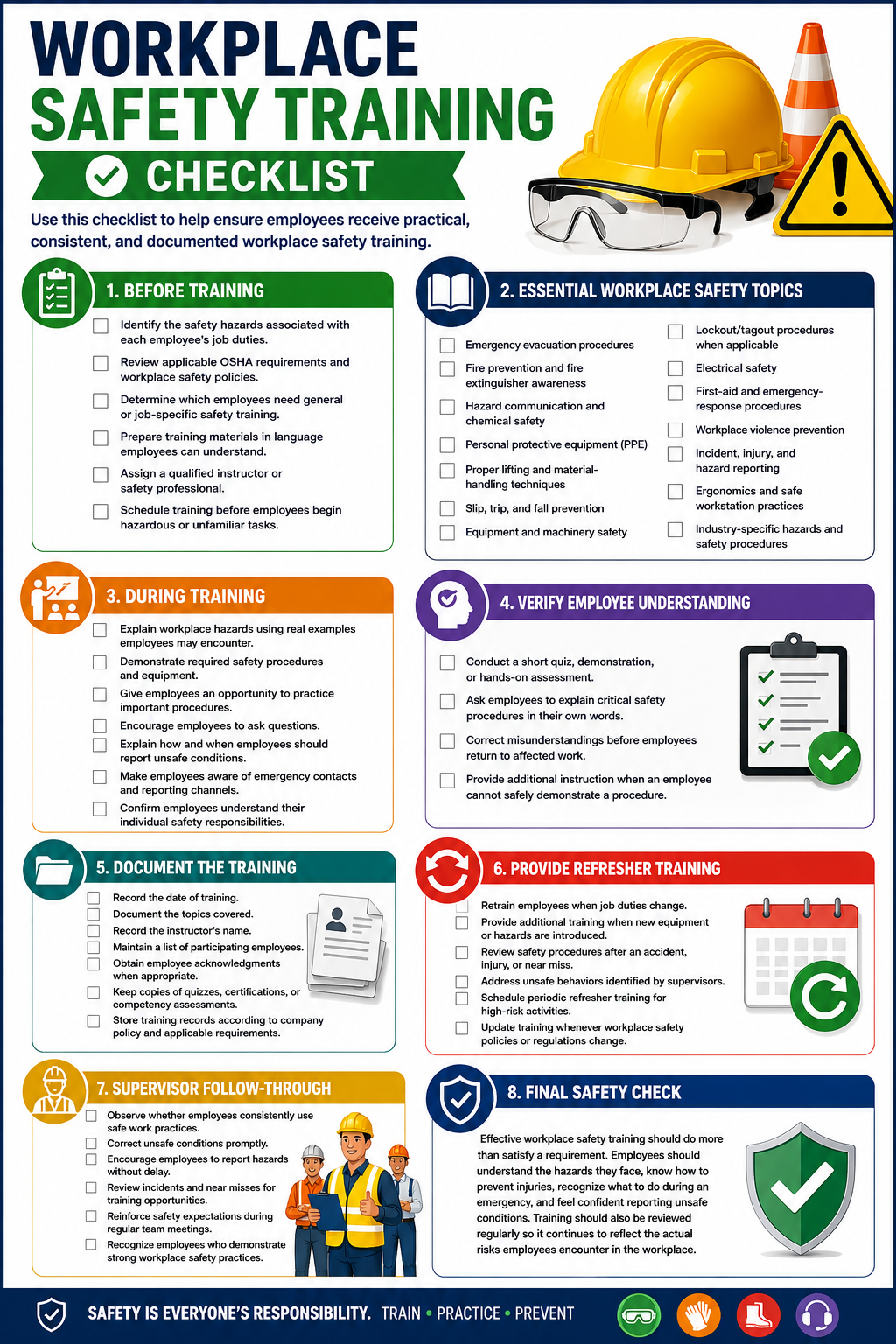
Workplace safety training educates employees and managers about workplace hazards, applicable safety procedures, reporting expectations, their roles within the organization's safety program, and the use of personal protective equipment, which is essential for protecting workers from workplace hazards. The appropriate training depends on the workplace, employee duties, hazards, applicable requirements, and what the program may offer. OSHA recommends a PPE program to maximize worker protection, and proper PPE use can significantly reduce workplace injuries.
Should workplace safety training match the employee handbook?
Policies and training should be consistent. Employees should not receive one set of reporting instructions during training and a different set in the employee handbook.
Why are managers important to employee safety training?
Managers often receive employee concerns first. Training can help supervisors understand their responsibilities, internal reporting processes, documentation expectations, and when a concern should be escalated. In settings such as construction, it may also need to cover supervising compliance with topic-specific requirements when those hazards are present, including Lockout/Tagout training, which is required by OSHA standards and helps prevent injuries from hazardous energy release, electrical safety training that mitigates risks of burns and shocks, and Hazard Communication to protect workers from unsafe chemical usage.
What should employees know about incident reporting?
Employees should understand the organization's reporting channels and what types of safety concerns should be reported. Employers should make those procedures clear before an incident occurs.
What are escalation procedures?
Escalation procedures identify when and how a matter should move to another person or level of the organization, such as HR, safety personnel, senior management, or legal counsel, depending on the circumstances.
Can Masterly Legal Solutions help with employee handbooks and training?
Masterly Legal Solutions currently provides employee handbook writing, development, and review services and offers customized training sessions for organizations. The appropriate scope should be discussed based on the organization's specific needs.
Discuss an Attorney-Guided Workplace Safety Training Program for Your Organization
Small safety concerns can expose larger weaknesses in reporting, documentation, manager response, and internal communication. In 2023, OSHA reported 1.5 million work-related injuries in the U.S. Employers do not need to wait until those weaknesses become visible during a serious workplace problem. Fatal falls remain a major hazard; 865 workers died from falls in 2022 in the U.S.
Masterly Legal Solutions can discuss how workplace safety training, employee handbook policies, manager expectations, incident reporting, hazard awareness, and escalation procedures may fit together for your organization. We can also help evaluate which courses and practical ways best train workers for your risks, including when a same-day rollout matters. Our approach is designed around the needs of the business rather than a one-size-fits-all template.
PPE rules only work when employees use the equipment; 56% avoid wearing PPE due to personal choice, and a Texas-based law firm providing broad legal and business services can help organizations address both policy design and compliance challenges related to these behaviors. If your organization needs to create or review an employee handbook or discuss an attorney-guided workplace safety training program, contact Masterly Legal Solutions at (972) 236-5051 or visit https://www.masterlylegal.com/ to request a consultation.
Teacher Rights When Assaulted by a Special Needs Student: Safety, Reporting and Investigation Issues


Looking for Legal & Business Solutions? Contact Us Now
Fill in the form or call us to set up a meeting