Avoiding Federal Penalties: Education Law Attorney Support for Colleges and Universities
A federal compliance notice can create immediate concerns for college presidents, university executives, institutional compliance leaders, and other administrators responsible for legal compliance in colleges and universities. Questions about financial aid administration, civil rights requirements, student privacy, or reporting obligations may expose an institution to regulatory scrutiny.
Even a routine policy review can reveal gaps in recordkeeping, unclear responsibility for compliance, or procedures that no longer match current federal requirements. When these concerns arise, a higher education compliance attorney helps colleges and universities understand their federal legal obligations, assess regulatory exposure, and determine an appropriate response.
Federal compliance issues can affect more than administrative operations. Depending on the circumstances, unresolved violations may lead to corrective actions, financial liabilities, enforcement proceedings, or restrictions on participation in federal programs. This page explains who within an institution is typically accountable for compliance, where responsibility gaps create risk, what preventive legal guidance and investigation response may involve, what penalties may be at stake, how to prepare for counsel, and when outside education-law counsel may be warranted.
Masterly Legal Solutions provides education-related legal guidance for clients facing regulatory and institutional concerns. A qualified legal review can help college leadership evaluate applicable requirements, examine available records, and discuss practical options based on the institution's circumstances.
Mapping Federal Compliance Responsibilities to University Leadership
Colleges and universities manage several legal obligations across academic, financial, and administrative departments.
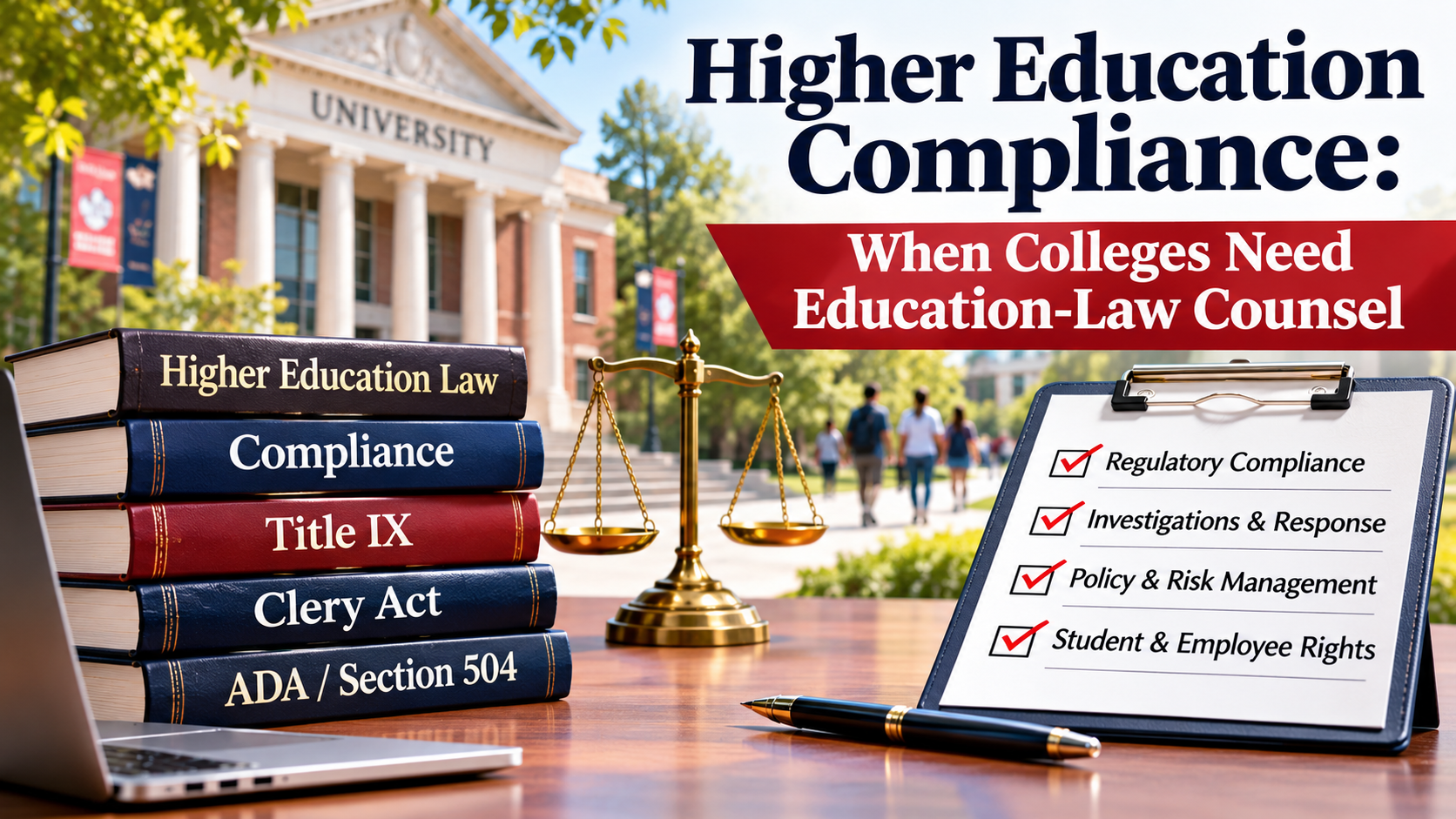
Federal requirements may apply to student financial aid, campus safety, nondiscrimination, disability access, student privacy, and institutional reporting.
These responsibilities often involve more than one office
.
A central concern for university leadership is whether responsibility for each legal obligation has been clearly assigned.
Identifying Responsible Institutional Officials
A college's compliance structure may involve several designated leaders:
- President or chancellor: Oversees institutional leadership, risk management, and major compliance decisions.
- Chief compliance officer: Coordinates institutional compliance responsibilities and internal reporting.
- Financial aid director: Manages applicable federal student aid requirements and Title IV program administration.
- Title IX coordinator: Oversees responsibilities assigned to that position under applicable Title IX regulations.
- Registrar or records officer: Handles student education records and related privacy procedures.
- Clery Act compliance personnel: Coordinate applicable campus crime reporting and disclosure requirements.
- General counsel or legal department: Advises institutional leadership on legal questions and regulatory exposure.
The actual allocation of responsibilities depends on the institution's structure, policies, and governing requirements.
Assigning an internal owner does not transfer away the institution's legal obligations.
Why Responsibility Gaps Create Compliance Risks
Compliance concerns may develop when different departments rely on inconsistent policies or assume that another office is responsible for required reporting.
For example, a financial aid office may maintain federal program records while another department controls relevant student status information.
If the institution lacks a clear reporting process, the resulting records may be incomplete or inconsistent.
A legal review can help leadership identify which requirements apply, which officials hold responsibility, and where the institution may need further examination.
No legal review can guarantee that a college will pass an audit or avoid regulatory findings. Its purpose is to provide informed legal guidance based on the applicable rules and available evidence.
Preventive Legal Advisory Services Versus Investigations and Enforcement
Institutions may seek legal counsel before a problem develops or after receiving a regulatory notice.
These situations require different levels of review and response.
Preventive Higher Education Compliance Attorney Services
Preventive advisory work focuses on legal questions that arise during ordinary institutional operations.
College leadership may request counsel when reviewing policies, changing reporting procedures, developing new programs, or evaluating concerns raised by internal compliance personnel.
Common areas for legal review may include:
- Federal student aid participation requirements under Title IV.
- Title IX and other applicable civil rights obligations.
- Family Educational Rights and Privacy Act (FERPA) requirements.
- Clery Act reporting and campus safety disclosures.
- Institutional governance and administrative policies.
- Compliance obligations connected to external service providers.
A higher education compliance attorney can evaluate relevant legal requirements and advise leadership on identified risks.
The scope of this work may involve a targeted policy review, legal assessment, or advice on specific reporting responsibilities.
Preventive advisory services are not the same as an independent financial audit, accreditation evaluation, or federal compliance certification.
Responding to Regulatory Investigations
An institution may need a different approach after receiving a notice from a federal agency, accrediting body, or other regulatory authority.
For example, the U.S. Department of Education may conduct reviews related to an institution's participation in federal student aid programs.
Its Office for Civil Rights may also investigate certain discrimination complaints involving educational institutions. Compliance matters may also involve sensitive investigations of discrimination and misconduct.
Regulatory correspondence may request policies, financial information, student records, or explanations of institutional procedures. Some crisis situations involve threats of violence or financial malfeasance.
The institution may face deadlines and specific obligations to cooperate or provide information.
Legal counsel can help determine the scope of the request, assess applicable requirements, and support an accurate institutional response, including crisis management concerns that may require coordination with risk managers and communications professionals.
Understanding Enforcement and Potential Penalties
Not every compliance concern leads to enforcement.
However, certain violations of federal student aid requirements may result in financial liabilities, corrective actions, fines, or restrictions on program participation.
Civil rights matters may involve investigations, negotiated resolutions, appearances before administrative agencies, administrative hearings and lawsuits, or other enforcement measures.
The available procedures and consequences depend on the law and agency involved.
A qualified attorney can explain the institution's position, evaluate the findings, and assess available response or review options.
What Colleges and Universities Should Assemble for Legal Counsel
When institutional leadership receives a compliance notice, legal counsel needs to understand the specific concerns and the records connected to them.
A productive review begins with a clear picture of the institution's policies, reporting processes, and relevant dates.
Institutional Policies and Governance Documents
Written policies can help establish which procedures were in place when the relevant events occurred.
These materials may include compliance manuals, board-approved policies, department procedures, institutional reporting guidelines, student handbooks, and faculty employment policies and practices, including issues related to faculty tenure.
An attorney may also examine documents that explain how responsibilities are assigned among university officials.
Comparing written policies with actual institutional practices can help identify issues requiring legal attention.
Reporting Records and Internal Communications
Compliance reviews may involve records of required disclosures, internal reports, agency correspondence, and communications among responsible departments.
The materials needed depend on the particular federal program or legal concern.
For example, a Title IV matter may require financial aid records, program participation documents, or correspondence with federal officials.
A civil rights matter may involve relevant policies, complaint records, and documentation of institutional responses.
Records should be preserved and shared through appropriate channels, with attention to privacy, confidentiality, and applicable retention requirements.
Reporting Paths and Decision-Making Authority
An important question is how a concern moved through the institution.
Legal counsel may examine which department received the original report, who reviewed it, and whether the matter reached the official responsible for the relevant requirement.
This information helps clarify the institution's response and whether further legal review is necessary.
Important Dates and Regulatory Notices
Federal correspondence, investigation notices, requests for information, and response deadlines are particularly important.
The date an institution receives a notice may affect its available response period.
An attorney can examine the specific communication and determine which procedural requirements apply.
Masterly Legal Solutions can discuss the available materials and whether the proposed legal engagement is appropriate for the institution's needs.
Defining the Scope of a Higher Education Compliance Legal Engagement
A college seeking outside legal counsel should understand the nature of the services required.
Some institutions need a focused legal opinion on a federal requirement. Others may need assistance with a regulatory notice, institutional investigation, or potential enforcement proceeding.
The appropriate scope depends on the issues involved.
Targeted Legal Assessment
A targeted engagement may focus on one particular concern, such as a reporting obligation, policy interpretation, or regulatory communication.
Counsel may review selected records, identify applicable legal requirements, and explain potential options.
This approach may be appropriate when leadership needs advice about a defined issue rather than a broad institutional review.
Broader Institutional Compliance Review
An institution facing connected compliance concerns may require review across multiple departments.
Some broader reviews arise when institutions of higher education are considering mergers, acquisitions, or similar structural changes, and recent activity has included over 20 institutions that underwent mergers or acquisitions.
This may involve examining governance documents, legal responsibilities, and communication procedures.
For higher education institutions in those situations, change of ownership rules can be important to regulatory compliance.
Additional professionals, such as financial auditors or specialized compliance consultants, may be necessary for matters outside the attorney's engagement.
Legal counsel can help leadership distinguish legal advice from operational or technical review services, while bringing legal expertise to issues that cross departmental lines.
Investigation and Regulatory Response Representation
When an institution faces a formal investigation, the engagement may involve reviewing allegations, examining documents, preparing appropriate legal submissions, communicating with regulators, and, where appropriate, handling related litigation in federal and state courts; Miller Nash attorneys also represent educational institutions in state court.
The precise services depend on the attorney's qualifications, the agency involved, and the agreed scope of representation.
Institutions should also consider whether existing in-house counsel, outside counsel, or specialized regulatory professionals need to coordinate their work.
When College Executives Should Seek Outside Education-Law Counsel
An institution does not need to wait for a formal penalty before considering legal advice.
Outside counsel may be useful when a compliance issue involves uncertainty about federal requirements, potential conflicts among institutional policies, employment-related compliance questions, or other legal issues that could affect federal program participation.
Legal consultation may also be appropriate when:
- Leadership receives a formal notice of concern or investigation.
- An agency requests records or an institutional explanation.
- Internal personnel identify possible regulatory violations.
- A policy change creates questions about legal responsibilities.
- Several departments disagree about required procedures.
- Potential corrective actions may affect students or institutional operations.
- Questions about labor relations arise, including union organizing efforts at colleges that are increasingly scrutinized by the National Labor Relations Board.
Sound personnel policies can help reduce litigation risk in employment-related matters.
Outside legal review can provide leadership with an assessment of the applicable law and available options. Jackson Lewis represents educational institutions in employment-related cases.
Masterly Legal Solutions can discuss education-related legal concerns and determine whether a proposed matter fits the firm's services or requires additional specialized counsel.
For executives and compliance leaders, the purpose of seeking legal advice is to support informed decisions and a responsible institutional response.
Higher Education Legal Counsel for Institutional Compliance and Regulatory Challenges
The higher education sector faces a broad range of legal challenges involving higher education law, institutional governance, and regulatory compliance. Higher education clients, including community colleges, private colleges, private universities, major universities, academic medical centers, proprietary schools, school districts, and other entities, may require legal guidance on policy development, academic freedom, academic misconduct, intellectual property, employee benefits, and distance learning. Many educational institutions also face sensitive matters involving sexual misconduct, sexual assault, workplace discrimination, and accessibility obligations under the Americans with Disabilities Act and applicable state law.
Qualified higher education attorneys and an experienced education team can work closely with institutional leaders to assess compliance concerns, conduct independent investigations, address federal investigations, and counsel clients on appropriate legal responses. Depending on the circumstances, legal representation may also involve personal injury claims, employment litigation, or motions for summary judgment. When selecting outside counsel, education clients should consider whether experienced attorneys demonstrate a deep understanding of institutional responsibilities, are well versed in relevant regulations, and have significant experience handling comparable matters.
Institutions may also review verified credentials, such as membership in a relevant national association, documented work involving advised universities, or an independently confirmed top tier ranking or other tier ranking. Effective legal support requires that attorneys work closely with leadership to understand the institution's campus culture, legal obligations, and operational needs. Masterly Legal Solutions offers colleges, universities, and other education organizations an opportunity to discuss their legal concerns and determine whether the firm can assist institutions with appropriate compliance guidance or representation.
Frequently Asked Questions About Higher Education Compliance Attorneys
When should a college involve outside education-law counsel?
A college should consider outside counsel when facing unclear federal obligations, a formal compliance notice, potential violations, or regulatory deadlines. Early legal review can help leadership evaluate risks and available options. Outside counsel may also be appropriate for Title IX compliance concerns or sensitive student affairs matters.
What materials make an initial higher-education compliance review productive?
Relevant materials include institutional policies, regulatory correspondence, reporting records, internal procedures, identified compliance officers, and important dates. Counsel can determine whether additional information is needed.
What does a higher education compliance attorney do?
A higher education compliance attorney advises colleges and universities about applicable education laws, institutional policies, regulatory obligations, and legal responses to compliance concerns. This can include guidance on Title IX, which prohibits sex-based discrimination in educational institutions. Compliance work may also include staff training on sexual harassment reporting and response obligations.
Can an attorney guarantee that a university will pass a federal audit?
No. An attorney cannot guarantee audit results or prevent every regulatory finding. Legal counsel can assess applicable requirements, identify legal risks, and provide advice about appropriate responses.
Can colleges face penalties for federal compliance violations?
Yes. Depending on the law and circumstances, violations may lead to corrective actions, financial liabilities, sanctions, or other enforcement measures. Not every compliance concern results in a penalty.
Does a compliance review replace an institutional audit?
No. Legal compliance reviews and financial or regulatory audits serve different purposes. Institutions may need separate legal, accounting, or specialized compliance professionals.
Can a university involve legal counsel after receiving a federal notice?
Yes. An institution may seek legal advice after receiving a notice, request for records, or investigation correspondence, including matters involving government agencies such as the U.S. Department of Education’s Office for Civil Rights and the Equal Employment Opportunity Commission. Counsel can review the matter and identify applicable response obligations.
Can Masterly Legal Solutions assist with higher education compliance concerns?
Masterly Legal Solutions can evaluate an inquiry about education-related legal services and discuss whether the firm's qualifications and available representation are appropriate for the institution's specific compliance matter, including whether it involves collegiate athletics or other higher education compliance concerns, since NCAA compliance is crucial for collegiate athletics.
Request a Qualified Institution Consultation
Federal compliance concerns deserve careful legal attention, particularly when they involve institutional responsibilities, regulatory notices, or potential enforcement actions.
College executives and university compliance leaders need clear information about the legal requirements affecting their institutions.
Masterly Legal Solutions offers an opportunity to discuss education-related legal concerns and assess whether appropriate representation is available.
If your institution is seeking a higher education compliance attorney, contact our firm to discuss the relevant regulatory issue, available documentation, and potential scope of legal assistance.
An initial consultation can help identify the legal questions requiring further review and determine whether a qualified engagement is appropriate.
Request a qualified institution consultation with Masterly Legal Solutions.
Phone: (972) 236-5051
Website: https://www.masterlylegal.com/
Legal representation depends on the nature of the matter, attorney qualifications, and agreed engagement terms. No audit result, regulatory decision, or enforcement outcome can be guaranteed.






Looking for Legal & Business Solutions? Contact Us Now
Fill in the form or call us to set up a meeting