

Work Retaliation Laws and Teacher Licenses: What’s at Risk During a TEA Investigation
When your career is built on years of education, certifications, and service to students, the threat of losing your license can feel overwhelming. For Texas educators, a TEA investigation is not just an administrative process. It can trigger fear of job loss, public scrutiny, and permanent damage to your professional reputation. In many cases, concerns about retaliation at work surface at the same time.
At Masterly Legal Solutions, we represent teachers and school professionals who suddenly find themselves under investigation. The risk is real. An adverse action tied to alleged misconduct or a complaint can place your employment and your teaching certificate in jeopardy. Understanding how retaliation and administrative leave intersect during these investigations is critical to protecting your future.
Understanding the Stakes During a TEA Investigation
A TEA investigation can begin with a report of alleged misconduct, a parent complaint, or concerns raised by a supervisor. Once initiated, the process may involve interviews, document requests, and coordination with agency officials. The agency determines whether a possible violation of educator standards or law has occurred. .
For many workers in education, the most immediate fear is license suspension or revocation. The loss of a teaching certificate can mean the end of your career in public education. It may also impact your ability to secure employment in private schools or related fields. .
The investigation process can feel intimidating, especially when you are unsure of your rights. Teachers often worry about retaliation, harassment, or being placed in a less desirable position while the matter is pending, and many do not know how to survive a TEA investigation and protect their license. That fear is not misplaced. .
What Is Retaliation at Work in the Education Setting?
When an employer acts negatively against a worker because the worker engaged in protected behavior, this is known as retaliation. In the school environment, protected activity may include reporting discrimination, raising concerns about workplace safety, or participating in an investigation.
Under both state law and federal law, including Title VII of the Civil Rights Act, workers are protected from retaliation. A reasonable employee should be able to report misconduct or discrimination without fear of punishment. When retaliation occurs, it can take many forms, some subtle and others direct.
An example of retaliation might include a sudden negative evaluation after you filed a complaint. It could involve changes in pay, denial of benefits, reassignment to a less desirable position, or being placed on administrative leave without clear justification.
Protected Activity and Teacher Rights
Protected activity includes filing a complaint about discrimination, reporting harassment, cooperating with an internal investigation, or raising concerns about policy violations. It also includes other related protected activity, such as serving as a witness in someone else’s complaint.
Teachers who engage in related protected activity should not face an adverse action simply for speaking up. For example, if you report racial discrimination under Title VII or raise concerns about special education compliance, that is protected activity. Your employer cannot lawfully punish you for that decision.
In some circumstances, retaliation may occur indirectly. A manager may reduce your work duties, limit opportunities, or assign you to short periods of undesirable tasks. Even these actions can be considered an adverse action if they would discourage a reasonable employee from engaging in protected activity.
The Role of Administrative Leave During an Investigation
Administrative leave is one of the most common tools used during a TEA investigation. An employer may place employees on administrative leave while reviewing alleged misconduct. This can be with pay or unpaid, depending on the agency policies and the circumstances.
Paid administrative leave is often presented as a neutral measure. The stated purpose is to protect workplace safety, preserve evidence, or maintain overall employee morale. However, for the employee involved, administrative leave can feel like a presumption of guilt.
There are different types of administrative leave, including investigative leave, notice leave, and safety leave. In some cases, the agency head may grant administrative leave for brief or short periods while reviewing a possible violation. In others, the leave may extend for weeks or even months.
Investigative Leave and Notice Leave Explained
Investigative leave is used when an agency determines that an employee’s presence could interfere with an investigation. The employee may be temporarily relieved of work duties. This type of administrative leave is often on a paid leave status.
Notice leave may occur when an employer plans to take disciplinary action but allows the employee to remain on paid leave for a brief period before separation. This can be confusing for teachers who believe they are simply on administrative leave while the investigation continues.
The agency head has significant discretion in these decisions. Agency judgments about workplace safety, employee morale, and the agency's mission often influence whether to grant administrative leave. However, those judgments must still comply with the law.
When Administrative Leave Becomes an Adverse Action
Not all administrative leave is unlawful. In some circumstances, placing employees on paid administrative leave for brief periods is appropriate. For example, if there is a credible allegation of serious misconduct, an excused absence from campus may protect students and staff.
However, administrative leave can become an adverse action if it is directly related to retaliation. If the timing suggests that the leave followed protected activity, or if similarly situated other employees were treated differently, legal concerns arise.
A negative impact on pay, benefits, or reputation can also transform administrative leave into something more serious. Even if the leave is technically paid leave, the damage to your professional standing can be significant.
Agency Authority and Limits Under the Law
School districts and educational entities operate under state law and federal guidance. In certain federal contexts, the United States Code, OPM regulations, and OPM guidance provide structure for administrative leave. While Texas school districts are not federal agencies, similar principles of personnel management often apply.
Agency officials must issue internal policies consistent with governing law. An executive order or presidential directive in the federal context may outline limits on investigative leave or notice leave. These frameworks highlight the importance of fairness and proportionality.
An agency head cannot act in an ad hoc manner that ignores internal policies or established procedures. If the agency determines that administrative leave is necessary, that decision must align with agency policies and not serve as a disguised form of retaliation.
How Retaliation Ties Into TEA License Proceedings
A TEA investigation may begin at the district level, but it can quickly escalate to the state agency. If the employer reports alleged misconduct, the Texas Education Agency will conduct its own review. Agency officials may coordinate with other authorized agency officials during the process. .
If the underlying report was motivated by retaliation, the consequences can be severe. A false or exaggerated complaint may lead to a full investigation and potential disciplinary action against your certificate, making it critical to understand common causes of TEA investigations and teacher protections. The employee’s current position, future employment, and license are all at risk. .
Retaliation at work does not always end when you leave the campus. If a district reports you to TEA in response to protected activity, that report itself may be an adverse action.
Common Examples of Retaliation in Schools
An example of retaliation in the education setting may include:
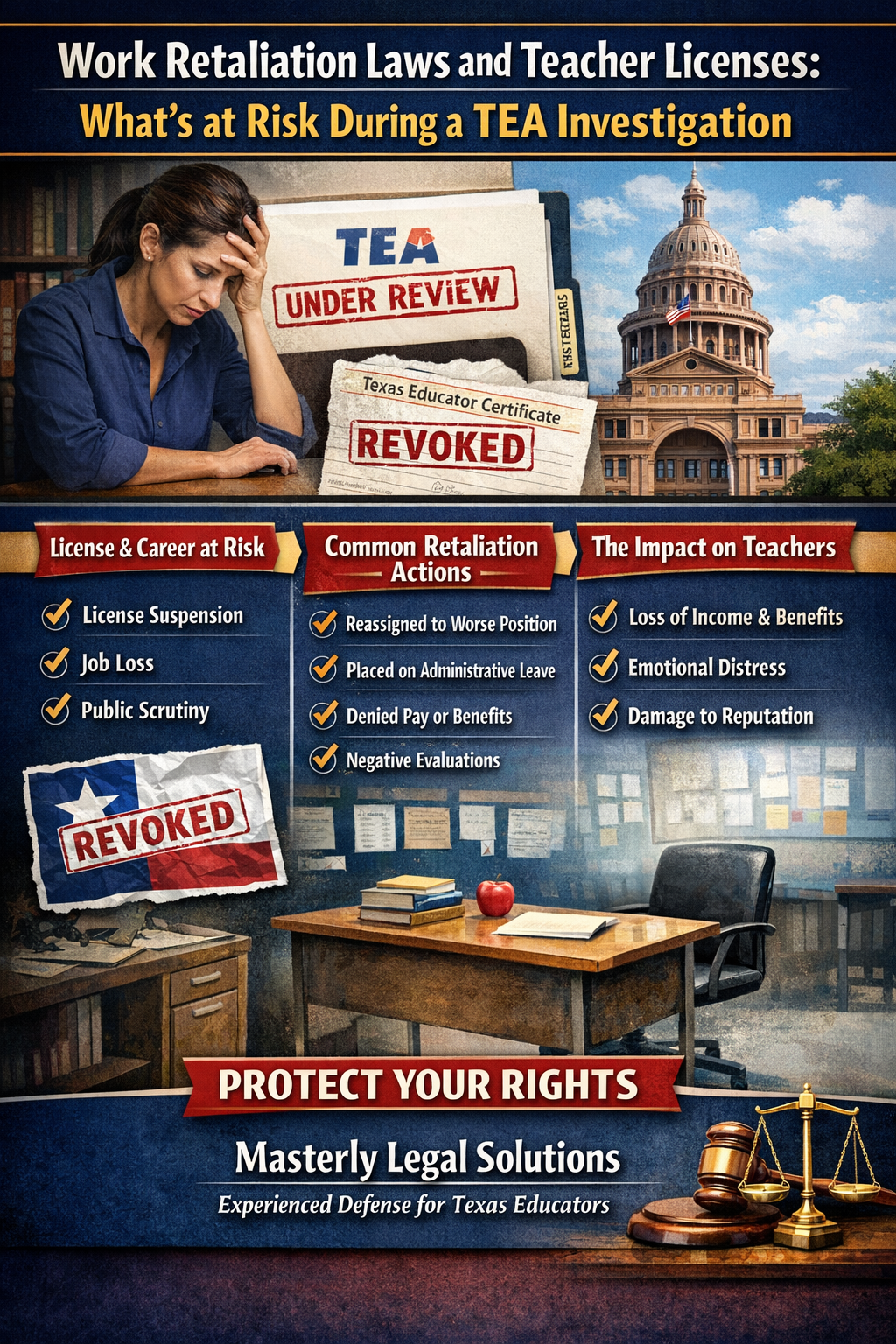
- Reassignment to a less desirable position after filing a discrimination complaint
- Denial of pay increases or benefits following harassment reports
- Placement on administrative leave immediately after participating in an investigation
- Increased scrutiny or negative evaluations after raising workplace safety concerns
These actions can harm employee morale and overall employee morale across the campus. Other employees may become afraid to speak up, undermining the agency's mission and trust within the organization.
The Impact on Pay, Benefits, and Employment
For many teachers, employment is not just a job. It is a calling. When retaliation or administrative leave disrupts your career, the financial and emotional toll can be immediate.
Loss of pay, suspension of benefits, and threats of termination create instability. Even brief periods of unpaid leave can cause serious hardship. In some circumstances, the agency head may grant administrative leave on a time limited basis, but uncertainty remains.
A record of disciplinary action or investigation can follow you. Future employers may hesitate to hire someone who was the subject of a TEA investigation, even if no wrongdoing was found, especially in the wake of high-profile Texas teacher certification crackdowns.
Harassment, Discrimination, and Title VII Protections
Harassment and discrimination are prohibited under federal and state law. Title VII protects workers from discrimination based on race, color, religion, sex, and national origin. Retaliation and ethics violations tied to discrimination are also unlawful.
When a teacher reports harassment or discrimination, that report is protected activity. If the employer responds with administrative leave, reassignment, or termination, the question becomes whether retaliation occurred.
A reasonable employee in similar circumstances should not be discouraged from reporting misconduct. Courts often analyze whether the adverse action would deter someone from engaging in protected activity.
Internal Policies, Human Resources, and Reporting Channels
Most districts have human resources departments and internal policies outlining how complaints are handled. These policies are intended to protect workers and ensure fairness. However, when internal policies are not followed, problems arise.
Human resources may recommend administrative leave during an investigation. The agency head may rely on agency judgments about risk and safety. But those decisions must be grounded in consistent guidance and not personal bias.
Union representatives can also play a role. If you are part of a bargaining unit, a union representative may attend meetings and advocate on your behalf, especially when you are responding to a TEA complaint notice or related disciplinary process.
The Danger of Acting Without Legal Counsel
Facing a TEA investigation without legal counsel is risky. Statements made during interviews can be used against you. Agency officials may document every response, so it is important to know the immediate steps to take after receiving a TEA investigation notice.
Teachers sometimes assume that cooperation alone will protect them. While cooperation is important, you also have rights. Legal counsel can help you understand how to respond to allegations and how to protect your Texas teacher certification during a TEA investigation.
An experienced attorney can evaluate whether retaliation is directly related to your protected activity. They can also challenge improper administrative leave or disciplinary action.
Federal Comparisons and Broader Guidance
In the federal system, OPM regulations limit how long agencies may place employees on investigative leave. A presidential memorandum and executive order have addressed excessive administrative leave. These measures aim to balance agency needs with employee rights.
Although Texas educators are governed by state law, these federal principles offer useful guidance. They reinforce the idea that administrative leave should not be indefinite or punitive.
Agency policies should clearly define when to grant administrative leave, how long it may last, and what protections apply. Vague or ad hoc decisions can signal deeper problems.
The Emotional Toll on Teachers
Being placed on administrative leave can feel isolating. Colleagues may speculate. Parents may ask questions. The stigma can damage your reputation, even if you are later cleared.
Employee morale suffers when teachers see others disciplined without transparency. Overall employee morale may decline, affecting the agency's mission of educating students.
Retaliation and harassment in the workplace erode trust. Protecting your rights is not just about your career. It is about preserving fairness for all workers.
What to Do If You Suspect Retaliation
If you believe retaliation has occurred, document everything. Keep copies of emails, evaluations, and notices. Record the timeline of events, including your protected activity and any subsequent adverse action.
Report concerns through appropriate channels, including human resources or a union representative if applicable. However, do not rely solely on internal processes.
Seek legal guidance as soon as possible. Early intervention can prevent further damage and may protect your employee record and license.
Protecting Your Teaching License and Future
Your teaching certificate represents years of hard work. A TEA investigation combined with retaliation can threaten everything you have built.
At Masterly Legal Solutions, we understand the urgency. License loss is not just a professional setback. It can change the course of your life.
We help teachers respond to investigations, challenge improper administrative leave, and assert their rights under the law. Our goal is to protect your employment, your reputation, and your future.
Contact Masterly Legal Solutions for Immediate Support
If you are facing a TEA investigation, placed on administrative leave, or concerned about retaliation at work, do not wait. The earlier you act, the more options you may have to protect your license and career.
At Masterly Legal Solutions, we offer a free consultation to discuss your situation. We will listen carefully, explain your rights, and provide clear guidance tailored to your circumstances. Every case is different, and quick action can make a meaningful difference.
Call us at (972) 236-5051 to speak with our team. Your livelihood, your pay, your benefits, and your professional reputation are too important to leave unprotected. Let us help you take the next step with confidence.
This article is for educational purposes only and does not constitute legal guidance. Reading this material does not create an attorney-client relationship. For advice regarding your specific circumstances, please contact Masterly Legal Solutions directly.



Teacher Rights When Assaulted by a Special Needs Student: Safety, Reporting and Investigation Issues



Looking for Legal & Business Solutions? Contact Us Now
Fill in the form or call us to set up a meeting