
Can CPS Use Old Allegations Against You?
A Child Protective Services (CPS) investigation may be closed, but questions about its long-term impact can remain. Can a closed CPS case be used against you in a future investigation, custody dispute, or employment matter?
In Texas, the answer depends on the original findings, the records retained, and the circumstances of any new concern. Closing an investigation does not always mean the records disappear. However, an old allegation does not automatically establish that abuse or neglect occurred.
For parents, teachers, school administrators, and other professionals, these differences matter. An inaccurate or misunderstood record can raise concerns about family stability, professional responsibilities, and reputation.
Masterly Legal Solutions provides legal guidance for individuals facing CPS-related questions, disputed findings, and concerns about past investigations. A qualified legal consultation can help clarify what a closed case means and what legal options may be available.
What Case Closure Does and Does Not Mean
When CPS closes an investigation, it means the agency has completed or otherwise ended its review of that particular report. It does not necessarily mean every allegation was proven false or that all related information was deleted.
In Texas, CPS investigations may end with different findings, including:
- Ruled out: Available information supports the conclusion that the alleged abuse or neglect did not occur.
- Unable to determine: The investigation did not establish a sufficient basis for another finding.
- Reason to believe: The agency found evidence supporting a determination that abuse or neglect occurred.
- Administrative closure: The agency ended the matter under applicable administrative rules.
- Unable to complete: The agency could not reach a conclusion because the investigation could not be completed.
These findings have different legal meanings. A closed investigation with a ruled-out finding should not be treated the same as one with a reason-to-believe finding.
Can a Closed CPS Case Be Used Against You in Texas?
Yes, information from a closed case may be reviewed or considered in certain future matters when the law permits. However, whether it can support a particular decision depends on the finding, the available evidence, and the legal process involved.
For example, a new CPS investigation may involve a review of earlier reports. In a family court proceeding, previous allegations may also become relevant if the information meets applicable legal requirements.
A closed report is not, by itself, proof of misconduct.
For educators and school leaders, there may be additional concerns involving professional licensing, district investigations, or employment decisions.
An education law attorney can help assess how a past CPS matter relates to current professional responsibilities and whether additional legal issues require attention.
When Prior Reports May Be Reviewed
Old CPS allegations can become relevant when a new report, legal dispute, or professional concern arises.
Understanding the difference between a historical allegation and an established finding is essential.
New CPS Investigations
When a new allegation is reported, CPS may review prior investigation history to understand the circumstances surrounding the family. In a new investigation, the agency may also focus on current safety concerns and can act based on perceived risk to children, not only on proven misconduct.
CPS prior investigation history may include earlier reports, findings, interviews, agency decisions, prior history, and multiple reports.
The fact that a previous report exists does not automatically confirm that the same concern is valid today.
A qualified attorney can examine whether historical information is being interpreted accurately and whether the agency's current actions follow applicable requirements.
Custody and Family Court Concerns
Past CPS involvement may also become an issue during a custody dispute or a custody case.
For example, one parent may refer to a previous investigation when raising concerns about a child's safety. Even closed allegations may be raised in custody disputes or custody battles, especially when one side claims ongoing safety issues.
A court may consider relevant, admissible evidence when making decisions about a child's best interests. However, the existence of a closed case does not automatically determine custody or parental rights, though it can still affect custody rights or temporary custody in some proceedings.
The original finding, supporting evidence, and current circumstances are important.
Legal representation can help distinguish documented findings from disputed claims and clarify which information may have legal significance.
Employment and Professional Reputation
Teachers, administrators, superintendents, and other school professionals may have concerns about whether old CPS allegations could affect their careers.
These concerns may involve:
- Professional certification or licensing reviews.
- Internal school district investigations.
- Employment-related background screening.
- Administrative leave or workplace complaints.
- Questions about past conduct or professional responsibilities.
CPS records are generally confidential, and access is controlled by law. They are not automatically available to every employer.
Still, certain authorized reviews or related proceedings may raise questions about previous investigations.
For an educator facing an employment concern, the connection between CPS records and professional obligations deserves careful legal review.
Document Retention and Disputed Records
One of the most common misunderstandings about CPS investigations is that case closure automatically removes the information from agency records.
In Texas, closed CPS case records may remain available to the agency and other legally authorized parties.
The Texas Department of Family and Protective Services generally treats investigation records as confidential, although specific laws permit access or disclosure in certain circumstances.
The length of time information remains in agency systems can depend on applicable retention requirements and the type of record involved.
What Happens When a CPS Record Is Inaccurate?
An inaccurate record can create problems when information is reviewed without its full context.
For example, an investigation may contain an allegation that was later ruled out. If the final finding is overlooked, someone reviewing the history could misunderstand what happened.
Texas law provides certain procedures for challenging investigation findings, and in some cases that can include supporting documentation such as medical records, school reports, or witness statements.
Under Texas Family Code Section 261.309, a person who disputes an abuse or neglect finding may be eligible to request an administrative review.
Applicable regulations generally require an eligible administrative review request within 45 days after notice of the finding, subject to specific exceptions.
Texas Family Code Section 261.315 also provides a process for requesting the removal of information concerning a person's alleged role when the agency determines that the person did not commit abuse or neglect.
These processes have specific eligibility requirements, and whether you can present evidence depends on the specific procedure involved.
Why Professional Legal Review Matters
A legal review can help protect legal rights during CPS cases by determining whether the issue involves an incorrect finding, missing documentation, improper disclosure, or a misunderstanding of the original decision.
Masterly Legal Solutions can assist clients with evaluating relevant records and identifying appropriate legal procedures based on their circumstances. Parents are not entitled to court-appointed legal representation in CPS cases, so speaking with a cps defense attorney early may be important.
The objective is to understand the record accurately, work toward a favorable outcome, and consider the available options before the issue becomes more complicated.
How to Prepare for a New CPS Contact
Receiving new contact from CPS after a previous case was closed can be concerning.
A new report does not necessarily mean the earlier investigation has been reopened. It may involve a separate allegation requiring a new review.
The distinction matters because each situation can involve different legal procedures, evidence, and deadlines.
Process and Documentation
When a previous CPS case becomes relevant again, the quality and completeness of the documentation can make a difference in understanding the investigation process.
A legal review may consider:
- The original investigation findings and closure notice.
- Relevant correspondence from CPS.
- Any administrative review or appeal decisions.
- Documents concerning disputed allegations.
- Notices involving employment or professional certification.
- Information about the nature of the new contact.
- Any safety plan, court order, or notices connected to the child’s home or placement decisions.
These materials can help an attorney understand what the agency previously decided and what issues remain unresolved.
A client does not need to determine the legal meaning of every document alone. Professional consultation can provide context and help identify which records are most important, including records about medical care, family members interviewed, and other child protective investigations tied to the same allegations.
Realistic Planning Questions Before Responding
A useful decision checklist focuses on the legal issues that could affect the next step.
Important questions include whether the new contact concerns a separate report, and whether false allegations may be involved, even though proving a false report’s malicious intent is difficult, whether the earlier finding was accurately recorded, whether a response deadline applies, and whether an employment or licensing matter is also involved.
For teachers and administrators, an additional question may be whether statements made during one investigation could affect a separate school district proceeding.
These are matters that deserve individual assessment rather than assumptions based on the previous closure.
Legal guidance can help clarify communication requirements, documentation concerns, and available options.
Why Old CPS Allegations Deserve Careful Legal Attention
The impact of a past CPS investigation is not always limited to the family involved.
For an educator, an allegation may raise concerns about professional standing. For an administrator, it may create questions about employment obligations. For a parent, it may become part of a later custody dispute, court proceedings, or even a related criminal case.
Even when an allegation was not substantiated, misunderstanding the official record can create unnecessary complications. Prior history can also create legal consequences if old child abuse or neglect allegations are read without context.
That is why the original findings and the circumstances of any later review matter.
The goal is not simply to respond to an old allegation. It is to understand what the record establishes, how it may lawfully be considered, and which protections or review procedures may apply, especially if the matter returns with some level of court involvement.
Legal Support From Masterly Legal Solutions
Masterly Legal Solutions works with educators, professionals, and individuals navigating complex legal concerns, including advising parents and other clients on CPS-related legal rights and related proceedings.
For matters involving closed CPS investigations, legal services may include reviewing available records, assessing disputed findings, evaluating administrative options, and advising on related professional or legal proceedings, including custody case issues, court hearings, and possible criminal charges where those issues intersect with a closed CPS matter.
The appropriate scope of representation depends on the facts, applicable law, and the firm's assessment of the matter.
Masterly Legal Solutions offers a free consultation to discuss your specific circumstances and legal options.
For clients concerned about career stability, family matters, or their professional reputation, qualified legal counsel can provide a clearer understanding of the issues and potential next steps.
Additional Legal Concerns in Child Protective Services Cases
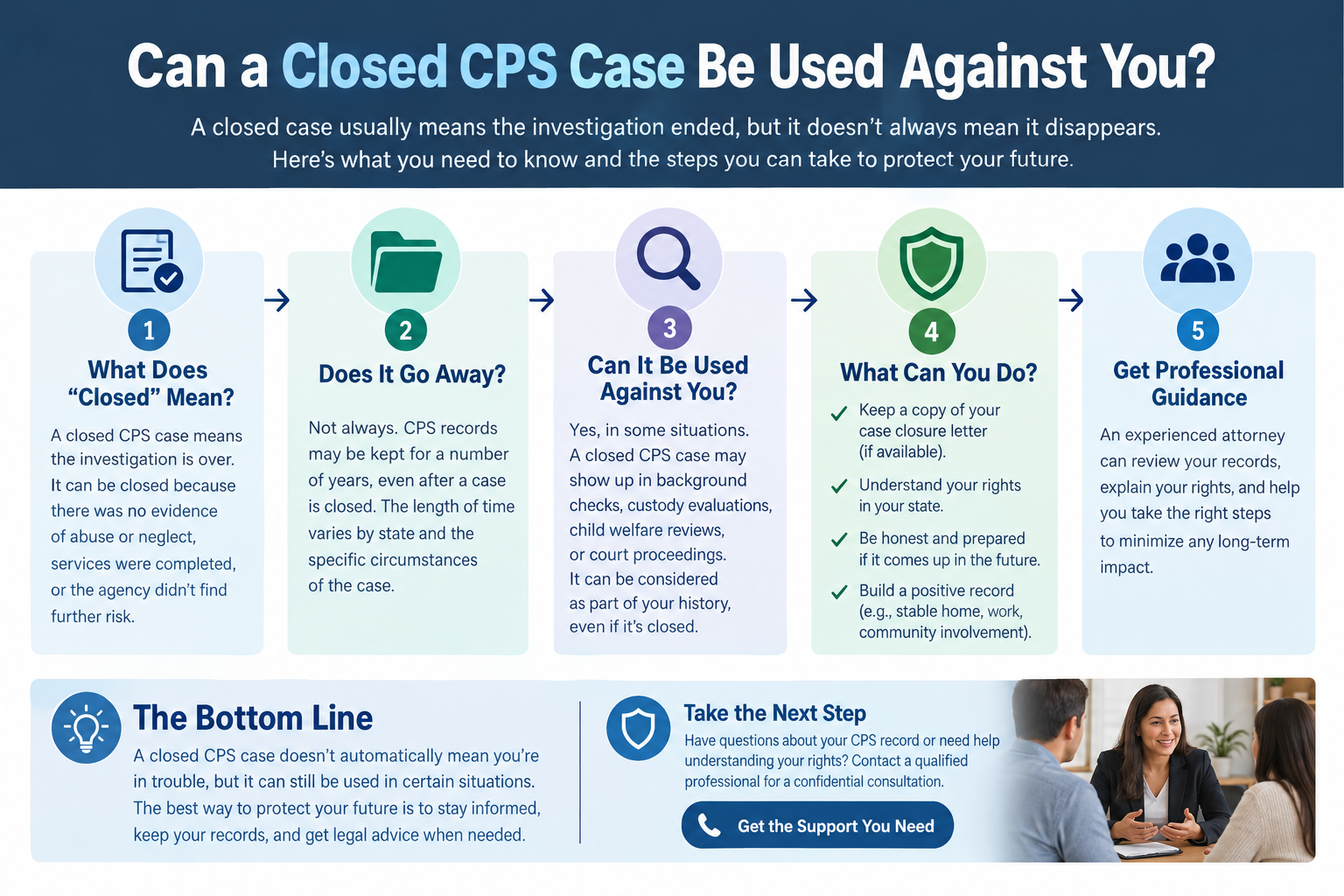
Child protective services cases can involve more than allegations of abuse or neglect. In Texas, a closed investigation may raise questions about domestic violence, drug testing, background checks, and the legal authority of CPS to review prior information. Each issue requires careful consideration of the facts, the original investigation findings, and applicable Texas law. Individuals seeking guidance may explore legal aid resources, including the Texas Legal Services Center, which provides legal assistance and information to eligible Texans. However, eligibility, available services, and the scope of representation vary. Masterly Legal Solutions offers professional legal consultation for parents, teachers, administrators, and other individuals who need help understanding how a previous CPS investigation may affect their legal rights, employment, or professional reputation.
Frequently Asked Questions
Can a closed CPS case be used against you later?
Yes, information from a closed CPS case may be considered in a later investigation, custody case, or other court proceedings when permitted by law. However, an earlier allegation does not automatically prove abuse or neglect. The original finding and current circumstances matter.
Can an old CPS case be reopened?
In Texas, Family Code Section 261.301(l) generally permits reopening an investigation and changing its finding within 60 days after closure only for good cause. After the 60th day, that provision prohibits reopening or changing the finding to conclude that abuse or neglect occurred. A separate new report may still be investigated. If that new contact leads to a neglect investigation or other child protective investigations, CPS may review prior reports as part of that process.
How can a parent challenge an inaccurate record?
Texas provides administrative review procedures for certain disputed CPS findings, including when a parent, conservator, or alleged perpetrator needs to challenge an inaccurate record. The process may involve medical records, school reports, or witness statements depending on the allegation. A person may also qualify to request removal of information about their alleged role when the allegations were ruled out. Eligibility and deadlines depend on the circumstances.
Do closed CPS case records disappear automatically?
No. Closing an investigation does not automatically delete its records. Retention, access, confidentiality, and possible removal depend on applicable laws and agency rules.
Can old CPS allegations affect a teacher's job?
They may become relevant in certain employment, certification, or school district proceedings. However, confidentiality requirements, the original findings, and the specific professional rules involved determine how information may be considered.
Can CPS use prior investigation history in a new case?
Yes. CPS may consider prior investigation history when reviewing a new report, especially where there are multiple reports or renewed safety concerns. However, historical allegations and established findings are different, and a new allegation must be evaluated under applicable legal standards. CPS may also look at criminal history or criminal records when those issues are part of the current safety assessment or placement review.
Should I consult an attorney about a closed CPS case?
A legal consultation may be appropriate when a previous investigation becomes relevant to a new report, custody issue, disputed record, or employment matter. Reading this article does not create an attorney client relationship. An attorney can help assess the specific facts and available legal options, which may be especially important if the matter affects parental rights, a custody dispute, or a possible criminal case.
Request a Qualified, Confidential Legal Consultation
If you are asking can a closed CPS case be used against you, the answer deserves more than a general explanation.
Your original investigation findings, existing records, and current circumstances may affect your legal position, and a closed matter may still affect parents, children, custody rights, or professional issues depending on the records and the current concern.
Masterly Legal Solutions offers legal consultation for individuals seeking clarity about past CPS allegations, disputed findings, and related professional concerns. Many parents feel overwhelmed by old allegations, especially when custody disputes, court involvement, or foster care concerns may also be in play.
Whether you are a parent, teacher, administrator, or other professional, discussing your situation with qualified legal counsel can help you understand the relevant legal issues before deciding how to proceed.
Call (972) 236-5051 or visit www.masterlylegal.com to request a confidential legal consultation about your case, including issues tied to parenting classes or reports made by mandatory reporters.
Every matter is different. Legal options and potential outcomes depend on the facts and applicable law. No particular result is guaranteed.








Looking for Legal & Business Solutions? Contact Us Now
Fill in the form or call us to set up a meeting