Coaching Contract Buyout Clauses: What Coaches Should Review Before Signing
Whether you run a small partnership or follow college football coaching changes, the buyout clause is a contract provision that can make or break financial outcomes for everyone involved. In 2025 alone, at least 13 head coaches were fired, with several owed buyouts exceeding $15 million. Meanwhile, business owners face equally high-stakes decisions when a partner exits or dies unexpectedly.
This guide breaks down how buyout clauses work across both business and coaching contexts, what essential elements every agreement should include, and how to negotiate terms that protect your money and your future.
What Is a Buyout Clause?
A buyout clause is a contractual provision that gives a party the right to end a relationship for a predetermined price. It spells out how much one side must pay, when payment is due, and under what conditions a contract can be terminated early or ownership can be transferred. Think of it as a financial exit ramp built directly into the agreement.
Buyout clauses can appear in business partnerships, real estate leases, employment contracts, and sports agreements. The contexts differ, but the core purpose stays the same: define the cost of walking away.
Here are two examples to make it concrete:
- A 3-owner LLC in 2026 where one partner wants to leave. Their operating agreement requires the remaining two to purchase the departing partner's share based on a multiple of historical earnings.
- A university firing a head coach mid-contract. The buyout clause obligates the school to pay a percentage of the coach's remaining salary, sometimes exceeding $50 million.
If you're a business owner, coach, executive, or founder, understanding buyout clauses is not optional. These provisions determine your financial exposure and your leverage in any negotiation. Getting them wrong can cost you years of income or saddle your organization with an unsustainable liability.
Buyout Clauses vs. Buyout Agreements
A buyout clause is a single provision inside a larger contract, while a buyout agreement is a separate, legally binding buy-sell contract that comprehensively governs ownership exits. Here's when you'll typically encounter each:
- In standard coaching contracts, the buyout clause is embedded directly in the employment deal, covering early termination and hiring-away scenarios.
- In a partnership or LLC, like a 4-partner marketing agency formed in 2024, the owners almost always sign a full written buyout agreement that covers valuation, funding, triggering events, and payment schedules in detail.
- A buyout agreement typically sets out all possible exit paths (death, disability, retirement, voluntary departure), while a coaching contract's buyout clause usually focuses on "without cause" termination and reverse-buyout fees.
- The agreement sets the broader framework. The clause captures specific dollar figures and formulas within that framework.
Key Purposes of a Buyout Clause
Buyout clauses exist to manage risk on both sides of a contract. Without them, every departure turns into a negotiation from scratch, often under adversarial conditions.
Here's what they accomplish:
- They protect business continuity during ownership transitions. When an owner exits, becomes incapacitated, or dies, the clause ensures there is a clear process for departure and compensation, preventing deadlock when triggering events occur.
- Buyout agreements reduce the risk of disputes among business owners by establishing clear terms upfront, before emotions or financial pressure cloud judgment.
- They provide a clear plan for transferring ownership to successors, keeping the company operational instead of frozen.
- They protect the interests of all parties involved in a business or coaching relationship by defining obligations before a crisis occurs, adding protection against disputes and preserving each side's position.
- In coaching, buyout clauses give colleges and professional teams flexibility to make changes without breaching contracts, while providing coaches with income security if they are fired without cause.
- A well-structured buyout clause can deter impulsive firings or poaching. If hiring away a coach in 2027 means paying an 8-figure fee, an athletic director will think twice.
- Buyout clauses can provide a way to avoid lengthy legal battles and ensure clean separations, especially when the terms are transparent and both parties understand what is owed.
In a coaching relationship, transparent buyout language also acts as a boundary-setting tool. It reduces "he said, she said" disputes and helps both sides move forward with respect when parting ways.
Types of Buyout Agreements in Business
Multi-owner businesses typically choose from a few standard buyout agreement structures. Each has different implications for taxes, complexity, and cash flow.
- A cross-purchase agreement involves remaining owners buying a departing owner's interest directly. This often results in a stepped-up tax basis for the buyers.
- An entity-purchase or stock-redemption agreement allows the business itself to buy back ownership interest from the departing member. This simplifies insurance policies and funding logistics.
- A wait-and-see agreement (hybrid structure) defers the buyout decision until a triggering event occurs, letting owners choose between cross-purchase and entity-purchase based on tax or cash-flow realities at that time.
- A one-way buyout agreement is used for selling to a specific individual, such as a pre-identified active partner expected to purchase when another owner exits in 2028.
- A leveraged buyout agreement finances the purchase primarily through borrowed funds, often used in larger acquisitions or when cash reserves are insufficient.
These agreements nearly always contain detailed buyout clauses addressing price valuation, timing, and funding, whether through insurance proceeds, installment notes, or company reserve funds.
How Buyout Clauses Work in Coaching Contracts
College and professional coaching contracts routinely center on the buyout clause, governing the coach's services as well as the termination economics that can be worth tens of millions of dollars. These provisions often dominate headlines during coaching changes and determine whether a university can afford to make a move.
The two main directions a coaching buyout can flow:
- School fires a coach "without cause." The buyout clause requires the school to pay a specified percentage or fixed amount of the coach's remaining compensation. For example, in 2025, James Franklin's buyout at Penn State was reportedly valued at $49 million before mitigation.
- School pays a "reverse buyout" to another institution to hire away a coach still under contract. The hiring school must cover the fee to release the coach from his current deal.
- Common drafting patterns in 2024–2026 coaching contracts include step-down buyout amounts by contract year, mitigation requirements if the coach lands a new job, and offsets where new earnings reduce the original school's obligation.
- The buyout clause often interacts with performance incentives, extension triggers, and termination-for-cause language, creating layered financial dynamics.
- Fans typically hear about these numbers in headlines when a coach is fired or hired away. Those figures are the direct result of the buyout clause negotiated years earlier.
Case Study: Brian Kelly's Buyout Clause at LSU
LSU signed Brian Kelly after the 2021 season on a 10-year contract worth approximately $95 million. The buyout clause in that deal became one of the most talked-about provisions in college sports when LSU dismissed Kelly without cause in October 2025 from its Baton Rouge campus.
- Firing "without cause" triggered a payout of 90% of remaining salary due under the contract. The buyout amount declines as the contract term runs down, but four years into a decade-long deal, the exposure was still enormous.
- As of a December 2025 firing date, reporting estimated the obligation at approximately $53.3 million before mitigation. That figure is calculated as remaining years multiplied by annual compensation, then multiplied by 90%.
- The clause includes mitigation and offset language. Kelly must actively seek another qualifying coaching or related job. Any compensation he earns will reduce what LSU owes, illustrating how schools try to limit total financial exposure.
- Despite mitigation, LSU ultimately agreed to pay the full $54 million buyout, ending a potential lawsuit. This case shows how buyout leverage shifts dramatically depending on the job market for fired coaches.
- Kelly's deal demonstrates that the buyout clause is not just legal fine print. It's a financial commitment that can shape an athletics department's budget for years.
Essential Elements of Any Buyout Clause
Whether in a buyout agreement among owners or a coaching contract, certain core elements appear across industries. Getting any one wrong creates financial risk and potential litigation.
- Triggering events must be clearly defined. Buyout agreements include specific triggering events for activation: retirement, death, disability, firing without cause, breach, voluntary exit, or sale of the program or company. Vague definitions immediately create disputes.
- Buyout clauses establish how the buyout price is calculated, often using formulas or fixed amounts. Valuation methods determine how ownership interests are valued, whether by a fixed dollar amount, salary multiple, or periodic third-party appraisal. For example, a 2026 partnership agreement might call for 3x average EBITDA over the past two years.
- Funding mechanisms outline how the buyout will be financed. Payments can come via a lump sum payment, installments, insurance-funded buyouts, promissory notes, or revenue-based formulas.
- Terms of payment specify how and when payments are made. A clear payment schedule in a buyout clause can help protect cash flow for both the departing party and the remaining business, and it should state whether any payment is final or eligible for a refund only if the agreement expressly says so.
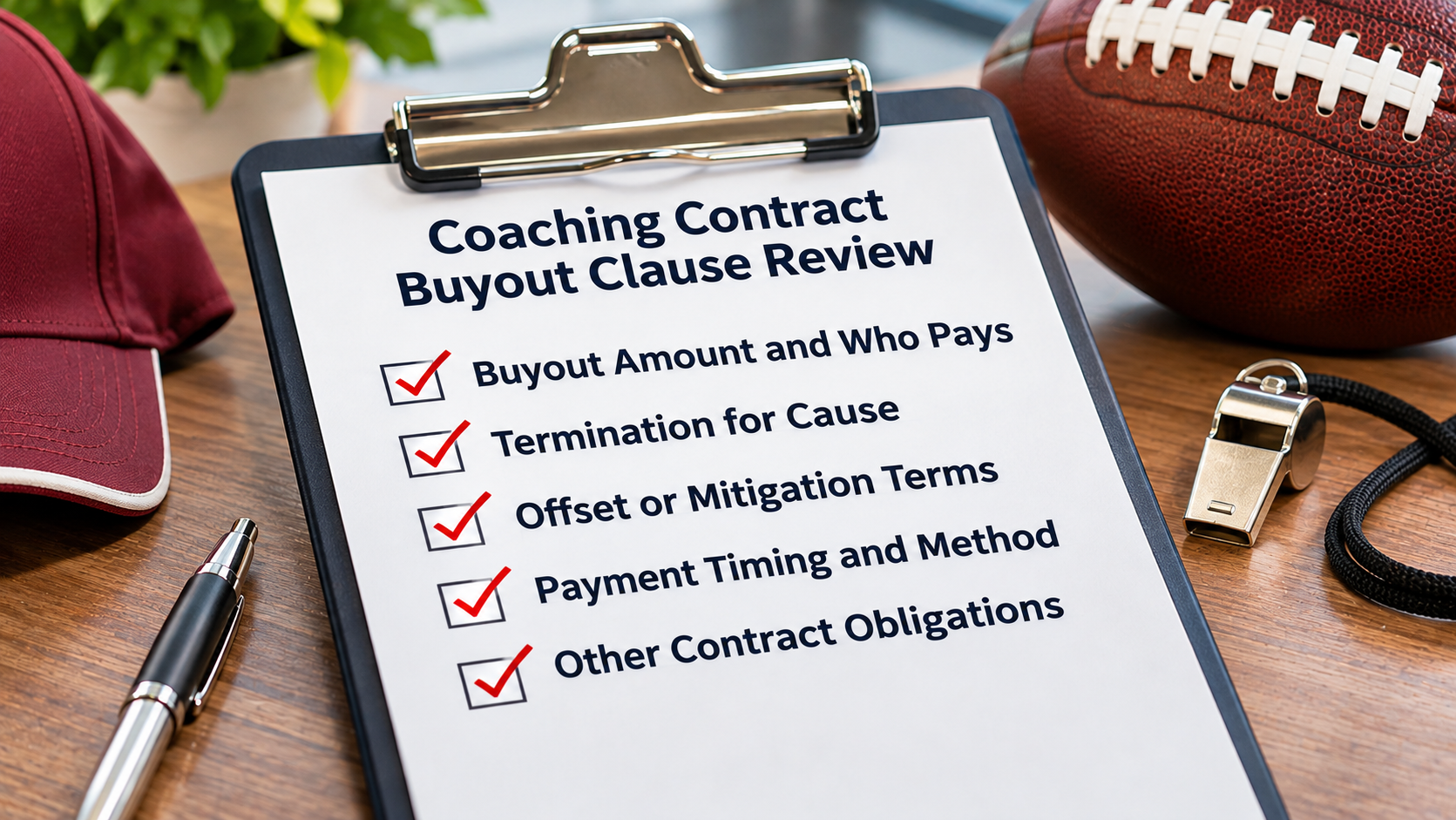
- Mitigation and offsets matter especially in coaching contracts, where new job income reduces the payout. Without offset provisions, a coach could earn a new salary while still collecting the full buyout, creating double compensation.
- Restrictive covenants limit the departing owner's future competition. Buyout clauses may also include provisions for the transfer of intellectual property, client lists, and control of business assets such as a site or site content after payment.
- Dispute resolution clauses outline processes for resolving conflicts, including arbitration requirements, governing law, and deadlines for notice.
- Specific provisions should be included to detail post-buyout obligations and rights, covering everything from non-compete windows to data access and communication protocols.
How Buyout Clauses Shape the Coaching Relationship
The buyout clause does more than sit in a filing cabinet. It actively shapes the day-to-day dynamics between a head coach and an athletic department, influencing hiring, firing, cooperation, and even recruiting.
- A strong buyout favoring the coach provides long-term security and leverage. A coach with a $50 million guarantee can push back on administrative pressure, make staffing decisions with confidence, and recruit with the credibility that comes from job stability.
- It also makes an athletic director think twice before making a quick coaching change after one bad week or a disappointing season. LSU has spent over $43 million on athletics buyouts over the past decade, illustrating the cumulative cost of these decisions.
- A more balanced buyout clause encourages collaboration and alignment on performance metrics, culture, and player development. When both sides have skin in the game, the program benefits.
- If external conditions shift, such as transfer portal rules or NIL income changes, a balanced clause makes both sides more willing to renegotiate mid-contract in a spirit of cooperation.
- Clearly drafted buyout provisions can reduce public drama when parting ways. When everyone knows what is expected and what will be paid, the coach's reputation and the program's brand are both managed with more care.
Drafting Buyout Agreements for Partnerships and LLCs
If you're a small-business owner, run a professional practice, or lead a startup, drafting a comprehensive buyout agreement that fits your actual services and ownership structure now will save you from costly conflict later.
- Decide when owners can trigger a buyout: set retirement age thresholds, define disability standards, include deadlock provisions if partners disagree, and address misconduct or breach. Also cover what happens if a partner receives an outside offer to sell.
- Choose a clear valuation method. Use a formula based on EBITDA, revenue multiples, or mandate annual third-party appraisals. Set review dates, such as every January 1 starting 2027, so the valuation stays current and disputes stay minimal.
- Build in funding strategies. Life insurance policies can fund death or disability buyouts. Bank financing, company reserve funds, or staged payments over 3–7 years ensure the departing owner gets paid without devastating the company's cash flow.
- Address non-compete or non-solicit obligations. If a departing partner plans to compete immediately, the agreement may reduce the buyout price or impose penalties. Conversely, strong non-competes can protect relationships with clients, and consent from all parties should be required for modifications.
- Without a written buyout agreement, a partner walking away in 2026 triggers state default mechanisms or forces costly litigation over valuation and payment. With a clear agreement, terms are enforced with predictable expectations and both sides understand their obligations from day one.
Common Mistakes and Hidden Risks in Buyout Clauses
A poorly defined buyout clause can lead to disputes and financial risk that far exceed the cost of drafting it correctly. Here are the most frequent pitfalls:
- Vague valuation criteria in buyout clauses can lead to expensive disputes. Terms like "fair market value" without defining the methodology invite expert battles and legal fees. In one case, two business partners litigated for 18 months over what that phrase meant in their 2018 agreement, arguing whether goodwill, recurring revenue, and intangible assets should be included.
- Unrealistic lump sum payment expectations that the business or university cannot actually fund in 2026 cash conditions. If the clause demands immediate full payment but revenue cannot cover it, the entire agreement breaks down.
- Forgetting to update buyout figures after extensions, raises, or ownership changes. A clause written in 2022 may be wildly out of line by 2026 if the contract has been amended but the buyout terms have not.
- Omitting mitigation or offset language in coaching contracts, overcommitting to guaranteed money. Without offsets, a school could owe full compensation even if the coach immediately takes another high-paying job.
- Triggering events defined too broadly or too narrowly. Defining "cause" so narrowly that it's almost impossible to invoke leaves the institution exposed. Defining it too broadly lets the organization avoid paying by citing minor infractions. Both extremes create claim risks and lawsuits.
Negotiating a Fair Buyout Clause or Buyout Agreement
Buyout terms are negotiable, and the best time to negotiate is before you sign. Whether you're a coach, founder, or minority owner, treat the buyout clause as a negotiation priority rather than an afterthought.
Strategies for individuals (coaches, founders, minority owners):
- Prioritize clarity over headline numbers. Ask for specific formulas and step-down schedules rather than vague interest-based benchmarks. For example: "If terminated without cause in year 1, pay X; in year 5, pay 60% of X."
- Seek caps, floors, or partial guarantees that balance security with realism. A floor ensures minimum compensation; a cap limits the institution's total liability.
Strategies for institutions (universities, companies, partnerships):
- Use performance metrics, timelines, and behavior standards that align with organizational goals. Build in sessions for periodic review so both sides can assess whether the clause still reflects the relationship.
- Include renegotiation points. For example, an option to revisit the buyout in 2028 if revenues change dramatically due to new media deals, conference realignment, or shifts in the marketing landscape.
- Hiring legal counsel with specialization in coaching contracts or buy-sell agreements is critical. Generic templates rarely account for the complexity and dollar exposure involved. Specialized counsel can help you determine the right formulas and negotiate language that holds up under pressure.
When to Get Professional Help With Buyout Clauses
This article is informational only and not legal advice. The enforceability of buyout clauses may vary by jurisdiction and require legal review. Always seek counsel in your own jurisdiction before making decisions.
Situations where professional support is especially critical:
- Signing or renewing a long-term coaching contract with a multi-million dollar buyout, especially when reverse buyout obligations or offset provisions are on the line and related contract-management support may also be needed.
- Creating or revising a partnership or LLC operating agreement in anticipation of an owner's 2027 retirement, so valuation, funding, and triggers are aligned with future projections.
- Handling a forced exit, firing, or major dispute when the buyout language is unclear about "cause" vs. "without cause," or when the demand for payment is contested.
Key professional roles to consider:
- Business or sports contract attorneys who can draft and negotiate precise, enforceable language.
- Independent valuation professionals who can set or challenge buyout price calculations, especially for intangible assets, goodwill, and future earnings.
- Tax advisors who can explain after-tax implications of lump-sum vs. installment payouts. Tax consequences may arise from buyout payments depending on contract types, and the right advisor can help you comply with reporting obligations.
Consulting with legal counsel is recommended before finalizing a buyout clause, whether you are on the paying or receiving side. Review related website policies for data protection too if you collect information or market your offerings, especially when agreements affect public-facing materials or paid ads. Review your current agreements today, before a triggering event forces your hand. The buyout clause should support your goals, not surprise you when it matters most.
Frequently Asked Questions About Coaching Contract Buyouts
What happens to a buyout if a coach is fired for cause?
A coach terminated for cause may receive a reduced buyout or no buyout, depending on the employment agreement. The contract's definition of cause is important because it identifies the circumstances that may trigger different payment obligations. Disputes can arise when the coach and institution disagree about whether the stated grounds for termination meet the contractual standard.
Does a coach have to pay a buyout to leave early?
A coach may have to pay a buyout when the employment agreement includes an enforceable early-departure provision. The amount and payment conditions depend on the contract. Some agreements require a fixed payment, while others use a declining schedule. An attorney can review the provision and assess potential obligations under applicable law.
What is offset or mitigation in a coaching contract?
Offset allows certain income from new employment to reduce payments owed by the former school, when permitted by the agreement. Mitigation generally refers to an obligation to take reasonable steps to limit financial losses, which may include seeking other employment. These provisions depend on the contract's language and applicable legal requirements.
Request a Confidential Consultation With Masterly Legal Solutions
A coaching contract buyout clause can affect your compensation, professional opportunities, and financial responsibilities long after an agreement is signed.
Before accepting a new contract, negotiating an extension, or responding to a proposed termination, understanding the agreement's financial provisions can help you make an informed decision.
Masterly Legal Solutions assists coaches and athletic organizations with buyout clause reviews, coaching contracts, termination provisions, and related sports-law concerns.
Call (972) 236-5051 to discuss your coaching contract and available legal options.
This article provides general legal information and does not constitute legal advice. Contract rights, payment obligations, and potential outcomes depend on the agreement, applicable law, and individual






Looking for Legal & Business Solutions? Contact Us Now
Fill in the form or call us to set up a meeting