

IEP vs. 504 Plan: What Parents and Students Should Know
By Andrew Rhoden | Masterly Legal Solutions
What is the difference between an IEP and a 504 plan? An Individualized Education Program (IEP) provides special education and related services to eligible students under federal law. A 504 plan addresses disability-related needs through accommodations and other appropriate support. The right choice depends on the student's disability, educational needs, and evaluation results.
For Texas parents, understanding these differences can affect how a child receives support at school. For college students, the distinction also matters because disability protections continue into higher education, but the legal requirements change.
IEP vs. 504 Plan: The Short Answer
The main difference in IEP vs 504 is the type of legal support available. An IEP serves students who meet eligibility requirements under the Individuals with Disabilities Education Act (IDEA) and need special education. Section 504 protects qualified students with disabilities from discrimination and requires appropriate educational support in public K-12 schools.
Neither option is automatically better. The student's individual needs determine which legal framework applies.
What Is an IEP Under IDEA, Special Education, and Who Qualifies?
An IEP is a formal, legally binding written document developed for a student who qualifies for special education under IDEA.
The Individualized Education Plan identifies the student's educational needs, learning goals, special education services, related services, and methods for measuring progress.
An IEP is intended to provide an eligible student with a free appropriate public education, commonly called FAPE. It is the document used to deliver a student with a disability an appropriate public education tailored to that student's needs.
Who Is Eligible for an IEP?
A student generally must meet two requirements, including having one of the 13 IDEA disability categories:
- Have a disability within an IDEA eligibility category.
- Need special education and related services because of that disability.
IDEA includes 13 disability categories, such as autism, specific learning disabilities, speech or language impairments, emotional disturbance, and other health impairments.
Having a medical diagnosis alone does not automatically establish IEP eligibility.
Schools must evaluate whether the student meets the legal eligibility standards, whether the disability adversely affects the student's educational performance, and whether the student requires specially designed instruction.
For example, a student with a learning disability may need specialized instruction, structured academic goals, and progress monitoring that go beyond standard classroom accommodations.
How the IEP Process and Decisions Work in Texas
In Texas, the Admission, Review, and Dismissal (ARD) committee makes decisions about special education eligibility and develops the IEP.
The committee generally includes parents, school representatives, teachers, and other required participants. Through the iep process, the school district and parents develop and review the student's plan.
Texas evaluation rules establish timelines for many initial special education evaluations. In typical cases, the evaluation report is due within 45 school days after the school receives written parental consent, subject to applicable exceptions.
The ARD committee generally must determine eligibility and, when appropriate, develop an IEP within 30 calendar days after the evaluation report is completed.
IDEA also requires IEP reviews at least once a year. Reevaluation is generally required at least every three years unless the parent and school agree it is unnecessary. IEP goals and IEP objectives should be Specific, Measurable, Achievable, Relevant, and Time-bound. Placement and services are reviewed in the restrictive environment and can include support from a special education teacher in a general education classroom.
For parents who are unsure whether the proposed services reflect their child's needs, an education attorney can review evaluation findings, school documents, and the applicable legal standards.
What Is a 504 Plan Under Section 504, and Who Qualifies?
A 504 plan is a formal plan that addresses disability-related educational needs under Section 504 of the Rehabilitation Act of 1973 and helps provide equal access when special education is not needed.
Section 504 is a civil rights law that applies to schools and other programs that receive federal funding; in covered schools, it prohibits discrimination against students with disabilities.
In the K-12 setting, Section 504 requires schools with federal funding to provide appropriate education to qualified students with disabilities.
A student may qualify even when special education under IDEA is not required, because Section 504 uses a broader definition of eligibility.
Who Qualifies for a 504 Plan?
For school-based services under Section 504, a student generally must have a physical or mental impairment that substantially limits one or more major life activities.
Major life activities include learning, reading, concentrating, walking, breathing, and other important daily functions.
A disability does not have to prevent a student from earning good grades to qualify.
For example, a student with diabetes may perform well academically but need accommodations for blood glucose monitoring, medication, meals, or other disability-related needs during school.
A student with ADHD may also qualify when the condition substantially limits a major life activity, even if the student does not require special education.
The school must consider the student's individual circumstances rather than relying only on the diagnosis.
What Support Can a 504 Plan Provide?
A 504 plan may describe accommodations, related aids, or services that help a student access the general curriculum and participate in school appropriately.
Depending on the student's needs, support may include extended testing time, accessible classroom arrangements, modified attendance procedures, health-related assistance, or other reasonable adjustments. Students with 504 plans typically remain in the general education classroom while receiving those supports.
Section 504 is not limited to a simple list of classroom accommodations. Some eligible students may require related services to receive an appropriate education.
Unlike IDEA, Section 504 does not prescribe the same detailed written IEP format or impose the same stringent parental-participation requirements as the IEP process.
Schools must conduct appropriate evaluations, make decisions through knowledgeable personnel, and periodically reevaluate students receiving services.
For parents researching 504 plan Texas requirements, legal guidance can help clarify whether the school has properly considered the student's disability and educational needs.
IEP vs. 504 Plan: Key Differences Parents Should Know
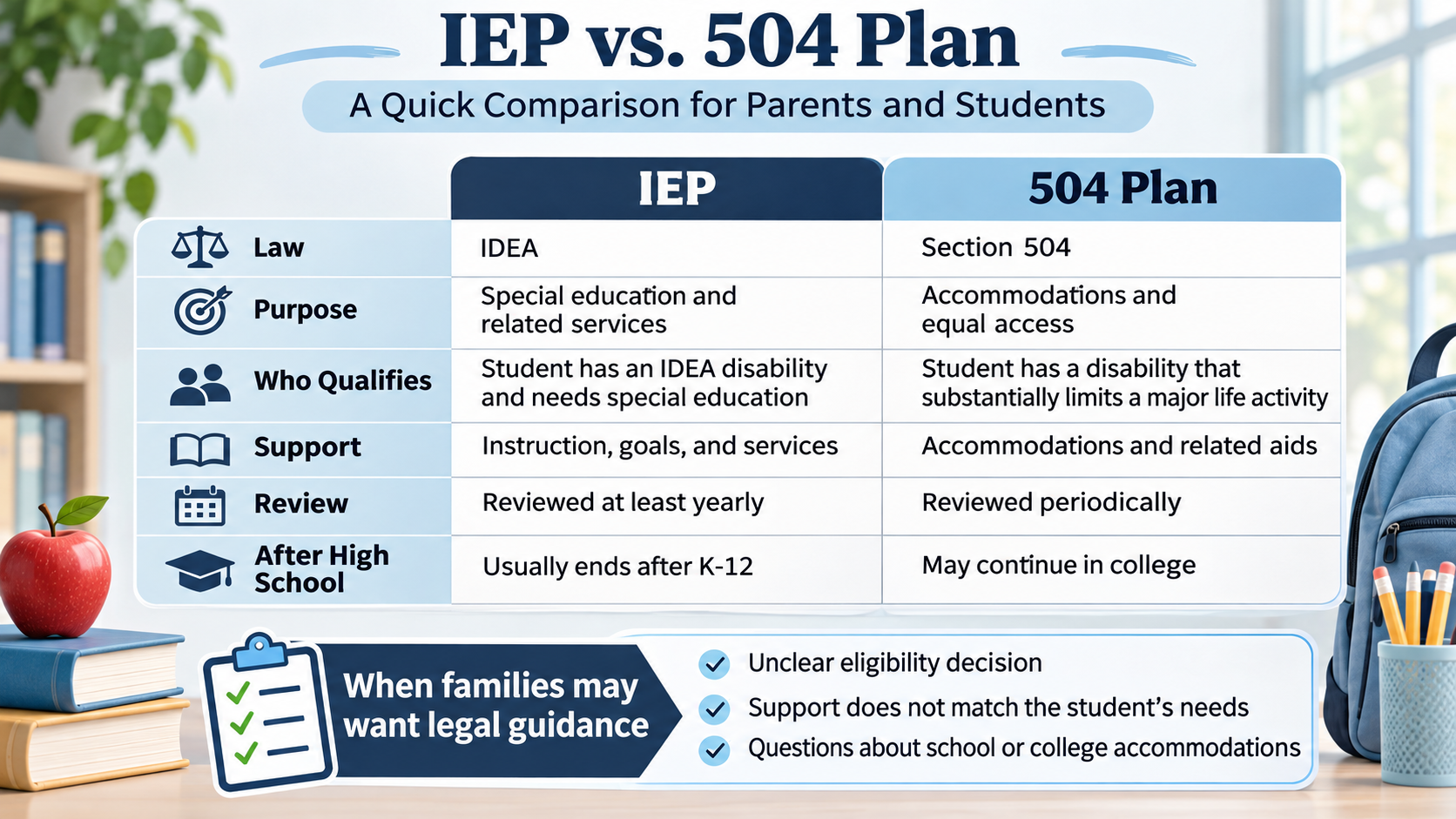
Understanding the difference between a 504 plan vs IEP helps Texas parents determine which educational support may be appropriate for their child. Both provide important protections for students with disabilities, but they differ in eligibility, services, documentation, and legal requirements.
1. Governing Law and Purpose
An Individualized Education Program (IEP) operates under the Individuals with Disabilities Education Act (IDEA). It provides specially designed instruction and related services to eligible students who need special education.
A 504 plan falls under Section 504 of the Rehabilitation Act of 1973. It protects qualified students with disabilities from discrimination and provides accommodations or other support needed for appropriate educational access.
2. Eligibility Requirements
To qualify for an IEP, a student must have a disability recognized under IDEA and need special education because of that disability.
For a 504 plan, a student generally must have a physical or mental impairment that substantially limits one or more major life activities, such as learning, reading, concentrating, or walking. Students may qualify for Section 504 support even when they do not need specially designed instruction.
3. Educational Services and Accommodations
An IEP includes individualized learning goals, specially designed instruction, and related services based on the student's educational needs.
A 504 plan may provide classroom accommodations, accessibility adjustments, health-related assistance, and other appropriate aids or services. The support depends on the student's disability and individual circumstances.
4. Written Documentation and Decision-Making
An IEP must be documented in a detailed written plan outlining educational goals, services, and progress measurements. In Texas, the Admission, Review, and Dismissal (ARD) committee develops the IEP.
Section 504 does not require the same federal written-plan format. However, schools commonly document accommodations and services in a 504 plan. Decisions must involve individuals knowledgeable about the student, evaluation information, and available placement options.
5. Review and Reevaluation Requirements
Under IDEA, schools must review a student's IEP at least once a year. Reevaluations generally occur at least every three years unless the parent and school agree they are unnecessary.
Section 504 requires periodic reevaluations and evaluation before significant changes in placement. Unlike IDEA, federal Section 504 regulations do not establish an identical nationwide annual review schedule.
6. IEP and 504 Plan Protections After High School
IEP requirements under IDEA generally end when a student leaves the K-12 education system.
Section 504 protections may continue into college or university. However, students usually must request accommodations through their institution's disability services process. A high school 504 plan does not automatically transfer as a binding college accommodation plan.
Which Plan Is Right for Your Child?
The appropriate choice depends on the student's disability, educational needs, and evaluation results. An IEP may be appropriate when a student requires specially designed instruction, while a 504 plan may address disability-related needs without IDEA special education eligibility.
Both laws protect students with disabilities, but they establish different eligibility rules and educational responsibilities.
Masterly Legal Solutions helps Texas parents understand these differences, review eligibility concerns, and evaluate whether a school's proposed educational support meets applicable legal requirements.
Why the Difference Matters for Families
Parents sometimes worry that accepting a 504 plan means giving up access to special education.
That is not necessarily true.
If a student needs specially designed instruction and meets IDEA eligibility standards, the school must consider those requirements.
Likewise, a student who does not qualify for an IEP may still have important rights under Section 504, whose broader definition can still protect the child's education through accommodations.
An IEP can also serve as the means by which a school meets Section 504 requirements for an IDEA-eligible student.
The legal question is not which plan sounds more comprehensive. It is which plan best matches the student's eligibility and educational needs after a proper evaluation.
Masterly Legal Solutions can assist families in understanding the legal differences and reviewing situations where the proposed educational support raises concerns.
Section 504 After High School: College and University Accommodations
One of the biggest changes occurs when a student leaves high school and enters college.
IDEA's school-based IEP requirements generally do not continue into postsecondary education.
However, Section 504 and the Americans with Disabilities Act (ADA) may continue to protect qualified college students with disabilities.
Does a High School 504 Plan Transfer to College?
A high school 504 plan does not automatically transfer to a college as a binding accommodation plan.
Colleges and universities have their own processes for evaluating accommodation requests under applicable disability discrimination laws.
Students may be asked to provide information about their disability and the adjustments they need.
A previous IEP or 504 plan can provide helpful background, but it may not be sufficient documentation for the institution's decision.
Unlike K-12 schools, colleges generally are not required to identify students with disabilities or create IEPs.
Students usually must notify the institution of their disability-related needs and request appropriate academic adjustments.
What Accommodations Can College Students Receive?
Depending on the circumstances, college accommodations may include:
- Accessible classrooms and campus facilities.
- Extended testing time.
- Assistive technology.
- Accessible course materials.
- Qualified interpreters or other communication assistance.
- Adjustments to certain academic procedures.
Colleges are not generally required to fundamentally alter essential academic requirements or lower legitimate academic standards.
However, institutions must evaluate accommodation requests under applicable law rather than dismissing them solely because the student no longer has an IEP.
For university administrators, this distinction is important when developing disability services policies and responding to accommodation requests.
When Should Parents or College Students Talk With an Education Attorney?
Families and students may benefit from legal advice when eligibility decisions, educational evaluations, or accommodation requirements are unclear.
A parent may receive an evaluation finding that the child qualifies for a 504 plan but not an IEP. Another family may be told that strong grades make special education unnecessary.
In higher education, a student may face questions about disability documentation, academic adjustments, or how an institution applies Section 504.
These situations require careful attention to the relevant legal standards.
How Masterly Legal Solutions Can Help
Masterly Legal Solutions provides education-law guidance for clients seeking to understand rights and responsibilities under federal and Texas education laws.
Depending on the circumstances, the firm can review evaluation documents, explain IDEA and Section 504 eligibility standards, examine school communications, and advise on available legal options.
For families facing broader special education issues, the firm's article on special education law and legal representation provides related information.
School discipline concerns may involve additional legal protections. Parents can read Manifestation Determination Review: What Parents Should Know Before the Meeting for information about the relationship between disability and disciplinary decisions.
The firm can also help clients understand when a question about an IEP or 504 plan may require further legal review.
The goal is to provide clear guidance based on the student's circumstances, the educational records, and the applicable legal framework.
Frequently Asked Questions About IEP vs. 504 Plans
Can a student have both an IEP and a 504 plan?
Yes, a student eligible under IDEA is also generally protected by Section 504. However, schools typically do not need to create a separate 504 plan when an appropriate IEP already addresses the student's educational and disability-related needs. Whether additional documentation is useful depends on the circumstances and school procedures.
Does a 504 plan follow a student to college?
No. A high school 504 plan does not automatically become a college accommodation plan. Section 504 protections may continue in higher education, but students generally must request accommodations through the institution's disability services process. Previous school records may help explain the student's needs.
Who decides whether a student gets an IEP or a 504 plan?
In Texas, the ARD committee determines IDEA eligibility and develops an IEP when appropriate. Section 504 eligibility and placement decisions are made by a group of knowledgeable individuals using relevant evaluation information. Parents may provide important information during both processes, and procedural protections apply.
Request a Confidential Consultation With Masterly Legal Solutions
Choosing between an IEP and a 504 plan involves more than comparing accommodations. It requires understanding the student's educational needs, the school's legal responsibilities, and the protections available under federal and Texas law.
If you have concerns about an eligibility decision, an evaluation, or disability accommodations at a school, college, or university, Masterly Legal Solutions can help you understand your legal options.
Call (972) 236-5051 to discuss your education-law concerns.
This article provides general legal information and does not constitute legal advice. Eligibility, services, and legal options depend on individual circumstances and applicable law.








Looking for Legal & Business Solutions? Contact Us Now
Fill in the form or call us to set up a meeting