Defending Your Reputation as a College Administrator: Legal Help You Can’t Afford to Ignore

May 2, 2025


The High-Stakes World of College Administration

College administrators face an incredible array of responsibilities and challenges. From overseeing educational institutions to managing staff, budgets, and student welfare, the demands are relentless. Yet when legal issues arise—whether related to school discipline, discrimination based complaints, sexual harassment claims, or special education services—your reputation and career can be jeopardized overnight.


At Masterly Legal Solutions, we know that protecting your reputation isn’t just about defending your job—it’s about preserving your professional legacy in the education field. This article will help you understand why securing experienced education law specialists is a powerful tool you can’t afford to ignore.


The Unique Challenges Facing College Administrators


A Complex Web of Legal Obligations

Today’s education systems are governed by a labyrinth of local, state, and federal laws. College administrators must navigate:

  • Civil rights laws
  • Special education law, including compliance with individualized education plans (IEPs)
  • Title IX regulations on sexual misconduct
  • Employment and labor obligations, including collective bargaining agreements
  • Oversight from the state board, school districts, and the Texas Education Agency


With so many overlapping rules, it’s no surprise administrators can quickly find themselves facing disciplinary proceedings, administrative hearings, or even legal complaints.


What’s at Stake?

An allegation or investigation can threaten:

  • Your professional reputation
  • Future career opportunities
  • Relationships with faculty, other school employees, and students
  • Financial stability due to suspension or termination


Even accusations that turn out to be unfounded can cause lasting damage.


Common Legal Issues in Higher Education


Sexual Harassment and Title IX Complaints

Title IX is one of the most misunderstood areas of education law. Administrators must handle sexual harassment claims carefully, balancing fairness for all parties while complying with federal requirements.


Special Education and Disability Rights

Handling special education cases, special needs children, or disputes over special education services and IEP meetings requires knowledge of both special education law and civil rights protections.


Disciplinary Actions and Hearings

Whether it’s overseeing school discipline or managing disciplinary hearings, administrators are often pulled into sensitive processes with major consequences for students, teachers, and parents.


Employment and Administrative Leave

Allegations of misconduct can result in administrative leave, loss of employment, and public scrutiny. Handling these matters without skilled education attorneys can be a costly mistake.


The Role of Education Law Specialists


Why You Need a Legal Advocate

An education law firm brings combined experience in handling a wide array of education matters. When you partner with education lawyers, you gain:

  • Strategic advice on complex legal matters
  • Guidance through process hearings and the appeal process
  • Representation during administrative hearings and disciplinary proceedings
  • Protection during collective bargaining negotiations
  • Expertise with special education cases and representing families


How We Support College Administrators

At Masterly Legal Solutions, we offer a wide range of legal services:

  • Provide immediate legal advice when you are notified of an investigation.
  • Represent you in hearings with the state board, school districts, or charter schools.
  • Craft strong defenses in Title IX or discrimination based complaints.
  • Help preserve your rights and reputation during employment disputes.
  • Ensure compliance with the complex special education process.


The Dangers of Waiting


Delayed Action Can Worsen the Situation

Too often, administrators wait to call a lawyer, hoping the issue will resolve itself. But in the education field, delays can:

  • Lead to missed deadlines in the appeal process
  • Weaken your position in disciplinary hearings
  • Allow the school system to take unilateral action against you
  • Cause irreversible damage to your professional reputation


Engaging experienced lawyers early is the most effective way to defend yourself.
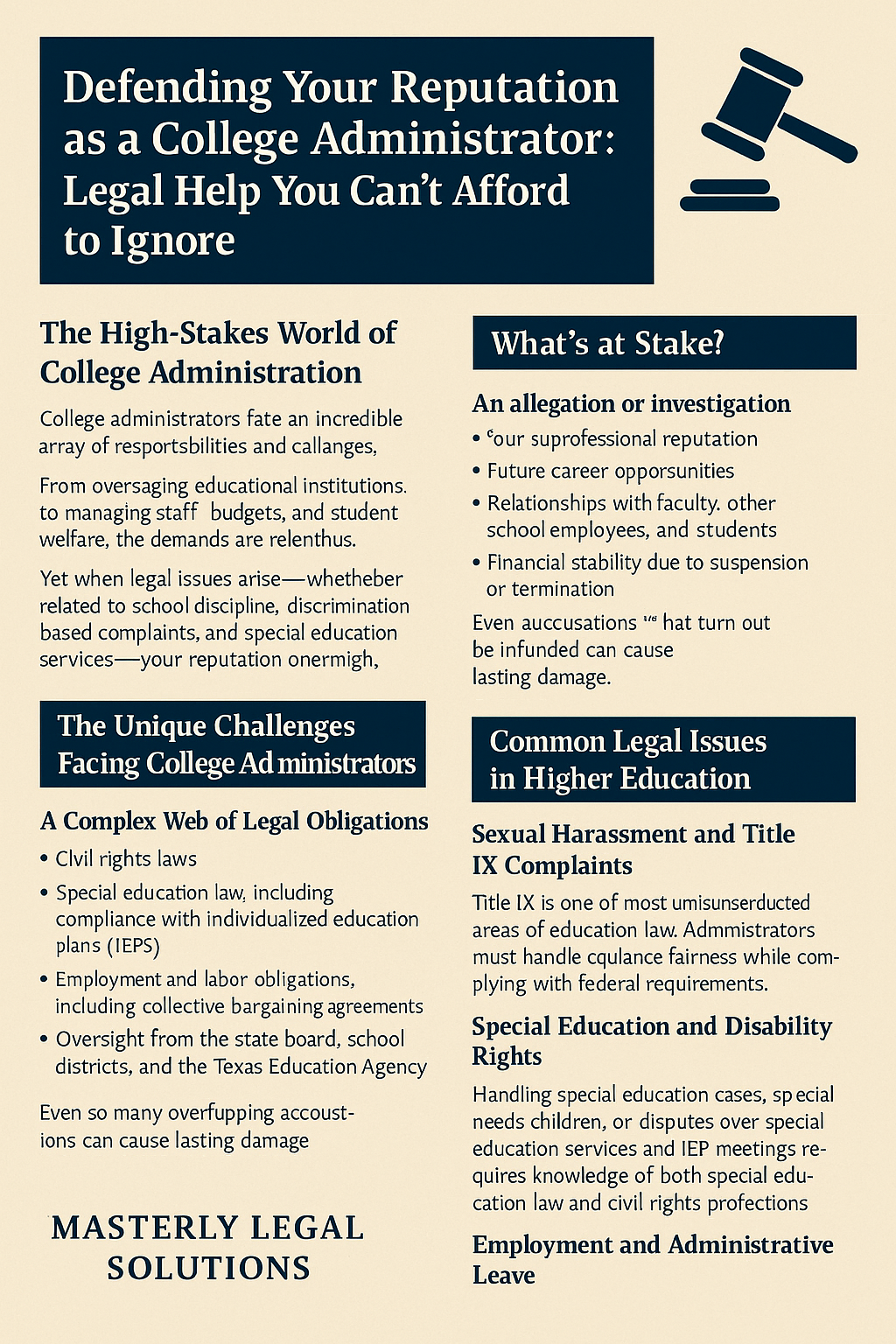
A poster about defending your reputation as a college administrator


Our Approach: Comprehensive Legal Services


Legal Services Tailored to Education

Our attorneys understand the nuances of public education, private schools, non profits, and charter schools. We handle:

  • Special education cases involving special needs children
  • School discipline matters
  • Employment disputes with school employees
  • Administrative leave reviews
  • Disputes over special education services


Advocating for You, Not Just Representing Institutions

While many education lawyers focus on representing students or representing families, our firm is uniquely equipped to defend school administrators and other school employees facing legal challenges.


Safeguarding Your Career and Reputation


Protecting What You’ve Built

You have dedicated your career to improving education systems, supporting teachers, and guiding students. But when legal troubles arise, you need an advocate to:

  • Preserve your reputation in the educational field
  • Defend your rights under state and federal laws
  • Navigate the intricate requirements of the Texas Education Agency
  • Help you through disciplinary proceedings and administrative hearings


When to Call an Education Attorney

You should contact an education attorney immediately if you:

  • Receive notice of a disciplinary hearing
  • Are placed on administrative leave
  • Are accused of violating Title IX
  • Face complaints about handling special education or disabilities
  • Become aware of pending legal issues or investigations


Our Commitment to College Administrators


A Partner in Challenging Times

Masterly Legal Solutions stands beside you when you need it most. Our education attorneys provide:

  • Clear, practical advice
  • Direct representation in legal proceedings
  • Proactive strategies to minimize risk
  • Support through every stage of the legal process


What Sets Our Law Firm Apart

  • Deep expertise in education law matters
  • A track record of success in defending school administrators
  • Knowledge of civil rights, special education law, and employment disputes
  • Personalized attention to every case


How We Help in Special Education and Disability Cases


Navigating the Special Education Process

Disputes over special education services can entangle administrators in:

  • Process hearings under IDEA
  • Challenges to individualized education plans
  • Claims of discrimination against special needs children


We guide you through these complex issues to safeguard both institutional integrity and student rights.


The Importance of Strategic Defense in Disciplinary Hearings


Preparing for the Best Outcome

In disciplinary hearings, preparation is everything. Our education lawyers help by:

  • Reviewing evidence and allegations
  • Preparing your testimony and witnesses
  • Identifying procedural errors
  • Ensuring a fair process


Addressing Title IX and Discrimination Issues


Managing Sensitive Allegations

Accusations of discrimination based on sex, race, or disability can end careers. Our attorneys help you:

  • Comply with Title IX requirements
  • Avoid common procedural mistakes
  • Defend against false or exaggerated claims
  • Protect your rights and reputation


Defending Against Employment-Related Actions


Keeping Your Job and Future Intact

From administrative leave to termination, employment actions can devastate your career. We help you:

  • Challenge unfair employment actions
  • Negotiate settlements when appropriate
  • Protect your rights under employment law


Empowering You with Knowledge


Understanding the Legal Landscape

We believe informed clients make better decisions. That’s why we:

  • Explain the relevant laws and procedures
  • Clarify your legal options
  • Help you anticipate potential outcomes


Acting as Your Advocate in All Education Law Matters


Serving Administrators Across the Education Spectrum

Our legal services cover:

  • Public schools
  • Private schools
  • Charter schools
  • Special education cases
  • School discipline and employment issues


We’re Here to Help You Navigate Complex Issues

When you’re facing challenges in the education field, you need a team with the skills, knowledge, and determination to protect you. We are ready to stand with you and advocate for your best interests.


Experienced Education Lawyers Offer Critical Legal Support in Educational Disputes

When educational disputes arise, having school lawyers and an experienced education lawyer on your side can make all the difference in safeguarding your future. For Texas educators, facing challenges such as employment termination, misconduct allegations, or contractual disagreements can feel overwhelming without proper legal support. At universities and colleges, many educators have spent years building a strong reputation, only to see it jeopardized in a matter of days when legal problems strike.


In such cases, our attorneys work diligently on your behalf, focusing on gathering evidence, analyzing policies, and crafting a defense strategy tailored to the unique needs of educators and administrators. Whether you’re a department chair or senior administrator, our team understands the high stakes involved and is prepared to defend your career, reputation, and standing within the academic community.


Protecting the Careers of Texas Educators with Skilled Legal Advocacy

Texas educators face unique challenges in today’s academic environment, where legal risks are higher than ever and reputations can be damaged quickly. College administrators and faculty members across universities often encounter issues like contract disputes, employment termination, Title IX investigations, and disciplinary actions. Without experienced legal guidance, Texas educators may struggle to navigate these complex challenges, risking both their careers and their professional standing.


At Masterly Legal Solutions, we are dedicated to defending the rights and reputations of Texas educators by providing knowledgeable, strategic legal representation. Our team understands the intricacies of state regulations, board policies, and institutional procedures, ensuring that administrators and faculty receive the strongest possible defense when it matters most. Contact Us Today for a Free Consultation


If you are a college administrator facing legal challenges or accusations that threaten your career, don’t wait until it’s too late. Contact Masterly Legal Solutions today at (972) 236-5051 for a free consultation. Our education law specialists are ready to discuss your situation, answer your questions, and help you understand your options. We are here to protect your reputation, career, and future in the education field.


Disclaimer: This post is meant primarily as information and does not create a client-attorney relationship or offer legal advice. For situation-specific counsel, please speak with an attorney.
(972) 236-5051
November 6, 2026
A parent complaint, student allegation, or unexpected meeting with school leadership can place a private-school teacher's career at risk. What begins as an internal concern may l ead to administrative leave, a formal investigation, disciplinary action, or termination. For educators facing private school teacher employment investigations in Texas, understanding the employment relationship is essential. Private schools operate under different rules than traditional public school districts. Those differences can affect employment contracts, investigation procedures, disciplinary decisions, and available legal protections. A teacher may be asked to provide a written statement, attend an interview, or resign before fully understanding the allegations. Each decision can affect future employment, professional reputation, and, in certain cases, educator certification. Masterly Legal Solutions provides legal guidance to Texas educators facing employment investigations, workplace allegations, and professional disciplinary concerns. An attorney can review the relevant d ocuments, evaluate potential risks, and help determine appropriate steps before important employment decisions are made. 1. How Private-School Employment and Public-School Employment Differ Private schools and public school districts serve students, but their employment systems are not identical. Texas public school districts generally employ qualifying teachers under probationary, term, or continuing contracts governed by Chapter 21 of the Texas Education Code. These arrangements may provide specific procedures for contract termination, nonrenewal, and employment disputes. Private schools generally do not operate under those same statutory teacher-contract requirements. Instead, the employment relationship may be controlled by an individual agreement, school policies, and applicable state and federal employment laws. Why Private-School Employment Agreements Matter A private-school teacher may work under a fixed-term contract or an at-will employment arrangement. The difference can affect how a school handles discipline, termination, and contract renewal. For example, a written agreement may explain: The length of employment and renewal conditions. Grounds for discipline or termination. Required notice before certain employment decisions. Internal complaint or grievance procedures. Responsibilities involving student safety and professional conduct. Resignation requirements and possible contractual consequences. Private schools may also have religious missions or institutional policies that affect certain employment disputes. Applicable legal protections depend on the school's structure, the employee's responsibilities, and the specific claim. Teachers should not assume that public-school appeal procedures automatically apply to their private-school positions. Masterly Legal Solutions can examine the employment relationship and identify which contractual provisions and legal protections may apply when an investigation threatens a teaching career. 2. What to Retrieve From an Employment Agreement and Staff Handbook A school investigation may begin with limited information. An administrator might request an immediate meeting without explaining whether the concern involves classroom performance, student conduct, a parent complaint, or alleged policy violations. Before responding, it is important to identify the documents that establish the teacher's employment obligations. Private School Employment Agreement and Contract Provisions An attorney may need to review the signed employment contract, offer letter, renewal agreement, any amendments, and any available background-check paperwork or pre-employment screening documents. These records may explain whether the school must follow particular notice procedures, whether the teacher has a contractual right to respond, what job the teacher was hired to do, and what happens if either party ends the employment relationship early. Hiring records may also show whether the school checked the TEA Do Not Hire Registry and followed any required screening rules before employing the applicant. Private schools are not generally required by the state to run criminal-history checks, though qualified private schools may access national criminal history information and may keep those records if screening was performed. Some agreements also describe assigned duties, and some contain confidentiality, dispute-resolution, or separation provisions that deserve careful review. Background-check materials may also reflect Fair Credit Reporting Act procedures, Texas DPS Sex Offender Registry screening, or pre-employment affidavits required in some Texas educational settings. Staff Handbook and Investigation Policies The staff handbook may contain additional rules concerning: Employee conduct and professional boundaries. Reporting student or parent complaints. Investigations and disciplinary procedures. Administrative leave and workplace restrictions. Confidentiality and student information. Employee grievance or appeal procedures. A handbook does not automatically create an enforceable employment contract. Its legal effect depends on its language, disclaimers, and the surrounding employment agreement. Performance Records and Written Notices Relevant records may also include teaching assignments, prior evaluations, documented performance concerns, emails from administrators, investigation notices, and meeting invitations. These materials can help establish what the teacher was expected to do and whether earlier concerns are related to the current allegations. Teachers should preserve records they are lawfully permitted to retain. They should not access restricted school systems, remove confidential student files, or forward protected information to personal accounts without authorization. Masterly Legal Solutions can review available employment documents and help determine whether additional records should be requested through appropriate legal procedures. 3. How to Document a Parent or Student Complaint Without Contacting Witnesses A parent or student complaint can create immediate concern for a teacher's professional standing. Allegations may involve classroom discipline, inappropriate communication, unfair treatment, supervision, student safety, or suspected misconduct. Not every complaint establishes wrongdoing. However, an educator's response may become part of the school's official investigation record. Preserve a Clear Timeline of Events An accurate timeline can help legal counsel understand what happened before and after the complaint. A teacher may record the dates of relevant events, the nature of any official communications, when the allegation was disclosed, and what instructions school leadership provided. The timeline should distinguish personally observed facts from assumptions, secondhand information, and matters the teacher cannot confirm. Avoid Independent Witness Contact Teachers may feel tempted to contact students, parents, or colleagues to explain their position or ask what they witnessed. During an active investigation, that approach can create additional risks. Even well-intended conversations may be interpreted as attempts to influence witnesses, interfere with the investigation, or violate school confidentiality rules. Rather than conducting an independent inquiry, educators should discuss witness-related concerns with legal counsel. An attorney can assess appropriate ways to identify relevant evidence and address factual disputes without creating unnecessary complications. Protect Student Privacy Student records and communications may contain protected or sensitive information. Federal privacy requirements, school confidentiality policies, and other applicable laws may restrict how those records are accessed or shared. An educator should not assume that documents needed for a defense can be copied or disclosed without permission. Masterly Legal Solutions can help evaluate relevant evidence, confidentiality concerns, and lawful ways to obtain information needed for an employment defense. 4. When an Investigator, School Leader or Licensing Body Becomes Involved Private-school investigations can involve different decision-makers depending on the allegation and the school's internal policies. An initial complaint may be reviewed by a principal, head of school, human resources representative, governing board, or outside investigator. The school's response may involve interviews, document review, administrative leave, or disciplinary recommendations. Internal School Investigations Internal investigations generally focus on whether an employee violated an employment agreement, staff policy, or workplace expectation, and the review may also consider the nature and severity of the alleged conduct, including reported behavior, when the school decides how to proceed. Teachers may receive instructions not to discuss allegations, communicate with certain individuals, or enter school property while the review is pending. Administrative leave does not automatically establish misconduct. However, the terms of that leave may affect compensation, benefits, access to records, and employment status, and schools may outline possible outcomes before reaching a final decision. An attorney can evaluate whether the school's actions are consistent with applicable employment agreements and laws and whether the process is fair. Texas Education Agency and Certification Concerns A private-school investigation may also create state-level concerns. Texas does not generally require private-school teachers to hold state teaching certification. However, certified private-school educators may still face educator certification consequences when allegations fall within the authority of the Texas Education Agency (TEA) or State Board for Educator Certification (SBEC). In that role, TEA reviews and evaluates misconduct allegations against Texas educators to enforce professional standards and protect students, and it may evaluate criminal history information during the matter. Texas Education Code Section 22A.301 also establishes reporting requirements for specified misconduct involving private-school employees or applicants. Certain allegations may require reporting even if the employee resigns before the investigation is completed. The legal significance depends on the alleged conduct, the reporting law, and the employee's circumstances. An internal school employment decision and a state educator investigation are separate processes. Their procedures and possible consequences may differ, including what is investigated, whether a person is subject to state action, and whether state review leads to different investigative steps or disciplinary outcomes tied to high standards than the school's own employment process. When Allegations Extend Beyond Employment and Lead to Disciplinary Outcomes Certain complaints may involve suspected child abuse or neglect, criminal conduct, discrimination, physical abuse, or other matters requiring outside reporting or investigation where student health or safety may be at issue. These situations can involve agencies or authorities beyond the private school. Private-school teachers remain subject to general Texas criminal laws and mandatory-reporting statutes, including the duty to report suspected child abuse or neglect immediately to law enforcement, child protective services, or the police as required for compliance. In child-abuse matters involving private schools, Texas DFPS may conduct the investigation, and Texas law requires training for mandatory reporters to recognize signs of abuse. Legal guidance becomes particularly important when an educator faces overlapping employment, certification, or criminal concerns. Masterly Legal Solutions can help assess the nature of the allegations, identify the applicable processes, and address legal risks affecting the educator's professional future, including when a teacher should not be penalized for making a required child-abuse report. 5. Questions to Ask Counsel Before Written Statements, Resignation or Agreement An educator may face pressure to respond quickly after receiving an investigation notice. School leadership might request a written explanation, schedule an interview, or present a proposed separation agreement. Before making a significant employment decision, legal counsel can help clarify the teacher's rights, responsibilities, and potential consequences. Should I Provide a Written Statement Immediately? Written statements can influence how an investigation develops. A statement prepared without understanding the allegations may contain unnecessary assumptions, incomplete explanations, or wording that creates confusion. An attorney can review the request, evaluate deadlines, and advise on an appropriate response. Legal review does not necessarily mean refusing to cooperate. It helps educators understand their obligations before providing information that may affect future proceedings. Could Resigning End the Investigation? Resignation does not necessarily stop an investigation or prevent a required report. In certain misconduct cases, the school may remain obligated to report information to the appropriate state authority even when the employee leaves. A resignation may also affect contractual obligations, compensation, benefits, or future employment references. Teachers should understand these consequences before submitting a resignation letter, and should also consider whether any contract, association, collective bargaining rights, or other collective-representation rights may affect how the matter should be handled, including what support may be available to members. What Should I Review Before Signing an Agreement? A school may offer a resignation agreement, settlement, release, or other employment-related document. Before signing, educators should ask whether the agreement affects: Unpaid wages, benefits, other compensation, or pay. Confidentiality and nondisparagement obligations. Employment references, future opportunities, and how criminal-history information may be used by later employers in employment decisions. Potential legal claims or waivers of rights. Continuing reporting obligations. Existing employment contract requirements. When criminal-history information is at issue, employers should make an individualized assessment of its relevance and should not discriminate unlawfully during hiring. The meaning and enforceability of each provision depend on the agreement and applicable law. How Can Masterly Legal Solutions Help? Masterly Legal Solutions provides education-law representation and legal guidance for educators facing employment and professional disciplinary matters. Depending on the circumstances, legal services may include reviewing contracts and investigation notices, assessing applicable employment protections, evaluating evidence, advising on interviews or written statements, and addressing proposed employment actions. Early legal consultation can help teachers make informed decisions before a workplace complaint develops into a larger career concern. Employment Contract Lengths and Early Termination Risks Private schools ma y offer one year contracts or agreements lasting two years, three years, or four years, depending on the institution and position. Teachers who need to end a contract early should understand their contractual obligations before submitting a resignation. Leaving before an agreement expires may create disputes involving notice requirements, compensation, or other employment terms. Masterly Legal Solutions can review employment agreements and advise educators about their legal options before m aking important career decisions. Paid Sick Leave, Unpaid Time, and Employee Benefits Employment investigations can ra ise questions about paid sick leave, administrative leave, and unpaid time away from work. Unlike traditional public school districts, private schools may establish their own leave policies within applicable employment laws. Teachers should understand whether their employment agreement provides paid leave, whether any protected unpaid l eave applies, and how an investigation could affect wages or benefits. Legal counsel can help evaluate these issues when an educator's financial stability and professional future are at stake. Private Schools, Charter Schools, and Preschool Employment Protections Employment rights can differ among private schools , charter schools, and preschool programs in Texas. These institutions may operate under different legal structures, employment contracts, and government regulations. Classroom teachers, teaching assistants, and other individuals working in educational settings may face complaints involving student supervision, professional conduct, or workplace policies. Masterly Legal Solutions can assess the employment relationship and identify the protections and obligations relevant to each educator's circu mstances. School Supervisors, Investigation Teams, and Family Complaints A workplace investigation may begi n after a complaint from a student, parent, or family member. School supervisors, administrators, or an internal investigation team may review allegations using information gathered from multiple sources, including employment records, witness statements, and school communications. Educators should avoid contacting potential witnesses independently or disclosing confidential student information. An attorney can help assess the investigation process and provide guidance before the employee participates in formal interviews or submits written statements. Regulatory Compliance, Department Investigations, and Civil Penalties Texas private schools mu st ensure compliance with applicable employment laws, student safety requirements, and reporting regulations. Depending on the allegations, an investigation may involve the Texas Education Agency, the Department of Family and Protective Services, or another government department. Certain statutory violations may expose responsible parties to civil penalties or other legal consequences, depending on the law and circumstances. Educators facing investigations involving outside authorities shoul d seek legal advice to understand their rights, reporting obligations, and potential professional consequences. Key Takeaways: Understanding Your Rights During a Private-School Investigation The key takeaways for Texas private-school educators include understanding employment contracts, preserving relevant records, reviewing investigation procedures, and seeking legal counsel before making significant decisions. This article provides general information about private-school employment investigations and does not replace advice tailored to an individual situation. Masterly Legal Solutions can help teachers evaluate allegations, understand potential employment consequences, and determine appropriate legal options.
November 5, 2026
A complaint at a Texas charter school can quickly place an educator's employment, professional reputation, and future career opportunities at risk. A written allegation, unexpected leave notice, or contract dispute may leave teachers and staff unsure about their rights or what the school can legally require. Unlike traditional public school districts, Texas charter schools operate under different governance and employment rules. These differences can affect how investigations proceed, whether an employee has certain contract protections, and which grievance procedures apply. Understanding texas charter school educator investigation rights is important for certified teachers, administrators, and noncertified employees facing workplace allegations. A charter school investigation may involve internal policies, employment agreements, state education regulations, or professional certification concerns. The applicable rules depend on the school's structure and the employee's position. Masterly Legal Solutions provides legal guidance for Texas educators facing investigations, employment disputes, and professional disciplinary concerns. Early consultation allows an attorney to examine the relevant documents, identify possible deadlines, and assess the educator's legal options before important decisions are made. How Charter School Governance and Employment Documents Differ From Traditional Districts Texas open-enrollment charter schools are public schools, but their employment relationships do not automatically follow the same rules as independent school districts (ISDs). Traditional school districts generally employ certain educators under probationary, term, or continuing contracts governed by the Texas Education Code. These arrangements provide statutory rights and procedures that may apply to contract renewal, termination, or other employment decisions. Charter schools often operate differently. Some charter schools use written employment agreements with specific terms. Others employ staff under at-will arrangements, subject to applicable laws and contractual limits. As a result, an educator should not assume that the protections available to an ISD teacher automatically apply to a charter school position. Why Charter School Employment Agreements Matter A charter school's governing documents, employment agreement, and adopted policies may help determine: Whether employment is at-will or governed by a fixed-term agreement. Who has authority to investigate or make employment decisions. What procedures apply to employee complaints or discipline. Whether an employee has internal appeal or grievance rights. How contract renewal, nonrenewal, or termination decisions are handled. Whether specific notice requirements or deadlines apply. The school's legal structure also matters. An open-enrollment charter school, a district-authorized charter campus, and a campus operated through a district partnership may involve different legal arrangements. Charter schools are not simply private schools. They operate within Texas public education and remain subject to applicable state and federal requirements. However, public school s tatus does not automatically provide every employment protection available in a traditional district. Masterly Legal Solutions c an review the educator's employment relationship and applicable school policies to determine which legal protections may apply to the dispute. Early Steps After an Educator Misconduct Complaint, Temporary Removal, or Written Allegation An educator may first learn about an investigation through an email from human resources, a meeting request, a written complaint, or a notice of temporary administrative leave tied to alleged educator misconduct. Sometimes, the notice provides little information about the allegations, including claims involving abuse, and being placed on leave is not a final determination. The school may ask for a written statement, request an interview, restrict campus access, or place the employee on leave while reviewing the complaint. These actions can create serious uncertainty, which is why immediate legal review is often critical. Why an Investigation Notice Deserves Legal Attention Temporary removal does not automatically mean an employee has committed misconduct. Schools may use administrative leave while collecting information or reviewing complaints involving alleged educator misconduct or suspected abuse. However, the terms of that leave may affect compensation, benefits, access to records, and employment status, and leave is not a final determination. An attorney may need to determine whether the notice is consistent with the employee's agreement, applicable policies, and due process protections. Legal review is especially important when the allegations involve: Student safety or inappropriate conduct. Professional boundary concerns. Workplace harassment, discrimination, or civil rights complaints. Failure to follow school policies. Alleged contract violations or performance concerns. Misuse of school resources or confidential information. Conduct that could trigger a report to the Texas Education Agency. Certified educators may face concerns beyond their current employment. Certain misconduct allegations can lead to review by the Texas Education Agency (TEA), and the available evidence may affect possible action involving the State Board for Educator Certification (SBEC) and an educator's certificate. Noncertified employees may also face state-level employment eligibility concerns in certain misconduct cases. An internal school investigation and a state regulatory investigation are separate matters. Their legal standards, procedures, and possible consequences may differ, especially where Texas law, state law, or school district reporting requirements may require a principal or superintendent to provide notice, ensure a report is filed within seven business days, or address related reports while administrators comply with agency rules. Obtaining legal advice before providing a detailed written response can help an educator understand which process is involved, protect process rights, prepare for possible disciplinary actions or administrative hearings, and assess whether allegations tied to children, special education services, procedural errors, or other issues could expand beyond an internal employment matter. What to Preserve: Contract, Handbook, Assignment, Communications, and Notices Texas charter school educator investigation rights often depend on documents that explain the employee's responsibilities, the school's policies, and the decisions made during an investigation. A legal consultation becomes more useful when counsel can examine reliable records rather than relying only on verbal descriptions. Several categories of documents may be especially important. Employment Contracts and Appointment Documents Signed contracts, offer letters, renewal agreements, and employment amendments can establish the terms of the working relationship. These records may show whether employment is at-will, whether notice provisions apply, and what contractual obligations exist. They can also help counsel evaluate allegations involving contract violations or termination. Employee Handbooks and Governance Policies Employee handbooks may explain workplace conduct rules, investigation procedures, grievance processes, and disciplinary standards. The version in effect when the relevant events occurred may be particularly important. An attorney can examine whether the school's actions are consistent with applicable policies and whether those policies create enforceable obligations. Job Assignments and Performance Records Job descriptions, assignment letters, duty schedules, evaluation records, and previous performance notices may help explain an educator's responsibilities. These materials can provide context when an allegation concerns supervision, workplace expectations, professional duties, or performance. Emails, Messages, and Written Communications Relevant communications may include messages from administrators, human resources personnel, supervisors, and other individuals involved in the matter. Dates, wording, and context may help establish a timeline. Educators should preserve records they are legally permitted to retain. They should not access restricted systems, remove confidential student information, or forward protected records to personal accounts without proper authorization. Investigation Notices, Disciplinary Actions, and Contract Actions Written allegations, leave notices, meeting invitations, disciplinary letters, proposed separation agreements, and termination notices may establish important facts and deadlines. These documents can help counsel determine whether immediate legal action or a timely response may be necessary. Related reports or other evidence tied to the communication chain may also matter when evaluating the investigation timeline, response, and any resulting disciplinary actions, including situations where school action may continue after a resignation. Preserving records does not mean collecting every school document . It means identifying relevant, lawfully accessible information while respecting student privacy and confidentiality requirements. Masterly Legal Solutions can help educators determine which materials are relevant to their legal circumstances and whether additional records should be requested through appropriate procedures. Questions for Counsel Before a Written Statement or Grievance Decision An educator may feel pressure to respond immediately after receiving an allegation. However, statements made during an employment investigation can become part of the school's decision-making record. In some circumstances, information may also be reviewed by outside agencies. Before responding, legal counsel can examine the allegations, the employment relationship, and any deadlines. Does the Charter School Have Authority to Take the Proposed Action? A lawyer can review whether the relevant administrator or governing body has authority under the school's policies and employment arrangements. The review may also address whether required notices or procedures apply. Is a Written Statement Required? The answer depends on the applicable employment terms, policies, and legal circumstances. Counsel can assess the request, the scope of the allegations, and the potential consequences of providing a statement. The goal is to make an informed decision without overlooking an existing duty to cooperate or respond. Is a Formal Grievance the Appropriate Response? Not every employment dispute follows the same grievance route. Texas charter schools may maintain their own employee complaint procedures, with specific filing requirements and deadlines. TEA directs many local employment concerns to the school or charter operator's internal grievance process rather than handling the underlying workplace dispute itself. Missing an applicable deadline can limit available options. An attorney can review whether a grievance, contractual claim, agency complaint, or another legal process may be appropriate. Could the Investigation Affect Professional Certification or Texas Education Agency Reporting? Certified educators should consider whether the allegations may involve TEA or SBEC review. An employment decision and a certification matter can have different consequences. Counsel can evaluate the relationship between these proceedings and help determine what representation or response may be needed.  Why Legal Representation Matters Before a Decision An employment investigation can involve several connected issues, including contracts, workplace policies, regulatory duties, and professional reputation. Without a careful legal review, an educator may misunderstand which procedures apply or overlook a significant provision in an employment agreement. Masterly Legal Solutions provides individualized legal guidance based on the educator's documents, allegations, and professional circumstances. The firm can assess applicable rights, explain available legal options, and assist with appropriate responses or proceedings based on the scope of representation.
Texas paraprofessional misconduct investigation and legal defense.
November 4, 2026
Facing a Texas paraprofessional misconduct investigation? Understand allegations, reporting requirements, and how experienced legal counsel can protect your rights.
STAAR testing irregularity investigation involving Texas educators and test security allegations.
November 3, 2026
Facing a STAAR testing irregularity investigation? Masterly Legal Solutions defends Texas teachers, coordinators, and campus administrators facing allegations.
Business ethics training on workplace policies and compliance.
October 26, 2026
Business Ethics Training: Turn workplace policies into defensible practices. Explore compliance, employee conduct, and training needs with Masterly Legal Solutions.
Misappropriation of funds legal guidance and financial records review.
October 21, 2026
Understand what misappropriation of funds involves, how to preserve financial records, and when to seek experienced legal guidance before taking appropriate action.
NIL law, athlete contracts, and school compliance guidance
October 20, 2026
Explore NIL law in school athletics, institutional compliance, contract concerns, and when schools may need experienced legal guidance to protect their interests.
Texas Medical Board complaint, physician license defense, and legal guidance.
October 19, 2026
Texas Medical Board Complaint. Convert licensed physicians facing TMB complaint notices. Explore practical next steps and request a confidential consultation.

Looking for Legal & Business Solutions? Contact Us Now

Fill in the form or call us to set up a meeting

(972) 236-5051
A black and white drawing of a straight line on a white background.