
Teachers Under Investigation: Why Houston ISD’s Procurement Violations Still Put Educators at Risk
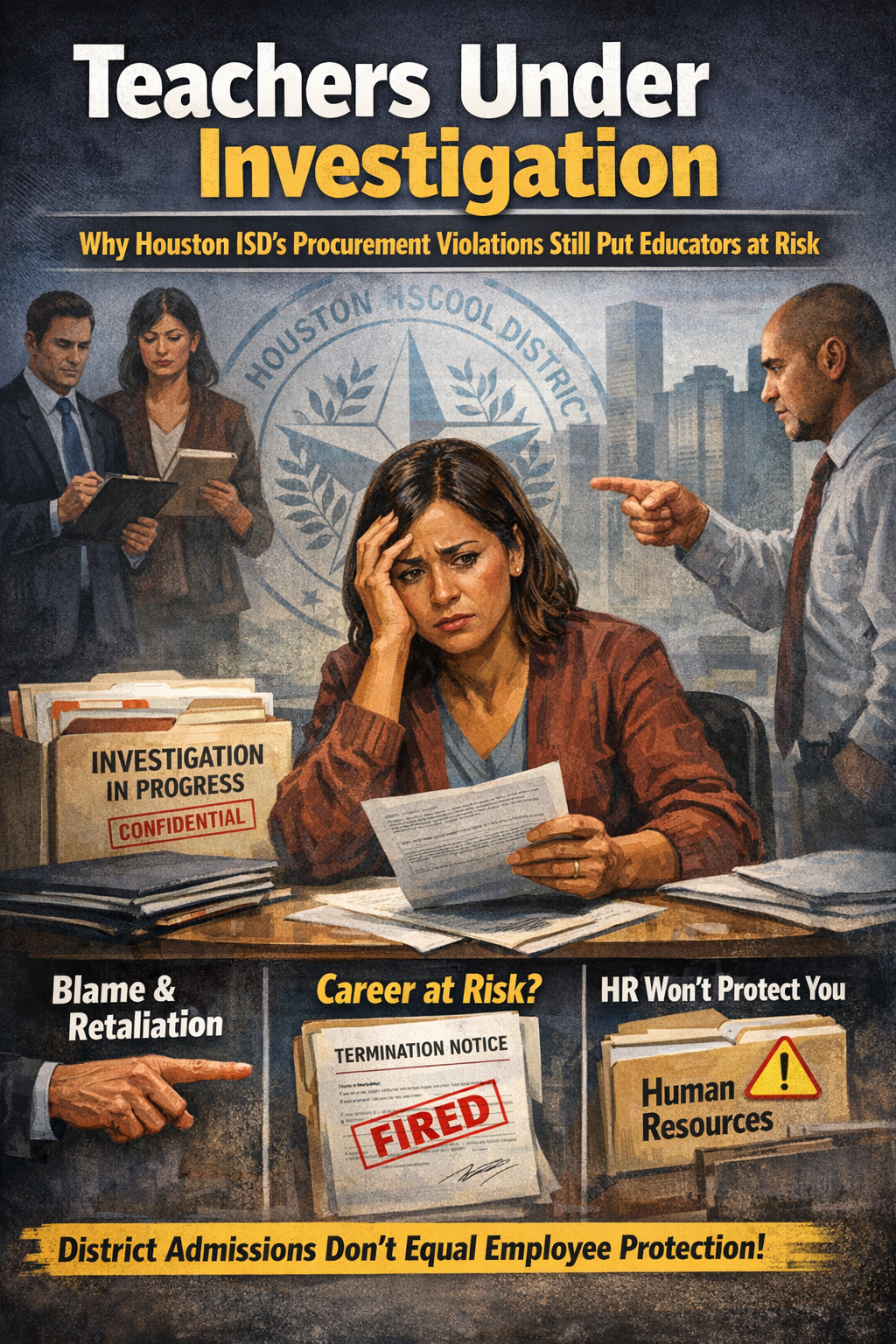
When a large school district publicly admits mistakes, many teachers assume the danger has passed. That assumption can be costly. Even when houston isd admits it violated procurement policy, the reality is that investigations rarely end with institutional accountability alone. Instead, attention often shifts quietly and aggressively toward the individual employee.
Teachers and staff members are frequently placed in an impossible position. They trusted internal systems, followed instructions from a supervisor or manager, and relied on guidance from the human resources department. Yet once a state agency or federal oversight body steps in, those same employees may find themselves singled out, questioned, and exposed.
At Masterly Legal Solutions, we see this pattern repeatedly. District admissions do not equal employee immunity. In many cases, they create the conditions for heightened scrutiny, retaliation, and long-term professional damage for educators who believed they were safe.
Why District Accountability Does Not Equal Employee Protection
A public admission by an employer can feel reassuring at first. It suggests transparency and responsibility. However, from a legal standpoint, those admissions often trigger deeper reviews under federal and state laws that focus on individual conduct.
Regulators and investigators are tasked with identifying who approved, processed, or benefited from the actions in question. That means teachers, administrators, and staff members become individual employees of interest. Even routine involvement can be framed as a possible violation.
For a reasonable employee, this shift is rarely expected. Many believe that acting under direction shields them from exposure. Unfortunately, investigations often reinterpret actions through hindsight, not workplace reality.
How TEA Investigations Shift Risk Onto Teachers
When the Texas Education Agency initiates or expands an investigation, its mandate is enforcement. The agency is not focused on preserving employee morale or protecting careers. Its role is to determine responsibility under applicable laws. For more details on what to do after being notified of a TEA investigation, learn about essential steps to protect your certification and career.
In practice, this can mean blame is redistributed. Even when policies were unclear or procurement systems failed, individual employees may be accused of noncompliance. The risk grows when documentation is incomplete or when verbal instructions came from a supervisor who now denies involvement.
This is where retaliation occurs quietly. Teachers who cooperate, answer questions, or raise concerns may later experience adverse actions that appear unrelated but carry a negative impact.
Early Statements Can Permanently Damage Careers
One of the most dangerous moments in any investigation is the first interview. Teachers often believe honesty alone will protect them. While truth matters, unrepresented statements can be misunderstood, misquoted, or taken out of context.
Investigators are trained to gather admissions, not explanations. A single comment can later be cited as justification for disciplinary action or termination. Performance reviews, once positive, may suddenly reflect concerns that never existed before.
This risk is especially high when teachers speak without legal assistance or guidance from employment lawyers familiar with education investigations.
The Illusion of Protection From Human Resources
Many educators turn to human resources expecting support. After all, HR policies and the employee handbook are supposed to protect workers. In reality, human resources serves the employer, not the employee.
When investigations arise, the human resources department often becomes an information pipeline. Statements made in confidence may be shared with investigators or used to justify internal decisions. Teachers who rely solely on HR advice may unknowingly weaken their position.
This does not mean HR acts maliciously. It means their duty is aligned with the company or district, not the individual employee facing risk.
Procurement Violations Create Employment Law Exposure
Procurement issues rarely stay confined to financial policy. They frequently intersect with employment law, labor standards, and compliance obligations. Once investigators expand their scope, they may review work hours, overtime pay practices, and supervisory approvals.
Employees involved in procurement processes may also face scrutiny related to wages, contracts, and reporting structures. These reviews can trigger allegations under federal laws governing employment relationships.
What began as a policy lapse can quickly evolve into a multifaceted investigation affecting multiple workers.
Retaliation Is More Common Than Educators Expect
Retaliation does not always look dramatic. Often, it appears subtle and administrative. Teachers may notice schedule changes, reassignment, reduced responsibilities, or sudden criticism. These adverse actions can occur after protected activity such as cooperation with investigators or reporting discrimination.
Under Title VII and related laws, retaliation is prohibited. However, proving it requires careful documentation and legal strategy. Without guidance, many employees miss the connection until significant harm has already occurred.
The emotional toll on overall employee morale can be severe, especially when colleagues witness the consequences of speaking up.
Understanding Protected Activity in School Settings
Protected activity includes more than filing a lawsuit. It covers reporting discrimination, participating in an investigation, requesting job protected leave, or opposing unlawful practices. Many teachers engage in protected activity without realizing it.
When retaliation occurs after these actions, legal protections may apply. However, those protections are not automatic. They must be asserted correctly and supported by evidence.
Educators often assume that simply doing the right thing is enough. Unfortunately, enforcement depends on how and when complaints are raised.
Discrimination Risks During Investigations
Investigations can expose or worsen discrimination. Teachers may face disparate treatment based on age, disability, or other protected characteristics. Age discrimination claims often arise when senior educators are blamed while younger staff are spared.
The disabilities act and the civil rights act provide safeguards, but they require timely action. Delays in reporting discrimination can weaken claims and allow patterns to continue unchecked.
Workplace discrimination during investigations is not uncommon, particularly when leadership is under pressure to show accountability.
Sexual Harassment and Harassment Claims Can Surface
Procurement investigations sometimes uncover unrelated issues, including sexual harassment or hostile workplace conditions. When this happens, teachers may become potential witnesses or complainants.
Participating in these processes is protected, yet it also increases exposure to retaliation. False rumors may circulate, and reputations can suffer even without formal findings.
Harassment claims require careful handling to avoid additional harm, including emotional distress or physical harm stemming from workplace hostility.
The Role of Employment Contracts and Policies
Employment contracts and district policies play a significant role in determining rights and obligations. Many teachers are unaware of clauses that govern investigations, discipline, and termination.
These documents may outline procedures that the employer must follow. When those procedures are ignored, wrongful termination claims may arise. However, identifying violations requires legal analysis.
Teachers should never assume policies will be applied fairly without advocacy.
How FMLA Leave Becomes a Retaliation Target
Requests for FMLA leave or medical leave act protections can trigger scrutiny. Eligible employees who seek leave during investigations may later face allegations of misconduct or performance issues.
While fmla leave is job protected, retaliation complaints are common in these scenarios. Employers may frame actions as unrelated operational decisions.
Understanding how federal protections apply is essential for safeguarding employment.
Performance Reviews as a Retaliation Tool
Sudden changes in performance reviews often signal retaliation. Teachers with strong histories may receive negative evaluations after filing a formal complaint or engaging in other related protected activity.
These reviews can justify future adverse actions, including termination. Challenging them requires timely response and documentation.
Ignoring early warning signs can limit options later.
Why Teachers Are Not “Safe” After Admissions
District admissions often satisfy public pressure but leave employees exposed. Investigators still need accountability, and individual employees become the focus.
Teachers may be accused of violating policies they did not design or control. Without representation, they are vulnerable to narratives that shift blame downward.
Safety comes from preparation, not assumptions.
The Intersection of Labor and Education Law
Education investigations sit at the crossroads of labor law and administrative enforcement. Labor standards, employment act provisions, and federal oversight all apply.
Teachers are workers under these laws, even if their roles feel distinct. Understanding this intersection is critical to protecting rights.
Labor and employment lawyers are uniquely positioned to navigate these complexities.
Federal Employees and State Oversight
While teachers are not federal employees, federal standards often influence investigations. Agencies apply federal frameworks when evaluating conduct.
This means federal laws and state laws may both apply, increasing complexity. Missteps in one area can affect another.
Legal assistance helps coordinate responses across overlapping jurisdictions.
The Cost of Staying Silent
Some teachers choose silence to avoid conflict. Unfortunately, silence does not prevent discipline or termination. It may actually limit defenses later.
Filing a complaint or participating in an investigation can be risky, but failing to act may forfeit protections. Each situation requires careful evaluation.
There is no one-size-fits-all answer, only informed strategy.
Potential Witnesses and Collateral Damage
Teachers may be identified as potential witnesses even if they are not accused. This status still carries risk, including scrutiny of work history and conduct.
Statements made as a witness can later be used against the employee. Preparation is essential to avoid unintended consequences.
Witnesses deserve protection, but they must assert it.
Punitive Damages and Employer Exposure
When violations escalate, employers may face punitive damages. To reduce exposure, they may discipline or fire employees to demonstrate corrective action.
This dynamic places individual employees in jeopardy. Loyalty to the company does not guarantee protection.
Understanding employer incentives helps explain why blame shifts.
Wrongful Termination After Investigations
Termination following an investigation is not always lawful. Wrongful termination claims may arise when firings violate contracts, policies, or retaliation laws.
However, proving these claims requires evidence and timely filing. Delays can undermine otherwise strong cases.
Employment lawyers play a key role in evaluating options.
The Equal Employment Opportunity Commission’s Role
The equal employment opportunity commission investigates discrimination and retaliation complaints. Teachers may file charges when internal remedies fail.
EEOC processes are procedural and deadline-driven. Missing a filing window can end a claim entirely.
Strategic guidance ensures compliance with requirements.
Workplace Safety and Occupational Concerns
Investigations can also expose occupational safety issues. Stress, harassment, and retaliation can lead to physical harm or health problems.
Occupational safety obligations extend beyond physical environments. Employers must address psychological safety as well.
Failure to do so can compound liability.
Employer Narratives Versus Employee Reality
Employers often present polished narratives to investigators. Employees experience the reality on the ground.
Discrepancies between these perspectives matter. Documenting events contemporaneously strengthens credibility.
Relying on memory alone is risky.
Filing Complaints Strategically
Filing a complaint is a legal act, not just a workplace step. The timing, wording, and forum matter.
Complaints may trigger protections, but they also escalate conflict. Strategic planning balances risks and benefits.
Legal counsel helps navigate this decision.
The Impact on Employee Morale
Investigations ripple through workplaces. Fear, uncertainty, and silence spread quickly.
Overall employee morale suffers when colleagues see careers damaged. This environment discourages reporting future discrimination or misconduct.
Healthy workplaces require trust and accountability.
Resources Teachers Should Use Carefully
Not all resources are neutral. Internal hotlines, HR portals, and informal meetings may not protect employees.
External resources, including attorneys and advocacy groups, offer independent perspectives.
Choosing the right resources matters.
Why Early Legal Guidance Matters
Early involvement of attorneys can prevent mistakes. Guidance before interviews or filings preserves options.
Waiting until discipline occurs limits remedies. Proactive advice is often less costly than reactive defense.
Teachers deserve informed support.
How Masterly Legal Solutions Helps Educators
We focus on protecting educators during investigations. Our approach considers employment, discrimination, retaliation, and labor implications.
We understand how employers and agencies operate. This insight allows us to anticipate risks and respond effectively.
Our goal is to protect careers, not just resolve cases.
When to Seek Help
If you are contacted by investigators, asked to give a statement, or notice changes in treatment, it is time to act.
Do not assume admissions by the district protect you. Do not rely solely on internal assurances.
Your future deserves careful defense.
Contact Masterly Legal Solutions for Guidance
If you are a teacher or school employee affected by an investigation connected to Houston ISD procurement issues, we encourage you to speak with us. A free consultation can help clarify your rights, risks, and next steps before irreversible decisions are made. Investigations move quickly, and early action can make a meaningful difference in protecting your career and reputation.
Call (972) 236-5051 to schedule a confidential, no-obligation consultation with Masterly Legal Solutions. We are here to answer your questions and help you navigate this uncertain moment with clarity and confidence.
Disclaimer: This article is for informational purposes only and does not constitute legal guidance or legal advice. Reading this article does not create an attorney-client relationship. For advice specific to your situation, consult a qualified attorney.
Teacher Rights When Assaulted by a Special Needs Student: Safety, Reporting and Investigation Issues






Looking for Legal & Business Solutions? Contact Us Now
Fill in the form or call us to set up a meeting