

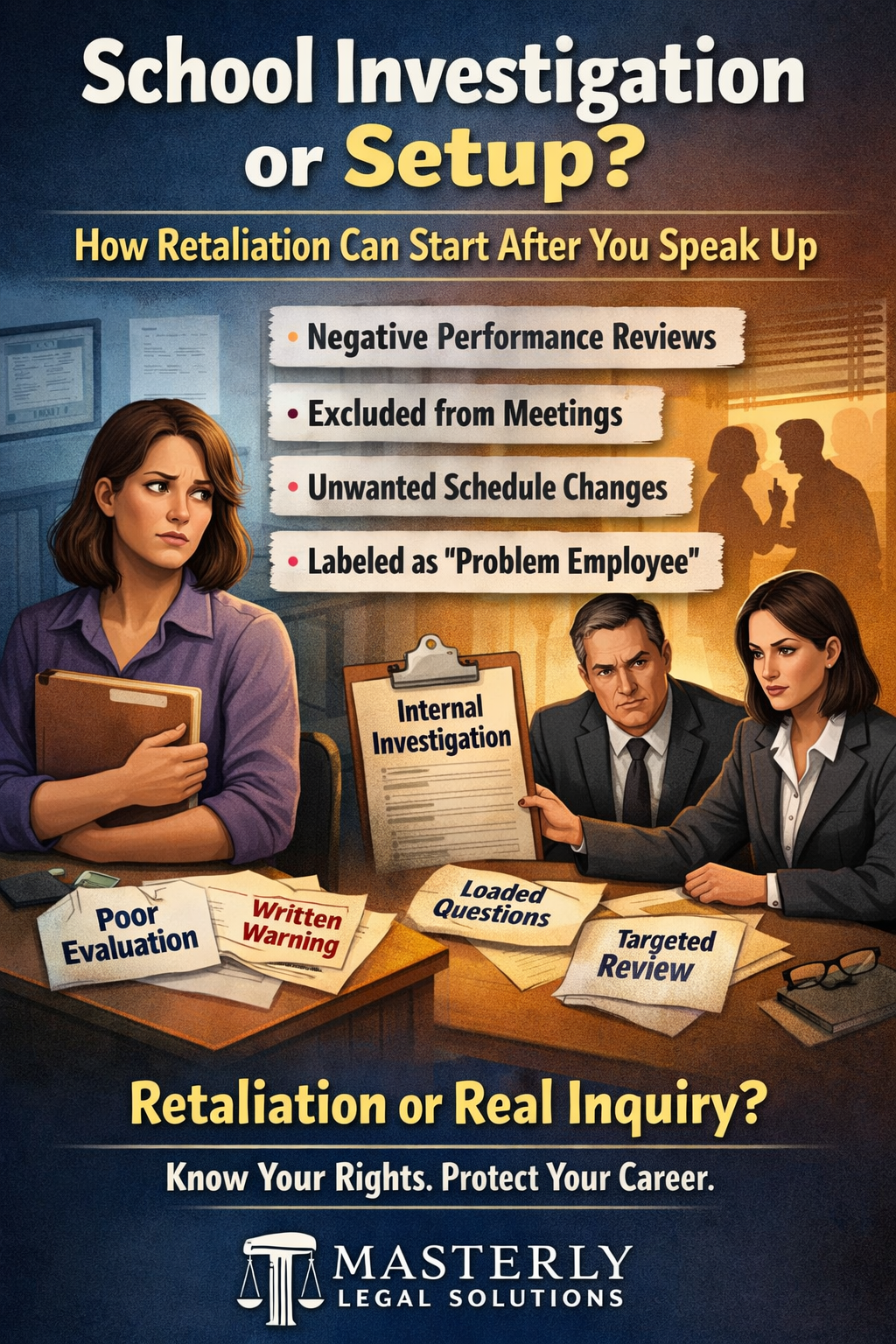
School Investigation or Setup? How Retaliation Can Start After You Speak Up
Speaking up in a school setting is rarely easy. Teachers often report wrongdoing because they believe it is the right thing to do, not because they want conflict. Yet many educators later find themselves asking a painful question: was this a real investigation, or was it a setup?
At Masterly Legal Solutions, we regularly hear from teachers who acted in good faith and then watched their workplace turn against them. Retaliation can begin quietly, disguised as policy enforcement or “routine review.” By the time an employee realizes what is happening, the damage may already be unfolding.
This article is written for educators who refused to go along with illegal acts, reported misconduct, or participated in investigations—and now feel targeted. Understanding how retaliation starts is the first step toward protecting your career.
When Doing the Right Thing Feels Dangerous
Most teachers enter education to help students, not to navigate employment law. Reporting misconduct, safety violations, or discrimination should not put your livelihood at risk. Unfortunately, workplace retaliation is far more common than many educators expect.
Retaliation often follows protected activity, such as reporting harassment or refusing to falsify records. The employer may never say the word “retaliation,” but the actions that follow can tell a different story. These patterns are well recognized in employment law.
Teachers are employees under both federal and Texas law, and their rights matter.
What Counts as Protected Activity in Schools
Protected activity is broader than most educators realize. It includes reporting discrimination, participating in an investigation, refusing to engage in unlawful discrimination, and raising concerns about illegal acts. Even cooperating with a government agency can qualify.
You do not need to be “right” to be protected. What matters is that you had a good faith belief that the conduct you reported was unlawful. Many anti discrimination laws are designed specifically to protect employees who speak up.
When an employee engages in protected activity, the employer is prohibited from retaliating.
How Retaliation Often Begins
Retaliation rarely starts with termination. Instead, it often begins with subtle changes that are easy to dismiss. These early steps can later support a retaliation claim.
Common early signs include:
- Sudden negative job performance feedback
- Increased scrutiny of job duties
- Exclusion from meetings or decision-making
- Schedule changes or undesirable assignments
These retaliatory acts may seem minor, but they can escalate quickly.
The Shift From Colleague to “Problem Employee”
Once an employee speaks up, the employer’s perception may change. A teacher who was once trusted can suddenly be labeled as “difficult” or “not a team player.” This shift often happens behind closed doors.
Managers may begin documenting trivial issues. Supervisors may reinterpret past conduct in a negative light. These actions help build a paper trail to justify later adverse employment action.
This pattern is common in workplace retaliation cases.
Investigations That Feel One-Sided
School investigations should be fair, but many are not. Teachers report that once they raise concerns, the focus shifts away from the misconduct and onto them. The investigation may feel less like fact-finding and more like fault-finding.
When the employer retaliated, the investigation itself can become a tool of pressure. Questions may be framed to elicit damaging answers. Context is often ignored.
An experienced attorney can identify when an investigation crosses the line into unlawful retaliation.
Adverse Employment Actions Explained
An adverse employment action is any action that would discourage a reasonable employee from engaging in protected activity. Termination is the most obvious example, but it is not the only one.
Other adverse actions may include demotion, pay reduction, denial of promotions, or significant schedule changes. Even placing an employee on a performance improvement plan can qualify in some cases.
These actions form the backbone of many retaliation claims.
Retaliation Versus Legitimate Discipline
Employers often argue that discipline was justified. The key legal question is timing and motivation. If discipline follows closely after protected activity, it raises red flags.
Employment lawyers analyze whether similarly situated employees were treated the same way. Inconsistent enforcement of workplace policies can suggest retaliation.
The employer’s explanation must align with the evidence.
Workplace Retaliation and Discrimination Overlap
Retaliation frequently overlaps with workplace discrimination. Teachers who report sexual harassment, age discrimination, or discrimination based on sexual orientation are especially vulnerable.
Federal law and state law prohibit both discrimination and retaliation. Reporting discrimination is itself protected activity.
When retaliation follows discrimination claims, the legal exposure for the employer increases significantly.
Sexual Harassment Reports and Retaliation
Reporting sexual harassment should never result in punishment. Yet many teachers who report harassment experience a hostile work environment afterward.
Colleagues may distance themselves. Supervisors may question the teacher’s motives. These reactions can amount to unlawful retaliation.
The civil rights act and other federal laws exist to prevent this exact scenario.
Age and Disability Concerns in Schools
Teachers over forty or those seeking reasonable accommodation under the disabilities act often face unique risks. Requests for accommodation or medical leave can trigger resentment.
Retaliation may follow requests under the medical leave act or for fmla leave. These protections apply to eligible employees, including full time employees in many school districts.
Retaliation in these contexts is illegal under federal and Texas law.
Human Resources Is Not Always Neutral
Many teachers turn to human resources expecting protection. While HR plays an important role, its primary duty is to the employer.
Complaints made to human resources may be shared with management or legal counsel. This does not mean reporting is wrong, but it does mean employees should proceed carefully.
An employment lawyer can help you decide how and when to raise concerns internally.
Retaliation After Refusing to “Go Along”
Some teachers are targeted simply for refusing to participate in illegal acts. This could involve altering records, ignoring safety violations, or misusing funds.
Refusal to engage in unlawful discrimination or illegal acts is protected activity. Retaliate against an employee for saying no is unlawful retaliation.
These cases often involve strong moral courage—and serious legal risk without guidance.
The Role of Federal and State Agencies
Teachers may interact with federal agencies or state agencies such as the Texas Workforce Commission. Participation in these processes is protected.
Filing with the employment opportunity commission EEOC or the equal employment opportunity commission can trigger retaliation if the employer reacts improperly. Federal employees have similar protections, though different procedures may apply.
Understanding which agency applies to your situation matters.
Timing Is Critical in Retaliation Cases
Timing often makes or breaks a viable retaliation claim. The closer the adverse action is to the protected activity, the stronger the inference of retaliation.
Employee waits too long to act may lose evidence or miss deadlines. Early documentation is essential.
An initial consultation can clarify timelines and next steps.
Retaliation Can Lead to Wrongful Termination
In some cases, retaliation ends in termination. Wrongful termination claims may arise when firing is motivated by protected activity.
Lost wages, emotional distress, and career damage can follow. These outcomes are devastating for educators who dedicated years to their profession.
Legal action may be the only way to hold employers accountable.
What a Retaliation Claim Must Show
A retaliation claim generally requires proof of protected activity, adverse action, and a causal link between them. Documentation is key.
Emails, evaluations, and witness statements can support the claim. Employee’s participation in investigations or reporting harassment should be clearly documented.
Employment law focuses on patterns, not excuses.
Why Teachers Often Doubt Themselves
Retaliation creates confusion. Teachers may question whether they are overreacting or misinterpreting events. Employers often rely on this doubt.
Legitimate fears keep many employees silent. Unfortunately, silence rarely stops retaliation once it begins.
Talking to a retaliation lawyer can bring clarity.
Workplace Retaliation Lawyers and Educators
A workplace retaliation lawyer understands how schools operate. These cases require knowledge of education systems and employment law.
A retaliation lawyer Dallas educators trust can evaluate whether the employer’s actions violate federal and Texas law. Not every bad experience is illegal, but many are.
Legal guidance helps separate fear from facts.
Dallas Teachers and Employment Law Protection
Dallas employment disputes follow specific procedures. Dallas workers must comply with filing deadlines and agency requirements.
A Dallas workplace retaliation lawyer can guide teachers through EEOC or Texas Workforce Commission processes. Missing a step can derail a legal claim.
Local experience matters.
The Cost of Waiting Too Long
Employee waits hoping the situation will improve often regret it. Retaliation tends to escalate, not fade.
Early intervention preserves evidence and options. Even if no legal action is taken, understanding your rights is empowering.
Delay benefits the employer, not the employee.
How Employers Defend Retaliation Allegations
Employers often claim legitimate business reasons. They may argue poor job performance or restructuring.
Employment lawyers scrutinize these defenses. Inconsistencies, shifting explanations, and timing all matter.
Unlawful retaliation is often revealed through careful analysis.
The Importance of Working With a Board Certified Attorney
Choosing a board certified attorney provides an added level of confidence when handling complex employment law matters. Board certification demonstrates advanced training, proven experience, and a high standard of professional excellence recognized by an accredited legal authority. In cases involving employment discrimination, employer retaliation, or violations of federal and state laws, a board certified attorney brings specialized knowledge and strategic insight that can significantly impact the outcome of a case.
Understanding the Employment Act and Anti-Discrimination Protections
The employment act works alongside federal and state laws to protect workers from employment discrimination, employer retaliation, and other unlawful workplace practices. Most anti discrimination laws prohibit employer's discrimination based on protected characteristics and restrict employers from unfair treatment when an employer participating in hiring, discipline, promotions, or termination decisions. These laws also regulate minimum wage standards and apply across industries, including medical care institutions, where compliance is especially critical. Working with a board certified legal professional can help ensure both employers and employees understand their rights, obligations, and available legal remedies when violations occur.
Holding Employers Accountable
The law allows employees to hold employers accountable for retaliation. Remedies may include lost wages, reinstatement, or other damages.
Not every case leads to a lawsuit, but every situation deserves informed evaluation. A law firm experienced in retaliation cases can explain realistic outcomes.
Accountability protects not just one teacher, but others who may face retaliation.
Why Teachers Need Experienced Legal Support
An experienced attorney understands both the legal and emotional toll of retaliation. Educators often feel isolated and betrayed.
Legal protections exist, but they must be asserted. Anti discrimination laws only work when enforced.
Support makes a difference.
When Retaliation Becomes a Hostile Work Environment
Retaliation can create a hostile work environment. Constant criticism, exclusion, and intimidation can make teaching unbearable.
This environment itself may violate employment law. Safety, dignity, and respect matter in every workplace.
Teachers should not have to choose between integrity and survival.
Choosing the Right Legal Help
Not every employment lawyer focuses on retaliation. A workplace retaliation attorney understands these dynamics.
Whether you need a workplace retaliation lawyer or a Dallas workplace retaliation lawyer depends on your situation. The goal is protection, not escalation.
The right guidance helps you move forward.
Speak With Masterly Legal Solutions About Retaliation
If you are a teacher who spoke up and now feels targeted, you are not imagining things. Retaliation often begins quietly and grows over time. A confidential conversation can help you understand whether what you are experiencing may be unlawful retaliation and what options you have moving forward.
At Masterly Legal Solutions, we focus on helping educators protect their careers and reputations. We invite you to contact us for an initial consultation to discuss your concerns and get clear, informed answers. Call (972) 236-5051 to speak with our team and take the first step toward protecting yourself.
Disclaimer: This article is for informational purposes only and does not constitute legal guidance or legal advice. Reading this article does not create an attorney-client relationship. Every situation is different, and you should consult with a qualified attorney regarding your specific circumstances.

Teacher Rights When Assaulted by a Special Needs Student: Safety, Reporting and Investigation Issues






Looking for Legal & Business Solutions? Contact Us Now
Fill in the form or call us to set up a meeting





