

Do Not Speak Without Counsel: Retaliation at Work in School Investigations
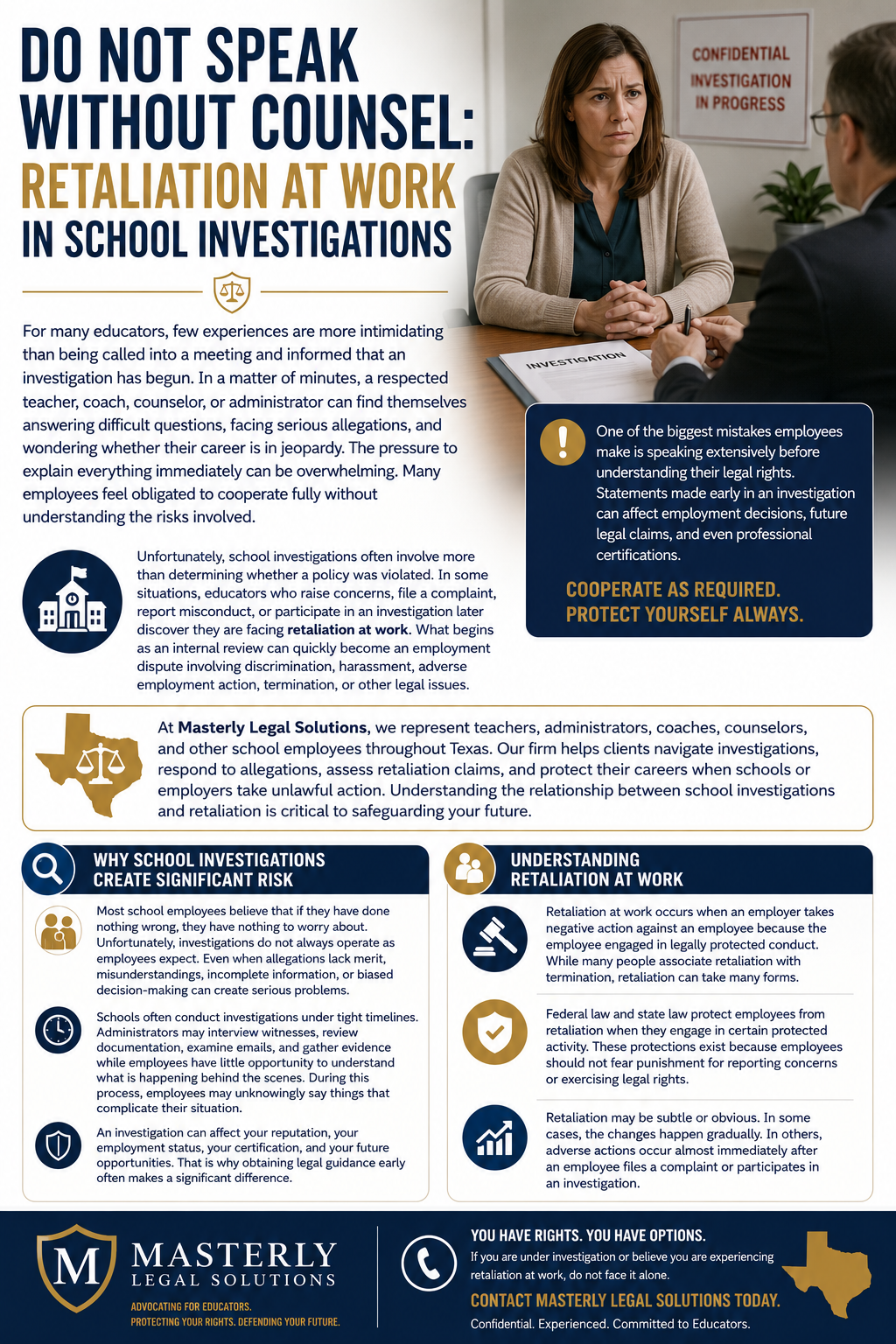
For many educators, few experiences are more intimidating than being called into a meeting and informed that an investigation has begun. In a matter of minutes, a respected teacher, coach, counselor, or administrator can find themselves answering difficult questions, facing serious allegations, and wondering whether their career is in jeopardy. The pressure to explain everything immediately can be overwhelming. Many employees feel obligated to cooperate fully without understanding the risks involved.
Unfortunately, school investigations often involve more than determining whether a policy was violated. In some situations, educators who raise concerns, file a complaint, report misconduct, or participate in an investigation later discover they are facing retaliation at work. What begins as an internal review can quickly become an employment dispute involving discrimination, harassment, adverse employment action, termination, or other legal issues.
One of the biggest mistakes employees make is speaking extensively before understanding their legal rights. Statements made early in an investigation can affect employment decisions, future legal claims, and even professional certifications. While cooperation may be required, educators should understand that protecting themselves is equally important.
At Masterly Legal Solutions, we represent teachers, administrators, coaches, counselors, and other school employees throughout Texas. Our firm helps clients navigate investigations, respond to allegations, assess retaliation claims, and protect their careers when schools or employers take unlawful action. Understanding the relationship between school investigations and retaliation is critical to safeguarding your future.
Why School Investigations Create Significant Risk
Most school employees believe that if they have done nothing wrong, they have nothing to worry about. Unfortunately, investigations do not always operate as employees expect. Even when allegations lack merit, misunderstandings, incomplete information, or biased decision-making can create serious problems.
Schools often conduct investigations under tight timelines. Administrators may interview witnesses, review documentation, examine emails, and gather evidence while employees have little opportunity to understand what is happening behind the scenes. During this process, employees may unknowingly say things that complicate their situation.
An investigation can affect your reputation, your employment status, your certification, and your future opportunities. That is why obtaining legal guidance early often makes a significant difference.
Understanding Retaliation at Work
Retaliation at work occurs when an employer takes negative action against an employee because the employee engaged in legally protected conduct. While many people associate retaliation with termination, retaliation can take many forms.
Federal law and state law protect employees from retaliation when they engage in certain protected activity. These protections exist because employees should not fear punishment for reporting concerns or exercising legal rights.
Retaliation may be subtle or obvious. In some cases, the changes happen gradually. In others, adverse actions occur almost immediately after an employee files a complaint or participates in an investigation.
What Is Protected Activity?
Protected activity refers to conduct that the law specifically safeguards from retaliation. Employees who engage in protected activity are entitled to protection from adverse employment action based on their participation.
Examples of protected activity may include:
- Reporting discrimination
- Reporting harassment
- Filing a complaint with human resources
- Participating in an internal investigation
- Cooperating with government agencies
- Requesting accommodations related to a disability
- Taking eligible FMLA leave
- Reporting wage violations
- Opposing unlawful conduct
Employees who engage in other related protected activity may also receive legal protection depending on the circumstances.
Why Educators Face Unique Challenges
Schools present unique employment environments. Teachers and administrators often work closely together, creating relationships that can become strained when concerns are reported.
Unlike many private workplaces, school districts frequently involve multiple levels of administration. Supervisors, principals, human resources personnel, investigators, and district leadership may all become involved in decision-making.
This creates a context where retaliation may be difficult to recognize initially. Employees sometimes believe adverse treatment is simply part of the investigation process when it may actually be connected to protected conduct.
Administrative Leave and What It May Mean
One of the most common developments during a school investigation is placement on administrative leave. Being removed from daily responsibilities can be shocking and emotionally difficult.
Administrative leave does not automatically mean wrongdoing occurred. In many situations, schools place employees on leave while gathering facts and interviewing witnesses. The purpose is often to prevent disruption and allow the investigation to proceed.
However, employees should carefully monitor how the leave process is handled. Decisions made during administrative leave can sometimes become relevant when evaluating potential retaliation claims.
Paid Administrative Leave Versus Other Employment Actions
Paid administrative leave is often viewed differently than disciplinary action because employees generally continue receiving wages and benefits during the investigation.
Even so, placement on paid administrative leave may carry a negative impact on an employee's professional reputation. Colleagues may speculate about the reasons for the leave, and future employment opportunities can be affected.
When evaluating a retaliation claim, attorneys often examine whether additional adverse action followed the leave placement and whether the employer's actions were justified.
When an Investigation Turns Into Retaliation
Not every investigation involves retaliation. However, retaliation occurs when an employer begins treating an employee differently because of protected conduct.
An employee may report harassment, cooperate with investigators, or file a complaint concerning discrimination. Shortly afterward, the employee may experience increased scrutiny, negative evaluations, reassignment, or other adverse treatment.
Timing alone does not prove retaliation. Nevertheless, a close connection between protected activity and adverse employment action often deserves careful examination.
Common Examples of Retaliation in Schools
Retaliation can take many forms within educational settings.
Examples may include:
- Demotion to a less desirable position
- Removal from leadership roles
- Reduction of responsibilities
- Unwarranted disciplinary actions
- Increased scrutiny from supervisors
- Negative performance reviews
- Exclusion from opportunities
- Dismissal or termination
Such actions may create significant career consequences even when the employee ultimately remains employed.
Understanding Adverse Employment Action
An adverse employment action is a negative employment decision that affects the employee's job, compensation, benefits, or opportunities.
Courts and government agencies evaluate whether a reasonable employee would view the action as harmful or likely to discourage protected conduct.
The definition may extend beyond termination. A transfer to a less desirable position, significant reduction in duties, or loss of opportunities may qualify depending on the circumstances.
Because every case is different, careful legal analysis is often necessary.
How Retaliation Affects Employee Morale
Retaliation does not only affect the individual employee. It can negatively impact employee morale throughout an organization.
When workers observe colleagues being punished for reporting concerns, they may become reluctant to speak up. Fear can spread through the workplace, making employees hesitant to report misconduct or cooperate with investigations.
Overall employee morale often suffers when accountability is lacking. Schools function best when employees feel safe raising legitimate concerns without fear of retaliation.
The Connection Between Harassment and Retaliation
Harassment complaints frequently lead to retaliation allegations. An employee who reports inappropriate conduct may suddenly face criticism, disciplinary measures, or hostility from supervisors or coworkers.
In some situations, the original complaint involves sexual harassment. In others, the complaint concerns discrimination or workplace misconduct.
The law recognizes that employees should not be punished simply for reporting behavior they reasonably believe violates workplace policies or legal standards.
Workplace Discrimination and Retaliation Claims
Discrimination and retaliation are often closely connected. An employee may file a complaint concerning discrimination and then experience negative treatment afterward.
Federal law prohibits discrimination based on certain protected characteristics. Employees who oppose discrimination or participate in investigations generally receive legal protection from retaliating conduct.
Determining whether retaliation occurred often requires reviewing documentation, witness statements, and employment records.
The Role of the Equal Employment Opportunity Commission
The Equal Employment Opportunity Commission, commonly known as the EEOC, is a federal agency responsible for enforcing employment discrimination laws.
The EEOC investigates complaints involving discrimination and retaliation. Employees who believe their employer violated federal law may have the right to file a charge with the agency.
The EEOC evaluates evidence, gathers additional information, and may attempt resolution before litigation occurs, while law firms that focus on labor and employment matters can assist with internal investigations and higher education employment issues.
Understanding filing deadlines is extremely important because missing deadlines can affect legal rights.
Why Documentation Matters
Strong documentation can make a substantial difference in retaliation cases.
Employees should document important events, communications, meetings, and employment decisions. Written records often provide valuable context that may not be apparent later.
Helpful documentation may include:
- Emails
- Text messages
- Performance evaluations
- Written complaints
- Meeting notes
- Personnel records
- Investigation correspondence
Maintaining organized records can help attorneys assess the strength of potential claims.
Gather Evidence Before Problems Escalate
Many employees wait until after termination to begin gathering evidence. By that point, important records may be difficult to access.
Whenever concerns arise, employees should preserve information that may become relevant later. This includes records relating to complaints, investigations, disciplinary actions, and communications with supervisors.
Evidence often becomes the foundation of a successful retaliation claim.
The Importance of Witnesses
Witnesses can provide valuable information regarding workplace conduct and decision-making.
Coworkers may have observed retaliating behavior, inconsistent treatment, or conversations involving management decisions. Their observations can sometimes support claims involving retaliation or discrimination.
Employees should avoid pressuring coworkers to participate. Instead, they should identify individuals who may possess relevant knowledge and discuss the situation with counsel.
Increased Scrutiny After a Complaint
One of the most common forms of retaliation involves increased scrutiny.
An employee who previously received positive evaluations may suddenly find every action questioned. Minor mistakes that were previously ignored may become disciplinary issues.
While employers may legitimately monitor performance, dramatic changes following protected activity may warrant further examination.
An attorney can help determine whether the scrutiny reflects legitimate concerns or possible retaliation.
Can Retaliation Lead to Termination?
Yes. Some retaliation cases involve termination.
Employees are occasionally fired shortly after reporting misconduct, participating in investigations, or exercising protected rights. Employers rarely admit that retaliation motivated the decision.
Instead, they often provide alternative explanations. Evaluating whether those explanations are legitimate requires a careful review of the facts and evidence.
What If You Were Fired After Reporting Concerns?
Being fired after reporting concerns can be devastating. Many employees assume there is nothing they can do once their employment ends.
However, termination following protected activity may create legal issues depending on the circumstances. Timing, documentation, witness testimony, and employment history often play important roles.
If you were fired after engaging in protected activity, it is important to seek legal guidance as soon as possible.
Constructive Discharge and Forced Resignations
Not all employees experience direct termination. Some encounter conditions so difficult that resignation appears to be the only option.
Constructive discharge occurs when working conditions become so intolerable that a reasonable employee feels compelled to resign.
Examples may include severe hostility, repeated retaliation, unreasonable demands, or ongoing harassment.
Constructive discharge claims can be complex and should be evaluated by experienced retaliation and employment lawyers.
Medical Leave and Retaliation Concerns
Employees who take medical leave sometimes experience retaliation upon returning to work.
Federal law provides protections for eligible workers in certain circumstances. Employees utilizing FMLA rights should not face punishment for exercising those rights.
Unfortunately, some employers respond negatively when employees take leave, request accommodations, or require additional support.
Understanding available protections is essential when evaluating possible violations.
Job Protected Leave and Employee Rights
Job protected leave exists to allow eligible employees to address certain personal or medical needs without losing employment.
When employees qualify for job protected leave, employers must comply with legal requirements. Retaliating against employees for exercising these rights may create legal liability.
Because eligibility requirements vary, employees should seek legal advice regarding specific situations.
Disability Accommodations and Retaliation
Employees with a disability may be entitled to reasonable accommodation under applicable laws.
Requesting accommodation is often considered protected activity. An employer should not retaliate against an employee for requesting assistance or support.
In some cases, retaliation occurs after accommodation requests are made. Documentation can be especially important when evaluating these situations.
Wage Issues and Workplace Complaints
Retaliation claims sometimes arise after employees report compensation concerns.
Issues involving unpaid wages, overtime pay, benefits, or other compensation matters may trigger legal protections.
Workers should be able to report pay concerns without fear of retaliation. When adverse actions follow wage-related complaints, additional investigation may be warranted, and many employers rely on employment lawyers for businesses to address wage and compliance issues.
The Relationship Between Supervisors and Investigations
A supervisor often plays a significant role during workplace investigations.
Supervisors may provide information to investigators, recommend disciplinary actions, or influence employment decisions. Unfortunately, personal conflicts sometimes affect these processes.
When evaluating retaliation allegations, attorneys often examine communications and interactions involving supervisors and management personnel.
How Managers Can Create Liability
A manager who retaliates against employees may expose an organization to legal risk.
Retaliating conduct can include negative evaluations, unwarranted discipline, exclusion from opportunities, or hostile treatment.
Organizations benefit when managers understand employment law obligations and maintain fair, objective practices, often supported by HR consulting and workplace training services.
Accountability is critical to maintaining trust within the workplace.
Police Involvement and School Investigations
Some school investigations involve allegations serious enough to attract police attention.
When law enforcement becomes involved, employees face additional risks, particularly if the investigation may also trigger Texas Education Agency (TEA) investigation procedures. Statements provided during interviews may affect both employment and legal matters.
This is one of the clearest examples of why employees should not speak extensively without counsel.
Protecting your rights requires understanding the broader implications of the investigation.
Why You Should Not Speak Without Counsel
Many employees believe that cooperating immediately will resolve concerns quickly. While cooperation is important, speaking without legal guidance can create unintended consequences.
Investigators may ask questions designed to gather additional information, assess credibility, or compare statements with other evidence. Answers that seem harmless may later be interpreted differently.
An attorney can help you understand the process, prepare for interviews, and protect your interests while remaining professional and cooperative, especially when navigating education law investigations involving teachers and administrators.
Assessing a Potential Claim
Every retaliation claim is unique.
Attorneys typically assess:
- The protected activity involved
- The adverse action taken
- Timing between events
- Available evidence
- Witness testimony
- Documentation
- Employer explanations
A thorough assessment helps determine whether legal action may be appropriate.
When Retaliation Becomes a Legal Violation
Not every workplace dispute qualifies as a legal violation. However, retaliation based on protected conduct may violate state or federal law.
Determining whether a possible violation occurred requires reviewing the complete factual context. What appears insignificant initially may reveal a larger pattern when viewed alongside other evidence.
Legal professionals can help determine whether conduct rises to the level of unlawful retaliation.
The Role of Employment Lawyers
Employment lawyers help employees understand their rights, preserve evidence, and navigate complex workplace disputes.
Whether the matter involves retaliation, discrimination, harassment, dismissal, termination, or another employment issue, legal representation can provide valuable protection.
An attorney can evaluate risks, explain options, and help develop an effective strategy.
How Masterly Legal Solutions Helps Employees
At Masterly Legal Solutions, we understand the challenges employees face during workplace investigations. Our firm represents teachers, administrators, school personnel, and other workers dealing with retaliation, discrimination, harassment, adverse employment action, FMLA concerns, disability accommodations, termination disputes, and other employment matters, while also providing estate planning, business consulting, and broader education law services.
We work closely with clients to review allegations, evaluate documentation, gather evidence, determine legal options, and protect their interests throughout the process. Whether you have been placed on paid administrative leave, subjected to increased scrutiny, transferred to a less desirable position, or terminated after engaging in protected activity, our team is prepared to help, including when allegations threaten your Texas Education Agency (TEA) educator license and disciplinary record.
We believe employees deserve fairness, accountability, and protection under the law. When employers cross legal boundaries, we work diligently to help our clients pursue justice.
When Retaliation Crosses the Line Into Illegal Conduct
Not every workplace disagreement is illegal, but employers cannot punish employees for exercising rights protected by law. Retaliation becomes illegal when an employer takes adverse action against a worker because that employee reported discrimination, participated in an investigation, requested a reasonable accommodation, filed an EEOC complaint, or engaged in another protected activity. Schools and other employers must comply with federal law and applicable state laws when making employment decisions. When retaliating conduct results in termination, dismissal, loss of benefits, or other negative consequences, employees may have legal remedies available. Understanding whether conduct is illegal often requires an experienced attorney to review the evidence, documentation, and circumstances surrounding the employment action.
Other Type of Retaliation Employees Should Watch For
Many workers assume retaliation only involves termination or demotion, but retaliation can take many forms. In reality, there may be another type of adverse treatment that is less obvious but equally harmful to an employee's career. Examples can include exclusion from important meetings, denial of training opportunities, removal from leadership responsibilities, sudden schedule changes, or unnecessary disciplinary actions. When these actions occur after an employee engages in protected activity, they may raise concerns about retaliation. Evaluating whether another type of workplace action is connected to a complaint or investigation often requires a careful review of the facts and surrounding context.
Speak With Masterly Legal Solutions About Retaliation at Work
If you believe retaliation at work may be affecting your career, do not wait until the situation becomes worse. Early action often provides the best opportunity to preserve evidence, protect legal rights, and address concerns before additional damage occurs. Whether you are facing an investigation, responding to allegations, dealing with discrimination, concerned about dismissal, or questioning whether your employer is retaliating against you, obtaining legal guidance can make a significant difference.
Contact Masterly Legal Solutions at (972) 236-5051 for a free consultation. Our team can answer your questions, review the facts of your situation, explain potential legal options, and help you understand the next steps. You have invested years building your career and professional reputation. Let us help you protect what you have worked so hard to achieve.
Disclaimer: This article is provided solely for educational and informational purposes. It is not legal advice and should not be relied upon as legal guidance regarding any specific matter. Reading this article does not create an attorney-client relationship. Laws and circumstances vary, and individuals should consult directly with an attorney regarding their particular situation.




Looking for Legal & Business Solutions? Contact Us Now
Fill in the form or call us to set up a meeting





