
Dyslexia Testing in Texas Schools: How Parents Request an Evaluation
By Andrew Rhoden, Masterly Legal Solutions
Texas parents can request dyslexia testing by submitting a written request for a special education evaluation to their child's school principal or district special education director. The school must respond within 15 school days. Evaluation results help determine whether the child qualifies for specialized reading instruction, classroom accommodations, or other educational support.
Signs That May Lead a Parent to Ask for Testing
Watching your child struggle with reading and spelling despite consistent effort can be concerning. When classroom instruction, homework assistance, and additional reading practice produce limited improvement, parents may begin to suspect an underlying learning disability.
Dyslexia is a learning disability that primarily affects reading, spelling, and word recognition. It can affect people of all ages, though concerns often first come up in school-age children. It does not reflect a child's intelligence, motivation, or ability to succeed academically.
Common signs that may indicate a need for dyslexia testing include:
- Difficulty recognizing letters and their sounds.
- Trouble reading unfamiliar words.
- Slow or inaccurate reading.
- Persistent spelling difficulties.
- Difficulty recognizing familiar written words.
- Avoidance of reading activities.
- Difficulty remembering written instructions.
- Reading performance that appears inconsistent with other academic abilities.
Screening may focus on early reading skills, and children can often be identified as at risk before second grade so early intervention may help prevent reading failure.
Some children develop strategies that help them manage their reading difficulties, making their challenges less noticeable in the classroom, and older students and adults may also develop coping strategies that hide similar problems. Others may experience frustration, reduced confidence, or anxiety about school assignments.
These signs do not automatically establish that a child has dyslexia. A comprehensive evaluation can help identify the underlying difficulties and determine whether additional educational services may be appropriate.
Parents should not have to wait until their child experiences significant academic failure before expressing concerns about a suspected learning disability, especially if there is a family history of dyslexia, since dyslexia has a strong genetic link and that can increase a child's risk.
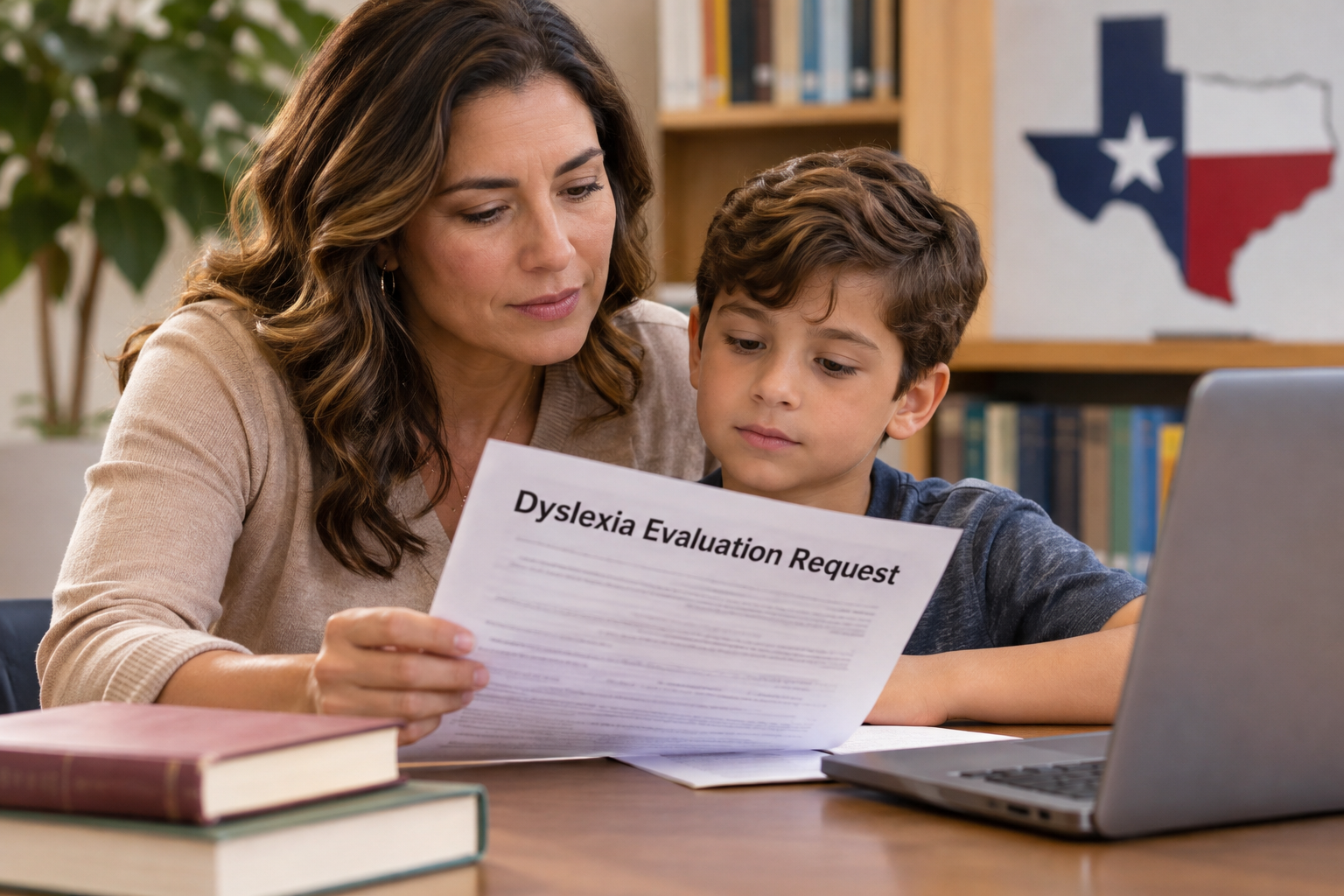
How to Request a Dyslexia Evaluation in Writing
Texas parents have the right to request an evaluation when they suspect their child has dyslexia. Under the Texas Dyslexia Handbook, evaluations for suspected dyslexia follow the special education evaluation process established by the Individuals with Disabilities Education Act (IDEA), which is shaped by federal regulations, even though eligibility and support criteria can vary by state.
A written request submitted to the school principal or district special education director can communicate the parent's concerns and request a full individual and initial evaluation (FIIE), including assessment for dyslexia. A public school district may also have Child Find duties to evaluate homeschooled children suspected of learning disabilities.
Relevant information may include previous reading assessments, teacher observations, academic records, and details about reading difficulties that continue despite classroom interventions.
The purpose of the request is to communicate the child's educational needs rather than establish a diagnosis before formal testing occurs.
Understanding the Texas Dyslexia Evaluation Process and Testing Timelines [CONFIRM]
Texas public schools must follow specific timelines when responding to qualifying parental requests for special education evaluations.
15 school days: After receiving a qualifying written request, the school district must provide written notice stating whether it agrees or refuses to conduct the evaluation. If the school agrees, parents must receive an opportunity to provide informed consent.
45 school days: Once written parental consent is received, the school generally has 45 school days to complete the initial evaluation and prepare the written report.
Five school days before the ARD meeting: The school generally must provide parents with a copy of the evaluation report no later than five school days before the initial Admission, Review, and Dismissal (ARD) committee meeting.
30 calendar days: Following completion of the evaluation report, the ARD committee generally has 30 calendar days to determine special education eligibility.
Exceptions may apply based on student absences, consent dates, and end-of-school-year circumstances.
These requirements are addressed in the Texas Education Agency's Dyslexia Handbook and related guidance.
Schools also have legal responsibilities to identify students who may have disabilities and require special education services. Learn more about these responsibilities in our article on Child Find in Texas.
When schools delay testing, decline evaluation requests, or fail to communicate clearly, Masterly Legal Solutions can help parents understand the applicable requirements and available legal options.
What the Dyslexia Evaluation Looks At and Who Reviews the Results
A comprehensive dyslexia evaluation examines more than a student's reading speed or classroom grades. It considers the child's educational history, reading abilities, language development, and individual learning needs.
Unlike a brief screening, a formal learning disabilities assessment gathers information from multiple sources to identify patterns of reading difficulties and determine whether the student may need educational support. It uses standardized measures to evaluate specific skills based on the student's age, grade, and developmental needs, typically through interactive, structured tasks rather than ordinary multiple-choice tests.
Evaluators may also screen for co-occurring conditions such as ADHD when those concerns are present.
Reading and Language Skills Assessed During Dyslexia Testing
Qualified evaluation professionals may assess several areas of reading and language development, and screening can begin in kindergarten with age-appropriate measures of specific skills, including:
- Phonological awareness: Recognizing and working with sounds in spoken language; early screening assessments often include phonological awareness tests because phonological processing affects how students identify and sequence sounds in words, syllables, and phonemes.
- Decoding skills: Applying letter and sound relationships to read unfamiliar single words.
- Word recognition: Identifying written common words and real words accurately.
- Reading fluency: Reading with appropriate speed, accuracy, and expression.
- Reading comprehension: Understanding written information.
- Spelling skills: Recognizing and applying written language patterns.
- Rapid naming: Quickly identifying familiar letters, numbers, or objects; slow naming speed is a strong predictor of reading difficulties.
The Predictive Assessment of Reading (PAR) is one example of a screening tool.
Tools such as the Dyslexia Z-Screener may use nonsense words to assess decoding skills.
Additional assessments may be necessary depending on the student's educational history and other suspected disabilities.
The evaluation should provide meaningful information about the child's strengths, challenges, and educational needs rather than rely on a single test score.
Reviewing Educational History and Classroom Performance
School evaluation professionals also consider information beyond standardized assessments.
Teacher observations, classroom assignments, previous interventions, language background, parent input, developmental history such as delayed speech, and family history can provide valuable context about the student's reading difficulties. Because dyslexia has a strong genetic link, a family history of dyslexia can increase a child's risk.
For example, a child may demonstrate strong verbal communication skills, solid oral language, and better listening comprehension than reading comprehension while continuing to experience significant challenges with reading and spelling.
A comprehensive evaluation helps the school examine these differences and consider appropriate educational services.
Who Reviews the Dyslexia Testing Results?
A multidisciplinary team of qualified professionals, which may include a school psychologist and, when language concerns are present, a speech-language pathologist, conducts and interprets the evaluation.
When dyslexia is suspected, Texas requirements include participation by a professional with specialized training related to dyslexia.
The ARD committee, which includes the student's parent, reviews the evaluation findings and determines whether the student meets special education eligibility requirements. Those written findings may be summarized in a diagnostic report or other comprehensive report used to discuss eligibility and supports.
Parents have an opportunity to participate in discussions about the evaluation, express concerns, and consider how the findings relate to their child's educational experience.
When evaluation findings appear incomplete or unclear, legal guidance can help families understand their rights and the available options.
From Dyslexia Testing Results to Educational Support
Identifying dyslexia is an important part of understanding a child's reading difficulties. However, an evaluation must also consider how those difficulties affect the student's access to education and whether specialized services are necessary.
Depending on the findings, educational support may be provided through special education or Section 504.
Special Education, Learning Disability, and an Individualized Education Program
Dyslexia is recognized within the specific learning disability category under IDEA.
A student with dyslexia who meets eligibility requirements and needs specially designed instruction may qualify for an Individualized Education Program (IEP).
An IEP may include services and supports based on the evaluation findings, including identified strengths and weaknesses, such as:
- Evidence-based dyslexia instruction.
- Individualized reading and spelling goals.
- Classroom and testing accommodations.
- Assistive technology.
- Regular monitoring of educational progress.
- Additional special education services based on individual needs.
Under the Texas Dyslexia Handbook, evidence-based dyslexia instruction required because of a student's disability is considered specially designed instruction and is provided through special education.
The ARD committee determines the appropriate services based on the student's evaluation findings, educational needs, and how the child responds to targeted instruction when deciding whether services are justified and necessary.
When a Section 504 Plan May Be Appropriate
Some students with dyslexia may not require specially designed instruction but may still need accommodations to access educational opportunities.
Section 504 of the Rehabilitation Act protects eligible students whose disabilities substantially limit one or more major life activities, including reading and learning.
Depending on the student's needs, a Section 504 plan may include extended testing time, accessible reading materials, text-to-speech technology, or adjustments to classroom assignments.
A dyslexia diagnosis does not automatically qualify a student for a particular accommodation or educational program. Eligibility and services depend on individual circumstances.
For additional information about these educational options, read our article on IEP vs. 504 Plan: What Parents and Students Should Know.
When Dyslexia Evaluation Results Raise Concerns
Parents may disagree with a school's findings if an evaluation overlooks persistent reading difficulties, fails to assess suspected areas of disability, or does not adequately address educational needs.
Masterly Legal Solutions can assist families by reviewing evaluation reports, school communications, educational records, proposed services, and the evaluation materials, including test scores and standard scores.
Parents who disagree with a completed school evaluation may also have rights involving an independent educational evaluation in Texas.
Understanding these options can help parents participate more effectively in decisions affecting their child's education, including whether the report adequately describes the student's strengths and weaknesses or the student's ability in the tested areas.
How Dyslexia Testing Identifies Reading and Language Difficulties
A comprehensive dyslexia evaluation examines a child's ability to process written language, recognize individual words, and understand the relationship between letters and sounds. According to the International Dyslexia Association, dyslexia can affect individuals with average intelligence or above. Children described as poor readers may struggle with letter sound knowledge, blending sounds, reading words, and developing accurate spelling skills.
An evaluation may include timed measures that compare reading performance with that of students of the same age. Qualified professionals, including an educational psychologist when appropriate, may assess written expression, vocabulary knowledge, spelling problems, and signs of a possible language impairment.
A persistent reading problem can affect a child's learning across multiple subjects, including understanding mathematical word problems. Identifying these difficulties can help school professionals determine appropriate educational support. Evaluation records may also support future accommodation requests for college entrance exams, although testing organizations have their own eligibility requirements.
The Texas Education Agency's dyslexia page provides additional information about state evaluation requirements and educational services. Masterly Legal Solutions can help families understand evaluation findings and address legal concerns regarding their child's educational support.
Frequently Asked Questions About Dyslexia Testing
Can a Texas School Refuse to Test a Child for Dyslexia?
Yes. A Texas school may refuse an evaluation request if the available information does not support the need for a special education evaluation, though parents may also speak with the district’s special services office or a school psychologist when making the request.
However, the school must provide prior written notice explaining its decision and the information used to reach that decision. Some families view district testing as a form of free testing and a useful starting point, even if more assessment is needed later.
Classroom interventions cannot be used to delay or deny an evaluation when the school has reason to suspect that a student has a qualifying disability and may need special education services.
Does a Dyslexia Diagnosis Qualify a Student for a 504 Plan?
Not automatically. A student may qualify for a Section 504 plan when dyslexia substantially limits a major life activity, such as reading or learning.
Students who require specially designed dyslexia instruction must be considered for special education eligibility. The appropriate educational program depends on the student's individual needs and evaluation findings.
Can Parents Use a Private Dyslexia Evaluation at School?
Yes. Parents may provide a private dyslexia evaluation to their child's school. Testing through a qualified professional may help, but insurance often treats dyslexia testing as educational rather than medical because these learning issues can affect academic performance. Many evaluators do not accept insurance, and coverage for dyslexia testing is extremely rare. Some families seek reimbursement through an FSA and may need a detailed written or comprehensive report.
Schools must consider independent evaluation findings that meet applicable criteria when making relevant educational decisions.
However, a private diagnosis does not automatically require the school to accept every recommendation or provide a particular educational service.
Request a Confidential Consultation with Masterly Legal Solutions
Persistent reading difficulties, delayed evaluations, and disagreements over educational services can leave families uncertain about their child's future.
Masterly Legal Solutions provides legal guidance and educational advocacy for Texas families navigating dyslexia testing, special education evaluations, eligibility decisions, and school accommodations.
Our firm can review your child's educational records, assess concerns about the evaluation process, explain your parental rights, and help you explore appropriate legal options based on your family's circumstances.
Whether your child's school has denied a dyslexia evaluation request or you have concerns about proposed educational services, we can help you understand the legal requirements and available next steps.
Phone: (972) 236-5051
Disclaimer: This article is provided for general informational purposes only, does not constitute legal advice or establish an attorney-client relationship, and does not promise any specific legal or educational outcome.






Looking for Legal & Business Solutions? Contact Us Now
Fill in the form or call us to set up a meeting