

Independent Educational Evaluation in Texas: What Parents Can Ask For
Author: Andrew Rhoden, Masterly Legal Solutions
Independent Educational Evaluation: The Short Answer
An independent educational evaluation (IEE) is an assessment conducted by a qualified professional who does not work for the public agency responsible for a child's education, and under federal special education law, parents may request an IEE at public expense when they disagree with an evaluation completed by their child's school district.
When a school evaluation does not accurately reflect your child's abilities, challenges, or educational needs, it can affect the special education services and support your child receives. For Texas parents and families facing that situation, this page explains what an IEE is, when and how to request one, how school districts may respond, how an IEE can affect educational decisions, why written requests matter, and when legal help may be worth considering.
Masterly Legal Solutions helps Texas families understand their special education rights, address evaluation disputes, and communicate their concerns through appropriate legal channels.
When a Parent Can Ask for an Independent Educational Evaluation
Under the Individuals with Disabilities Education Act (IDEA), specifically 34 CFR 300.502, parents have the right to obtain an independent educational evaluation, subject to the conditions established by federal law.
Parents may request an independent evaluation at public expense when they disagree with an evaluation obtained by the school district, or have their child evaluated independently at their own expense.
Common concerns include:
- The school's evaluation does not adequately address every area of a suspected disability.
- Assessment results do not reflect the student's learning difficulties.
- Important behavioral, developmental, or communication concerns were overlooked.
- The evaluation process did not accurately describe the child's educational needs.
- Parents disagree with the findings used to determine special education eligibility and want the child tested more fully.
- The assessment provides an incomplete understanding of the child's abilities, and parents may seek additional tests or additional academic tests when the district evaluation did not cover all relevant areas.
A disagreement does not necessarily mean that the school psychologist or evaluation team acted improperly. Independent testing may offer additional information that helps parents and school officials better understand the student's needs, including more comprehensive assessment of cognitive processing or developmental disorders.
Understanding IEE Special Education Rights
The right to an IEE is an important procedural safeguard under IDEA. Parents are generally entitled to only one IEE at public expense for each time the school conducts a district evaluation with which they disagree.
The district may ask parents why they disagree with its evaluation, but this is a legal right under IDEA. However, federal law does not require parents to provide an explanation as a condition of exercising this right.
An education attorney can review the existing evaluation, identify relevant legal concerns, and explain whether the family's circumstances support an IEE request.
How an Independent Evaluation Can Affect Educational Decisions
Evaluation findings can influence decisions involving special education eligibility, special education services, classroom accommodations, related services, and individualized instruction.
An incomplete assessment may leave certain educational needs unidentified. For example, a student experiencing communication difficulties may require additional assessment to better understand how those challenges affect classroom participation, especially if school staff did not assess every relevant skill area.
An independent evaluator may provide another professional perspective on the student's strengths, limitations, and support needs. The IEE results may help guide revisions to the child's IEP, although the team is not required to adopt every recommendation.
For families who are uncertain about the differences between disability-related educational services and accommodations, our article on IEP vs. 504 plans explains these separate forms of educational support.
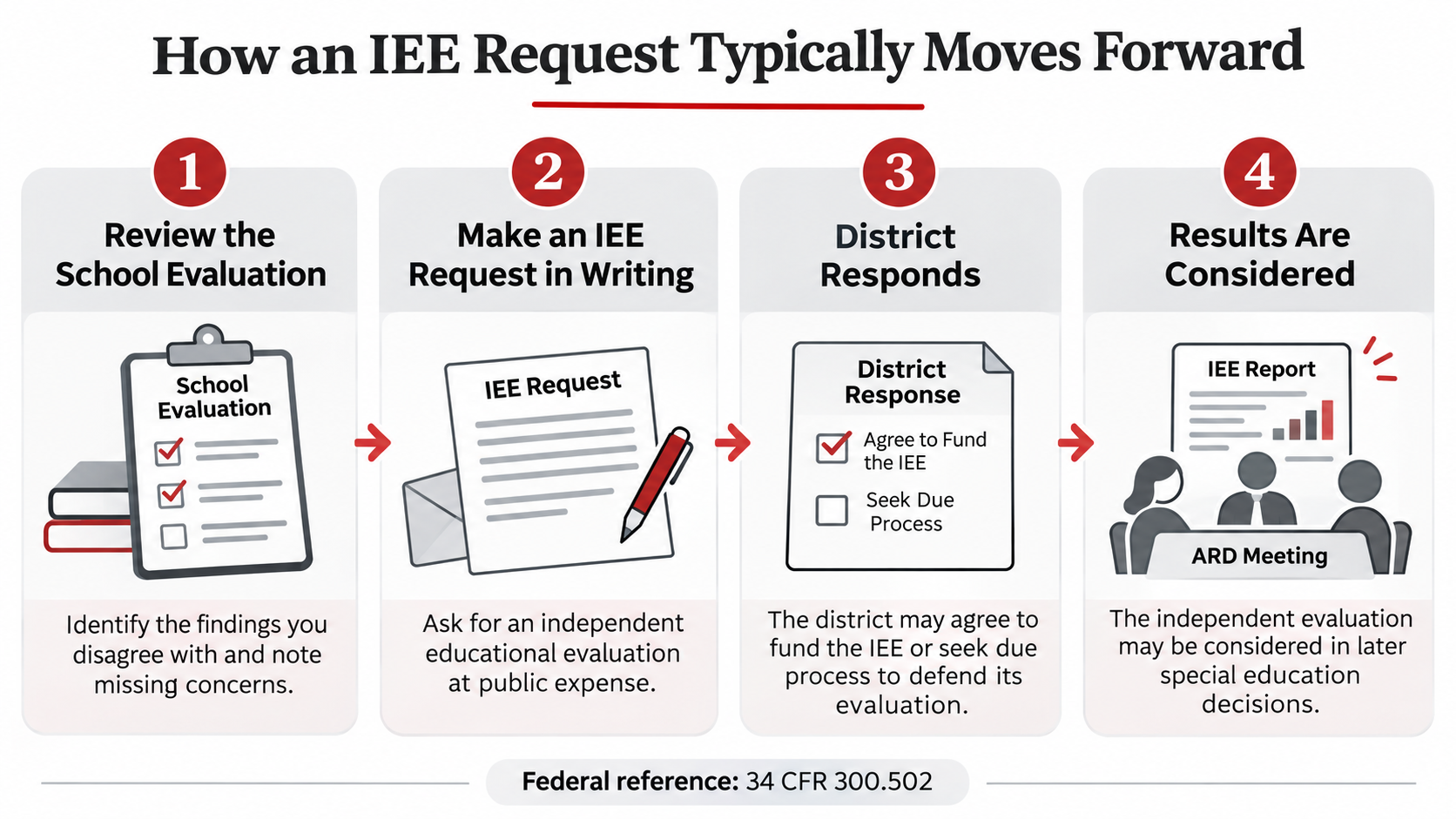
How to Make an IEE Request in Writing and What to Include
Although federal law does not expressly require every IEE request to be submitted in writing, written communication creates a clear record of the parent's disagreement and the date the request was made.
[CONFIRM] Texas special education resources recommend submitting an IEE request in writing when a parent disagrees with a school district's evaluation.
A written request typically identifies:
- The student's name, the parent's contact information, and a daytime telephone number.
- The parent's street address city and zip code.
- The school name and school street address city as part of the school's mailing information.
- The district evaluation in question.
- The parent's disagreement with that evaluation.
- The request for an independent educational evaluation at public expense.
- A request for information about independent evaluators and applicable district criteria.
Parents may also describe specific concerns about the evaluation, and some families use a sample letter as a starting point, although federal law does not require them to explain their disagreement.
The wording of an IEE request can become particularly important when a district disputes the parent's rights, questions the scope of the requested assessment, or raises concerns about evaluator qualifications.
Why Clear Documentation Matters
School evaluation disputes often involve multiple reports, emails, meeting records, and assessment findings. These documents may become important if disagreements continue.
A clearly documented request can help establish what the parent asked for and how the district responded. It may also provide useful information for an attorney reviewing the matter.
Masterly Legal Solutions can assist families with reviewing educational records, preparing appropriate written communications, and evaluating the district's response under applicable special education law.
What the District May Do After an IEE Request
Under 34 CFR 300.502(b), when a parent requests an independent educational evaluation at public expense, the school system must act without unnecessary delay.
The district generally has two options: if the school district agrees, the school system pays for the independent evaluation; or it may initiate a due process hearing to defend the appropriateness of its own evaluation, the school district's assessment. It cannot simply refuse the request, and if it challenges the request, a hearing officer decides whether the district must pay. IEEs must meet the same criteria as the school's evaluation.
The District Agrees to Fund the Independent Evaluation
When the district agrees to the request, it must provide information about where an independent evaluation may be obtained and the criteria that apply, and a publicly funded IEE must meet the same criteria the district uses for its own evaluations.
These criteria may address examiner qualifications and, if relevant, location standards used for an initial evaluation. They must be consistent with the parent's federal IEE rights.
Public funding means the evaluation conducted is provided without cost to the parent, subject to applicable legal requirements, and must be completed by a qualified examiner who is not employed by the responsible district.
The District Requests a Due Process Hearing
A district may initiate a due process hearing to establish that its original evaluation was appropriate.
If the hearing officer decides that the district's evaluation was appropriate, the parent retains the right to obtain an independent educational evaluation, but not at public expense on that basis, and may still have the child evaluated independently at their own expense.
Disagreements involving evaluation standards, funding, and procedural rights can become legally complex. Families facing this situation may benefit from reviewing our article on special education due process in Texas.
Texas School District Response Timelines
[CONFIRM] Texas special education guidance follows the federal requirement that districts respond to publicly funded IEE requests without unnecessary delay, and some guidance describes a 15 school day response window even though federal law itself uses that broader standard.
Federal law does not establish a specific number of calendar or school days for this response. The circumstances surrounding the request may affect whether a delay results in unreasonable delays.
Parents should not confuse the response deadlines for an initial special education evaluation request with the requirements governing an independent educational evaluation.
An attorney can assess whether a district's response, extended delay, or additional requirements raise procedural concerns, including when a short period for discussion may be reasonable but extended inaction is not.
How the ARD Committee Considers Independent Evaluation Results
Under 34 CFR 300.502(c), qualifying independent evaluation results must be considered when the public agency makes decisions concerning the provision of a free appropriate public education (FAPE), and they also become part of the child's educational record.
[CONFIRM] In Texas, the Admission, Review, and Dismissal (ARD) committee is responsible for making decisions concerning a student's special education eligibility, child's IEP, and educational services.
Considering an independent evaluation does not mean the committee must adopt every recommendation made by the independent examiner.
However, the findings may provide relevant information about the child's educational needs and appropriate support, including the child's native language when relevant to accurate interpretation of results. The report's detailed explanations can also help the committee understand how the child's needs affect access to a child's free appropriate public education.
Parents can learn more about this decision-making process in our article on ARD meetings in Texas.
When Families Talk With an Education Attorney
Disagreeing with a school evaluation can place considerable pressure on families. Parents may worry that their child is not receiving appropriate services while struggling to understand complex assessment reports and federal regulations.
Legal assistance may be particularly valuable when a district delays its response, disputes an IEE request, imposes restrictive evaluation criteria, or initiates a due process hearing.
Masterly Legal Solutions helps families evaluate their legal options through services that may include:
- Reviewing school district evaluations and educational records.
- Assessing applicable procedural safeguards.
- Preparing and reviewing written IEE requests.
- Evaluating district responses and funding disputes.
- Addressing concerns involving independent evaluator criteria.
- Advising families regarding special education dispute resolution.
- Providing legal representation when appropriate.
Every student's circumstances are different. Legal guidance can help parents understand the relationship between evaluation findings, educational decisions, and the protections available under federal and Texas law.
The objective is to help families make informed decisions while keeping their child's educational needs at the center of the discussion.
Frequently Asked Questions About Independent Educational Evaluations
Who Pays for an Independent Educational Evaluation?
Under IDEA, parents may request an independent educational evaluation at public expense when they disagree with a district evaluation.
The district must fund the evaluation or pursue the applicable due process procedure to defend its assessment. Parents may also arrange an independent evaluation at their own expense.
Whether public funding is available depends on the circumstances and applicable legal requirements.
Can a District Refuse an IEE Request?
A school district cannot simply reject a qualifying request for an independent educational evaluation at public expense because it disagrees with the parent.
If the district believes its own evaluation was appropriate, federal law provides a due process procedure for resolving the disagreement. Disputes may also involve whether an independent evaluation meets lawful district criteria.
An education attorney can review the district's position and explain the parent's available options.
How Long Does a District Have to Respond to an IEE Request?
Federal law requires the district to act without unnecessary delay but does not specify a fixed response period.
[CONFIRM] Texas parents experiencing extended delays may benefit from legal guidance to determine whether the district's actions are consistent with applicable procedural safeguards.
Request a Confidential Consultation with Masterly Legal Solutions
When a school evaluation does not fully address your child's educational needs, understanding your legal rights is an important step. Masterly Legal Solutions helps Texas families navigate independent educational evaluation requests, school district disputes, and special education concerns.
Our firm provides professional legal guidance tailored to your child's circumstances, helping you understand your options and make informed decisions about their education.
Call
(972) 236-5051 or
request a confidential consultation with Masterly Legal Solutions
to discuss your child's independent educational evaluation and available legal options.








Looking for Legal & Business Solutions? Contact Us Now
Fill in the form or call us to set up a meeting