EEO Training: What Managers Should Understand Before Employment Decisions Create Avoidable Risk
A manager does not need to intend to discriminate for an employment decision to create a serious problem.
A supervisor may discipline one employee more harshly than another. A hiring manager may rely on subjective reasons for rejecting a candidate. A department leader may change an employee's schedule shortly after the employee raises a workplace concern. Another manager may recommend termination without adequate documentation showing why the decision was made.
These decisions can create questions about consistency, fairness, and legal compliance.
Practical EEO training helps managers understand those risks before they make decisions that affect employees. For employers, the goal is not simply to give managers another presentation. The goal is to help the people making day-to-day employment decisions understand when they can act, when they should document their reasoning, and when they need to involve HR or legal counsel.
Masterly Legal Solutions provides comprehensive HR consulting services and training for businesses that want stronger management practices backed by legal knowledge. The firm offers customized training to organizations of different sizes and provides programs both in person and virtually.
The Employment Decision That Seems Routine May Not Be Routine
Managers make decisions every day.
Who gets hired? Who receives the better shift? Who gets promoted? Whose performance needs improvement? Who receives discipline? When should an employee be terminated?
The Equal Employment Opportunity Commission identifies recruiting, hiring, promotion, pay, performance evaluations, layoffs, discipline, termination, and leave decisions among employment matters where federal EEO responsibilities can arise.
For a manager, however, the decision may feel entirely operational.
That difference matters.
A supervisor focused on meeting a deadline may not stop to consider whether similar employees were treated differently. A manager dealing with a difficult employee may not realize that the employee recently made a discrimination complaint. A hiring manager may believe that personal judgment is enough without considering whether the criteria are being applied consistently.
Effective manager training helps close this gap.

EEO Training Helps Managers Understand the Rules on Sexual Harassment Before They Have to Apply Them
EEO training should give managers a practical understanding of equal employment opportunity principles in the context of their actual responsibilities.
Federal employment discrimination laws prohibit employment decisions based on protected characteristics covered by the applicable law, including race, gender, religion, age, disability, and genetic information. The EEOC specifically tells managers that decisions involving matters such as hiring, firing, scheduling, and work assignments, including hiring and promotion decisions, should be based on qualifications rather than protected characteristics.
That principle sounds simple.
Applying it during a difficult management decision can be much harder.
Consider two employees who have attendance problems. One receives a written warning. The other is terminated. There may be a legitimate reason for the difference, such as prior discipline or substantially different attendance records.
The problem arises when the manager cannot clearly explain the difference or when the company's records do not support the explanation.
Consistency Can Matter as Much as Intent
Managers sometimes believe discrimination prevention is only about avoiding obviously discriminatory behavior.
It is broader than that.
The EEOC recommends neutral and objective criteria to reduce the risk that subjective employment decisions will be influenced by stereotypes or hidden bias. It also recommends training managers, supervisors, and employees on EEO policies, and those training programs cannot discriminate based on age, race, or gender, while holding them accountable for following those standards.
A manager therefore needs to consider not only what decision is being made, but also how that decision compares with similar situations.
That is one reason customized training can be more valuable than a generic overview of employment law, because similarly consistent standards support consistent training expectations.
Manager Training Should Connect EEO Rules to Actual Employment Decisions
Managers need information they can recognize when a real situation appears.
EEO concerns also include harassment, including sexual harassment and conduct based on race or religion.
Imagine that an employee who recently complained about discrimination receives a poor performance review. The employee may truly have performance problems. The complaint does not prevent legitimate performance management.
But the timing makes careful decision-making important.
The EEOC advises managers considering a negative action involving someone who reported or opposed discrimination to consider whether they are applying stricter standards, treating the employee differently from people who violated similar rules, or departing from established policies or past practices.
This is where effective EEO training becomes practical.
The manager should understand that a legitimate business decision may still require careful review, consistent treatment, supporting documentation, and the ability to recognize risk in both employment decisions and workplace conduct.
Documentation Helps Explain the Business Reason Behind a Decision
Managers frequently know why they made a decision but fail to create records that clearly show their reasoning.
That can become a problem months later.
Memories change. Managers leave. Emails lack context. A performance concern that seemed obvious at the time may become difficult to reconstruct.
Good documentation creates a clearer record of what happened and why, with enough detail to explain the decision later.
The EEOC's retaliation guidance recommends that consequential employment actions be reviewed as part of a review process to determine whether they are supported by legitimate, nondiscriminatory and non-retaliatory reasons. It specifically discusses identifying the reasons for an action and making sure necessary documentation supports the decision.
This does not mean managers should create paperwork simply to create paperwork.
It means the organization's records should accurately reflect legitimate employment decisions.
Training Can Address Common Documentation Problems
An attorney-guided documentation procedure can help managers recognize issues such as vague performance notes, inconsistent explanations, missing dates, subjective language, and records that do not match the reason ultimately given for an employment action, so concerns can be addressed before that reason changes later.
The goal is clarity and consistency.
Managers should know what the organization expects them to document and when a matter requires review before action is taken.
Escalation Procedures Give Managers a Clear Place to Go
Managers should not be expected to resolve every EEO issue by themselves.
In fact, knowing when not to act alone is an important management skill.
An employee may mention discrimination during a performance discussion. A supervisor may receive a complaint about another manager. An employee who recently reported a concern may suddenly become the subject of proposed discipline.
These situations can require additional review.
Clear escalation procedures help managers understand when human resources, senior management, or legal counsel should become involved.
The EEOC recommends training management and HR personnel to respond proactively when employees raise potential EEO concerns, including seeking clarification, consulting appropriate organizational resources, and following up with the employee.
A manager should not have to guess who needs to know.
Some issues may need to escalate beyond the immediate team and, in rare cases, to senior leadership or board members, depending on the organization’s structure.
Retaliation Risk Can Arise After the Original Complaint
One of the most important areas for managers to understand is retaliation.
An employee's discrimination complaint does not prevent the employer from managing performance or addressing legitimate misconduct. It does mean managers need to understand that an employment action cannot be motivated by the employee's protected activity.
The EEOC recommends consistent treatment and advises employers that they are responsible for responding promptly to discrimination concerns, explain anti-retaliation expectations, and take steps aimed at preventing discrimination after a complaint as well as before one.
This is especially important because a manager's response after a complaint can create a separate problem.
For example, a supervisor may become frustrated with an employee who complained and begin excluding that person from meetings. Another manager may suddenly enforce rules more aggressively against the complaining employee, creating retaliatory or related incidents.
Managers need to understand that retaliation concerns can involve more than termination.
Strong discrimination prevention training should therefore address what happens both before and after an employee raises a concern.
Weak EEO Practices and Equal Pay Can Affect More Than Legal Risk
A poorly handled employment decision can spread through a workplace quickly.
Employees notice when rules appear inconsistent. They notice when one manager handles complaints professionally while another becomes defensive. They notice when promotions seem subjective or when discipline appears different depending on who is involved.
Over time, those experiences can affect confidence in leadership.
They can also affect recruiting, retention, productivity, and the company's reputation as an employer.
For leadership, this makes EEO compliance more than an HR issue. It is also a management-quality issue that can benefit from integrated legal and business consulting services.
Managers represent the organization when they interview applicants, assign work, evaluate employees, respond to complaints, recommend promotions, issue discipline, and make termination recommendations.
Their decisions can become the company's decisions.
Generic Training May Not Address the Decisions Your Managers Actually Make
A standardized presentation can explain basic concepts. It may not address the circumstances creating risk inside your organization.
A customized EEO training program can be built around the roles and decisions your managers actually handle. Managers may also need guidance on how to accommodate job applicants and employees with a disability, including when employers must provide reasonable accommodation during training itself.
A retail organization may need scenarios involving scheduling, promotions, attendance, customer-facing assignments, and accommodation issues. A professional services company may need greater attention to performance evaluations, compensation recommendations, remote employees, and advancement decisions. A growing business may need supervisors to understand when an issue must leave the department and go to HR or counsel.
The EEOC itself recommends tailoring training to address EEO knowledge gaps and workplace situations that have occurred or are reasonably likely to occur, which can be reinforced through well-drafted, legally compliant employee handbooks.
That is an important distinction.
The objective is not merely to tell managers that discrimination is prohibited. It is to prepare them to recognize risk when they are making real decisions.
Attorney-Guided EEO Training From Masterly Legal Solutions
Masterly Legal Solutions combines HR consulting with general counsel services for businesses and legal and business services for employers. Its existing services include HR consulting and customized workplace training, and its website states that training can be provided in person or virtually.
For employers seeking EEO training, that means the conversation can focus on practical management responsibilities rather than a one-size-fits-all presentation.
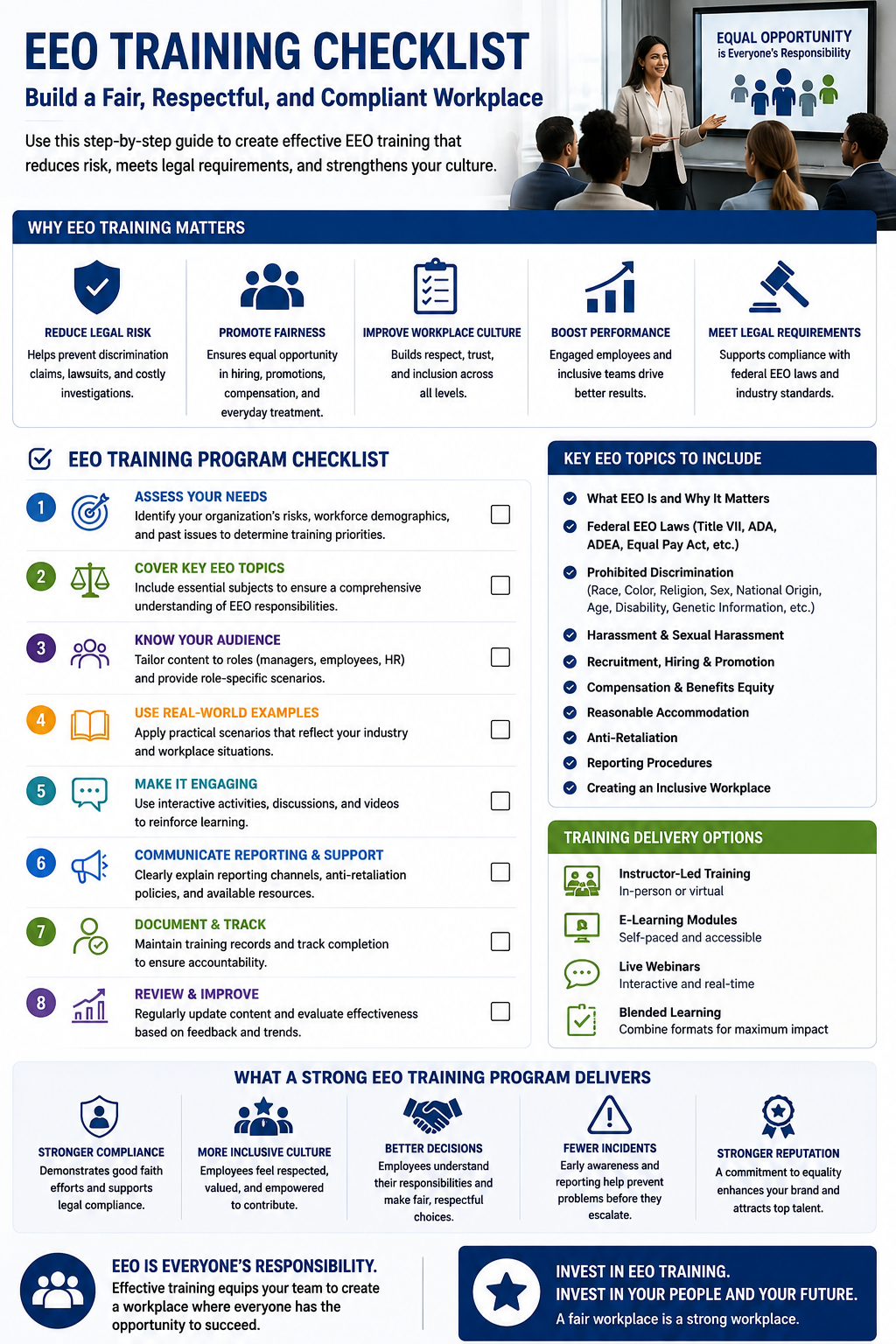
Training can be designed around areas such as:
- Equal employment opportunity responsibilities
- Hiring and promotion decisions
- Performance evaluations and discipline
- Consistency in employment decisions
- Documentation practices
- Responding to discrimination concerns
- Retaliation awareness
- Manager responsibilities after receiving a complaint
- Internal escalation procedures
- Situations that should receive HR or legal review
- Accommodation responsibilities, including known limitations related to pregnancy and disability, to the point of providing reasonable adjustments such as ramps, additional break times, or interpreters for a blind employee unless doing so creates undue hardship through significant difficulty or expense
Employers that also need broader HR support can review the firm's HR Consulting Services, which describes Masterly Legal Solutions' combination of legal knowledge and practical HR consulting, along with business consulting services to improve operations and manage risk.
For broader legal and customized training capabilities, employers can also visit the firm's Legal Services and Training page to learn more about Masterly Legal Solutions’ comprehensive law firm services.
Frequently Asked Questions About EEO Training
What is EEO training?
EEO training helps managers and employees understand workplace responsibilities related to equal employment opportunity and discrimination prevention. For managers, useful training helps them learn how equal employment opportunity rules apply in real workplace situations and in the decisions they make as part of their jobs.
Who should receive EEO training?
Managers and supervisors are an important audience because they make and influence employment decisions. Depending on the organization, other employees and HR personnel may also need training.
What employment decisions and job applicants should EEO training address?
Training may address hiring, promotion, scheduling, work assignments, performance evaluations, discipline, termination, and other decisions affecting employment, including collecting only the essential information in pre-employment inquiries and ensuring job tests relate directly to actual job requirements.
Why is documentation important in EEO matters?
Clear documentation can help show the legitimate business reasons supporting an employment action and whether established procedures were followed. The EEOC recommends documentation and review as practices employers can consider to reduce retaliation risk.
Should managers know when to contact human resources or legal counsel?
Yes. Clear escalation procedures can help managers recognize situations that should receive additional review instead of trying to resolve every issue alone, including when to contact HR or legal counsel, who should have access to the issue details, and when the matter should escalate further.
Can EEO training be customized for our managers?
Yes. Masterly Legal Solutions provides customized training sessions, including in-person and virtual options. A program can be developed around an organization's management and HR needs as part of broader business consulting and coaching support.
Is EEO training only for large employers?
No. Management decisions can create EEO concerns in organizations of different sizes. Masterly Legal Solutions states that it provides customized training to entities and organizations of all sizes.
Discuss an Attorney-Guided EEO Training Program for Managers and Supervisors
Managers make decisions that can affect an employee's career and your organization's reputation. They should not have to rely on instinct when a hiring, promotion, discipline, scheduling, performance, or termination decision raises an EEO concern.
Customized EEO training can help your managers better understand equal employment opportunity requirements, discrimination prevention, documentation, consistent employment decisions, and when to use established escalation procedures. It can also cover hiring, job ads, applications, and accommodation issues that affect applicants and workers.
Masterly Legal Solutions provides customized HR consulting and training backed by legal knowledge. If your organization wants a program built around the decisions your managers and supervisors actually make, contact Masterly Legal Solutions, which also offers a broad range of legal and HR consulting services.
Call (972) 236-5051 or visit MasterlyLegal.com to discuss an attorney-guided EEO training program for managers and supervisors. It can also support broader federal and state compliance through legal business consulting that supports long-term growth and risk management and client-centered legal services for individuals and organizations.


Teacher Rights When Assaulted by a Special Needs Student: Safety, Reporting and Investigation Issues

Looking for Legal & Business Solutions? Contact Us Now
Fill in the form or call us to set up a meeting