Ethics Training: Building a Program Employees Can Apply When Policy Does Not Give an Easy Answer
A written policy cannot predict every decision an employee will face.
An employee may notice a conflict involving a vendor but not know whether it must be disclosed. A manager may hear a concern and hesitate because the employee asked to keep the conversation private. A supervisor may see behavior that feels inappropriate but does not fit neatly into a policy example. In these moments, the real question is not whether your company has rules. It is whether your employees know how to apply them.
That is the problem effective employee ethics training should solve.
Businesses need more than employees who can confirm that they received a code of conduct. They need people who understand the company's expectations, recognize conflicts of interest, know their reporting expectations, and can use sound ethical decision making when the right response is not immediately clear.
Masterly Legal Solutions helps employers build customized ethics training around the situations their employees and managers may actually face. The goal is practical: give your workforce clearer standards for making responsible decisions while helping management create a more consistent and accountable workplace, supported by HR consulting services and training that reinforce those expectations.
When Employees Know the Policy but Still Do Not Know What to Do
Most workplace problems do not begin with an employee announcing an intention to violate company policy.
They often begin in a gray area.
An employee receives a gift from a company that wants more business. A manager learns that two employees have a personal relationship that could affect scheduling decisions. Someone sees a coworker doing something questionable but is unsure whether it is serious enough to report. A supervisor receives a complaint but does not know whether the issue should stay within the department or be escalated.
The employee may have read the policy covering the situation. The problem is applying that policy when facts are complicated.
That gap between written rules and real decisions is where ethics training becomes valuable.
Employee Ethics Training Should Prepare People for Real Decisions
Effective training should help employees recognize an ethical issue before it becomes a larger workplace problem and understand the importance of slowing down before making ethical decisions.
That requires more than presenting a list of prohibited actions. Employees should understand what the organization expects them to consider when they encounter a difficult situation so they can make better decisions, stay aware of potential risks, and support ethical decisions that align with company policy.
A useful training program can address questions such as:
- Does accepting gifts from a company seeking more business create an actual or perceived conflict?
- Would I be comfortable if my manager knew about this decision?
- Does company policy require disclosure or approval?
- Am I expected to report what I observed?
- Who should receive the report?
- What should a manager do after receiving a concern?
- When should HR or leadership become involved?
This approach turns ethics from an abstract idea into a decision-making standard employees can use.
Your Code of Conduct Is the Starting Point, Not the Entire Program
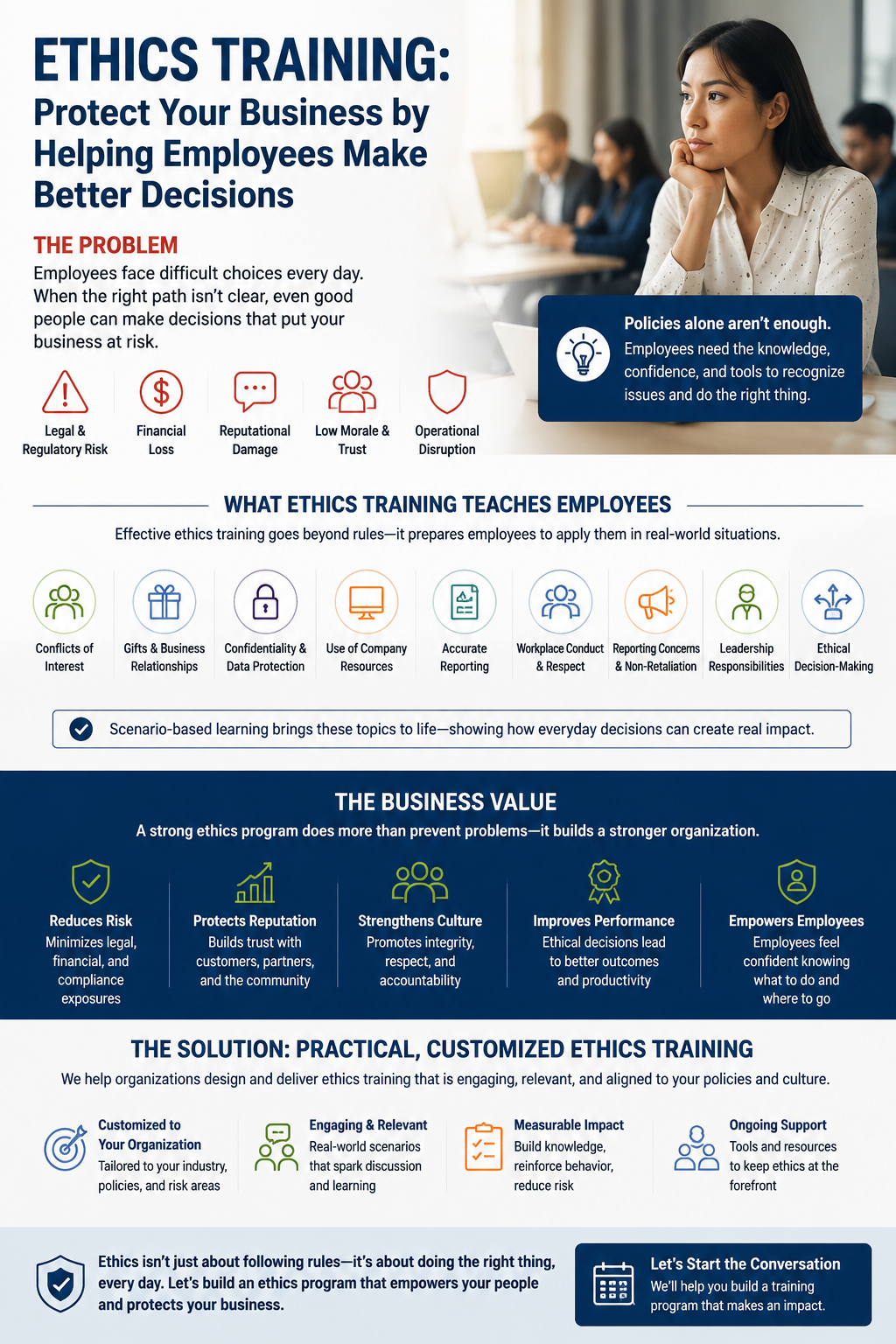
A strong code of conduct can help employees recognize ethical issues, stay aware of potential risks, and make better decisions before a problem grows.
But employees still have to interpret those expectations in daily situations, and an effective code only works when the company's code is applied in context.
Consider a policy requiring employees to disclose potential conflicts of interest. The statement may appear straightforward until an employee's relative applies for a position, a supervisor develops a financial relationship with a vendor, or an employee begins outside work involving one of the company's clients.
The employee needs to recognize that the situation may require disclosure before making a decision. Employees should understand what the organization expects them to consider when they encounter a difficult situation. That means making sound ethical decisions, not just recalling rules.
Customized training can connect the company's written standards and ethical guidelines to examples that make sense for its workforce. It can also reinforce clear guidelines for handling sensitive situations. 37% of employees are unsure how to respond to ethical dilemmas, which is why practical guidance matters.
Masterly Legal Solutions also provides professional employee handbook services and policy development for employers that need their workplace policies reviewed or developed. Employers can learn more about those services on the Masterly Legal Solutions Employee Handbook Services page.
Clear Reporting Expectations Reduce Dangerous Guesswork
A company’s Code of Conduct should be the starting point within broader ethical guidelines, so employees should not have to guess what happens when they raise a concern.
They should understand where concerns can be reported, what managers are expected to do with information they receive, and what the company expects after a report is made.
The EEOC recommends accessible complaint systems, regular communication about reporting procedures, and training that helps employees and managers understand their responsibilities. It also recommends that managers receive clear instruction about responding to and escalating workplace concerns to ensure employees feel safe reporting issues and have the support they need when questions come up, including regular sexual harassment training as part of a comprehensive prevention strategy.
These principles matter beyond a single type of workplace complaint.
When reporting expectations are unclear, employees may stay silent, tell the wrong person, or assume that another employee will handle the matter. Managers can create additional problems when they receive information but fail to recognize that it needs to be escalated. But employees still have to interpret those expectations in daily situations. Clear guidelines on paper do not eliminate uncertainty, and 22% of employees unknowingly violated the Code of Conduct.
Ethics training should remove as much of that uncertainty as possible, even when the code itself is well written, by reinforcing expectations in day-to-day situations.
Employees Need to Know Where to Go
A reporting process is only useful when employees understand it and feel able to use it.
The EEOC has specifically identified accessible reporting procedures, representatives who take reports seriously, timely responses, and trained investigators as important parts of an effective workplace reporting system. Employees must also know they are protected under whistleblower policies when raising concerns.
Your ethics program should therefore connect ethical expectations with the actual reporting structure used by your organization. Reporting procedures should support employees, make clear that they do not control the outcome once a concern is raised, and explain the available reporting options, including hotlines where applicable.
Ethical Decision Making Matters Most in the Gray Areas
Simple situations rarely test a company's ethical culture.
Employees are also more likely to use a reporting process when they understand what they can and cannot control after reporting.
The difficult situations are the ones where an employee can make several choices and none appears immediately perfect.
Imagine an employee who discovers that a close friend at the company may have provided inaccurate information to a customer. Reporting the concern could affect the friendship. Ignoring it could expose the business to a larger problem and create potential consequences for the customer and the company.
Or consider a manager who receives a complaint about a high-performing employee. The manager may worry that escalating the issue will disrupt an important project, especially in complex situations where deadlines and personal interests can cloud judgment.
Training should help employees separate personal concerns from organizational responsibilities and understand their ethical obligations.
Effective ethical decision making gives employees a framework for asking what company policy requires, who could be affected, whether disclosure is necessary, and when the matter should be escalated.
That is far more useful than asking employees to memorize a presentation. A trusted reporting structure also strengthens trust between leadership and staff, which improves employee engagement and retention.
Manager Accountability Cannot Be an Afterthought
Managers need special attention because employees often bring concerns to them first.
Imagine an employee who discovers a conflict involving personal interests and has to choose between staying silent, reporting it, or risking consequences either way. A manager who mishandles a report can turn a manageable issue into a serious employee-relations problem. The manager may promise confidentiality that cannot realistically be maintained, creating false expectations about transparency, begin investigating without authorization, dismiss the employee's concern, delay escalation, or take an employment action that creates additional concerns.
The EEOC advises employers to train supervisors and managers on preventing, identifying, reporting, and responding to problematic conduct. Its retaliation guidance also recommends training management and HR personnel to respond proactively when employees raise concerns, supported by customized workplace training and legal services that address these risks.
That makes manager accountability an important part of an ethics program.
Managers should understand that leadership responsibility includes knowing when they must act, when they must report, and when an issue should be transferred to HR, senior management, or legal counsel. Training should help them manage personal concerns, organizational responsibilities, and ethical obligations in complex situations.
37% of employees are unsure how to act in ethical dilemmas, which is why a usable framework matters in gray areas.
Poor Ethics Training Can Become a Business and Reputation Problem
An ethical lapse does not remain isolated simply because it started with one employee.
A questionable decision can affect customers, vendors, coworkers, leadership, and the company's public reputation. Internal complaints can become harder to address when employees received conflicting instructions or managers applied policies differently, or when managers promise confidentiality without being clear about what they can and cannot keep private, which can undermine employee security.
Consistency matters.
The U.S. Department of Justice's corporate compliance guidance evaluates whether compliance programs are well designed, effectively implemented, and actually working in practice. Training, communication, reporting structures, management commitment, discipline, and continuous improvement are among the areas considered in that framework, because employees need practical guidance to protect sensitive information, reinforce integrity in day-to-day decisions, and avoid choices that could lead to larger compliance failures, often supported by outside general counsel services for compliance.
For employers, the larger lesson is important: a program should work in practice, not simply exist on paper, and leadership should know how to manage concerns appropriately before they become larger problems that affect trust, performance, and long-term success.
Generic Training May Miss the Risks Unique to Your Business
A technology company, professional services firm, healthcare organization, construction company, nonprofit, and family-owned business can face very different ethical situations, so ethics training should protect the organization's integrity and brand reputation. Ethical lapses can also undermine a sense of security among customers and staff.
Job responsibilities also matter.
Sales employees may encounter gifts and vendor relationships. Managers may deal with reporting and employment decisions. Finance personnel may handle sensitive transactions and insider trading concerns. Employees with access to confidential information, sensitive information, and data may face different risks than employees working in the field.
Training should reflect those differences.
A customized program allows examples and scenarios to be connected to the organization's structure, policies, workforce, and risk areas. It can build practical knowledge of how to handle disclosures, conflicts, and role-specific decisions. It can also distinguish the responsibilities of employees from the additional obligations placed on managers, similar to how higher education institutions receive tailored compliance and training support. Consistency matters. Weak training can increase the chance of lawsuits and fines, while stronger training can protect the business.
Near the DOJ discussion, training should also cover anti-bribery and corruption policies because bribery can severely damage a company's reputation. A program that works in practice supports better compliance outcomes and long-term business success and can be strengthened through strategic business consulting and risk management.
What Masterly Legal Solutions Can Do for Your Organization
Masterly Legal Solutions provides employers with a done-for-you approach to workplace ethics and HR consulting, backed by comprehensive legal and business services.
Instead of giving your company a generic presentation and leaving your team to connect the pieces, we can help develop training around your organization's policies, workforce, management structure, and workplace concerns, and conduct training in a way that is tailored to your team.
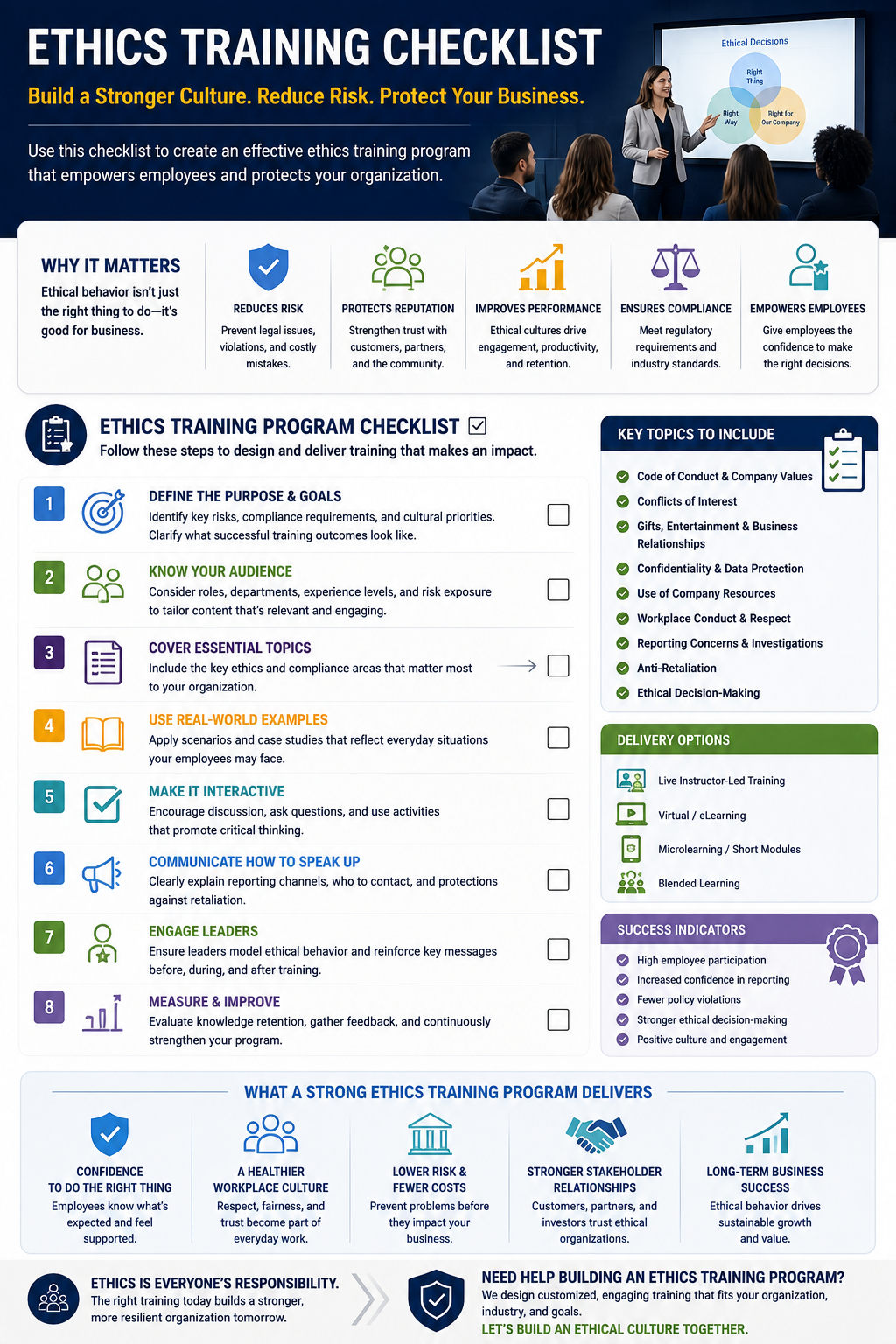
Depending on the needs of the organization, a customized program can address:
- Employee ethics training tied to realistic workplace situations
- Application of your code of conduct
- Recognition and disclosure of conflicts of interest
- Clear reporting expectations
- Practical ethical decision making
- Manager responsibilities and escalation
- Manager accountability
- Consistency between workplace policies and training to support overall effectiveness
- Scenario-based discussions for difficult decisions
- Related HR and employee-policy concerns, including finance personnel facing risks such as insider trading and employees with access to data, sensitive information, and the knowledge needed to handle it properly
Confidentiality training protects sensitive and proprietary information, is critical in today's digital age, and 22% of employees unknowingly violated confidentiality policies.
This approach allows employers to focus on running their businesses while receiving professional assistance developing a program designed for their workforce, supported by broad legal services for businesses and individuals.
Frequently Asked Questions About Employee Ethics Training
What is employee ethics training?
Employee ethics training teaches employees how workplace standards apply to actual decisions. It can cover conflicts, reporting duties, company values, appropriate conduct, and how employees should respond when a situation is unclear.
Is ethics training the same as a code of conduct?
No. A code of conduct establishes standards and policies. Ethics training helps employees understand how those standards apply to situations they may encounter at work.
Should managers receive different ethics training?
Often, yes. Managers may have additional responsibilities when they receive complaints, observe questionable conduct, make employment decisions, or need to escalate an issue.
Can ethics training address conflicts of interest?
Yes. Training can help employees identify potential conflicts of interest and understand when disclosure, review, or approval may be required under company policy.
Why are reporting expectations important?
Employees need to know where to take concerns and what happens after they make a report. Managers also need to understand when information must be escalated.
How often should employee ethics training be provided?
There is no single schedule that fits every employer or every topic. Training frequency should reflect applicable legal requirements, the organization's risks, workforce changes, policy updates, and previous workplace issues. The EEOC recommends that certain workplace training be repeated and reinforced regularly.
Can Masterly Legal Solutions customize ethics training for our company?
Yes. Masterly Legal Solutions can help employers develop training based on their workforce, policies, management structure, and workplace needs rather than relying solely on generic materials.
Request a Consultation About a Customized Ethics Training Program
Employees will eventually face situations where a policy does not provide an easy answer. What they do next can affect coworkers, customers, management, and the reputation of the entire organization.
Employee ethics training can give your workforce clearer expectations for handling those moments while strengthening reporting practices, ethical decision making, and manager accountability.
Masterly Legal Solutions can help you develop a customized, done-for-you ethics training program designed around your organization and its workplace needs.
Call Masterly Legal Solutions at (972) 236-5051 or visit MasterlyLegal.com to request a consultation about a customized ethics training program.
Teacher Rights When Assaulted by a Special Needs Student: Safety, Reporting and Investigation Issues

Looking for Legal & Business Solutions? Contact Us Now
Fill in the form or call us to set up a meeting