

How CPS Houston Decisions Affect Custody and Family Stability
A call or unexpected visit from Child Protective Services can leave a Houston family worried about what happens next. Parents may be asked to discuss allegations, provide family records, agree to interviews, or consider temporary changes to their household. Without clear legal guidance, even a simple request can create confusion about parental rights and family stability.
If you are dealing with CPS Houston, the concern is not just the investigation itself. It is how the decisions made during the first contact may affect your children, your household, and your future.
A Houston CPS investigation may involve sensitive claims, conflicting information, and requests that carry legal consequences. Parents deserve to understand the scope of the concern before making important decisions.
At Masterly Legal Solutions, we provide legal guidance for families facing Child Protective Services investigations. Our approach focuses on understanding the allegations, reviewing relevant records, protecting parental rights, and addressing concerns before they develop into more serious disputes.
Early legal support can help families respond carefully while keeping child safety and long-term stability at the center of every decision.
1. CPS Houston: Understanding First Contact and the Scope of the Concern
The first contact from Texas Child Protective Services may involve a phone call, written notice, scheduled meeting, or unexpected home visit. Child Protective Services (CPS) operates under the Texas Department of Family and Protective Services. The purpose is generally to assess reports involving possible child abuse or neglect, often made through the Texas Abuse Hotline, which are assigned and prioritized by urgency before investigation steps begin.
However, an initial contact does not automatically mean the allegations are true or that a child will be removed from the home. High-priority matters may require investigators to begin responding within 24 hours.
During the early stages of the CPS process in Houston, investigators may seek information about:
- The specific safety concern or reported incident.
- The child's living arrangements and daily care.
- Family members and other caregivers.
- Medical, educational, or household circumstances.
- Any immediate concerns about the child's well-being.
The scope of an investigation depends on the allegations and available information. Children may be interviewed at home, school, or daycare depending on the circumstances. Some matters may be resolved after a review, while others may lead to further interviews, services, or court involvement.
Parents may feel pressure to explain everything immediately. Yet incomplete information or misunderstood statements can complicate the investigation.
Legal counsel can help identify what CPS is requesting, explain the parent's rights, and assess whether additional information or formal action may be necessary.
For teachers, school administrators, and superintendents, allegations involving children can also create concerns about employment, professional reputation, or school reporting duties. These concerns may require coordinated legal advice when a CPS matter overlaps with an education-related investigation.
2. What Parents Should Document During a Houston CPS Investigation
Accurate documentation can be important when a family faces questions about an incident, living conditions, or a child's care.
A Houston CPS investigation may involve information gathered from different sources. Medical providers, schools, relatives, and other individuals may have records that help explain the circumstances.
Important information may include:
- Dates and details of CPS communications.
- Names and roles of investigators involved.
- Written notices, requests, and proposed agreements.
- Medical records related to the reported concern.
- School attendance, educational, or childcare records.
- Relevant family communications and existing custody orders.
CPS generally must complete the investigation within 30 days, though a supervisor may approve an extension in some cases. When that happens, the agency may attempt to finish the case within an overall period of up to 90 days.
These materials may help establish a clearer timeline and support a parent's review of the agency's findings notice after completion, which can affect the outcome.
For example, an allegation involving a child's school attendance may require a review of medical appointments, attendance records, and communication with school officials. A concern involving an injury may require medical documentation and an explanation of the relevant circumstances.
The purpose is not to create a competing story. It is to ensure that decisions are based on complete, accurate information.
Masterly Legal Solutions helps families review and organize relevant records so that important facts are not overlooked. Our legal team can assess how documentation relates to the allegations and determine what information may be appropriate to present.
This approach can also protect sensitive family information from unnecessary disclosure.
3. Understanding Interviews and Home Visits
Interviews and home visits are common parts of a child protective investigation. They allow an investigator to gather information about the child's safety, family relationships, and living environment.
Parents may be asked to participate in interviews, permit a home visit, or provide access to certain records, but a request to enter the home is not the same as a court order, and parents may refuse entry unless one has been issued.
However, not every agency request carries the same legal requirements.
Under Texas law, parents have important rights during child protective investigations, including the right to consult legal counsel. If access is denied and the agency still wants to move forward with that step, a caseworker may seek court authorization when necessary.
Understanding these distinctions matters because statements and records gathered during an investigation may later become relevant to administrative findings, custody proceedings, or criminal matters.
A parent may also be concerned about how a child's interview will take place, whether an attorney should be involved, what happens when the family disagrees with an investigator's interpretation, or whether to agree or refuse an interview request involving an alleged victim.
Professional interview preparation is about understanding legal rights, not rehearsing answers.
At Masterly Legal Solutions, we help families assess interview requests, review relevant circumstances, and prepare for communication with investigators. Our goal is to support accurate responses while protecting clients from avoidable legal risks.
For education professionals, a CPS inquiry may overlap with school investigations, employment reviews, or administrative leave. Separate legal obligations may apply, especially where student safety, mandatory reporting, and professional conduct are involved.
Coordinated legal guidance can help address these overlapping concerns without confusing the CPS investigation with a school employment matter.
4. Safety Plan Questions That Can Affect Family Stability
A proposed safety plan can create immediate concerns for parents.
Safety plans are generally voluntary agreements intended to address identified risks while an investigation continues. Depending on the circumstances, a plan may involve supervision requirements, temporary living arrangements, or restrictions on certain interactions. When children can safely remain at home, CPS may instead push for Family-Based Safety Services rather than removal.
Although a safety plan is described as voluntary, its practical impact can be significant. If home safety cannot be addressed, the agency may look to kinship placement or foster care.
Parents may need answers to questions such as:
- What specific safety concern does the plan address?
- How will the agreement affect contact with the child?
- Who will supervise or support the proposed arrangement?
- How long is the plan expected to remain in place?
- What happens if the family disagrees with the proposed terms?
These questions matter because a safety plan may change household routines, childcare responsibilities, and contact between parents and children.
A voluntary safety plan is also different from a court order. The legal duties and consequences are not necessarily the same, and CPS manages cases involving placements with relatives or another approved person.
Parents should understand the terms before making decisions that may affect who has legal custody if CPS believes the child cannot safely remain at home, including temporary or permanent legal custody.
Masterly Legal Solutions provides legal review of proposed safety arrangements, helping families assess their rights, responsibilities, and available options.
Our focus is on addressing genuine child safety concerns while helping families avoid unnecessary disruption and uncertainty.
5. When CPS Hearings or Legal Deadlines May Arise
Not every CPS investigation results in a court case.
Some investigations conclude without removal or further court action. Others may involve additional services, a formal determination, or legal proceedings when the agency believes a child faces a serious safety risk.
When removal proceedings begin, deadlines can become urgent.
In many Texas emergency removal cases, emergency and adversary hearings are the proceedings used to validate the state's custody position after a removal, and the adversary hearing must often occur within 14 days, subject to applicable legal exceptions and procedures. At that hearing, the court considers whether the child should remain outside the home while the case continues.
Other court orders, notices, or administrative findings may involve separate deadlines.
Missing a required hearing or failing to understand an official notice can affect a parent's ability to respond effectively.
The legal issues may include:
- Whether the evidence supports the agency's allegations.
- Whether immediate protective measures are legally justified.
- Whether a child can remain safely with a parent or relative, including in removal cases where a judge reviews that question.
- Whether court-ordered services or restrictions are appropriate.
- What procedural rights and deadlines apply.
Parents should not assume that an informal agency request and a judicial order have the same effect.
Legal counsel can review the documents, explain the relevant obligations, and prepare a response based on the family's circumstances.
If a formal court proceeding begins, early representation becomes especially important because court decisions can affect placement, custody, and parental rights.
6. Seeking Fact-Specific CPS Investigation Help
Every family situation is different.
An allegation involving medical care may require a different legal response from one involving school attendance, supervision, or household safety. A family with an existing custody order may also face issues that do not apply to other investigations.
This is why general online information cannot replace legal advice based on the actual facts.
CPS is often focusing on child safety, family preservation, and connecting families with resources in the surrounding communities. When families contact Masterly Legal Solutions for CPS investigation help, our legal approach may include:
- Reviewing the initial contact and reported concerns.
- Evaluating notices, records, and agency communications.
- Explaining parental rights and communicating directly with CPS when appropriate so parents do not have to deal with the agency alone.
- Providing guidance regarding interviews and home visits.
- Reviewing proposed safety plans, related restrictions, and whether services such as parenting education or counseling may be involved.
- Assessing legal options if a matter moves toward formal proceedings.
CPS may also work with local government agencies and community programs when trying to stabilize the family and support reunification, which is a primary goal in many cases.
Our goal is to help clients make informed decisions while protecting both family stability and child safety.
Families should not have to interpret complicated legal requests without support, particularly when a decision could affect their children or household.
For teachers and school leaders, legal review may also be important when a CPS matter creates related concerns involving school investigations, administrative leave, or professional responsibilities.
Masterly Legal Solutions offers a professional, confidential approach to sensitive CPS matters, with attention to the facts, legal requirements, and each family's needs.
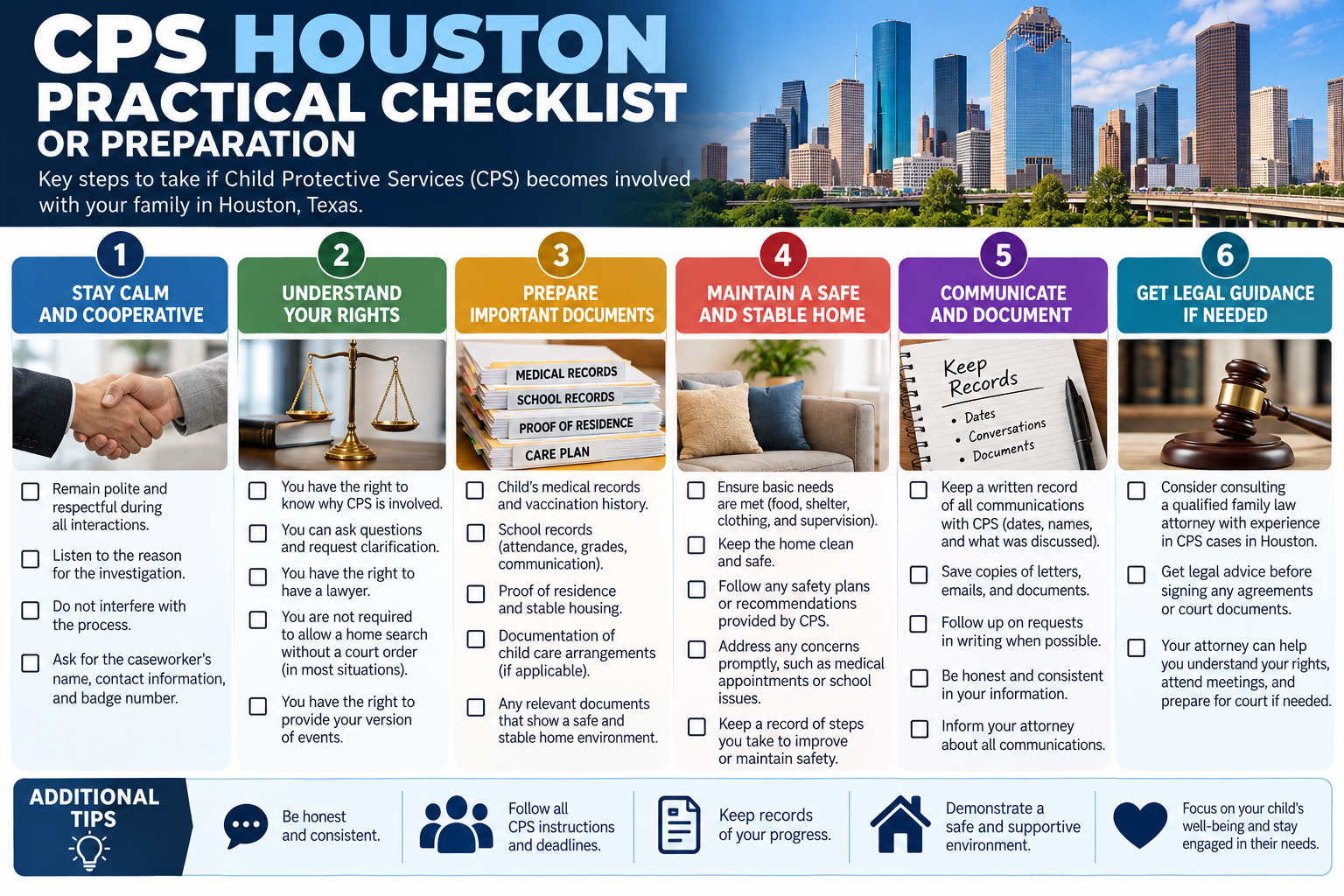
How Family and Community Resources Support CPS Investigations
During a CPS Houston investigation, Texas Child Protective Services may evaluate risk factors involving a child's safety, supervision, health, and living conditions. Concerns may include neglect, abuse, or exploitation, especially when a child is unable to protect themselves because of their age or circumstances. Investigators may review information from parents, teachers, doctors, and other professionals while considering available family and community resources. Access to appropriate community resources may help address safety concerns and support family stability. Depending on the findings, an investigation may result in administrative closure, additional services, or court involvement. If the agency files a petition, a judge may review the evidence before making decisions. A court may ultimately rule on protective measures, custody, or other legal matters. Masterly Legal Solutions helps families understand these developments, evaluate their legal options, and protect their parental rights throughout the process.
Frequently Asked Questions About CPS Houston
What should a parent record after a CPS contact?
Parents should preserve the date and time of contact, the investigator's name, the concerns discussed, written notices, requested documents, and any proposed agreements. Keeping a clear timeline also helps if the report is later assigned a priority level or the agency disputes what was said during the first contact. An attorney can help determine which family records are relevant.
What is the difference between a voluntary request and a formal order?
A voluntary request generally asks for consent, while a valid court order creates legal obligations that may be enforceable. Not every request meets the legal definition of abuse or neglect that supports each investigative step, so the source of formal authority matters. Some matters are investigated only after the agency decides the report fits that definition and warrants that level of action. The precise rights and requirements depend on the request, the order, and the circumstances.
Does every CPS Houston investigation lead to child removal?
No. A CPS investigation does not automatically result in removal. Some cases end in dismissal when CPS decides there is not enough evidence of abuse or neglect or the child is not at risk. Outcomes depend on the allegations, evidence, safety concerns, and applicable legal requirements.
Can parents speak with an attorney before a CPS interview?
Yes. Parents have the right to seek legal counsel during a Texas child protective investigation. An attorney can help them deal with the investigator or caseworker directly, explain their rights, and help them avoid statements that may affect the outcome. Depending on the allegations, an interview may involve the parent, the child, other family members, or alleged perpetrators.
Can a CPS safety plan affect where a child lives?
Yes. Depending on the circumstances, a proposed safety plan may involve temporary supervision or living arrangements. CPS may look at whether the proposed caregiver or supervising adult can be approved to keep the child safe. The approved arrangement may involve a relative or another person identified by the family. Parents should understand the terms and legal implications before agreeing.
When should a family seek legal assistance to protect parental rights during a Houston CPS investigation?
Families should consider legal assistance as soon as they receive formal contact, especially when interviews, safety plans, removal concerns, or court documents are involved. Early legal help can be especially important once a caseworker has been assigned, an assessment has begun, or the family is responding to formal reports or notices. Prompt advice can also matter if CPS is making a disposition or other final determination that could affect the CPS case.
Request a Confidential CPS Houston Investigation Consultation
When Child Protective Services contacts your family, the decisions ahead may affect your children, household stability, and parental rights, and abuse or neglect reports may also be shared with law enforcement, including matters involving immediate risk of serious harm or death.
You deserve legal guidance that addresses the actual concerns rather than relying on assumptions or general advice.
At Masterly Legal Solutions, we help families understand CPS communications, review relevant records, evaluate safety plan concerns, and prepare for possible legal proceedings. We also help families respond carefully when a CPS case may involve parallel agency and law-enforcement attention. Our approach is professional, careful, and focused on protecting your legal interests while respecting the importance of child safety.
If you are facing a CPS Houston investigation, contact our legal team to discuss your circumstances and the options that may be available.
Request a confidential CPS investigation consultation promptly when the family receives formal contact.
Call (972) 236-5051 or visit www.masterlylegal.com to contact Masterly Legal Solutions.
Disclaimer: This article provides general information and is not legal advice. CPS investigations depend on individual facts and applicable Texas law. Reading this article does not establish an attorney-client relationship. Consult a qualified attorney for advice about your specific situation.






Looking for Legal & Business Solutions? Contact Us Now
Fill in the form or call us to set up a meeting