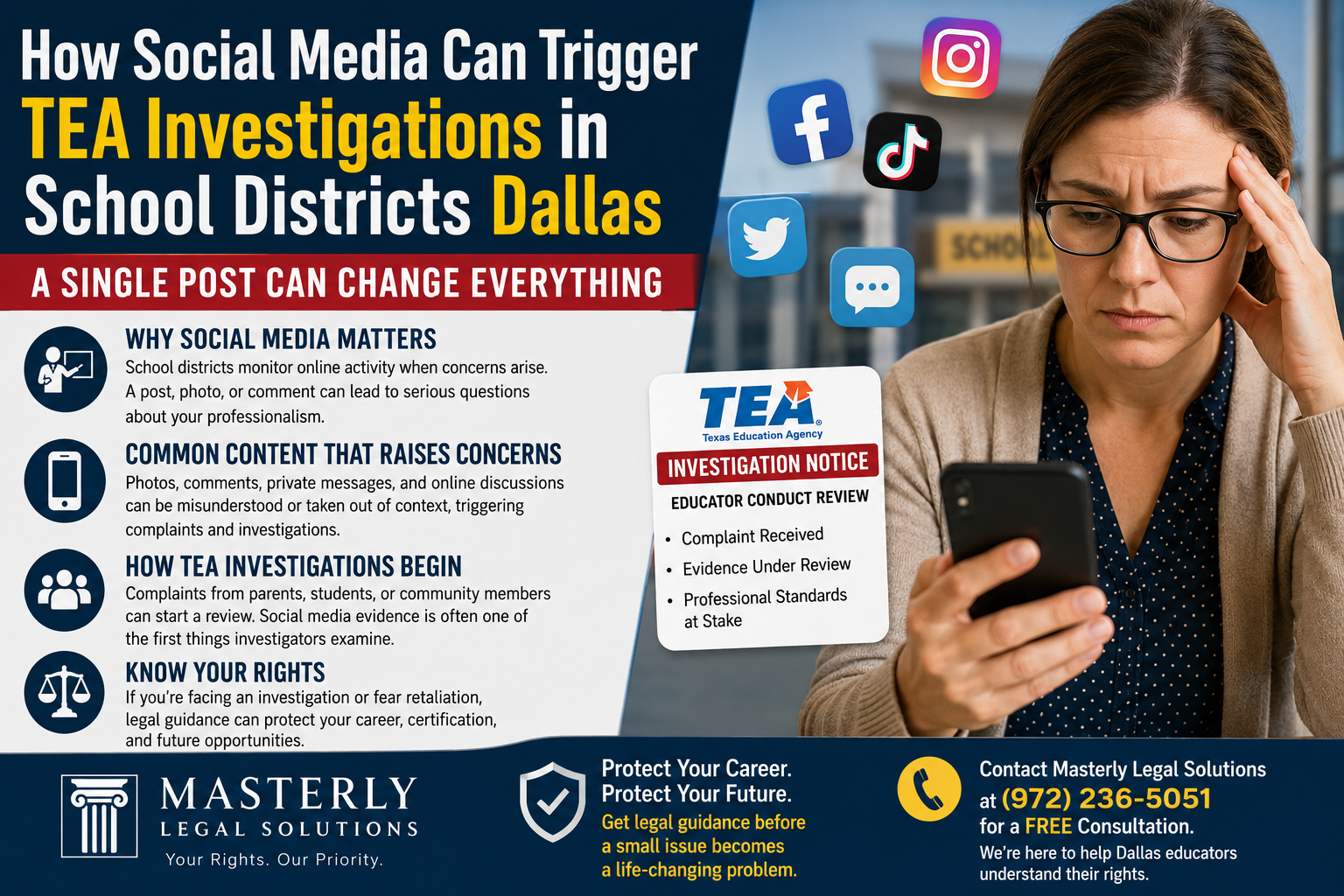
How Social Media Can Trigger TEA Investigations in School Districts Dallas
A Single Post Can Change Everything
Most educators use social media for the same reasons everyone else does. They share family photos, celebrate achievements, connect with friends, discuss hobbies, and stay informed about current events. What many school employees do not realize is that a personal post made in seconds can become part of a professional investigation months or even years later.
In today's digital world, social media has become one of the most common sources of evidence in employment-related investigations. Teachers, administrators, coaches, counselors, and other school employees are often surprised to learn that posts made outside of work can attract attention from school districts, parents, students, and even regulatory agencies. In some situations, online activity can trigger investigations involving the Texas Education Agency, commonly known as the TEA.
At Masterly Legal Solutions, we regularly speak with educators who never expected a Facebook comment, Instagram photo, TikTok video, or social media message to become a professional issue. Unfortunately, once concerns are raised, the consequences can be significant. Careers, certifications, reputations, and future opportunities may all be affected.
Understanding how social media can trigger investigations is essential for every educator working in Dallas and throughout Texas. The more employees understand these risks, the better positioned they are to protect themselves and respond appropriately if concerns arise, often with support from an education lawyer for teachers in Texas.
Why Social Media Receives So Much Attention During Investigations
School districts have a responsibility to maintain public trust and ensure that employees meet professional standards. Because social media is publicly accessible in many situations, investigators frequently review online content when allegations arise.
Posts that seem harmless to the person who created them may appear very different when viewed by parents, administrators, students, or investigators. Context can easily be lost, especially when screenshots circulate without explanations.
Unlike conversations that disappear once they end, social media content often creates a permanent record. Even deleted posts may survive through screenshots, archived content, or information saved by other users.
As a result, social media frequently becomes a starting point for investigations involving educator conduct.
The Connection Between Social Media and TEA Investigations
The Texas Education Agency oversees educator certification and professional standards throughout the state. When concerns arise regarding an educator's conduct, the agency may become involved depending on the circumstances.
A TEA investigation can begin in several ways. School districts may report concerns directly. Parents may file complaints. Community members may raise issues. In some situations, social media activity itself becomes the catalyst for the investigation.
A post that appears inappropriate, unprofessional, threatening, discriminatory, or inconsistent with professional expectations may attract scrutiny. Once concerns are reported, investigators may begin reviewing online content as part of a larger inquiry.
Because these investigations can have serious consequences, educators should take all allegations seriously from the very beginning, and many benefit from guidance from a dedicated TEA license defense law firm.
How Personal Posts Become Professional Problems
Many educators believe their personal social media accounts are entirely separate from their professional lives. Unfortunately, school districts do not always view the situation that way.
A personal account may still be connected to an educator's professional identity. Students, parents, colleagues, and community members often know who the employee is regardless of privacy settings.
For example, a teacher may post comments expressing frustration after a difficult day. While the teacher views the comments as harmless venting, others may interpret them differently. If concerns are raised, the district may decide to review the situation more closely.
What begins as a personal expression can quickly become a professional matter.
Photos That Can Trigger Investigations
Photographs frequently become evidence during school investigations. A single image may generate questions regarding judgment, professionalism, policy compliance, or employee conduct.
Investigators often examine photos involving:
- Alcohol consumption
- Potentially inappropriate behavior
- Student interactions
- School-sponsored events
- Offensive gestures
- Illegal activity
- Sensitive political statements
- Content perceived as threatening
The issue is not always whether the conduct itself was improper. Sometimes the concern focuses on how the image may affect public confidence in the educational institution.
Because perceptions matter, photos can become a significant focus during an investigation.
Comments and Online Discussions Can Create Unexpected Risks
Many social media investigations begin not because of photos but because of written comments. A comment posted during a heated discussion may be interpreted differently than intended.
Educators sometimes participate in conversations involving politics, religion, controversial topics, or community disputes. While individuals generally have rights to express opinions, public statements can still create professional challenges depending on the circumstances.
Investigators may examine whether comments violate district policies, create concerns about professionalism, or affect relationships with students and families.
This is one reason why employees should think carefully before posting content that may later be viewed out of context.
Private Messages Are Not Always Private
Many people assume that direct messages are protected because they are not publicly visible. Unfortunately, private messages often become part of investigations.
Recipients may share screenshots. Devices may be reviewed during investigations. Information may be voluntarily provided to school officials by third parties.
Messages involving students create particularly serious concerns. Even when no misconduct occurred, the appearance of inappropriate communication may generate questions that lead to further review.
Educators should remember that any digital communication has the potential to become public at some point.
When Students and Parents Report Online Activity
Social media investigations frequently begin with reports from students or parents. A parent who discovers concerning content may contact administrators immediately.
Students often share screenshots with one another, and information can spread rapidly across social media platforms. Content that originally reached only a small audience can quickly become widely circulated.
Once administrators become aware of potentially concerning material, they may feel obligated to investigate. Even if allegations are ultimately unfounded, the investigation itself can be stressful and disruptive.
Responding appropriately during the early stages can significantly affect the outcome.
Social Media Evidence Is Often Preserved Forever
One of the biggest mistakes employees make is assuming that deleting content eliminates the problem. In many cases, the evidence has already been preserved before deletion occurs.
Screenshots, downloads, archived web pages, and saved communications often remain available. Investigators may still obtain and review information even after posts are removed.
Deleting content after learning of an investigation can sometimes create additional complications. Depending on the circumstances, investigators may question why material was removed.
Before taking action, educators should consider speaking with an experienced attorney who understands education law and professional licensing issues.
How Workplace Retaliation Can Develop After Social Media Complaints
Social media issues sometimes create concerns beyond the investigation itself. Employees who raise concerns about unfair treatment may later experience workplace retaliation.
For example, an educator may report that a district handled a social media complaint unfairly. After making the report, the employee may believe negative treatment has begun. These situations require careful legal analysis because not every adverse event qualifies as unlawful retaliation.
Employment laws exist to protect workers who engage in certain forms of protected activity. Whether a viable claim exists depends on the specific facts and circumstances involved.
When questions arise regarding workplace retaliation, seeking legal guidance early from a knowledgeable retaliation lawyer for workplace retaliation and employment law issues is often critical.
Understanding Protected Activity in School Employment Cases
A protected activity generally involves actions that employment laws specifically protect from retaliation. Examples may include reporting misconduct, opposing unlawful conduct, participating in investigations, or asserting workplace rights.
Many employees hesitate to raise concerns because they fear negative consequences. These concerns are often understandable. However, both state and federal laws provide protections in many situations.
The challenge is that retaliation cases can be complex. School districts often provide legitimate explanations for employment decisions, making it important to examine the facts carefully.
An experienced employment lawyer or education law attorney for teachers and administrators can help determine whether legal protections may apply.
Why Early Legal Advice Matters
By the time many educators contact an attorney, an investigation is already well underway. Statements have been made, documents have been reviewed, and decisions may be approaching.
Early legal guidance can help educators understand their rights, evaluate risks, and develop an informed response. This is especially important when social media content becomes part of a TEA investigation.
An experienced employment attorney familiar with educator investigations or a dedicated education law attorney who helps protect teacher rights can help identify potential issues before they become larger problems. Early intervention often provides more options than waiting until disciplinary action has already occurred.
When careers and professional certifications are at stake, preparation matters.
School District Policies Often Extend Beyond the Classroom
Many educators are surprised to discover that district workplace policies may apply to conduct occurring outside school property and outside normal work hours. While employees have personal lives, school districts often expect educators to maintain professional standards that reflect positively on the educational environment.
These policies frequently address social media activity, electronic communications, interactions with students, and public conduct. Even when an employee believes a post is private, district officials may view it differently if it becomes public knowledge.
Understanding these policies is important because violations can lead to investigations, disciplinary action, and even TEA reporting obligations. Employees should review district policies carefully and seek clarification when questions arise.
When uncertainty exists, consulting an experienced employment lawyer may help prevent costly mistakes.
Social Media and Allegations of Workplace Discrimination
Online activity can sometimes create allegations involving workplace discrimination. Comments, posts, memes, or shared content may be interpreted as discriminatory based on race, religion, gender, disability, age, or other protected characteristics.
In today's environment, even content shared years earlier can resurface and become part of an investigation. School districts often examine whether online activity raises concerns regarding professional judgment or treatment of students and colleagues.
When allegations arise, investigators may review the context of the content, its audience, and whether similar concerns have been reported previously. What an employee intended may not always align with how others perceive the content.
These situations can become particularly complicated when accusations of employment discrimination are involved.
When Social Media Leads to Sexual Harassment Complaints
Social media can also become evidence in cases involving sexual harassment allegations. Comments, direct messages, photos, and interactions may all be reviewed during an investigation.
Sometimes the issue involves communications between employees. In other situations, concerns arise from interactions with students, parents, or members of the public. Even if no misconduct was intended, certain communications may create the appearance of inappropriate behavior.
School districts often take these complaints seriously because of potential liability concerns. As a result, investigations may begin quickly and move faster than employees expect.
Seeking legal representation early can help employees understand their rights and responsibilities during the process.
Age Discrimination Concerns Can Appear Online
Social media content sometimes becomes relevant in disputes involving age discrimination. Posts, comments, or communications may be cited as evidence of bias against older or younger employees.
For example, remarks about retirement, generational differences, or workplace stereotypes can sometimes become part of employment disputes. While not every comment creates legal liability, investigators may review whether such statements contribute to a larger pattern of conduct.
Employees should recognize that online communications often receive the same scrutiny as in-person statements. What seems like a joke today may be interpreted differently during an investigation years later.
Understanding these risks can help educators avoid unnecessary complications.
How Employment Law Intersects With Social Media Investigations
Modern employment law continues to evolve as technology changes workplace interactions. Social media platforms create new challenges for both employees and employers.
School districts must balance employee rights with their obligation to maintain safe and professional learning environments. This balancing act often creates difficult legal questions when online activity becomes the subject of complaints.
Investigations may involve privacy concerns, free speech issues, professional standards, and district policies. Because multiple legal principles can apply simultaneously, these cases are often more complex than they initially appear.
An experienced employment lawyer can help employees understand how employment law applies to their specific situation.
The Growing Role of Human Resources in Digital Investigations
Most school districts involve their human resources department when allegations arise concerning social media activity. Human resources professionals may gather information, coordinate interviews, and review district policies.
The goal is often to determine whether employee conduct violated district expectations or created potential legal concerns. During this process, employees should understand that statements provided to investigators may become part of the official record.
Many employees assume human resources exists primarily to advocate for workers. In reality, human resources generally serves the interests of the organization itself.
For that reason, obtaining independent legal advice can be extremely valuable.
Social Media Posts and Disability Discrimination Allegations
Social media content occasionally becomes relevant in disputes involving disability discrimination. Comments regarding medical conditions, accommodations, or physical limitations may be reviewed during employment investigations.
Questions sometimes arise regarding whether an employee received a reasonable accommodation as required by law. In other cases, online content may be used to challenge claims involving medical restrictions or workplace limitations.
These situations require careful legal analysis because appearances can be misleading. A photograph or social media post rarely tells the entire story.
Employees facing these allegations should seek guidance from an experienced employment attorney as early as possible.
The Importance of Good Faith Belief When Reporting Concerns
Many employment protections depend on whether an employee acted with a good faith belief that misconduct occurred. This principle is important when employees report concerns involving discrimination, harassment, policy violations, or other workplace issues.
An employee does not necessarily need to prove that misconduct actually occurred. Instead, the focus may be on whether the employee reasonably believed a violation existed at the time the report was made.
This distinction becomes important when evaluating retaliation-related concerns. Employees should not be punished simply because an investigation ultimately reaches a different conclusion.
A good faith belief often plays a central role in employment-related disputes.
When Reporting Discrimination Leads to Retaliation Concerns
Employees who engage in reporting discrimination may later become concerned about negative treatment. In some cases, workers believe an employer has taken action because they raised concerns about unlawful conduct.
This can create questions regarding employer retaliation and whether the employee engaged in a legally protected activity. Determining whether a valid claim exists requires a careful examination of timelines, communications, and employment decisions.
Not every negative workplace event constitutes retaliation. However, patterns of conduct sometimes suggest deeper concerns that deserve legal review.
An experienced retaliation lawyer can evaluate whether legal protections may apply.
Understanding the Equal Employment Opportunity Commission
The Equal Employment Opportunity Commission plays an important role in enforcing federal employment protections. Employees who believe they have experienced discrimination or retaliation may eventually interact with this agency.
Although TEA investigations focus on educator conduct and certification issues, employment-related claims may involve separate legal processes. Depending on the circumstances, multiple agencies may become involved.
Understanding these overlapping systems can be confusing for employees already facing professional stress. This is one reason why experienced legal representation can be so valuable.
The sooner employees understand their options, the better positioned they are to protect their interests.
Workplace Retaliation Can Follow Social Media Complaints
Some employees experience workplace retaliation after raising concerns about how a social media investigation was handled. They may believe administrators treated them unfairly because they questioned procedures or challenged findings, and legal support from a dedicated retaliation lawyer focused on workplace and employment protections can be crucial.
These situations require careful review because retaliation claims often depend on specific facts. Timing, documentation, and witness testimony may all become important pieces of evidence.
Employees should avoid assuming that every disagreement qualifies as retaliation. However, they should also avoid ignoring warning signs that may indicate unlawful conduct.
Proper legal guidance can help determine the best course of action.
Why Documentation Matters More Than Ever
When social media becomes part of an investigation, documentation is critical. Employees should preserve emails, messages, screenshots, policy documents, and records of significant conversations whenever appropriate.
Documentation often helps establish timelines and clarify what actually occurred. This information may become extremely important if disputes later arise regarding the facts of the case.
Waiting until an investigation reaches an advanced stage can make evidence more difficult to obtain. Early preparation often provides significant advantages.
An experienced law firm can help identify what information may be important to preserve and review.
When Social Media Content Is Reported to the TEA
Not every social media concern results in a TEA case, but certain situations may trigger reporting obligations for school districts. Administrators sometimes determine that online activity raises questions about an educator's professional conduct, judgment, or fitness to hold a certificate.
Once a report is made, the educator may find themselves facing both district-level review and a separate TEA investigation. These are often distinct processes with different goals and procedures. Many employees mistakenly assume that resolving the district matter automatically resolves the TEA issue as well.
Because educator certifications are often at stake, employees should take every report seriously. Early legal guidance may help protect both employment and licensing interests.
Dallas Employment Issues Often Extend Beyond School Policies
Many educators focus only on district policies when allegations arise. However, social media investigations can also create broader Dallas employment concerns involving retaliation, discrimination, and employment rights.
A teacher may believe a district treated them differently because they reported misconduct. An administrator may feel they were unfairly targeted after raising concerns about workplace practices. These issues often extend beyond educational regulations and into broader areas of employment law.
Understanding all potential legal implications is essential. What begins as a social media review can sometimes evolve into a much larger employment dispute.
This is why experienced legal counsel should evaluate every aspect of the situation.
How a Retaliation Claim Can Develop During a TEA Investigation
A retaliation claim may arise when an employee experiences negative treatment after engaging in a protected activity. This could include reporting misconduct, participating in an investigation, or opposing conduct believed to violate the law.
For example, an educator may report concerns regarding district practices and later become the subject of increased scrutiny. In another situation, an employee may cooperate with investigators and subsequently face unfavorable treatment.
Whether a valid claim exists depends on many factors. Timing alone is not enough, but patterns of conduct can sometimes support allegations of retaliation.
A careful legal review is often necessary to determine whether a viable retaliation claim may exist.
Workplace Retaliation Often Starts Subtly
One reason workplace retaliation cases can be difficult to identify is that the conduct often begins gradually. Employees may notice small changes before more serious actions occur.
An educator may be excluded from meetings, denied opportunities, or subjected to unusual scrutiny. Over time, these actions may become more severe and affect career advancement or employment status.
Because retaliation is not always obvious, employees should pay attention to changes that occur after engaging in protected activities. Documentation can be extremely important in these situations.
An experienced workplace retaliation attorney can help evaluate whether the conduct may violate applicable laws.
The Role of the Texas Workforce Commission
Certain employment disputes may involve the Texas Workforce Commission. This agency addresses various employment-related issues and may become relevant depending on the nature of the allegations.
Although TEA investigations focus primarily on educator certification and professional conduct, employment-related concerns sometimes require review by other agencies as well. Understanding which agencies have authority can be confusing.
Employees should not assume that one agency handles every aspect of a dispute. Different issues may require different legal approaches.
Experienced legal counsel can help determine which processes may apply.
Wrongful Termination Following Social Media Allegations
Some educators fear that a social media investigation could ultimately lead to wrongful termination. While employers have authority to address legitimate concerns, termination decisions must still comply with applicable laws.
The issue is not simply whether an employee was terminated. The key question often involves why the termination occurred and whether unlawful factors influenced the decision.
Evidence, timing, communications, and district actions may all become important when evaluating these cases. Every situation is unique and requires individual analysis.
Employees facing possible termination should seek legal guidance as early as possible.
Social Media Complaints and Hostile Work Environment Claims
Investigations sometimes create tension within the workplace. Employees may feel isolated, excluded, or treated differently after allegations become known.
In certain situations, workers may believe they are experiencing a hostile work environment. The conduct may involve coworkers, supervisors, or administrators who alter their behavior after learning about an investigation.
Not every uncomfortable workplace situation meets the legal standard for a hostile work environment. However, persistent negative treatment may raise important concerns.
Careful documentation and legal evaluation are often necessary to determine whether legal remedies may be available.
The Impact of Employment Discrimination Allegations
Social media content occasionally becomes evidence in allegations involving employment discrimination. Investigators may review whether posts, comments, or interactions reflect discriminatory attitudes that affect workplace decisions.
These cases often involve complex factual questions. Investigators may examine whether employment actions were influenced by bias involving age, disability, gender, race, religion, or other protected characteristics.
Employees accused of discriminatory conduct deserve an opportunity to present their side of the story. Likewise, employees who experience discrimination deserve protection under the law.
Both situations require careful and thorough legal analysis.
Federal and State Law Protections for Educators
Various protections exist under federal and state law to help safeguard employee rights. These protections may apply even when investigations begin with social media complaints.
Depending on the circumstances, laws involving retaliation, discrimination, leave rights, accommodations, and employee protections may become relevant. Educators often discover that their situation involves multiple overlapping legal issues.
Understanding these protections can be challenging without legal assistance. Each law contains unique requirements, deadlines, and procedures.
Seeking legal advice early often helps employees avoid costly mistakes.
When Human Resources Becomes Involved
Most significant investigations involve human resources at some stage. Human resources personnel often coordinate interviews, collect evidence, review policies, and assist decision-makers.
Employees should remember that human resources generally represents the interests of the district. While HR professionals may conduct investigations professionally and fairly, they are not personal advocates for individual employees.
Statements made during HR interviews can become part of the official record. Employees should take these meetings seriously and prepare carefully.
Legal guidance before participating in interviews can often be beneficial.
Understanding Adverse Employment Actions
An adverse employment action may include termination, demotion, suspension, significant changes in responsibilities, or other actions affecting employment conditions.
In retaliation-related cases, proving an adverse employment action is often an important component of the claim. Employees frequently focus on the event itself, but investigators and courts may also examine the reasons behind it.
For example, a social media complaint followed by disciplinary action does not automatically establish retaliation. The surrounding facts matter.
Proper legal analysis helps determine whether an adverse employment action may support a legal claim.
Why Dallas Employment Lawyers Often Recommend Early Action
Many Dallas employment lawyers encourage employees to seek legal advice before an investigation reaches a critical stage. Early intervention often creates opportunities that may not exist later.
An attorney may help identify legal risks, preserve evidence, prepare responses, and evaluate potential claims. Waiting too long can sometimes limit available options.
The reality is that investigations often move quickly once they begin. Decisions may be made before employees fully understand the seriousness of the situation.
Taking action early can provide important advantages and peace of mind.
Social Media Investigations Can Affect More Than Your Current Position
Many educators focus on protecting their current employment, but investigations can have broader consequences. Professional reputations, future opportunities, certifications, and references may all be affected.
A single allegation can follow an educator long after the original dispute ends. This is especially true when social media evidence becomes part of the record.
Because the stakes are often high, employees should approach investigations strategically rather than emotionally. Professional guidance can make a meaningful difference.
Protecting a career requires looking beyond immediate concerns and considering long-term consequences.
Why Educators Should Speak With a Retaliation Lawyer Dallas Employees Trust
When an educator believes negative treatment followed a report of misconduct or participation in an investigation, it may be time to consult a retaliation lawyer Dallas employees trust. Retaliation cases can be difficult because employers often provide alternative explanations for their actions. What appears to be a routine personnel decision may actually involve unlawful motives.
An experienced attorney can review timelines, communications, disciplinary records, and witness statements to determine whether legal concerns exist. The sooner legal advice is obtained, the easier it may be to preserve critical evidence.
At Masterly Legal Solutions, we understand how quickly workplace disputes can escalate once social media allegations become part of the conversation.
Social Media Complaints Can Lead to Discrimination Claims
In some situations, social media investigations evolve into broader discrimination claims. An employee may believe that discipline was imposed more harshly because of age, gender, race, disability, religion, or another protected characteristic.
Investigators and attorneys often examine whether similar conduct by other employees resulted in different outcomes. Consistency is frequently an important issue when evaluating discrimination concerns.
When evidence suggests unequal treatment, employees may have additional legal options beyond simply responding to the original investigation.
Understanding the full scope of potential claims is critical when protecting your career.
The Role of Federal Law in Employment Disputes
Many employment protections arise under federal law, including laws addressing discrimination, retaliation, and workplace rights, and employees sometimes must file retaliation and labor complaints with the Department of Labor or similar agencies. These statutes often work alongside state protections to provide safeguards for employees facing workplace disputes.
When social media allegations trigger investigations, multiple legal frameworks may apply simultaneously. Employees sometimes focus solely on district policies while overlooking broader legal protections.
An experienced employment lawyer can help identify which laws may apply and how they affect a particular situation.
This analysis often becomes especially important when a TEA investigation overlaps with employment concerns.
The Civil Rights Act and Workplace Protections
The Civil Rights Act remains one of the most important employment statutes in the United States. It provides protections against certain forms of discrimination and retaliation in the workplace.
When employees report discrimination or participate in protected activities, they may receive legal protections under this law. These protections can be particularly relevant when school investigations involve allegations of unequal treatment.
Educators should understand that employment rights often extend beyond district policies and internal procedures. Federal protections may still apply even when an employer believes its actions were justified.
This is one reason legal guidance can be invaluable during complex employment disputes.
Age Discrimination Concerns in School District Investigations
Although many social media cases focus on conduct issues, some disputes involve allegations of age discrimination. Older educators sometimes believe they were treated differently than younger colleagues under similar circumstances.
These concerns may arise when disciplinary decisions appear inconsistent or when comments suggest age-related bias. Investigators may review employment records, communications, and personnel decisions to determine whether discrimination occurred.
Not every unfavorable outcome constitutes age discrimination, but employees should not ignore potential warning signs.
Legal analysis often helps distinguish lawful personnel decisions from potentially unlawful conduct.
Sexual Harassment Allegations and Social Media Evidence
Social media content is frequently reviewed in cases involving sexual harassment allegations. Investigators may examine messages, comments, photographs, videos, and online interactions.
Even communications that appear harmless to one person may be viewed differently by another. Context often becomes one of the most important factors in determining how evidence is interpreted.
Because these allegations can have serious professional consequences, employees should respond carefully and avoid making assumptions about the outcome.
An experienced employment attorney can help evaluate the evidence and develop an appropriate response strategy.
Understanding Employer Retaliated Allegations
Many retaliation cases center on claims that an employer retaliated against an employee for engaging in a protected activity. The employee may have reported misconduct, participated in an investigation, or opposed conduct believed to be unlawful.
To evaluate these allegations, attorneys often examine the timing of events, decision-making processes, and documentation created during the investigation.
The goal is to determine whether the adverse treatment was connected to the protected activity or whether legitimate reasons existed for the employer's actions.
This analysis frequently plays a central role in employment litigation.
Why a Viable Retaliation Claim Requires Evidence
A viable retaliation claim requires more than suspicion. Employees generally need evidence showing a connection between their protected activity and the adverse action they experienced.
This evidence may include emails, witness testimony, disciplinary records, performance evaluations, and other documentation. The stronger the evidence, the stronger the potential claim.
Because evidence can disappear over time, early action is often important. Waiting too long may make it harder to establish critical facts.
An experienced retaliation lawyer can help identify and preserve evidence that supports a claim.
Federal Courts and State and Federal Courts Handle Employment Disputes
Certain employment disputes eventually proceed through federal courts or state and federal courts depending on the claims involved. While many cases resolve before reaching litigation, employees should understand that court proceedings are sometimes necessary.
Litigation often involves extensive evidence gathering, witness interviews, and legal arguments. Preparation frequently begins long before a case reaches a courtroom.
This is another reason why obtaining legal advice early can be beneficial. Building a strong case takes time and careful planning.
Employees should never assume that waiting will improve their legal position.
The Texas Labor Code and Employee Protections
The Texas Labor Code contains important provisions affecting workplace rights and employment disputes. Depending on the facts of a case, these protections may become relevant when evaluating retaliation, discrimination, wage issues, and other concerns.
Educators often focus primarily on TEA regulations while overlooking employment protections available under Texas law. However, both sets of rules may be important.
Understanding how these laws interact can be challenging without legal guidance. Each situation requires individual analysis.
Proper legal representation can help identify the strongest available claims and defenses.
Disability and Gender Discrimination Issues
Social media investigations occasionally intersect with allegations involving gender discrimination or other forms of unequal treatment. Questions may arise regarding how employees were treated compared to similarly situated coworkers.
In other cases, disputes involve accommodation requests or concerns related to disabilities. Laws protecting employees with disabilities often require individualized assessments and compliance with legal standards.
When employees believe discriminatory motives influenced employment decisions, those concerns deserve careful evaluation.
Ignoring potential discrimination issues can lead to missed opportunities to protect important rights.
The Importance of a Good Faith Belief
Many retaliation protections depend upon whether an employee acted with a good faith belief that misconduct occurred. This standard is important because employees are not expected to prove wrongdoing before reporting concerns.
Instead, the law often focuses on whether the employee reasonably believed a violation existed at the time. This principle encourages employees to report concerns without fear of automatic punishment.
When evaluating retaliation cases, attorneys frequently analyze whether the employee's belief was reasonable under the circumstances.
Understanding this concept is often critical to assessing legal options.
Dallas Employment Matters Require Strategic Planning
Complex Dallas employment disputes rarely resolve themselves. Whether the issue involves social media investigations, retaliation concerns, discrimination allegations, or TEA proceedings, strategic planning is essential.
An effective legal strategy often begins with understanding the facts, preserving evidence, and identifying applicable laws. Every decision made during an investigation can affect future outcomes.
Employees should avoid reacting emotionally or making assumptions about what investigators may do next.
Professional legal guidance often provides clarity during uncertain situations.
When Employment Law Matters Become More Serious
Some employment law matters start as simple workplace disagreements and eventually develop into significant legal disputes. Social media allegations can accelerate this process because digital evidence is often widely available and easily shared.
As investigations expand, employees may face disciplinary action, certification concerns, or employment-related claims simultaneously. Managing these issues requires a comprehensive approach.
The sooner employees understand the potential risks, the better positioned they are to make informed decisions.
Preparation and early intervention frequently provide the strongest protection.
Understanding the Pregnancy Discrimination Act and Related Protections
Some employment disputes involve allegations arising under the Pregnancy Discrimination Act. Although social media content may not directly create these claims, online communications can sometimes become evidence in broader employment disputes.
For example, comments regarding pregnancy, parental responsibilities, or workplace accommodations may later be reviewed during an investigation. What may seem like a casual remark online can become relevant evidence when employment decisions are questioned.
Employees should remember that digital communications often have a longer lifespan than expected. Careful consideration before posting can help avoid unnecessary complications.
The Medical Leave Act and Social Media Investigations
The Medical Leave Act provides important protections for eligible employees who need time away from work for qualifying reasons. Social media sometimes becomes relevant when disputes arise regarding leave usage or leave-related employment decisions.
Employers may review publicly available content when evaluating concerns, but assumptions based solely on social media activity can be misleading. A single photograph or post rarely tells the complete story.
Employees who experience negative treatment after taking leave should understand that legal protections may exist. These matters often require careful review by an experienced employment lawyer.
When Severance Agreements Appear After an Investigation
In some cases, school districts may present a severance agreement after a social media investigation or employment dispute. While such agreements may appear straightforward, employees should never feel pressured to sign immediately.
Severance agreements often involve waivers of legal rights and may affect future claims. Understanding the long-term implications is critical before making a decision.
An experienced attorney can review the agreement, explain its terms, and identify potential concerns. What seems beneficial today may have significant consequences later.
Careful review is always recommended before signing employment-related documents.
The Human Rights Act and Employment Protections
Various employment protections may arise under state statutes, including provisions of the Human Rights Act. These laws often address discrimination, retaliation, and employee rights in the workplace.
Educators facing investigations sometimes focus exclusively on district procedures while overlooking broader legal protections. However, state employment laws may provide additional remedies and safeguards.
Understanding how these laws apply requires careful analysis of the facts and circumstances. Every case is unique and deserves individual attention.
How Anti Discrimination Law Applies to School Employees
Modern anti discrimination law protects employees from certain forms of unequal treatment in the workplace. These protections may apply when employment decisions involve race, sex, disability, religion, age, or other protected categories.
Social media evidence sometimes becomes part of these disputes when investigators examine communications, comments, or online interactions. The focus is often whether unlawful motives influenced employment actions.
Because discrimination cases can be complex, legal guidance is frequently essential. Employees should not assume that internal investigations fully address their legal concerns.
Understanding available protections can make a meaningful difference.
Most Anti Discrimination Laws Protect Employees Who Speak Up
One important feature of most anti discrimination laws is that they protect employees who oppose unlawful conduct or participate in investigations. These protections help encourage workers to report concerns without fear of retaliation.
Unfortunately, some employees have legitimate fears about reporting misconduct. They worry that raising concerns could damage relationships, limit opportunities, or affect career advancement.
While every situation is different, employees should understand that legal protections may exist. Speaking with an attorney can help clarify available options.
Knowledge often reduces uncertainty during difficult situations.
The Disabilities Act and Workplace Rights
The Disabilities Act provides important protections for qualified employees who need accommodations or who face discrimination based on disabilities. These protections can become relevant when investigations involve medical conditions, leave requests, or accommodation issues.
Social media content is sometimes reviewed in these cases, particularly when questions arise regarding restrictions or limitations. However, isolated posts rarely provide complete context.
Employees should avoid assuming that social media evidence alone determines outcomes. Careful legal analysis is often required to understand the full picture.
Protecting employee rights requires attention to both facts and applicable laws.
Why Dallas Workers Should Act Quickly
Many Dallas workers underestimate how quickly employment disputes can escalate. What begins as a social media complaint may evolve into disciplinary action, certification concerns, or legal claims.
The reality is that investigations often move faster than employees expect. Critical evidence may be gathered, interviews may occur, and decisions may be made within a relatively short period.
Acting early allows employees to evaluate risks, understand options, and protect important interests. Waiting can sometimes limit available opportunities.
Early legal guidance is often one of the most effective ways to protect a career.
Illegal Acts Reported Online Can Trigger Investigations
Posts referencing potential illegal acts may immediately attract attention from school districts and regulatory agencies. Even when content is misunderstood or taken out of context, investigations may still occur.
Administrators often feel obligated to review allegations involving criminal activity, threats, misconduct, or other serious concerns. Social media frequently serves as the initial source of information.
Employees should remember that investigators may not initially know the full story. Providing appropriate context often becomes essential.
This is another reason legal representation can be so important.
Lost Wages and Financial Consequences
Employment disputes often involve more than professional reputation. Employees may experience financial losses resulting from suspensions, disciplinary actions, or separation from employment.
In certain circumstances, workers may seek recovery for lost wages and other damages associated with unlawful conduct. The availability of these remedies depends on the specific facts and legal claims involved.
Because financial consequences can be significant, employees should carefully evaluate all available options. Early action may strengthen potential claims.
Protecting your livelihood is just as important as protecting your reputation.
Independent Contractors and Employment Questions
Questions occasionally arise regarding whether certain workers qualify as employees or independent contractors. This distinction can affect legal rights, available protections, and applicable procedures.
Although most educators are employees, classification issues sometimes emerge in specialized educational settings. Understanding employment status is important when evaluating legal options.
Because these issues can be complex, professional legal guidance is often beneficial. Proper classification may affect multiple aspects of a case.
Employees should not assume that labels alone determine legal status.
Why Employee Waits Can Become Costly
One of the biggest mistakes occurs when an employee waits too long to seek legal advice. Many individuals hope the problem will resolve itself or assume the investigation is not serious.
Unfortunately, delays can create challenges. Evidence may become harder to obtain, deadlines may pass, and opportunities to address concerns early may disappear.
The sooner an employee understands the situation, the more options are typically available, especially for Texas teachers placed on administrative leave. Waiting rarely improves legal positioning.
Prompt action often provides the strongest protection.
Very Short Deadlines Can Affect Legal Rights
Many employment-related claims involve very short deadlines. Missing a filing requirement may affect an employee's ability to pursue certain remedies.
Depending on the situation, deadlines may involve agency complaints, appeals, administrative proceedings, or court filings. These timelines are often strictly enforced.
Employees should never assume they have unlimited time to act. Understanding deadlines is a critical part of protecting legal rights.
Consulting an attorney promptly can help ensure important deadlines are not missed.
The Texas Commission and Other Agencies May Become Involved
Certain disputes may involve the Texas Commission or other agencies responsible for enforcing employment-related laws. Depending on the allegations, multiple government entities may have authority over different aspects of a case.
This can create confusion for employees who are already dealing with stressful investigations. Understanding which agencies are involved and what procedures apply is essential.
An experienced attorney can help navigate these overlapping systems and ensure that important rights are protected throughout the process.
Proper guidance often reduces uncertainty and helps employees make informed decisions.
How Labor and Employment Law Impacts School Employees
Many social media investigations involve issues that extend beyond district policies and educator regulations. In some situations, labor and employment law protections may become relevant when disciplinary actions, retaliation concerns, or workplace disputes arise. Employees should understand that school districts must comply with various legal obligations when making employment decisions. An experienced attorney can help determine whether employment-related protections apply to a particular situation.
The Employment Act and Employee Protections
Various provisions within federal and state employment statutes, sometimes referred to collectively as the employment act framework, help protect workers from unlawful treatment. These laws address issues involving retaliation, discrimination, workplace rights, and employee protections. When a school investigation affects employment status, understanding these legal safeguards can be extremely important. Educators should seek legal guidance to ensure their rights remain protected throughout the process.
Attorneys Who Practice Law in Employment and Education Cases
Not every attorney handles educator investigations or employment disputes. Lawyers who practice law in the areas of education and employment understand the unique challenges that arise when workplace concerns intersect with licensing and certification issues. Because TEA investigations often involve multiple legal considerations, employees benefit from working with attorneys who understand both systems. Choosing experienced counsel can make a significant difference in the outcome of a case.
Identifying Employer's Discrimination During Investigations
Sometimes employees believe that disciplinary actions or investigation outcomes are influenced by an employer's discrimination rather than legitimate workplace concerns. These situations may involve allegations related to race, age, disability, religion, gender, or other protected characteristics. Determining whether discrimination occurred requires a careful review of facts, policies, and employment decisions. Legal representation can help employees evaluate whether unlawful treatment may have occurred.
Concerns About an Employer Participating in Unfair Conduct
Questions occasionally arise regarding whether an employer participating in an investigation acted fairly and consistently throughout the process. Employees may worry that decision-makers reached conclusions before reviewing all available evidence. When concerns exist regarding bias or procedural irregularities, it is important to understand available legal options. An attorney can help assess whether the investigation was handled appropriately.
Why Legal Specialization Matters in TEA Cases
School investigations often involve unique legal issues that require a specific legal specialization. Employment law, education law, administrative proceedings, and professional licensing concerns frequently overlap. Attorneys who routinely handle educator cases understand how these issues interact and how investigations can affect long-term career opportunities. This knowledge can be invaluable when responding to allegations or defending professional credentials.
Minimum Wage Issues Can Also Create Employment Claims
Although TEA investigations often focus on professional conduct, some disputes involve compensation concerns such as minimum wage violations. Employees who raise concerns regarding compensation practices may be protected under employment laws. If negative treatment follows a wage-related complaint, additional legal issues may arise. Understanding these protections can help employees evaluate their options.
When Legal Action May Become Necessary
Many employment disputes are resolved without formal proceedings, but some situations ultimately require legal action. When investigations lead to serious consequences or when employers fail to address unlawful conduct, pursuing legal remedies may become necessary. Each case should be evaluated individually based on the available evidence and applicable laws. Early legal guidance from an education law attorney providing expert guidance for teachers often helps employees make informed decisions regarding potential action.
Sexual Orientation Protections in the Workplace
Employment laws may provide protections against discrimination based on sexual orientation. If an employee believes workplace decisions were influenced by bias related to sexual orientation, those concerns deserve careful review. Social media content sometimes becomes part of these disputes when investigators examine communications or workplace interactions. Understanding legal protections can help employees protect their rights and professional reputations.
Investigations Involving Medical Care Institutions
In certain circumstances, educators who work with or interact with medical care institutions may encounter additional reporting requirements or professional standards. Social media activity involving confidential information, patient-related matters, or professional conduct can create unique concerns. Employees should be cautious when discussing work-related matters online. Legal counsel can help clarify applicable obligations and protections.
The Role of the Texas Board in Educator Matters
Some educator disputes may involve proceedings before a Texas board or regulatory body responsible for professional standards and certification issues. These proceedings can have serious consequences for educators who depend on their licenses and credentials. Understanding the rules and procedures governing these matters is essential. Experienced legal representation can help employees navigate the process effectively.
Recognizing Retaliatory Acts After a Complaint
Employees who raise concerns about misconduct sometimes worry about retaliatory acts occurring afterward. These actions may include increased scrutiny, exclusion from opportunities, or other forms of adverse treatment. While not every negative workplace event qualifies as retaliation, patterns of conduct should not be ignored. Legal evaluation can help determine whether employment laws provide protection.
Unpaid Overtime Complaints and Workplace Rights
Concerns regarding unpaid overtime can lead to significant employment disputes. Employees who report wage violations are often protected under various employment laws. If an employer responds negatively after a wage complaint is made, additional legal concerns may arise. Understanding workplace rights is essential when addressing compensation-related issues.
Why It Is Important to Gather Evidence Early
One of the most important steps employees can take during an investigation is to gather evidence as early as possible. Emails, text messages, social media records, performance evaluations, and witness information can all become valuable. Preserving documentation helps ensure that important facts are available when needed. Early preparation often strengthens an employee's ability to respond effectively.
Job Performance Often Becomes a Central Issue
School districts frequently examine an employee's job performance when making disciplinary decisions. Investigators may review evaluations, work history, and previous concerns to determine whether disciplinary action is warranted. Employees should understand that performance-related records often become important evidence. Legal counsel can help evaluate how these records may affect a case.
Serving Educators for Several Decades
Many employment and education attorneys have represented teachers, administrators, and school employees for several decades. Experience matters because workplace disputes and TEA investigations often involve complicated legal and procedural issues. Attorneys with extensive experience understand how school districts, regulatory agencies, and employment laws interact. This knowledge can provide valuable advantages when defending a career.
Why Dallas Sooner Is Better Than Later
When facing a TEA investigation or employment dispute, seeking legal advice in Dallas sooner rather than later can make a significant difference. Important evidence may disappear, deadlines may approach, and investigators may already be gathering information. Early legal intervention often provides more options and opportunities to protect professional interests. Waiting rarely improves an employee's position.
Understanding Complaint Based Investigations
Many TEA and district reviews are complaint based investigations. A report from a parent, student, coworker, or community member may trigger an inquiry even when the allegations have not been proven. Once a complaint is filed, districts often have an obligation to review the matter. Employees should take these investigations seriously and seek guidance to ensure their rights and reputations are protected.
Contact Masterly Legal Solutions for a Free Consultation
A social media post may seem harmless when it is published, but once concerns are raised, the consequences can become very real. TEA investigations, employment disputes, retaliation allegations, and certification concerns often move quickly. What you do during the early stages can have a lasting impact on your career, professional reputation, and future opportunities.
At Masterly Legal Solutions, our law firm has helped professionals navigate complex legal challenges involving educator investigations, Dallas employment disputes, workplace issues, and retaliation concerns. Whether you are facing allegations involving social media activity, a potential retaliation claim, workplace retaliation, discrimination claims, or questions involving employment law, our team is prepared to help you understand your options.
If you believe your employer has taken an adverse employment action, if you are concerned about workplace retaliation, or if you simply want to understand your rights before speaking with investigators, now is the time to act. An initial consultation can provide valuable information and help you make informed decisions about protecting your future.
Contact Masterly Legal Solutions, a Texas law firm focused on defending educators in TEA and school investigations at (972) 236-5051 for a free consultation. We are committed to helping educators, administrators, coaches, and school employees understand their rights and respond strategically when professional challenges arise. Our attorneys have experience handling matters involving employment law, retaliation concerns, TEA investigations, and related legal issues affecting educational professionals throughout Texas.
Important Disclaimer: This article is provided for educational and informational purposes only. It is not legal advice and should not be relied upon as legal guidance for any specific situation. Reading this article does not create an attorney-client relationship with Masterly Legal Solutions. If you have questions regarding a TEA investigation, workplace dispute, retaliation matter, or other employment-related concern, contact a qualified attorney to discuss the specific facts of your case.



Looking for Legal & Business Solutions? Contact Us Now
Fill in the form or call us to set up a meeting