
Building Your Defense: Handling Retaliation at Work During School Investigations

June 8, 2026

School employees dedicate their careers to helping students succeed, maintaining safe learning environments, and supporting educational institutions. Unfortunately, when concerns arise and an investigation begins, some employees find themselves facing something entirely different than they expected. Instead of receiving fair treatment, they may experience retaliation, intimidation, exclusion, or other forms of unfair treatment. Understanding your rights and knowing how to respond can make a significant difference in protecting both your career and your future.


Many teachers, administrators, counselors, coaches, paraprofessionals, and other school employees believe that simply telling the truth during an investigation will be enough to protect them. While honesty is essential, it does not always prevent an employer from engaging in conduct that may negatively affect an employee's career. In many situations, retaliation begins subtly and becomes more severe over time. Recognizing the warning signs early can help employees take appropriate steps to protect themselves.


At Masterly Legal Solutions, we have represented educators and school professionals facing investigations, disciplinary actions, and allegations that threaten their careers. Our education law attorneys for teachers and schools understand how stressful these situations can become and how quickly an investigation can evolve into a dispute involving workplace retaliation. This article discusses common forms of retaliation, legal protections available to employees, and practical strategies for building a strong defense when your rights are at risk.


Understanding School Investigations and Employee Rights

A school investigation may arise from numerous circumstances. Allegations involving student safety, policy violations, professional misconduct, ethics concerns, discrimination, harassment, testing irregularities, financial matters, or personnel disputes can all trigger an investigation.


Employees often assume that cooperating with an investigation automatically protects them from adverse treatment. However, an employer may react negatively when an employee files a complaint, reports misconduct, participates in an inquiry, or provides information that leadership finds unfavorable.


Federal law and many state laws provide protections for employees who engage in certain protected activities. These protections are designed to ensure that employees can speak honestly without fear of punishment or intimidation.


What Is Workplace Retaliation?

The legal definition of workplace retaliation generally involves an employer taking negative action against an employee because that employee engaged in a protected activity. The purpose of retaliation is often to discourage employees from reporting concerns or exercising their rights.


Workplace retaliation can occur in both public and private educational settings. It may involve a supervisor, manager, administrator, or even multiple members of management acting together.


In many cases, retaliation is not obvious at first. Instead, it develops gradually through a pattern of conduct that creates a negative impact on the employee's career, reputation, or working conditions.


Why School Employees Are Vulnerable to Retaliation

Schools are unique environments. Employees frequently work closely together, and professional reputations can significantly influence future opportunities. When allegations arise, emotions often run high.


A teacher who files a complaint regarding workplace discrimination may suddenly receive increased scrutiny. A coach who reports misconduct may find promotional opportunities disappearing. An administrator who participates in an investigation may experience exclusion from important meetings or projects.


These situations can create significant stress and uncertainty. Employees may worry about losing their job, damaging professional relationships, or harming future employment prospects.


Protected Activity and Legal Safeguards

A protected activity generally refers to conduct that laws recognize and protect from retaliation.

Examples of protected activity may include:

  • Filing a complaint involving discrimination.
  • Reporting harassment in the workplace.
  • Participating in an internal investigation.
  • Cooperating with the EEOC.
  • Requesting accommodations for a disability.
  • Reporting safety concerns.
  • Opposing unlawful discrimination.
  • Participating in discrimination claims.
  • Assisting another employee involved in a complaint.


Employees should understand that engaging in a protected activity does not guarantee immunity from discipline for legitimate reasons. However, it does mean that an employer cannot lawfully punish someone simply for exercising protected rights.


Common Examples of Workplace Retaliation During School Investigations

Retaliation can take many forms. Sometimes it is obvious. Other times it is subtle and difficult to identify.


Example: Sudden Negative Evaluations

A teacher with years of positive evaluations may suddenly begin receiving poor ratings after participating in an investigation.

If there is little objective basis for the criticism, the timing may raise concerns regarding workplace retaliation.


Example: Unfavorable Schedule Changes

A manager may alter schedules, classroom assignments, coaching responsibilities, or duties after an employee files a complaint.

These changes can create hardship while appearing legitimate on the surface.


Example: Exclusion From Opportunities

An employee who previously received leadership assignments or promotion opportunities may suddenly find those opportunities disappearing.

This type of adverse action may constitute retaliation when linked to protected conduct.


Example: Increased Monitoring

Some employees discover that management begins monitoring them far more closely than coworkers.

While oversight itself is not necessarily unlawful, selective scrutiny can become evidence supporting retaliation claims.


Signs That Retaliation Begins After an Investigation

When retaliation begins, employees often notice patterns rather than a single event.

Warning signs may include:

  • Unexplained disciplinary actions.
  • Removal from committees.
  • Increased criticism.
  • Exclusion from meetings.
  • Negative schedule changes.
  • Reduction in responsibilities.
  • Loss of promotion opportunities.
  • Hostile treatment from a supervisor.
  • False rumors circulating among coworkers.


Recognizing these patterns early can help employees preserve valuable evidence.


The Connection Between Discrimination and Retaliation

Many retaliation claims originate from reports involving discrimination.

Federal laws prohibit discrimination based upon several protected characteristics, including:

  • Race.
  • National origin.
  • Sex.
  • Religion.
  • Age.
  • Disability.


An employee who reports workplace discrimination should not face punishment for speaking up.

Unfortunately, some employers attempt to conceal discriminatory practices by retaliating against those who report concerns.


Title VII and Educational Employees

Title VII provides important protections against workplace discrimination and retaliation.


Under Title VII, employees may be protected when they oppose discriminatory conduct or participate in investigations involving discrimination claims.


Schools, districts, and educational institutions must comply with these requirements, and many rely on experienced education law attorneys to navigate compliance and investigation procedures. Violations can expose an employer to significant liability.


The Role of the Equal Employment Opportunity Commission

The Equal Employment Opportunity Commission plays an important role in enforcing anti-discrimination laws.


The Employment Opportunity Commission EEOC investigates complaints involving discrimination and retaliation. Employees who believe their rights have been violated may file charges with the EEOC, and a dedicated retaliation lawyer for workplace claims can help employees navigate this process.


The EEOC reviews allegations, gathers information, and may investigate claims involving unlawful discrimination or workplace retaliation.


Understanding deadlines and procedural requirements is critical because missing important filing deadlines can affect legal rights.


Retaliation and Harassment Often Occur Together

Retaliation frequently overlaps with harassment.

An employee who reports misconduct may experience:

  • Bullying.
  • Social isolation.
  • Public criticism.
  • Intimidation.
  • Hostile interactions.


Harassment that develops after a complaint may support retaliation claims, particularly when the conduct is connected to protected activity.

School employees should document these incidents carefully.


How Human Resources Should Respond

Human resources departments have a responsibility to address complaints appropriately, and many organizations seek support from HR consulting and training services to ensure their procedures comply with employment laws.


When a report of retaliation is received, human resources should:

  • Review the complaint.
  • Gather evidence.
  • Interview witnesses.
  • Investigate allegations objectively.
  • Implement corrective measures when necessary.


Unfortunately, not every company or educational institution handles complaints properly. In some situations, employees discover that human resources is more focused on protecting the employer than protecting employees.


The Importance of Documentation

Documentation can become one of the most powerful tools available when building a defense.

Employees should preserve:

  • Emails.
  • Text messages.
  • Evaluation records.
  • Meeting notes.
  • Witness information.
  • Performance reviews.
  • Written complaints.


Strong documentation may help prove that retaliatory conduct occurred after protected activity.


Without evidence, disputes often become one person's word against another.


Preserving Evidence During an Investigation

Evidence should be collected carefully and lawfully.


Employees should avoid removing confidential student information or violating school policies. Instead, they should focus on preserving documents that demonstrate changes in treatment, communications, or disciplinary actions.


Maintaining detailed notes regarding dates, conversations, and events can help establish a timeline.


A clear timeline often becomes critical when attempting to prove retaliation.


When Poor Work Performance Is Used as a Defense

Employers frequently argue that disciplinary actions were based upon poor work performance rather than retaliation.


Sometimes this explanation is legitimate. Other times it is merely a pretext.


For example, an employee with years of strong evaluations who suddenly receives criticism immediately after filing a complaint may have reason to question the employer's explanation.


Careful review of performance records often reveals important inconsistencies.


Adverse Actions That May Support Retaliation Claims

An adverse action is any action against an employee that could discourage a reasonable person from engaging in protected conduct.

Examples may include:

  • Demotion.
  • Suspension.
  • Termination.
  • Reduced pay.
  • Denial of promotion.
  • Reassignment.
  • Negative evaluations.


Not every workplace dispute qualifies as retaliation. However, significant changes affecting employment conditions deserve careful evaluation.


Retaliation Against Federal Employees Working in Education

Certain educational institutions employ federal employees or receive oversight from federal agencies.

Federal employees often have additional protections under federal law. Understanding these rights is important because procedures may differ from those that apply to other workers.


Navigating federal employment matters frequently requires specialized legal guidance, especially for higher education institutions that may also face complex higher education law issues.


National Origin Discrimination and Retaliation

National origin discrimination remains a serious concern in many workplaces.


An employee who reports discriminatory treatment based upon national origin may later experience retaliation from management or coworkers.


Such conduct may violate both anti-discrimination and anti-retaliation laws.


Employers should take these complaints seriously and respond appropriately.


Disability Accommodation Requests and Retaliation

Employees with a disability have important rights under applicable laws.


A request for accommodation is generally considered protected conduct. An employer should not punish an employee for seeking accommodations necessary to perform his or her job.


Unfortunately, some employees experience retaliation after making accommodation requests.


When this occurs, legal intervention may be necessary to protect employee rights.


Family Responsibilities and Workplace Conflicts

Family responsibilities sometimes create workplace disputes.


For example, an employee may request leave to care for a family member or seek scheduling flexibility. If management responds negatively and later takes adverse actions, the employee may have grounds to investigate potential retaliation.


Each situation requires careful factual analysis.


Retaliation Through Changes in Job Descriptions

Employers occasionally alter job descriptions following a complaint.


While organizations may legitimately modify responsibilities, sudden changes targeting a particular employee may raise concerns.


These modifications can affect career advancement, promotional opportunities, and long-term earning potential.


Employees should carefully document any significant changes.


The Impact of False Rumors and Workplace Isolation

False rumors can damage professional reputations.


During school investigations, some employees report being isolated from coworkers, excluded from discussions, or subjected to gossip.


These actions may create significant emotional stress and negatively affect professional standing.


When connected to protected conduct, such behavior may become important evidence in retaliation claims.


Can Coworkers Participate in Retaliation?

Yes. Retaliation is not always limited to a supervisor or manager.


Coworkers may participate by spreading rumors, excluding employees, or assisting management in creating a hostile environment.


Employers have obligations to address retaliatory conduct when they become aware of it.


Failure to act can increase liability exposure.


Immigration Status and Employee Protections

Employees sometimes worry that immigration status affects their ability to report misconduct.


Various federal and state protections may still apply depending upon the circumstances.


No employee should assume they have no rights simply because immigration issues exist.


Consulting experienced employment lawyers can help clarify available protections.


Understanding the Difference Between Discipline and Retaliation

Not every disciplinary action constitutes retaliation.


An employer retains authority to enforce policies and address legitimate misconduct.


The critical question is whether the action was motivated by protected activity rather than legitimate business reasons.


Timing, documentation, witness testimony, and surrounding circumstances often provide important clues.


Building a Strong Defense Strategy

Employees facing retaliation should take proactive steps as early as possible.

Effective strategies often include:

  • Preserving evidence.
  • Maintaining professionalism.
  • Following reporting procedures.
  • Documenting communications.
  • Seeking legal advice.
  • Responding promptly to allegations.


A thoughtful approach can significantly improve outcomes.


Reporting Concerns Internally

Many employees first report retaliation internally.

This may involve:

  • Human resources.
  • A direct supervisor.
  • A compliance office.
  • School leadership.


Submitting a written report creates documentation and helps establish a record of concerns.

Employees should retain copies whenever possible.


Filing an EEOC Complaint

When internal efforts fail, filing an EEOC charge may become necessary.

The filing process involves specific deadlines and procedural requirements.

The EEOC may review evidence, interview witnesses, and evaluate whether discrimination or retaliation occurred.

Because mistakes can affect outcomes, many employees benefit from legal guidance before filing.


Proving Retaliation in Employment Cases

To prove retaliation, employees generally must establish several elements.

Evidence often focuses on:

  • Protected activity.
  • Knowledge by the employer.
  • Adverse employment action.
  • Connection between the two.


Strong documentation can significantly strengthen a case.

Witness testimony may also play an important role.


Why Timing Matters

Timing frequently becomes a key issue.

For example, if disciplinary actions occur immediately after an employee files a complaint, the sequence of events may support an inference of retaliation.

Although timing alone is rarely enough, it often becomes an important component of the overall evidence.


Courts and investigators commonly evaluate chronology carefully.


Training and Prevention in Educational Institutions

Effective training programs can reduce retaliation risks.

Schools should provide training addressing:

  • Harassment prevention.
  • Discrimination prevention.
  • Reporting procedures.
  • Investigation protocols.
  • Employee rights.


Proper training helps foster accountability and compliance throughout the organization.


How Employers Can Foster a Safer Workplace

Educational institutions should strive to foster environments where employees feel comfortable reporting concerns.

This requires:

  • Transparent procedures.
  • Consistent enforcement.
  • Respectful communication.
  • Prompt investigations.
  • Meaningful corrective action.


When organizations prioritize fairness, both employees and students benefit, and many institutions partner with firms that provide comprehensive legal services and training to strengthen their policies and internal practices.


Potential Consequences for Employers

Employers that engage in unlawful retaliation may face significant consequences.

Potential exposure may include:

  • Financial damages.
  • Legal fees.
  • Regulatory scrutiny.
  • Reputational harm.
  • Corrective action requirements.


These risks underscore the importance of compliance with applicable laws.


Why Early Legal Representation Matters

Many employees wait too long before seeking help.


Unfortunately, delays can result in lost evidence, missed deadlines, and weakened claims.


Early legal representation often allows attorneys to identify issues, preserve documentation, and develop effective strategies before problems escalate.


The sooner concerns are addressed, the more options may be available.


Protecting Your Career During a School Investigation

School investigations can be stressful, particularly when retaliation becomes part of the situation.


Employees should remember that they have rights. Whether the issue involves discrimination, harassment, retaliation, or another workplace concern, understanding available protections is critical.


Building a strong defense requires preparation, documentation, and informed decision-making. Taking action early may help protect your reputation, your employment, and your future career opportunities.
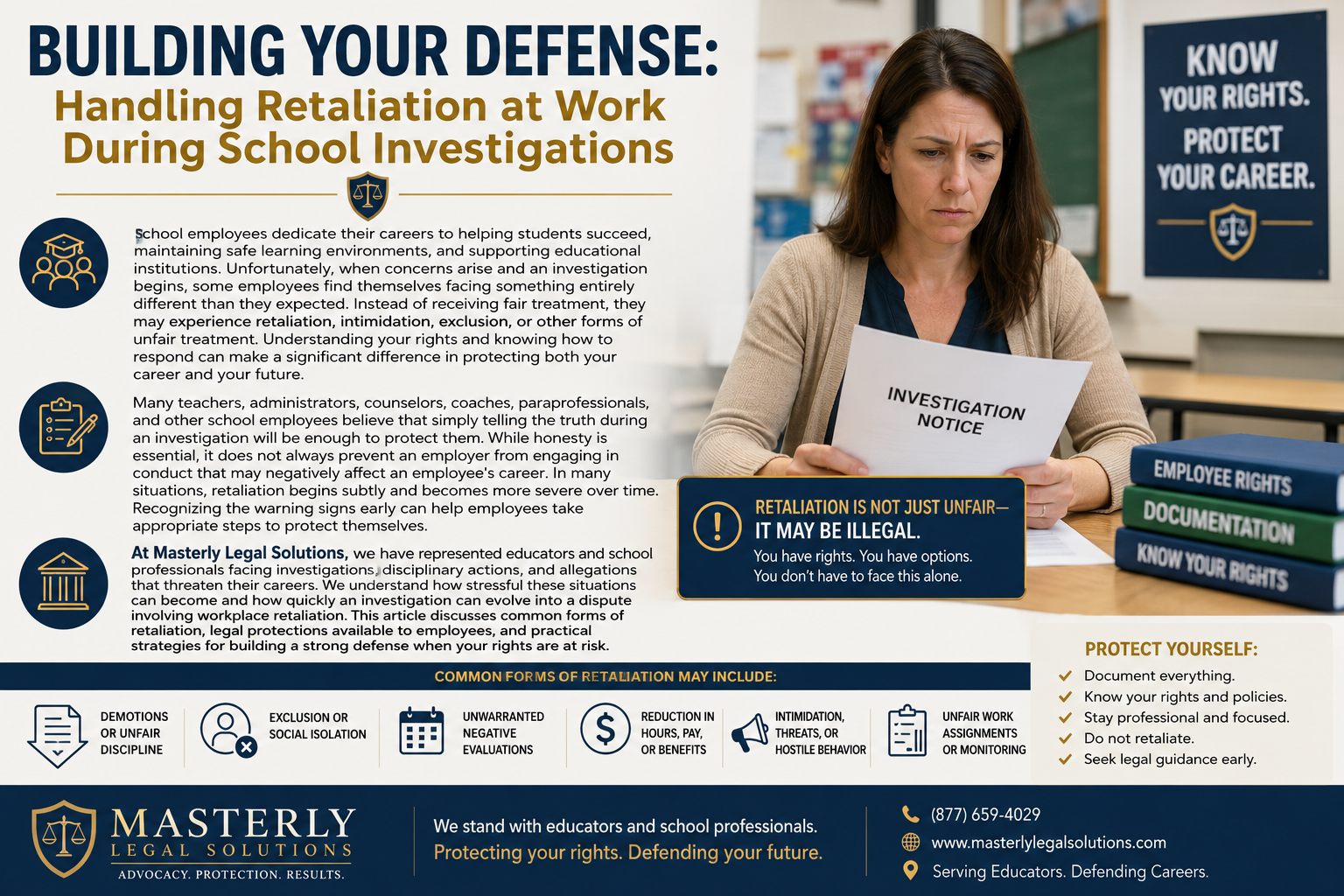
Building Your Defense: Handling Retaliation at Work During School Investigations.” The design features a concerned female educator sitting in a classroom reviewing an investigation notice. The infographic explains how school employees may face retaliation during workplace investigations and emphasizes the importance of knowing their rights. Visual icons represent common forms of retaliation, including unfair discipline, social isolation, negative evaluations, reduced pay or hours, intimidation, and unfair work assignments. A highlighted message states, “Retaliation is not just unfair—it may be illegal.” A checklist encourages employees to document everything, understand workplace policies, remain professional, avoid retaliation, and seek legal guidance early. The bottom banner displays the Masterly Legal Solutions logo and a message supporting educators and school professionals by protecting their rights and defending their careers.


How Retaliation Attorneys Help Protect Employees During School Investigations

When school employees believe they have been treated unfairly after reporting misconduct or participating in an investigation, retaliation attorneys can help evaluate the facts and determine whether legal protections may apply. Many federal and state laws prohibit retaliation against employees who engage in protected activities, such as filing a complaint, reporting discrimination, or cooperating with an investigation. Unfortunately, some employers still engage in conduct that can negatively affect an employee's career, reputation, and future opportunities.


Retaliation laws exist to protect individual employees from unfair treatment when they exercise their legal rights. A teacher, coach, administrator, or staff member should not face punishment simply because they reported concerns in good faith. For example, a co worker or supervisor may begin treating an employee differently after a complaint is filed, creating a hostile environment that affects both job performance and overall well being. In some situations, employees who speak up may feel isolated, excluded from workplace activities, or targeted by management.


It is important to understand that retaliation is often illegal when it occurs because an employee engaged in protected conduct. Likewise, it may also be unlawful for an employer to take action against someone who has reported being discriminated against based on a protected characteristic. When warning signs appear, seeking legal guidance early can help preserve evidence, protect employment rights, and reduce the risk of further harm. An experienced retaliation and employment law attorney can evaluate the circumstances, explain available options, and help employees build a strong defense before workplace problems become even more serious.Speak With Masterly Legal Solutions About Retaliation at Work


If you believe you have experienced retaliation after filing a complaint, participating in an investigation, reporting discrimination, requesting accommodations, or engaging in another protected activity, it is important to understand your options before making critical decisions. Every situation is unique, and the facts surrounding your case may significantly affect your rights and potential remedies.


The attorneys at Masterly Legal Solutions represent educators, administrators, coaches, and school employees facing complex employment disputes. Our education law attorneys for teachers understand the challenges that arise when an employer takes action against an employee after concerns have been reported, and we work diligently to protect our clients' careers and professional reputations.


Contact Masterly Legal Solutions today at (972) 236-5051 for a free consultation. We can answer your questions, evaluate your situation, discuss potential legal strategies, and help you understand the next steps available to protect your future. A single conversation may provide clarity during one of the most difficult periods of your professional career.


Disclaimer: This article is provided for educational and informational purposes only. It is not legal advice and does not create an attorney-client relationship. Every case is different, and the application of laws may vary depending upon the specific facts and circumstances involved. Readers should consult qualified legal counsel regarding their individual situations before taking or refraining from any legal action.


(972) 236-5051
Atlanta estate planning attorney
June 8, 2026
Atlanta estate planning attorney helping families create estate plans, trusts, wills, and probate solutions. Contact our law firm for experienced guidance today.
Charlotte child protection services
June 8, 2026
Learn how Child Protective Services addresses child abuse and neglect, CPS reporting duties, and legally mandated responsibilities to protect children and families.
June 8, 2026
Protect your parental rights with an experienced CPS attorney. Strong defense for CPS investigations, child welfare cases, and juvenile dependency matters.
Dallas retaliation lawyer.
June 8, 2026
Dallas retaliation lawyer providing legal services including employment law. Fight workplace discrimination, employer misconduct, and retaliation cases in TX.
Retaliation lawyer consulting employee
June 8, 2026
Protect your rights with a workplace retaliation lawyer. Our employment law firm offers a free consultation for retaliation, discrimination, and employer disputes.
HR consulting firm helping businesses with workforce management.
June 8, 2026
Need an HR consulting firm? Our human resources consultants provide HR compliance, employee training, risk management, recruiting support, and workforce solutions.
CPS defense attorneys protecting parents during child welfare investigations..
June 8, 2026
Need a CPS defense attorney? Our CPS attorneys help parents in Texas with CPS investigations, custody disputes, parental rights, DCFS cases, and court hearings.
June 8, 2026
When a CPS Investigation Suddenly Changes Everything Few events are more stressful for a parent than hearing that Child Protective Services wants to speak with them. For many families, the phone call comes without warning. One day life feels normal, and the next day there are questions about the safety of a child, interviews being scheduled, and concerns about what might happen next. Most parents immediately begin wondering what evidence CPS is gathering and how decisions will be made. Unfortunately, many families enter CPS investigations without understanding the types of information investigators rely upon. This lack of knowledge can create anxiety, confusion, and mistakes that may affect the outcome of the case. At Masterly Legal Solutions , we regularly help families navigate complex CPS investigations throughout Texas. Understanding the evidence commonly used during an investigation can help parents make informed decisions, protect their rights, and better prepare for what lies ahead. Understanding the Role of Child Protective Services Child Protective Services is a division of the Texas Department responsible for investigating reports involving child abuse or neglect. The agency's primary mission is protecting children from serious harm while also attempting to preserve families whenever possible. When Child Protective Services receives allegations involving abuse or neglect, the agency must determine whether intervention is necessary. Depending on the circumstances, the agency may offer services, monitor the family, seek court involvement, or close the case without further action. The focus of every investigation is determining whether a child is safe and whether any ongoing risks exist within the household. Why Evidence Matters During CPS Investigations Many parents assume that CPS investigations are based solely on accusations. In reality, investigators typically gather information from multiple sources before reaching conclusions. Evidence allows CPS to evaluate allegations, assess risk factors, and determine whether additional action is necessary. The strength and reliability of that evidence often influence the direction of a CPS case. Understanding what information investigators collect can help parents recognize the importance of documentation, preparation, and obtaining legal representation when necessary. How CPS Investigations Usually Begin Most CPS investigations start when someone reports suspected abuse or neglect. Reports may come from teachers, medical professionals, neighbors, family members, counselors, law enforcement officers, or other individuals who believe a child may be at risk. Once a report is received, CPS evaluates the allegations and determines whether an investigation is warranted. If the allegations meet statutory requirements, a CPS investigator may be assigned to begin investigating allegations involving the child and family. The severity of the allegations often influences how quickly CPS responds and the level of scrutiny involved. The Initial Risk Assessment One of the first steps in many CPS investigations involves a risk assessment. During this stage, CPS attempts to determine whether a child faces an immediate risk of harm. Investigators evaluate available information to identify safety concerns and assess the likelihood that future abuse could occur. This assessment helps determine whether emergency action is necessary. If CPS believes the child's safety may be threatened, the agency may take additional steps to protect the child while the investigation continues. Interviews With the Child Perhaps the most important evidence gathered during many child protective investigations comes directly from the child. Investigators often conduct interviews designed to obtain information regarding the reported incident and the child's living environment. The child's statements can significantly influence how a CPS case develops. Investigators may ask questions about daily routines, discipline methods, household relationships, and any incidents involving alleged abuse. The age of the child, communication abilities, and consistency of statements can all affect how investigators interpret the information provided. Statements From Family Members Family members are another critical source of evidence during CPS investigations. Parents, grandparents, siblings, and other individuals living in the home may be interviewed. Investigators often compare statements from different family members to identify inconsistencies or corroborating details. These interviews may provide insight into household dynamics, parenting practices, and the overall well being of the child. Because statements can become important evidence, families should carefully consider seeking legal counsel before participating in extensive interviews. The Child's Home Environment The condition of a child's home frequently plays a significant role in CPS investigations. Investigators may request access to observe the living environment and evaluate whether safety concerns exist. Factors often considered include: Cleanliness of the residence. Availability of food. Sleeping arrangements. Utilities and basic services. Physical hazards. Supervision practices. The child's living conditions may influence whether CPS believes neglect occurred or whether intervention is necessary to protect the child. Physical Evidence Collected During Investigations Physical evidence can be extremely important when allegations involve child abuse or neglect. Depending on the circumstances, investigators may review photographs, medical records, damaged property, or other tangible evidence. For example, photographs documenting injuries may be compared with witness accounts and medical evaluations. Physical evidence often helps investigators determine whether reported events are consistent with available facts. When physical evidence exists, it frequently becomes a significant factor in the final determination. Medical Records and Healthcare Evidence Medical records are among the most influential forms of evidence used during CPS investigations. Physicians, hospitals, therapists, and other healthcare providers may possess information relevant to the allegations. Medical professionals often document injuries, behavioral concerns, developmental issues, and treatment histories. These records may help investigators evaluate whether abuse or neglect occurred. When allegations involve serious injuries, medical evidence frequently becomes one of the most important components of the investigation. School Records and Educational Information Schools are often valuable sources of information during child protective services CPS investigations. Attendance records, disciplinary reports, counselor notes, and academic performance may provide insight into a child's circumstances. Teachers and school personnel may also provide observations regarding behavior changes, emotional concerns, or indicators of possible abuse or neglect, and in some situations may themselves need legal support for school investigations and TEA license issues . Because children spend significant time in educational settings, school-related evidence can play an important role in helping investigators assess overall safety. Witness Statements and Independent Observations Witness statements are commonly used to support or challenge allegations made during a CPS investigation. Witnesses may include neighbors, relatives, teachers, childcare providers, medical professionals, or other individuals familiar with the family. Independent observations often carry significant weight because the individuals providing information may not have a direct personal interest in the outcome of the case. Investigators frequently compare witness statements against other evidence to determine whether allegations appear credible and supported by available facts. Social Services Records and Prior Agency Involvement Social services records can provide important context regarding a family's history. Prior involvement with protective services, family services, or other agencies may be reviewed during the investigation. Previous reports do not automatically establish wrongdoing. However, investigators may consider patterns, recurring concerns, and prior interventions when evaluating current allegations. Understanding how these records are used is important because historical information sometimes influences the direction of a CPS case. Domestic Violence as Evidence in CPS Cases Domestic violence allegations often receive significant attention during CPS investigations. Even when a child is not the direct victim, exposure to violence within the home may create safety concerns. Investigators frequently examine police reports, protective orders, witness accounts, and other evidence related to domestic violence incidents. The presence of domestic violence may affect how CPS evaluates a child's safety and whether protective measures are necessary. Why Parents Should Take Every CPS Case Seriously Some parents assume that cooperating fully will automatically result in a favorable outcome. While cooperation is often important, parents should recognize that every statement, document, and interaction may become part of the evidence reviewed during the investigation. A CPS case can affect parental rights, child custody arrangements, and even future court proceedings. Understanding the evidence being gathered is an important step toward protecting both your family and your legal interests. Early guidance from family law attorneys can help families navigate the investigation process while avoiding mistakes that may complicate the case later. Safety Plans and Why CPS Uses Them One of the most common tools used during CPS investigations is a safety plan. A safety plan is often created when CPS believes there are concerns that need to be addressed while the investigation remains open. These plans may include restrictions on who can be around the child, requirements for supervision, or agreements regarding living arrangements. Many parents mistakenly believe signing a safety plan is a simple formality. In reality, the terms of a safety plan can significantly affect a family's life and may influence future decisions made by Child Protective Services. Before agreeing to any plan, parents should fully understand their rights and obligations. A safety plan may be presented as voluntary, but it can still have important consequences. Understanding how the plan fits into the larger CPS process is critical. Interviews With the Alleged Victim When a report involves an alleged victim, investigators generally devote substantial attention to obtaining detailed information from that child. The child's statements often become one of the most heavily relied upon pieces of evidence in a CPS case. Investigators may conduct interviews at school, at a child advocacy center, or in another setting designed to make the child comfortable. Questions often focus on family relationships, discipline methods, daily routines, and the specific allegations being investigated. The consistency of statements provided by the alleged victim may significantly influence how CPS evaluates the allegations. Interviews With the Alleged Perpetrator The alleged perpetrator is also frequently interviewed during the investigation. These interviews allow investigators to hear the accused individual's explanation and gather additional information regarding the allegations. Many parents underestimate the importance of these conversations. Statements made during interviews can become evidence that is reviewed throughout the investigation and may later be referenced in court proceedings. Because of the potential consequences, families often benefit from seeking legal representation before participating in extensive interviews with investigators. Criminal History Reviews A person's criminal history is another form of evidence commonly reviewed during CPS investigations. Investigators may examine past arrests, convictions, protective orders, or other records that could relate to child safety concerns. A criminal history does not automatically mean a parent is unfit. However, CPS may consider whether prior conduct creates risk factors affecting the child's safety. The nature of the offense, the amount of time that has passed, and evidence of rehabilitation often play important roles in how these records are evaluated. When CPS Reviews Prior Neglect Reports Investigators frequently review previous neglect reports involving the family. While prior reports do not prove that abuse or neglect occurred, they may provide context regarding recurring concerns. Patterns can be important during child protective investigations. Multiple reports involving similar allegations may receive closer scrutiny than an isolated allegation with no prior history. Parents should remember that even reports that were previously closed can sometimes be reviewed as part of a new investigation. Family Assessments and Household Evaluations Many CPS investigations include a family assessment. This process allows investigators to evaluate the overall functioning of the household and identify strengths as well as concerns. A family assessment may examine: Parenting practices. Household relationships. Financial stability. Child supervision. Emotional well being. Access to support systems. The goal is not simply to investigate allegations but also to understand whether the family can safely meet the child's basic needs moving forward, which may include long-term planning such as putting essential legal documents in place for the family . Evaluating the Child's Basic Needs Investigators carefully examine whether a child's basic needs are being met. This evaluation extends beyond food and shelter. Factors often considered include access to healthcare, educational support, supervision, emotional care, and a stable living environment. CPS wants to determine whether the child receives appropriate care and whether additional support may be necessary. When concerns arise regarding unmet needs, investigators may recommend services designed to improve family stability. The Role of Community Resources and Family Services One objective of Child Protective Services is to support families whenever possible. Rather than immediately seeking removal, investigators often evaluate whether community resources or family services can address concerns. Services may include counseling, substance abuse treatment, parenting education, housing assistance, or other programs designed to improve household stability. In many cases, connecting families with appropriate resources helps address safety concerns without requiring more significant intervention, and some families may also benefit from proactive trust-based estate planning services that support long-term stability for children. Parenting Classes and Other Recommended Services Parenting classes are among the most frequently recommended services provided during CPS investigations. These programs are often intended to help parents strengthen skills and improve family functioning. Participation in parenting classes does not necessarily mean CPS has determined that abuse or neglect occurred. Instead, investigators may view these programs as preventive measures designed to reduce future abuse concerns, similar to how establishing powers of attorney and other protections for children can serve as proactive safeguards. Parents should understand that participation may still become part of the evidence considered throughout the case. Voluntary Services and Their Impact CPS sometimes offers voluntary services to families during the investigation process. These services may be intended to address concerns identified through interviews, assessments, or evidence gathered during the investigation stage. Although participation is described as voluntary, parents should carefully consider how accepting or declining services may affect the case. Every decision can influence how investigators assess risk and safety. Obtaining legal counsel before agreeing to extensive services may help families understand potential implications. Service Plans and Compliance Expectations A service plan is often created when CPS believes specific actions are necessary to address concerns. These plans may require counseling, evaluations, treatment programs, parenting classes, or other activities. Compliance with a service plan may affect how CPS views a family's progress. Failure to complete required services can sometimes become an issue during court hearings or other proceedings. Because service plans can affect parental rights, families should fully understand the expectations involved before agreeing to any requirements. How CPS Evaluates Child Custody Concerns Child custody issues frequently arise during CPS investigations. If investigators believe a child faces substantial risks, they may evaluate whether custody arrangements need to be modified. Evidence reviewed during this process often includes household conditions, parenting history, witness accounts, and risk assessments. The primary focus remains protecting the child's safety. Parents involved in custody disputes should understand that CPS findings may influence future family law proceedings, including related issues such as estate planning and protecting family assets through wills and trusts . Temporary Custody and Emergency Interventions In some situations, CPS may seek temporary custody of a child. This generally occurs when investigators believe the child faces immediate risk or serious harm if left in the current environment. Emergency removals are among the most serious actions available to Child Protective Services. These decisions often involve judicial oversight and may require a court order authorizing intervention. The evidence supporting removal is usually scrutinized carefully because of the significant impact on both the child and family. Foster Care Placement Decisions When a child is removed from the home, foster care placement may become necessary. CPS evaluates available options while attempting to identify environments that can keep the child safe. Investigators may consider relatives, licensed foster homes, or other approved placements. Placement decisions are influenced by the child's needs, safety concerns, and available resources. Whenever possible, CPS generally seeks placements that maintain family connections while addressing safety risks. Ongoing Criminal Investigations and CPS Cases Some CPS investigations occur alongside an ongoing criminal investigation. Allegations involving physical abuse, sexual abuse, severe neglect, or other serious conduct may attract the attention of law enforcement. When a criminal investigation is active, information may be shared between agencies. Statements made during CPS interviews can sometimes have implications beyond the protective services matter. Families facing both CPS and criminal concerns should seek experienced attorney guidance as early as possible. The Relationship Between Criminal Charges and CPS Findings Criminal charges are not required for CPS to take action. Likewise, the absence of criminal charges does not automatically result in the closure of a CPS case. The standards used in criminal cases differ from those used during CPS investigations. As a result, CPS may continue evaluating allegations even when prosecutors decline to pursue criminal charges. Understanding this distinction is important for families attempting to navigate multiple legal processes simultaneously. Understanding the CPS Investigation Timeline Many parents ask about the CPS investigation timeline immediately after learning a report has been made. While every case is unique, investigations typically involve several stages including evidence gathering, interviews, assessments, and review.  The length of an investigation depends upon factors such as the complexity of allegations, availability of witnesses, and the amount of evidence that must be reviewed. Families should understand that delays do not necessarily indicate a particular outcome. Thorough investigations often require time to complete properly.

Looking for Legal & Business Solutions? Contact Us Now

Fill in the form or call us to set up a meeting

(972) 236-5051
A black and white drawing of a straight line on a white background.