
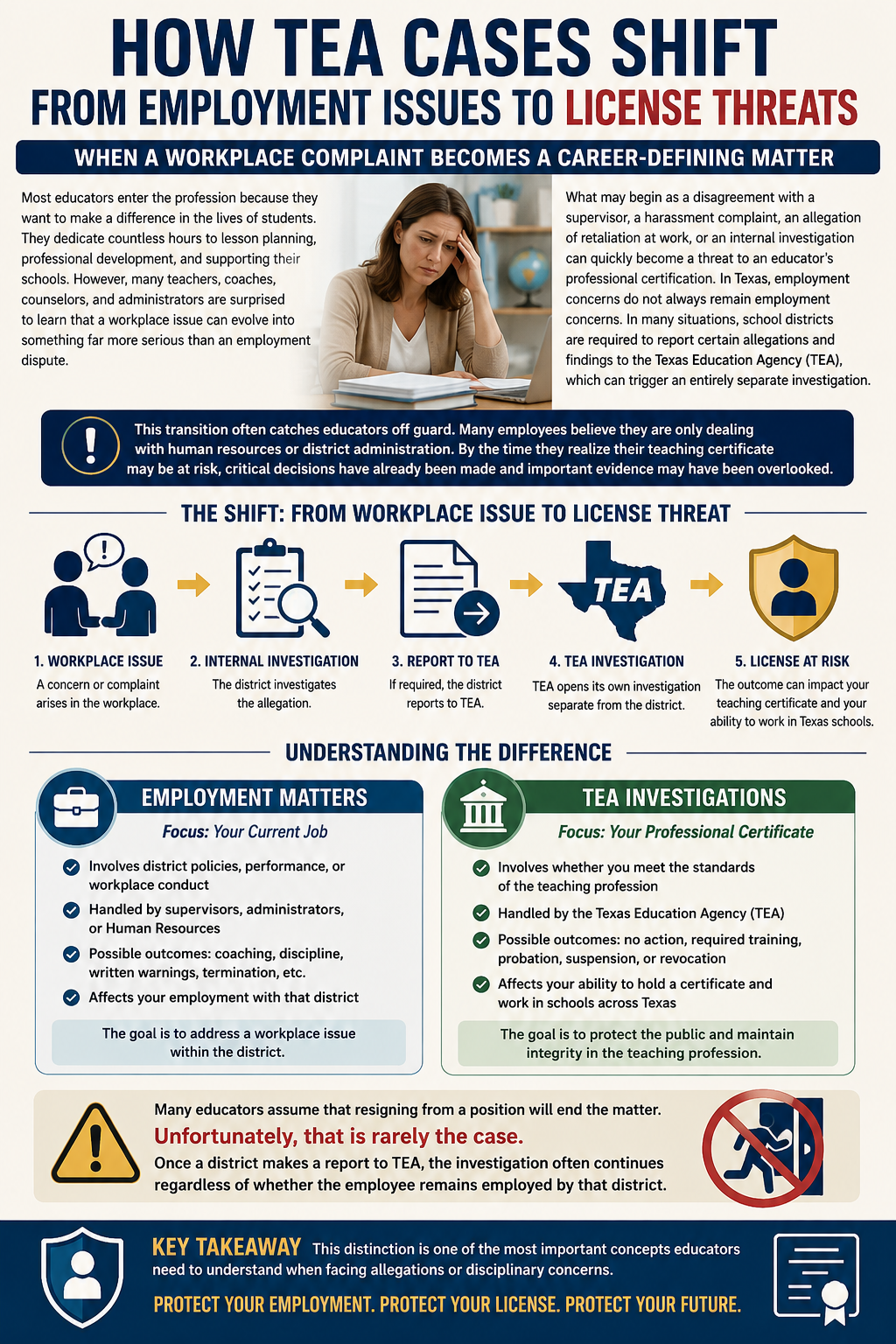
How TEA Cases Shift From Employment Issues to License Threats
When a Workplace Complaint Becomes a Career-Defining Matter
Most educators enter the profession because they want to make a difference in the lives of students. They dedicate countless hours to lesson planning, professional development, and supporting their schools. However, many teachers, coaches, counselors, and administrators are surprised to learn that a workplace issue can evolve into something far more serious than an employment dispute.
What may begin as a disagreement with a supervisor, a harassment complaint, an allegation of retaliation at work, or an internal investigation can quickly become a threat to an educator's professional certification. In Texas, employment concerns do not always remain employment concerns. In many situations, school districts are required to report certain allegations and findings to the Texas Education Agency (TEA), which can trigger an entirely separate investigation.
This transition often catches educators off guard. Many employees believe they are only dealing with human resources or district administration. By the time they realize their teaching certificate may be at risk, critical decisions have already been made and important evidence may have been overlooked.
Understanding how TEA cases develop can help educators protect both their employment and their professional future.
Understanding the Difference Between Employment Matters and TEA Investigations
An employment issue typically focuses on a person's current job. These disputes may involve performance concerns, workplace policies, disciplinary action, workplace conflicts, or allegations involving co workers.
A TEA investigation is different. Instead of focusing solely on a person's current employment status, the agency examines whether the educator should continue holding a state-issued certificate. The outcome can affect the educator's ability to work in schools throughout Texas.
Many educators assume that resigning from a position will end the matter. Unfortunately, that is rarely the case. Once a district makes a report to TEA, the investigation often continues regardless of whether the employee remains employed by that district.
This distinction is one of the most important concepts educators need to understand when facing allegations or disciplinary concerns.
How School Districts Trigger TEA Investigations
School districts have reporting obligations under Texas law. Certain allegations, findings, and employment actions may require a superintendent or administrator to report information to TEA.
In some situations, the report stems from an investigation involving alleged misconduct. In other situations, the report may result from a resignation that occurs while an investigation is pending.
Many educators mistakenly believe that leaving employment before a decision is made will prevent further scrutiny. Unfortunately, a resignation during an active investigation can sometimes increase questions rather than eliminate them.
Once the report is submitted, TEA may begin its own investigation to determine whether a possible violation of educator standards occurred.
Common Employment Issues That Can Lead to TEA Scrutiny
Not every workplace dispute results in a TEA case. However, certain allegations frequently move beyond local employment concerns and become certification matters.
Examples may include:
- Allegations involving student safety
- Claims of inappropriate communication
- Accusations of professional misconduct
- Alleged falsification of records
- Boundary violations
- Failure to report certain incidents
- Claims involving discrimination or harassment
- Allegations involving testing procedures
Even when an allegation ultimately proves unfounded, the investigation itself can have a significant negative impact on an educator's career.
The fact that an allegation exists does not mean a violation occurred. However, educators should never assume that an accusation will simply disappear on its own.
The Role of Human Resources During Early Investigations
Many TEA-related matters begin with human resources.
When a complaint is filed, human resources personnel may be tasked with gathering information, interviewing witnesses, reviewing documents, and preparing reports. These investigations often determine whether disciplinary action is appropriate and whether a report should be submitted to TEA.
Educators frequently make the mistake of believing that human resources exists primarily to protect employees. In reality, the department's role is generally to protect the school district and ensure compliance with applicable laws and policies.
This does not mean that human resources acts unfairly. However, it does mean that educators should approach interviews and investigations carefully.
Statements made during internal investigations can later become evidence in TEA proceedings.
When a Harassment Complaint Leads to Additional Allegations
A harassment complaint may initially appear to be a workplace concern only. However, circumstances sometimes evolve in unexpected ways.
For example, a teacher may file a harassment complaint against a manager or supervisor. During the investigation, other allegations may emerge regarding workplace conduct, communications, or policy violations.
In some situations, the educator who filed the complaint becomes the subject of scrutiny. In others, the focus remains on the accused individual.
These situations can become especially complex when retaliation allegations arise alongside harassment claims.
Because every statement and document may later be reviewed, it is critical to understand how the investigation process works from the beginning.
Retaliation at Work and Its Impact on Educators
Retaliation at work is one of the most misunderstood employment issues in education.
When an employer treats a worker unfairly because they participated in protected behavior, this is known as retaliation. This could include reporting discrimination, participating in an investigation, filing a complaint, or raising concerns regarding legal compliance.
Federal and state laws prohibit retaliation against employees who engage in protected conduct.
Examples of retaliation may include:
- Demotion
- Reduction in responsibilities
- Transfer to a less desirable position
- Unjustified discipline
- Denial of promotion opportunities
- Termination
Retaliation claims often become complicated because employers may argue that employment decisions were based on legitimate business reasons rather than retaliatory motives.
Understanding the difference is critical when evaluating a potential claim.
What Qualifies as Protected Activity?
Protected activity generally refers to actions that are safeguarded under applicable laws.
Examples may include reporting discrimination, filing a harassment complaint, participating in an investigation, reporting safety concerns, or opposing unlawful conduct in the workplace.
A reasonable employee should not fear punishment simply because they raised concerns about conduct they believed violated the law.
The law seeks to protect workers who report misconduct and cooperate with investigations.
When retaliation occurs after an employee engages in protected activity, legal protections may become available.
However, establishing retaliation often requires evidence connecting the protected activity to the adverse employment action.
The Importance of Documentation
One of the most important steps an educator can take is maintaining documentation.
When concerns arise, educators should carefully preserve relevant records, emails, messages, evaluations, and notes regarding incidents.
Documentation can help establish timelines and provide context for disputed events.
In many cases, evidence becomes the deciding factor in determining whether allegations are substantiated.
Without documentation, an educator may find themselves relying solely on memory months or even years after an incident occurred.
Strong documentation often strengthens both employment defenses and TEA-related defenses, especially for educators seeking Texas TEA investigations and teacher certification help.
Administrative Leave Is Not Always the End
Many educators panic when they are placed on administrative leave.
While administrative leave can be stressful, it does not automatically indicate wrongdoing. School districts frequently use administrative leave while conducting investigations.
The purpose is often to allow administrators to investigate allegations without interference and to protect the integrity of the process.
Unfortunately, some educators assume that being placed on leave means termination is inevitable. That assumption is not always accurate.
The key is understanding what the district is investigating and how the findings may affect both employment status and certification status.
How Witness Statements Influence Outcomes
Witness interviews play a major role in both district investigations and TEA proceedings.
Investigators frequently speak with co workers, students, administrators, parents, and other individuals who may have knowledge regarding the allegations.
Witness credibility can significantly influence the outcome of a case.
However, witness statements are not always accurate. Memories fade, misunderstandings occur, and individuals sometimes interpret events differently.
For this reason, it is essential to compare witness statements against objective evidence whenever possible.
Emails, text messages, policies, attendance records, and other documents may help clarify disputed facts.
When Employment Discipline Becomes a License Issue
Many educators assume disciplinary action affects only their current job.
Unfortunately, disciplinary findings may trigger reporting obligations that lead to TEA investigations.
A written reprimand, suspension, or termination may become part of the information reviewed by the agency.
This does not mean TEA will automatically take action against a license. However, disciplinary findings often receive significant attention during certification reviews.
The earlier an educator recognizes this possibility, the better positioned they are to protect themselves.
Waiting until TEA contacts them can place educators at a disadvantage.
The Impact of Termination on Future Opportunities
Termination can have consequences beyond the loss of current employment.
School districts reviewing applications often examine employment history carefully. In addition, certification investigations may continue after employment ends.
Some educators mistakenly believe that obtaining a position in another district will resolve the issue.
However, unresolved allegations and pending investigations may continue to follow them.
Understanding the broader implications of termination is critical when evaluating employment decisions and legal options.
Protecting a professional reputation requires a strategic approach from the earliest stages of an investigation.
How Allegations of Discrimination Can Escalate
Claims involving discrimination frequently involve complex factual and legal issues.
An employee may allege discrimination based on disability, pregnancy, age, race, gender, religion, or another protected category.
When these complaints are filed, employers often conduct extensive investigations to determine whether policies were violated.
If the investigation uncovers additional concerns, the matter may expand significantly beyond the original complaint.
In some situations, allegations against one person result in investigations involving multiple employees, departments, or administrators.
What begins as a workplace concern can quickly become a much larger issue affecting numerous individuals.
Medical Leave, Job Protected Leave, and Retaliation Concerns
Educators sometimes face challenges after requesting medical leave or other forms of job protected leave.
Federal and state laws provide protections in many circumstances. Employees who are eligible for leave should generally not face punishment simply because they exercised legal rights.
Unfortunately, concerns occasionally arise when an employee returns from leave and experiences adverse treatment.
Examples may include reduced responsibilities, exclusion from opportunities, or reassignment to a less desirable position.
When these situations occur, it may be necessary to determine whether legitimate business reasons exist or whether retaliation concerns are present.
The facts surrounding each case matter greatly.
Why Early Legal Guidance Matters
Many educators wait too long before speaking with an attorney.
They assume they can explain the situation themselves, cooperate fully, and resolve the issue without assistance. While cooperation is often important, understanding the legal implications of each step is equally important.
Statements made during interviews, written responses to allegations, and decisions regarding resignation or termination can have long-term consequences.
An experienced attorney can help evaluate the situation, identify risks, preserve evidence, and develop a strategy designed to protect both employment interests and professional certification, and an education law attorney offering expert legal guidance for teachers can explain how these issues play out in real TEA cases.
The earlier legal guidance is obtained, the more options may be available.
The Risk of Making Assumptions During an Investigation
One of the most common mistakes educators make is assuming they understand where an investigation is headed.
They may believe the complaint is minor. They may assume administrators support them. They may expect the matter to be resolved quickly.
Unfortunately, investigations often evolve in unexpected ways.
New witnesses emerge, additional allegations surface, and investigators uncover information that changes the direction of the case.
Educators should approach every investigation with the understanding that it could affect both their current employment and future career opportunities.
Protecting professional interests requires preparation rather than assumptions.
How School Administrators Evaluate Complaints
Administrators face significant pressure when investigating workplace concerns.
They must balance employee rights, student safety, district policies, and legal obligations.
When a complaint is received, administrators often evaluate whether immediate action is necessary. This may include placing an employee on leave, restricting access to certain areas, or initiating a formal investigation.
These decisions are not always intended as punishment.
Instead, administrators are often attempting to manage risk while gathering information and determining what occurred.
Understanding this perspective can help educators navigate investigations more effectively.
Recognizing When a Workplace Issue Is Becoming More Serious
Certain warning signs may indicate that a matter is transitioning from an employment concern to a certification concern.
These signs may include repeated requests for written statements, involvement of upper-level administrators, formal investigative interviews, requests for electronic communications, or discussions regarding reporting obligations.
Educators should pay close attention when investigations begin expanding beyond routine personnel matters.
Recognizing these warning signs early can provide valuable time to prepare an appropriate response and protect a professional license.
TEA Reporting Requirements Can Change Everything
One of the most significant turning points in an educator's career occurs when a school district determines that a report to TEA may be required.
Many employees are unfamiliar with reporting obligations imposed on school districts and administrators. As a result, they may underestimate the seriousness of an ongoing investigation.
A district may be required to report certain conduct, resignations, terminations, or findings involving an educator. Once the report is submitted, the issue often shifts from a local employment matter to a statewide certification concern.
This transition can dramatically increase the stakes because the educator's ability to work in public education may now be at risk.
What Happens After TEA Receives a Report?
After receiving information, TEA may review documents, interview witnesses, request records, and evaluate whether a possible violation of educator standards occurred.
The agency may seek information from school districts, employees, students, law enforcement, or other individuals involved in the matter.
Many educators are surprised by the amount of information reviewed during these investigations.
Even allegations that did not result in criminal charges or formal discipline may still receive attention from investigators.
Because every case is unique, educators should avoid assuming that a report automatically means discipline will occur.
The Importance of Responding Strategically
When TEA initiates contact, educators should take the situation seriously.
Some individuals believe that ignoring correspondence or delaying responses will cause the matter to disappear. In reality, failing to participate may create additional challenges.
Responding strategically does not mean responding emotionally.
Every communication should be carefully considered because statements made during the process may become part of the investigative record.
A thoughtful and organized response can often make a significant difference in how a case progresses.
How Evidence Shapes TEA Investigations
Evidence plays a central role in certification cases.
Investigators may review employment records, emails, text messages, witness statements, personnel files, evaluations, social media activity, and other relevant materials.
The strength of the evidence often determines whether allegations are substantiated.
Educators should avoid deleting records, altering documents, or attempting to influence witness testimony.
Instead, preserving evidence and presenting accurate information is generally the most effective approach.
Well-organized evidence can help demonstrate context that may otherwise be overlooked.
When a Complaint Evolves Beyond Its Original Scope
Many investigations begin with a single complaint.
As investigators gather information, however, they may identify additional concerns that were not part of the original allegation.
An incident involving workplace communication may expand into questions regarding professional judgment. A report concerning attendance may lead to examination of other employment records.
This expansion often surprises educators who believed the investigation would remain narrowly focused.
Understanding that investigations can grow over time helps individuals prepare for potential developments.
The Connection Between Retaliation Claims and TEA Cases
Retaliation claims sometimes intersect with certification investigations.
For example, an employee may report discrimination, harassment, or another protected activity and later experience disciplinary action.
The employee may believe the discipline was motivated by retaliation rather than legitimate workplace concerns.
At the same time, the employer may argue that its actions were based on performance issues, policy violations, or misconduct.
These situations frequently involve complicated factual disputes that require careful review of evidence and timelines.
Why Timing Often Matters
Timing is often one of the most important factors in retaliation cases.
If adverse action occurs shortly after a complaint, report, or participation in an investigation, questions may arise regarding the employer's motivations.
However, timing alone rarely determines the outcome.
Investigators generally examine the full context, including performance history, witness statements, documentation, and business reasons offered by the employer.
A thorough review of all available evidence is usually necessary before conclusions can be reached.
Adverse Action and Its Potential Consequences
An adverse action may take many forms.
While termination is one example, adverse actions may also include reassignment, suspension, denial of promotion opportunities, loss of responsibilities, reduced pay, or placement in a less desirable position.
The specific facts surrounding each action matter.
A reasonable employee would generally view certain actions as having a negative impact on employment opportunities or workplace conditions.
Determining whether an action qualifies as unlawful retaliation often requires careful legal analysis.
Promotion Decisions and Workplace Complaints
Promotion decisions occasionally become part of employment disputes.
An employee who engaged in protected activity may believe that a denied promotion resulted from retaliation.
Employers, however, may point to qualifications, experience, performance evaluations, or organizational needs as legitimate reasons for the decision.
These cases often require detailed examination of records and decision-making processes.
Understanding how promotion decisions are documented can be important when evaluating potential claims.
Overtime Pay, Wages, and Employment Disputes
Employment issues are not always related to misconduct allegations.
Disputes involving overtime pay, unpaid wages, benefits, labor concerns, and workplace policies can also create conflict between employees and employers.
When workers raise concerns regarding compensation practices, those complaints may qualify as protected activity under certain circumstances.
Employees should not face retaliation simply because they reported concerns regarding wage practices or legal compliance.
Employers are expected to follow applicable laws governing compensation and employment standards.
The Role of Witnesses During Investigations
A witness can significantly influence the direction of an investigation.
Witnesses may provide firsthand observations, describe workplace interactions, or offer information regarding specific incidents.
At the same time, investigators must evaluate credibility and reliability.
Different individuals may remember events differently or interpret conduct in different ways.
This is one reason documentary evidence is often so important when disputes arise.
Social Media Posts and Professional Consequences
Many educators do not realize how quickly a social media post can become part of an investigation.
Content shared online may be reviewed when questions arise regarding professional conduct, workplace behavior, or compliance with district policies.
Even posts intended for a limited audience may eventually be circulated more broadly.
Educators should carefully consider how online activity may be perceived by students, parents, administrators, and investigators.
Professional judgment extends beyond the physical workplace.
The Impact of False Accusations
Being accused of misconduct can be emotionally exhausting.
Educators often feel frustrated, embarrassed, and uncertain about the future.
While false accusations do occur, it is important to approach the situation strategically rather than emotionally.
Strong documentation, credible evidence, and a well-prepared response can help address inaccurate allegations.
Taking immediate steps to protect professional interests may improve the likelihood of a favorable outcome.
How School District Investigations Differ From Police Investigations
In some cases, allegations may be reviewed by both a school district and police.
These investigations serve different purposes.
A district investigation generally focuses on employment decisions and compliance with policies. A police investigation focuses on potential criminal violations.
An educator may face one type of investigation without facing the other.
Understanding these distinctions can help individuals make informed decisions during the process.
Why Resigning Does Not Always End the Matter
Some educators believe resignation is the easiest way to move forward.
Unfortunately, resignation does not necessarily prevent a report to TEA or stop an ongoing investigation.
In some circumstances, resigning during an investigation may actually trigger additional reporting requirements.
Because every situation is unique, resignation decisions should be evaluated carefully.
Making a rushed decision can create unintended consequences that affect future employment opportunities.
Protecting Employee Morale During Investigations
Investigations can affect more than the individuals directly involved.
Employee morale and overall employee morale often suffer when uncertainty spreads throughout a department or campus.
Rumors, speculation, and incomplete information can create tension among co workers.
Administrators frequently face the challenge of maintaining stability while respecting confidentiality obligations.
A fair and professional process benefits everyone involved.
The Challenges Faced by Administrators
Every administrator involved in an investigation faces difficult decisions.
Administrators must balance legal obligations, student welfare, district policies, employee rights, and community expectations.
These responsibilities often require quick decisions based on incomplete information.
The goal is generally to determine the facts while minimizing disruption to school operations.
Understanding these pressures can provide valuable context when navigating an investigation, and working with an education lawyer providing expert legal support for teachers and schools can help balance administrative concerns with your own rights.
Disability, Pregnancy, and Protected Rights
Federal and state laws provide important protections involving disability and pregnancy.
Employees who request accommodations, medical leave, or other legally protected benefits should not face unlawful discrimination or retaliation.
Unfortunately, disputes occasionally arise when employees believe workplace decisions were influenced by protected characteristics.
These concerns should be evaluated carefully because the facts often determine whether a legal violation occurred.
Documentation remains one of the most valuable tools in these situations, and many educators benefit from education law support to protect their legal rights at work.
Investigations Are Intended to Determine Facts
A properly conducted investigation is intended to determine what actually happened.
Investigators should gather information from multiple sources, review relevant records, and evaluate competing explanations.
The purpose is not to assume guilt or innocence before reviewing the evidence.
A fair process helps ensure that decisions are based on facts rather than assumptions.
Educators should understand their rights and responsibilities throughout the process.
Why Early Preparation Creates Better Outcomes
Waiting until discipline is imposed or a license threat emerges can limit available options.
Early preparation allows educators to preserve evidence, identify witnesses, understand legal risks, and develop a strategy before critical decisions are made.
Many successful defenses begin long before formal proceedings occur, particularly when educators follow immediate steps after receiving a TEA investigation notice.
The sooner concerns are addressed, the easier it may be to protect employment interests and professional credentials.
Preparation is often one of the most effective tools available.
How Masterly Legal Solutions Helps Educators Protect Their Careers
At Masterly Legal Solutions, we understand that educators devote years to building their careers, earning certifications, and serving students. When allegations arise, everything you have worked for can suddenly feel uncertain.
Whether you are facing retaliation at work, a harassment complaint, administrative leave, termination, discrimination concerns, an internal investigation, or a TEA certification matter, it is important to understand that your employment and your license may both be at stake.
Masterly Legal Solutions works with teachers, coaches, counselors, administrators, and education professionals facing complex workplace and licensing challenges. We help clients evaluate evidence, respond to investigations, protect professional reputations, and develop strategies designed to safeguard their careers, drawing on education law experience and teacher license defense legal services.
If you are under investigation, have been accused of misconduct, received notice from TEA, or believe your employer has violated your rights, obtaining legal guidance—such as Texas TEA license defense representation for educators—as early as possible may make a significant difference in the outcome of your case.
Understanding Other Related Protected Activity and Employer Responsibilities
Many educators are familiar with filing a complaint involving discrimination or harassment, but there are numerous forms of related protected activity that may also be protected under federal and state laws. Employees who participate in an investigation, serve as a witness, report safety concerns, request accommodations for a disability, or raise concerns about legal compliance may be engaging in other related protected activity protected by law. An employer or company cannot take adverse action simply because an employee exercised legal rights or participated in protected conduct.
When an employee believes they have been fired, demoted, denied opportunities, or subjected to unfair treatment because of protected activity, serious legal concerns may arise. In some situations, the employee may pursue a lawsuit if evidence shows the employer engaged in retaliation or another illegal employment practice. It is important to understand that retaliation can take more than one form, and an other type of adverse action may still violate employment laws even if it does not involve termination. Because every case is unique, educators should carefully document events and seek legal guidance—such as Texas educator TEA investigation and license protection support—when workplace actions appear connected to protected conduct.
Speak With Masterly Legal Solutions About Your Situation
If you have questions about retaliation, discrimination, administrative leave, termination, workplace investigations, educator misconduct allegations, or TEA certification issues, Masterly Legal Solutions is available to help.
Every situation is different, and the decisions you make early in the process can have long-term consequences for your career. Our team can evaluate your circumstances, explain your options, and help you understand the potential risks and opportunities ahead.
Contact Masterly Legal Solutions today at (972) 236-5051 for a free consultation. We welcome the opportunity to discuss your concerns, answer your questions, and help you take proactive steps to protect your professional future before a workplace issue becomes a license-threatening matter.
Disclaimer: This article is provided for educational and informational purposes only. It is not legal advice and should not be relied upon as legal guidance for any specific situation. Reading this article does not create an attorney-client relationship with Masterly Legal Solutions. Laws, regulations, and legal interpretations may change over time and can vary depending on the facts of each case. If you need legal advice regarding a TEA investigation, retaliation claim, workplace dispute, employment matter, or educator certification issue, contact a qualified attorney to discuss your specific circumstances.






Looking for Legal & Business Solutions? Contact Us Now
Fill in the form or call us to set up a meeting