
How Texas Teachers Lose Their Certification Without Ever Seeing a Courtroom
Most Educators Never Expect Their Certificate to Be at Risk
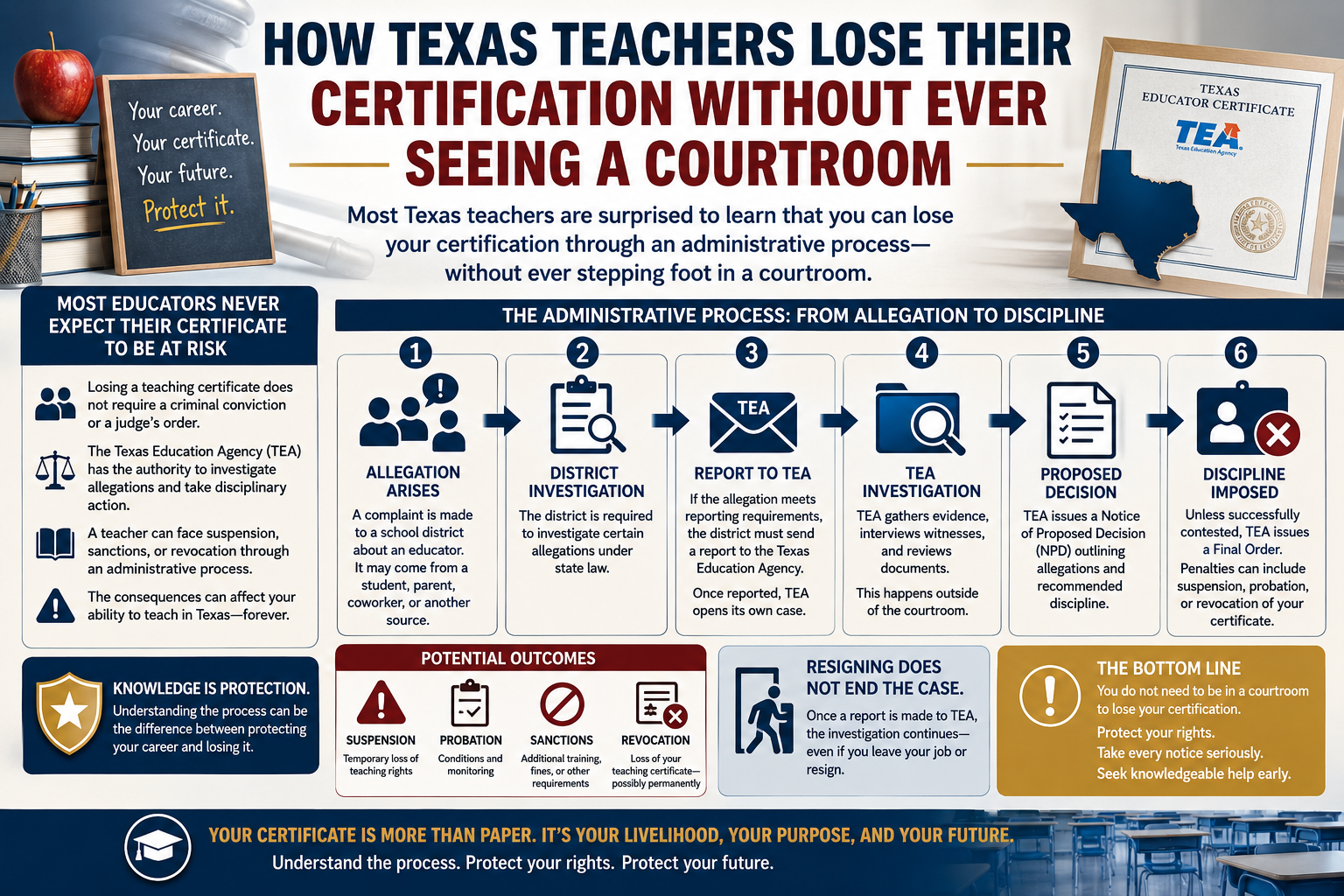
Most Texas teachers spend years earning their credentials, developing classroom skills, and building relationships with students and families. They often assume that losing a teaching certificate would require a criminal conviction, a courtroom hearing, or a judge's order. What many educators do not realize is that certification issues often arise through an administrative process that never involves a courtroom at all.
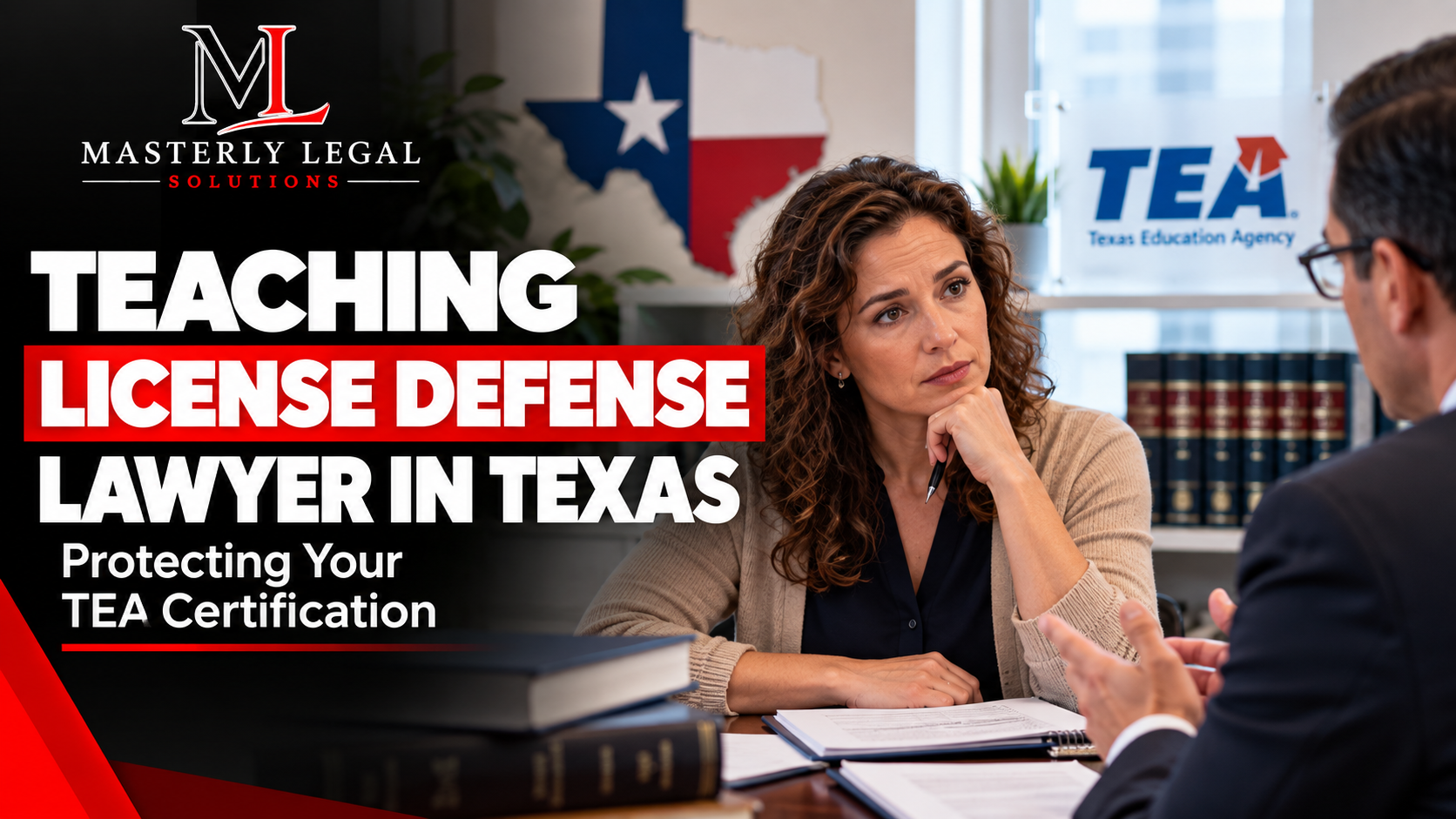
The Texas Education Agency (TEA) has the authority to investigate allegations involving educators and determine whether disciplinary action against a certificate is appropriate. In many cases, a teacher can face suspension, sanctions, or even revocation of a certification without ever standing before a judge. Understanding how this process works is critical because the consequences can affect an educator's entire professional future.
For teachers, coaches, counselors, and administrators, knowing how these cases develop can be the difference between protecting a career and losing years of hard work.
Understanding the Administrative Power of TEA
Many people assume that employment disputes and certification matters are handled the same way. They are not.
School districts handle employment decisions, while TEA evaluates whether an educator should continue holding a state-issued certificate. The agency's authority allows it to review allegations, conduct investigations, and impose disciplinary measures through administrative proceedings.
This means that an educator can face serious consequences even if criminal charges are never filed and no lawsuit is ever initiated. The administrative process operates independently from the court system.
For many educators, this reality comes as a surprise only after an investigation has already begun.
Why Certification Matters More Than a Single Job
Losing a teaching position is difficult, but losing a certification can be career-changing.
An educator who loses a job may still seek employment elsewhere. However, if TEA suspends or revokes a teaching certificate, the educator's ability to work in public education throughout Texas may be severely limited.
This is why certification investigations deserve immediate attention. A district employment issue may affect one position, while a certification action can affect an entire career.
Educators who understand this distinction are often better prepared to respond strategically when allegations arise.
How School Districts Become the Starting Point
Most TEA investigations begin at the local level.
A complaint may be filed by a parent, student, co worker, supervisor, or administrator. Human resources personnel may review the allegation and determine whether an internal investigation is necessary.
In some situations, the district is required to report findings to TEA. Once that report is submitted, the matter can move beyond employment concerns and into certification territory.
This transition often happens much faster than educators expect.
The Role of Human Resources in Certification Cases
Human resources departments serve an important function during investigations.
When concerns arise, human resources may collect statements, review records, interview witnesses, and evaluate policies. Their findings may influence employment decisions and reporting obligations.
Many educators mistakenly believe that human resources exists primarily to advocate for employees. In reality, the department's responsibility is generally to help the employer manage legal obligations and organizational risk.
Understanding this role helps educators approach investigations with realistic expectations.
Administrative Leave Often Signals a Serious Situation
Few employment actions create more anxiety than being placed on administrative leave.
Teachers frequently associate administrative leave with guilt, but that assumption is not always accurate. Districts often use leave as a temporary measure while they investigate allegations.
Even though administrative leave is not necessarily disciplinary, it often indicates that administrators consider the matter significant enough to warrant further review.
Educators should use this time wisely by preserving documents, identifying potential evidence, and understanding the scope of the investigation.
What Happens When a Complaint Is Filed?
A single complaint can trigger a chain of events that affects an educator's livelihood.
The complaint may involve classroom conduct, communication concerns, policy violations, harassment allegations, or professional judgment issues. Once filed, administrators may begin gathering information and interviewing witnesses.
Some investigations remain relatively narrow. Others expand as additional information is uncovered.
What begins as a minor concern can quickly become a major professional challenge if not addressed properly.
Not Every Investigation Involves Criminal Conduct
One of the biggest misconceptions among educators is that TEA only becomes involved when criminal behavior is alleged.
In reality, many certification investigations involve professional conduct rather than criminal activity. Administrative agencies often examine whether an educator complied with professional standards and ethical obligations.
As a result, a teacher may face certification scrutiny even when police never become involved.
Understanding this distinction is essential because it changes how educators should approach the process.
Why Teachers Are Often Caught Off Guard
Educators are trained to teach, mentor, and lead students. Most are not trained to navigate investigations.
Because of this, many teachers underestimate the seriousness of early warning signs. They may believe a meeting with a manager is routine or assume an administrator is simply gathering information.
Unfortunately, decisions made during these early stages can have lasting consequences.
By the time a teacher realizes a certification issue exists, important opportunities to protect themselves may already have passed.
The Importance of Documentation
Documentation can become one of the most valuable tools during an investigation.
Emails, performance evaluations, text messages, attendance records, lesson plans, and witness information may all become relevant. These records can help establish timelines and provide context for disputed events.
Without documentation, an educator may be forced to rely solely on memory months after an incident occurred.
Strong records often help clarify misunderstandings and support an educator's position during both district and TEA investigations.
When Retaliation Concerns Enter the Picture
Not every investigation begins with misconduct allegations.
In some cases, a teacher reports discrimination, harassment, safety concerns, or another protected activity. Shortly afterward, disciplinary actions begin to occur.
When retaliation occurs, educators may find themselves defending against allegations while simultaneously questioning whether the employer's actions were motivated by their complaint.
These situations can become highly complex because both employment rights and certification concerns may be involved.
Understanding Protected Activity
Protected activity refers to actions that are legally safeguarded under employment laws.
Examples include reporting harassment, participating in an investigation, filing a complaint, raising discrimination concerns, or cooperating with government inquiries. Employees should not face punishment simply because they exercised these rights.
A reasonable employee should feel comfortable reporting concerns without fear of retaliation.
Unfortunately, disputes sometimes arise when adverse employment actions occur after protected activity has taken place.
How Adverse Action Can Affect an Educator
An adverse action is not limited to termination.
An educator may be reassigned to a less desirable position, denied opportunities, receive negative evaluations, lose responsibilities, or experience other employment consequences.
The negative impact of these actions can extend beyond the immediate workplace.
When certification concerns emerge alongside employment actions, the risks become even greater because both current employment and future opportunities may be affected.
Employee Morale and Workplace Investigations
Investigations often impact more than the person directly involved.
Employee morale frequently declines when rumors circulate throughout a campus. Co workers may feel uncertain, uncomfortable, or concerned about what might happen next.
Overall employee morale can also suffer when communication is limited and speculation fills the gaps.
Administrators must often balance confidentiality requirements with the need to maintain stability within the workplace.
How Witness Statements Influence Outcomes
Witnesses frequently play a major role in investigations.
Administrators may interview teachers, staff members, students, and other individuals who have knowledge of an incident. Their statements may influence employment decisions and reporting obligations.
However, witness accounts are not always consistent.
Memories differ, perceptions vary, and misunderstandings can occur. This is why objective evidence is often critical when evaluating allegations.
Why Early Responses Matter
The first response provided during an investigation can have lasting consequences.
Many educators feel pressured to explain everything immediately. Others become defensive because they fear the worst.
A thoughtful response is often more effective than an emotional one. Taking time to understand the allegations and review available information can help avoid unnecessary mistakes.
Every statement made during an investigation may later be reviewed by additional decision-makers.
When an Internal Investigation Expands
Investigations rarely remain static.
An administrator may begin examining one incident only to uncover additional concerns. Witness interviews may reveal information that was not part of the original complaint.
As a result, the scope of the investigation can expand significantly.
Educators should never assume that a matter is limited to the initial allegation because the process often evolves as new information emerges.
The Difference Between Employment Decisions and Certification Decisions
Many educators mistakenly believe that a favorable employment outcome guarantees a favorable certification outcome.
That assumption can be dangerous.
A district may decide not to terminate an employee while TEA still pursues certification discipline. Likewise, employment discipline may occur even if certification sanctions are not imposed.
Because the standards and objectives differ, educators must understand that these processes are related but separate.
Can a Job Force You to Resign?
One question frequently asked by educators is, "Can a job force you to resign?"
In most situations, employers cannot literally force an employee to resign. However, circumstances may develop where an educator feels tremendous pressure to leave.
For example, an employee may believe resignation is the only option after being placed under intense scrutiny or facing potential disciplinary action.
Before making such a significant decision, educators should fully understand how resignation may affect employment rights, reporting obligations, and certification concerns.
Why Resignation Does Not Always End the Matter
Some educators assume that leaving a position will stop an investigation.
Unfortunately, resignation rarely guarantees that the matter will disappear. In certain situations, districts may still have reporting obligations even after an educator leaves employment.
TEA may continue reviewing allegations long after a resignation occurs.
This is one reason why understanding the whole process is so important before making major career decisions.
Recognizing Warning Signs Early
The earlier an educator recognizes potential certification risks, the more opportunities may exist to protect professional interests.
Warning signs may include repeated requests for written statements, involvement of upper-level administrators, placement on administrative leave, expanded interviews, or discussions about reporting obligations.
These indicators do not necessarily mean discipline will occur.
However, they often suggest that the matter deserves serious attention and careful planning.
The Cost of Waiting Too Long
Many teachers delay seeking guidance because they hope the matter will resolve itself.
Unfortunately, waiting can limit available options. Evidence may disappear, memories may fade, and important deadlines may pass.
Early action often provides the best opportunity to protect a certification and respond effectively to TEA allegations.
When careers are on the line, being proactive is generally far safer than being reactive.
How TEA Reviews Allegations Without a Courtroom
Many educators are surprised to learn that TEA can review allegations and take action without a traditional courtroom proceeding.
Administrative agencies operate under different procedures than criminal or civil courts. The focus is often on whether an educator violated professional standards rather than whether a crime occurred.
This means a teacher can face disciplinary consequences even when no criminal charges are filed and no lawsuit exists.
Understanding the administrative nature of these proceedings helps educators appreciate the urgency of responding appropriately from the very beginning, including how to survive a TEA investigation and protect a teaching license.
Why Administrative Power Creates Urgency
The authority granted to TEA allows the agency to evaluate conduct that may affect an educator's fitness to hold a certificate.
Because the process is administrative, decisions can move forward without many of the events people associate with courtroom litigation. There may be no jury, no public trial, and no criminal conviction.
For educators, this creates a unique challenge. The future of a career can depend on how effectively a teacher responds during an investigation.
Waiting for a courtroom hearing that never comes can be a costly mistake.
The Importance of Evidence During Certification Reviews
Evidence remains one of the most important factors in any certification matter.
Investigators may review emails, personnel records, witness statements, evaluations, communications, and other documents connected to an incident. The strength of the evidence often influences the outcome.
Educators should never assume investigators will automatically see their side of the story.
Instead, preserving records and understanding how evidence may be interpreted can significantly affect the direction of a case.
When a Supervisor Raises Concerns
Many investigations begin when a supervisor reports a concern.
The concern may involve professional judgment, workplace interactions, communication issues, policy compliance, or another matter that appears significant to administrators.
Once concerns are documented, administrators may investigate further and gather information from multiple sources.
Even when the allegation seems minor, the resulting investigation can have major consequences if reporting obligations arise.
The Administrator's Responsibility
Every administrator has responsibilities when allegations surface.
School leaders are often required to investigate complaints, document findings, and determine whether additional action is necessary. They must balance employee rights, student safety, district policies, and legal obligations.
These responsibilities can place administrators in difficult positions.
As a result, educators should understand that an investigation may continue even when administrators personally respect or support the employee involved.
How Human Resources Evaluates Complaints
Human resources professionals frequently become involved early in the process.
Their role may include reviewing documentation, interviewing witnesses, gathering facts, and determining whether policies were violated. Human resources personnel often coordinate closely with district leadership during investigations.
The findings generated during this stage can influence employment decisions and future reporting obligations.
Because of this, educators should treat every interview and request for information seriously.
Harassment Allegations Can Lead to Unexpected Consequences
A harassment complaint may initially appear to be a routine workplace issue.
However, investigations sometimes reveal additional concerns unrelated to the original allegation. Witnesses may provide new information, documents may raise questions, or administrators may identify possible policy violations.
As the scope expands, educators may find themselves facing issues they never anticipated.
What starts as a workplace dispute can become a certification concern if reporting obligations are triggered.
Retaliation Claims Often Complicate Investigations
Retaliation allegations frequently arise during workplace disputes.
An employee may believe disciplinary action occurred because they engaged in protected activity such as reporting misconduct, participating in an investigation, or filing a complaint.
The employer may argue that decisions were based on legitimate performance concerns or policy violations.
Determining what actually occurred often requires a careful review of evidence, timelines, and witness statements.
Understanding Other Related Protected Activity
Protected rights extend beyond filing formal complaints.
Employees may engage in other related protected activity by assisting with investigations, reporting legal concerns, cooperating with government agencies, or participating in workplace reviews.
Related protected activity is often safeguarded by federal and state laws.
When adverse employment actions occur after such activity, questions may arise regarding whether retaliation occurred.
How Employers Evaluate Potential Violations
When concerns are reported, employers often seek to determine whether a possible violation occurred.
Investigators may review policies, interview witnesses, evaluate records, and compare statements to available evidence.
The goal is generally to understand what happened and whether district rules were followed.
Unfortunately, misunderstandings and incomplete information sometimes create challenges during this process.
Why a Teacher May Feel Pressure to Leave
An investigation can create enormous stress.
Some educators begin wondering whether resignation is the best option. Others worry about future employment opportunities and fear being labeled as a problem employee.
While these concerns are understandable, decisions made during stressful moments can have long-term consequences.
Understanding the facts and available options before acting is often essential to protecting professional interests.
The Impact on Employee Morale
Investigations often affect more than the individual involved.
Employee morale may decline when coworkers become aware that allegations are being reviewed. Rumors and uncertainty can spread quickly within a campus environment.
Overall employee morale may also suffer when employees feel anxious about workplace stability.
Administrators frequently work to balance transparency with confidentiality during these situations.
When Co Workers Become Witnesses
Co workers often become important witnesses during investigations.
Their observations may help investigators understand workplace interactions, communications, and specific events.
However, witness accounts can vary significantly.
Different individuals may interpret the same situation in different ways, which is why supporting documentation is frequently so important.
The Role of Professional Judgment
Many certification cases involve questions about professional judgment rather than criminal conduct.
Investigators may examine whether an educator exercised appropriate discretion, followed policies, and acted consistently with professional standards.
These evaluations can be highly fact-specific.
Even when intentions were good, decisions may be scrutinized closely if concerns are raised.
How a Negative Employment Outcome Can Affect the Future
A negative employment outcome does not necessarily end with a job loss.
Certification concerns can affect future opportunities throughout Texas, especially in the context of the broader Texas teacher certification crisis. An educator who loses a certificate may face significant challenges finding work in public education.
This is why certification investigations deserve immediate attention.
Protecting a teaching credential is often just as important as protecting current employment.
Why Early Legal Assistance Matters
Educators often wait too long before seeking legal assistance.
Many believe they can resolve the issue themselves, explain the situation, and move forward. While cooperation can be important, understanding legal risks is equally important.
Early legal guidance may help identify potential issues, preserve evidence, and avoid mistakes that could complicate the matter later.
The earlier a strategy is developed, the more opportunities may exist to protect a professional future.
The Value of Experienced Attorneys
Certification matters can involve complex administrative procedures and professional standards.
Experienced education attorneys for teachers and schools understand how investigations develop and what factors may influence decision-makers.
They can help educators evaluate evidence, prepare responses, understand reporting obligations, and protect their interests throughout the process.
Knowledgeable representation often provides clarity during an otherwise confusing and stressful experience.
Why Every Case Requires Individual Attention
No two certification cases are exactly alike.
The facts, witnesses, documents, policies, and allegations involved can vary significantly. A strategy that works in one matter may not be appropriate in another.
This is why individualized guidance is so important.
Educators deserve advice based on their specific circumstances rather than assumptions or general information.
Protecting Your Professional Reputation
A professional reputation takes years to build.
Students, parents, administrators, and colleagues often develop trust through years of hard work and dedication. An investigation can place that reputation at risk in a very short period of time.
Responding carefully, preserving evidence, and understanding the process can help educators protect what they have worked so hard to achieve.
Professional reputations are valuable assets that deserve protection.
How Masterly Legal Solutions Helps Educators
At Masterly Legal Solutions, a Texas educator defense firm, we understand how overwhelming certification investigations can be. Many educators contact our firm after receiving notice of an investigation, being placed on administrative leave, or learning that their district may report concerns to TEA.
Our team works with teachers, coaches, counselors, and administrators facing difficult professional challenges. We help clients understand the process, evaluate evidence, respond strategically, and protect their careers whenever possible.
As a full service law firm providing broad legal services, we assist clients with a variety of legal matters. While this article focuses on educator certification issues, our attorneys also provide guidance in areas including education law and other legal services such as business law, family law, child support matters, divorce concerns, and other legal services.
With decades of combined experience, our education and business law attorneys understand how important your career, family, and future opportunities are. We work hard to protect our clients' interests and provide knowledgeable counsel during challenging situations.
Important Communication, Benefits, and Employment Considerations During an Investigation
When educators become involved in an investigation, they often focus exclusively on protecting their certification and overlook other important employment concerns. Questions may arise regarding continued pay, employment benefits, communication with the company, and how workplace decisions could affect long-term career opportunities. Understanding these issues can help employees make informed decisions throughout the process while protecting their professional interests.
In some situations, educators may receive communications by email, text message, or phone regarding an ongoing matter. Before participating in certain communications, employees should understand whether they have provided consent for specific forms of contact and whether district policies address communication procedures. For example, some automated text systems may include language such as "reply STOP" to discontinue future messages, while standard messaging and data rates may apply depending on the service provider. If concerns arise regarding employment rights, benefits, or certification issues, speaking with a knowledgeable lawyer can help clarify available options.
Every investigation is unique, and an other type of allegation or employment concern may require a different strategy than a traditional workplace dispute. Whether an educator works in Dallas, Arlington, or another Texas community, understanding communication procedures, employment benefits, and legal rights can play an important role in achieving a favorable outcome.
How Legal Issues Often Extend Beyond Certification Matters
Many educators facing a TEA investigation are surprised to learn that their situation may involve legal issues beyond certification concerns. While protecting a teaching certificate is often the immediate priority, employment disputes can sometimes overlap with other areas of law. Working with a full service law firm can provide access to broader legal guidance when multiple issues arise at the same time. Having experienced professionals who understand both employment and certification matters can be valuable when navigating complex situations.
At Masterly Legal Solutions, our law firm assists clients with a variety of legal concerns that may impact their careers, finances, and personal lives. In addition to representing educators facing certification investigations, our attorneys provide services in areas such as business law and family law. Whether a client needs assistance with professional licensing issues, employment disputes, business matters, or family-related legal concerns, having a legal team that understands multiple practice areas can help ensure that important issues are not overlooked. This comprehensive approach allows clients to receive guidance tailored to their specific circumstances while protecting both their immediate interests and long-term goals.
Speak With Masterly Legal Solutions Before a Certification Issue Becomes a Career Crisis
Many educators wait until the investigation is nearly over before seeking help. Unfortunately, that delay can reduce available options and make the process more difficult.
If you have been placed on administrative leave, received notice of an investigation, been asked to provide statements, or are concerned about a possible report to TEA, now is the time to learn the immediate steps to take after a TEA investigation notice and understand your rights and options.
Our legal team can help you understand the process, identify risks, evaluate evidence, and develop a strategy designed to protect your professional future.
Contact Masterly Legal Solutions today at (972) 236-5051 for a free consultation. Whether you are a teacher, coach, counselor, or administrator, we welcome the opportunity to answer your questions, provide guidance, and help you navigate this important matter before a certification issue threatens everything you have worked to achieve.
Disclaimer: This article is provided for educational and informational purposes only. It is not legal advice and should not be considered legal guidance for any specific situation. Reading this article does not create an attorney-client relationship with Masterly Legal Solutions. Laws, regulations, and administrative procedures may change over time and can vary based on individual facts and circumstances. If you need legal advice regarding a TEA investigation, certification issue, employment matter, or other legal concern, consult with a qualified attorney regarding your specific situation.




Looking for Legal & Business Solutions? Contact Us Now
Fill in the form or call us to set up a meeting